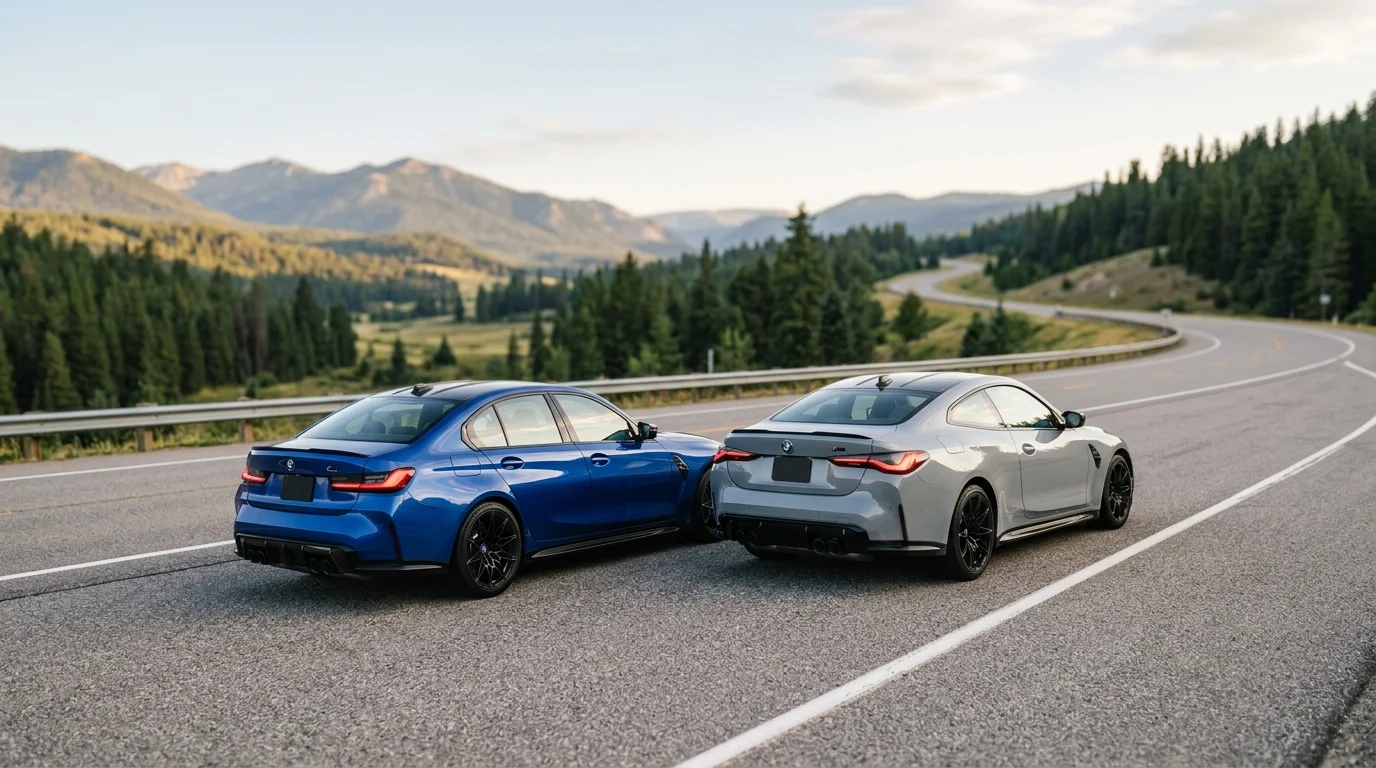
Quick answer: If you are trying to decide whats better bmw m3 or m4, the answer comes down to practical usability. For the vast majority of buyers, the BMW M3 is the better choice. It offers the exact same engine performance, suspension tuning, and cabin technology as the M4, but adds a spacious back seat with separate rear doors, more headroom, and a larger trunk. It is also more affordable, with a starting price that is $2,900 lower than the M4 coupe, and it historically holds its resale value better.
Key takeaways:
The defining difference between these two high-performance machines is their exterior styling and interior practicality. The BMW M3 is a four-door sedan built on the standard 3 Series platform, whereas the BMW M4 is a two-door coupe derived from the 4 Series. If you plan to use the vehicle as a daily driver or frequently carry passenger loads, the sedan configuration is far superior.
With four doors, rear passenger entry and exit in the M3 is straightforward. Passengers in the M4 must fold the front seats forward and slide into the back through the door opening. Furthermore, the sloping roofline of the M4 coupe reduces rear passenger headroom to 32.7 inches, compared to the M3 sedan's 35.6 inches.
Cargo utility also favors the sedan. According to official manufacturer specifications, the BMW M3 features a 16.9-cubic-foot trunk, whereas the BMW M4 coupe offers 12.0 cubic feet of space. In real-world luggage tests, this difference translates to the M3 holding six carry-on suitcases in its trunk, while the M4 coupe only accommodates five.
Analysis: The M3 serves as a highly viable primary car, handling grocery runs and child seats just as easily as weekend track days. The M4 is better suited as a secondary vehicle or weekend cruiser where daily cabin utility is not a priority.
Choosing the more practical four-door model does not mean sacrificing speed, handling capability, or horsepower. Both vehicles utilize the identical S58 3.0-liter twin-turbocharged inline-six engine and share matching power ratings across equivalent trim levels.
BMW offers three configurations for both models:
Because their powertrains are identical, their acceleration metrics are indistinguishable. BMW claims a zero-to-sixty mile-per-hour time of 3.4 seconds for both Competition xDrive models. However, independent testing yields even faster results. Drew Dorian, Managing Editor of the Buyer's Guide at Car and Driver, noted in his review of the S58-powered sedan that it can "snap off a 2.8-second 60 mph time" in Competition xDrive form, matching the exact acceleration performance recorded for the M4 coupe.
| Specification | BMW M3 (Base / Competition xDrive) | BMW M4 (Base / Competition xDrive) |
|---|---|---|
| Engine | 3.0L Twin-Turbo Inline-6 (S58) | 3.0L Twin-Turbo Inline-6 (S58) |
| Horsepower | 473 hp / 523 hp | 473 hp / 523 hp |
| Transmission | 6-Speed Manual / 8-Speed Auto | 6-Speed Manual / 8-Speed Auto |
| Drivetrain | Rear-Wheel Drive / All-Wheel Drive | Rear-Wheel Drive / All-Wheel Drive |
| 0-60 mph (Tested) | 2.8 seconds (xDrive) | 2.8 seconds (xDrive) |
| Trunk Volume | 16.9 cubic feet | 12.0 cubic feet |
| Rear Headroom | 35.6 inches | 32.7 inches |
Note: The M4 coupe has a slightly lower center of gravity and is marginally lighter than the M3, but this difference is negligible on public roads and only noticeable to professional drivers at the limit on a racetrack.
In the automotive market, extra utility usually commands a higher price. However, in the BMW M division, you pay a premium to have two fewer doors. The M3 starts at a lower initial price point than the M4, making it a stronger value proposition.
For the 2026 model year, the starting prices for equivalent trims are:
This difference represents a styling premium for the coupe. In addition to the lower initial MSRP, the M3 sedan holds its resale value better than the coupe. Because the sedan offers four doors and greater everyday practicality, it appeals to a much wider secondary market of used car buyers, including daily commuters and small families. This broader demand helps insulate the M3 from the steeper depreciation curves often seen with two-door coupes.
The choice between these two vehicles comes down to how you plan to use them.
Choose the BMW M3 if you want:
Choose the BMW M4 if you want:
No. In identical trims, the M3 and M4 exhibit identical acceleration and top-speed performance. In Competition xDrive configuration, both models accelerate from 0 to 60 mph in 3.4 seconds according to manufacturer figures, and both achieved a 2.8-second time in independent testing.
The M4 is more expensive because BMW places a pricing premium on the coupe body style. Luxury buyers are willing to pay more for the low-slung, sporty appearance of a two-door coupe, even though it shares the same mechanical components and S58 engine with the cheaper sedan.
The BMW M3 typically retains more of its purchase value over time. Its four-door layout makes it more practical for a wider range of pre-owned buyers, keeping demand high and depreciation rates lower than the two-door M4 coupe.
Please share by clicking this button!
Visit our site and see all other available articles!