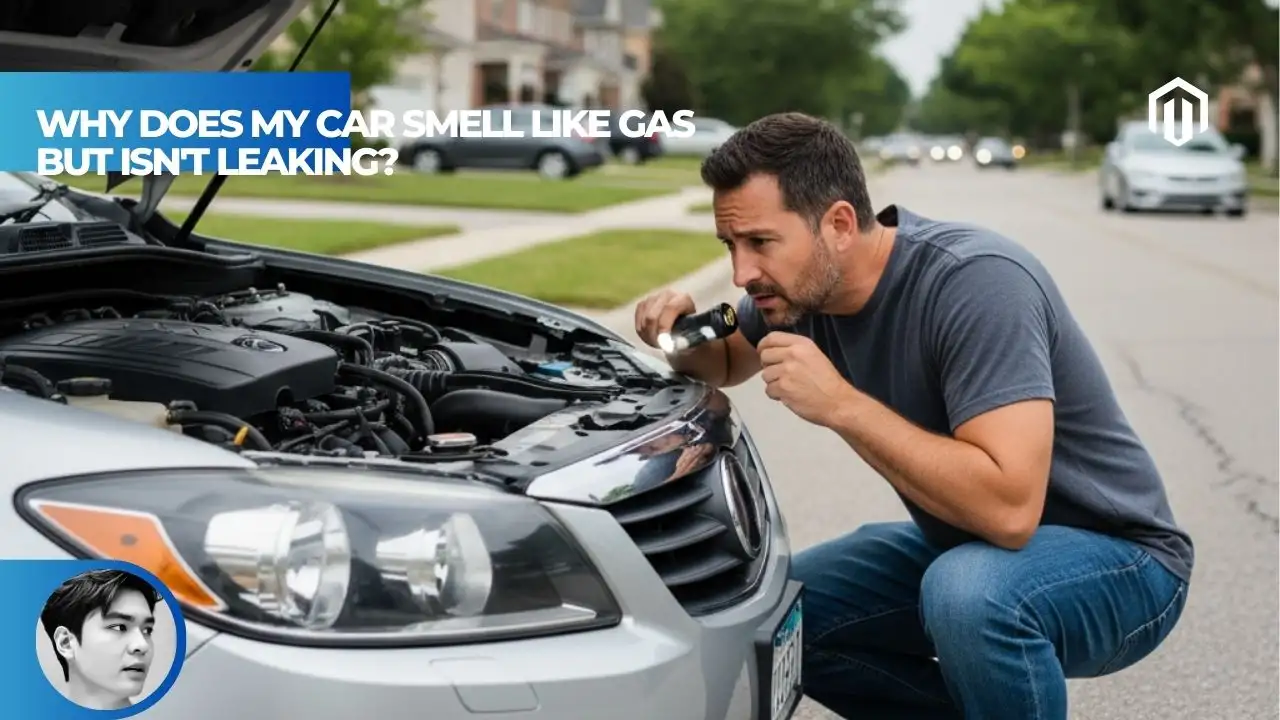

A gasoline odor without a visible leak almost always indicates escaping fuel vapors, not liquid fuel. The most common causes are a loose or cracked gas cap, EVAP system faults (purge valve, vent valve, charcoal canister), worn fuel injector O-rings, cracked vapor hoses, or a failing fuel pressure regulator[1][2]. U.S. EPA rules require the entire fuel system to remain sealed and detect leaks as small as 0.020 inch[3].
Key Takeaways
- “Gasoline evaporates within seconds, so vapor leaks rarely leave puddles even when the smell is strong.”
- “A loose, cracked, or worn gas cap is the single most common trigger for an EVAP leak code and a fuel odor.”
- “EPA-mandated EVAP systems must detect leaks as small as 0.020 inch, which sets DTCs P0440, P0442, P0455, and P0456.”
- “Persistent cabin gasoline odor is treated by NHTSA as a fire-risk condition and warrants immediate inspection.”
- “Switching the HVAC to recirculate isolates whether the source is external (engine bay/exhaust) or internal (cabin/EVAP).”
- “Total repair cost ranges from about $5 for a gas cap to $600+ for a charcoal canister replacement.”
Overview: Why Vapor Leaks Smell Without Liquid Evidence
Modern U.S. vehicles use a sealed, pressurized fuel system regulated by the EPA, so any gasoline odor without a visible leak almost always means hydrocarbon vapors are escaping the closed loop rather than liquid fuel pooling on the ground. Gasoline evaporates within seconds at ambient temperatures, which is why drivers smell fuel but find no puddle.
U.S. EPA and CARB rules cap evaporative emissions at roughly 0.5 grams per day over a three-day diurnal cycle and require onboard diagnostics to detect leaks as small as 0.020 inch (about 0.5 mm)[4][3]. Federal regulations (40 CFR §86.1813-17) further require sealed fuel systems and continuous EVAP monitoring on gasoline vehicles[5]. Because vapors are detected at parts-per-million levels by the human nose, even a leak well below the regulatory threshold can produce a strong odor without any liquid evidence[6].
[DETAILS] Symptom localization helps narrow the cause quickly. An odor concentrated near the rear of the vehicle typically points to the gas cap, filler neck, or charcoal canister. Odor concentrated under the hood often points to fuel injector O-rings, fuel rail connections, or the fuel pressure regulator. A smell that enters the cabin through the vents, especially at idle, suggests an exhaust or vapor source being drawn in through the HVAC fresh-air intake.
Top 7 Causes of Gas Smell Without a Visible Leak
The seven dominant causes are a loose or faulty gas cap, charcoal canister saturation, a stuck purge or vent valve, worn fuel injector O-rings, cracked vapor hoses, a failing fuel pressure regulator, and an exhaust leak drawn into the HVAC intake. Each leaves a distinct symptom pattern that helps with diagnosis.
Multiple independent shop references and OBD-II references converge on this list[1][2][7]. A P0456 (“EVAP small leak”) code, for example, is most commonly caused by a gas cap that is loose, damaged, or not sealing, followed by a defective purge or vent valve and cracked EVAP hoses[7]. NHTSA recall data also tie fuel injector seepage to fire risk, as in Ford’s 2024 recall of 42,652 Bronco Sport and Escape vehicles for damaged fuel injectors[8].
| # | Cause | Mechanism | When Smell Is Strongest | Typical DTC |
|---|---|---|---|---|
| 1 | Loose/faulty gas cap | Broken seal at filler neck[1] | Near rear of vehicle, after refueling | P0455 / P0456[7] |
| 2 | Charcoal canister saturation | Saturated carbon cannot absorb vapors[1] | Just after filling the tank | P0440 / P0446 |
| 3 | Stuck purge or vent valve | Improper EVAP venting/sealing[2] | At idle, hot engine | P0441 / P0443 / P0455 |
| 4 | Worn fuel injector O-rings | Hardened seals weep micro-fuel[1] | Engine bay, after warm-up | None (often no code)[8] |
| 5 | Cracked vapor hoses / fuel lines | Heat/vibration cracks rubber[2] | Engine bay or under vehicle | P0455 / P0442 |
| 6 | Faulty fuel pressure regulator | Excess fuel into intake; rich mixture | Exhaust smell, low MPG | P0172 (rich) |
| 7 | Exhaust leak into HVAC intake | Unburned hydrocarbons enter cabin | Cabin, at idle, vents on fresh air | None |
Expert Tip: Close all windows and switch the HVAC to recirculate. If the odor diminishes within one to two minutes, the source is external (engine bay or exhaust drawn through the cowl intake), not the cabin EVAP path.
EVAP System Explained: The Primary Suspect
The Evaporative Emission Control (EVAP) system is a sealed network that captures fuel vapors in a charcoal canister and routes them to the engine through a purge valve for combustion. A failure in any of its four core components—canister, purge valve, vent valve, or fuel tank pressure (FTP) sensor—can produce a noticeable gasoline odor without a liquid leak.
Federal law since 1971 has required EVAP systems on gasoline vehicles sold in the U.S., and EPA standards require leak detection at the 0.020-inch threshold and 24-hour sealed-tank performance[6][3]. Even a 0.020-inch leak can release roughly 1.35 grams of hydrocarbons per mile—about 30 times the allowable exhaust emissions limit—which is why the OBD-II monitor is so sensitive to it[6].
| EVAP Component | Function | Failure Symptom | Typical DTC |
|---|---|---|---|
| Charcoal canister | Stores fuel vapors on activated carbon[6] | Strong gas smell after refueling | P0446 / P0440 |
| Purge valve (canister purge solenoid) | Releases stored vapors to intake when commanded[9] | Rough idle, fuel odor at idle | P0441 / P0443 |
| Vent valve (canister vent solenoid) | Seals canister during leak test[9] | EVAP system cannot hold vacuum | P0446 / P0449 |
| Fuel tank pressure (FTP) sensor | Monitors EVAP pressure for OBD-II tests[7] | False or missed leak detection | P0452 / P0453 |
Diagnostic Checklist (Step-by-Step)
A reliable home-to-shop diagnostic sequence starts with the gas cap, moves to a visual under-hood inspection, then an OBD-II scan, and finishes with a professional smoke test if a leak is suspected but not located.
Shop diagnostic guides and OBD-II references agree on this order, since the gas cap is statistically the most likely cause of EVAP codes and a smoke test can localize leaks down to the EPA-mandated 0.020-inch threshold[2][3][10].
- Remove and reinstall the gas cap, tightening until it clicks at least three times; replace if the rubber gasket is cracked or deformed[2].
- Visually inspect under the hood for darkened, wet, or shiny areas around the fuel rail, injector seats, and rubber vapor hoses[2].
- Pull OBD-II codes and focus on the EVAP family: P0440, P0442, P0455, P0456[9][7].
- Have a technician perform a smoke test that pressurizes the EVAP system with non-toxic smoke to localize the leak point[10].
- Test the fuel pressure regulator by checking its vacuum line for fuel residue and measuring rail pressure with a gauge.
- Inspect the exhaust manifold and downpipe gaskets if cabin odor disappears in recirculate mode.
Repair Cost Estimates (USD)
Repair costs in the U.S. typically range from about $5 for a new gas cap to roughly $600 for a charcoal canister replacement, with most EVAP repairs falling between $100 and $400 once labor is included.
Cost ranges below are aggregated from independent shop sources and OBD-II databases and reflect typical 2025–2026 U.S. parts-and-labor figures rather than manufacturer-published prices[2][10].
| Repair | Parts Cost | Labor (Typical) | Total Range |
|---|---|---|---|
| Gas cap replacement | $5–$30 | $0 (DIY) | $5–$40 |
| EVAP purge valve | $20–$80 | $80–$170 | $100–$250 |
| Charcoal canister | $100–$400 | $100–$200 | $200–$600 |
| Fuel injector O-ring set | $20–$80 | $130–$320 | $150–$400 |
| Fuel pressure regulator | $80–$250 | $120–$250 | $200–$500 |
| Vapor hose replacement | $10–$60 | $80–$200 | $90–$260 |
Safety: Is It Safe to Drive?
A faint, intermittent gasoline odor with no check engine light is generally safe for short trips to a repair shop. A persistent, strong odor—especially inside the cabin—should be treated as a fire and inhalation hazard and the vehicle should be parked outdoors and inspected immediately.
NHTSA classifies fuel-system leakage as a fire-risk defect and has issued fuel-related fire-risk recalls in 2024–2025, including GM Recall 25V536 covering 23,656 Chevrolet Corvettes for fuel that could spill onto an ignition source during refueling[11], and Ford’s recall of 42,652 Bronco Sport and Escape SUVs for fuel injector cracks that could leak onto hot exhaust components[8].
| Symptom Severity | Check Engine Light | Recommended Action |
|---|---|---|
| Faint odor outside the vehicle | Off | Tighten gas cap; monitor; service within 1 week |
| Mild odor, occasional cabin entry | Off or steady | OBD-II scan within 48 hours; avoid enclosed garage |
| Strong cabin odor | Off | Stop driving; ventilate; tow to repair shop |
| Any odor + visible drip | On (any color) | Stop immediately; do not start engine; tow |
| Odor + flashing CEL | Flashing | Pull over safely; engine misfire/fire risk |
DIY vs. Professional Repair
Gas cap, exterior hose inspection, and OBD-II code reading are appropriate DIY tasks. Internal EVAP component replacement, fuel rail work, and any repair requiring system depressurization should be handled by a certified technician because of pressurized fuel and ignition risk.
| Task | DIY Difficulty | Tools Needed | When to See a Mechanic |
|---|---|---|---|
| Gas cap replacement | Easy | None | If light returns after replacement |
| OBD-II code scan | Easy | $20–$50 scanner | Any persistent EVAP code |
| Vapor hose visual check | Easy | Flashlight | If cracks are found |
| Purge valve replacement | Moderate | Sockets, jack | Tight engine bay packaging |
| Charcoal canister | Hard | Lift, fuel-safe tools | Always recommended |
| Injector O-rings | Hard | Fuel rail tools, torque spec | Always recommended[8] |
| Smoke test | Not DIY | EVAP smoke machine | Always[10] |
Pros and Cons of Delaying Repair
| Action | Risks | Benefits |
|---|---|---|
| Repair immediately | Higher upfront labor cost | Eliminates fire risk; passes emissions; prevents canister contamination[11] |
| Delay 1–2 weeks (mild case) | Fuel waste; possible failed inspection | Time to gather repair quotes |
| Delay >30 days | Charcoal canister damage, secondary failures, possible fire risk[11] | None recommended |
For related diagnostic guidance, see why does my car smell like a rotten egg and how to start a car with a bad fuel pump. For broader fuel-system context, how many gallons of gas does a car hold explains tank capacity, while what does the exclamation point mean in a car helps decode dashboard warnings that often accompany EVAP faults.
FAQs
Can a car smell like gas without leaking fuel?
Yes. Liquid gasoline evaporates within seconds at ambient temperatures, and EPA-regulated EVAP systems are designed to contain vapor pressure that can escape through micro-cracks, loose seals, or saturated charcoal canisters without ever forming a puddle[6]. The most common sources are a worn gas cap gasket, a stuck purge valve, weeping fuel injector O-rings, or cracked vapor hoses[1][7]. Because the odor threshold for gasoline is in parts-per-million, leaks well below the EPA’s 0.020-inch detection limit can still be very noticeable.
Is it safe to drive with a gasoline smell?
Short trips to a repair facility are generally acceptable when the odor is faint, no check engine light is on, and no liquid is visible. A persistent strong odor—particularly inside the cabin—should be treated as urgent because NHTSA classifies fuel leakage near ignition sources as a fire risk and has issued recalls on that basis, including 23,656 Chevrolet Corvettes in 2025[11]. Park outdoors, avoid enclosed garages, and have the vehicle scanned and smoke-tested promptly.
What DTC codes indicate an EVAP leak?
The most common EVAP-related diagnostic trouble codes are P0440 (EVAP system malfunction), P0442 (small leak), P0455 (large/gross leak), and P0456 (very small leak)[9][7]. Related codes include P0441 (purge flow), P0446 (vent control), and P0452/P0453 (fuel tank pressure sensor). These codes indicate where the OBD-II monitor detected pressure or flow anomalies but rarely identify the exact leaking component, which is why a smoke test typically follows.
Will a loose gas cap really cause a strong fuel odor?
Yes, and statistically it is the leading cause of EVAP-related complaints. The gas cap forms a critical seal on the filler neck; a worn O-ring, debris on the sealing surface, or insufficient tightening allows pressurized vapors to escape directly from the largest concentration of fuel in the vehicle[7]. Tightening the cap until it clicks at least three times often resolves both the odor and the associated check engine light within one or two drive cycles[2].
How much does it cost to fix an EVAP leak in the U.S.?
Repair costs depend entirely on the failed component. A gas cap replacement runs $5–$40, a purge valve $100–$250, a charcoal canister $200–$600, and fuel injector O-ring service $150–$400 including labor[2][10]. A diagnostic smoke test typically adds $75–$150 if it is not bundled with the repair. Because misdiagnosis is common, paying for a proper smoke test before replacing parts usually lowers the total cost.
References
- Right Car Detailing. (2026). “Causes of Gas Smell in Car Without Leaks: Symptoms, Fixes.” https://rightcardetailing.ca/causes-of-gas-smell-in-car-without-leaks/
- Strande’s Garage. (2025). “Why Do I Smell Gas Near My Car But See No Leaks?” https://www.strandesgarage.com/blog/why-do-i-smell-gas-near-my-car-but-see-no-leaks
- BM Process. (2025). “What Are the Standards for Vapour Emission Control Systems in Vehicles?” https://bmprocess.nl/what-are-the-standards-for-vapour-emission-control-systems-in-vehicles/
- Automotive IQ. (2014). “Evaporative Emission Regulations and EVAP Systems.” https://www.automotive-iq.com/thermal-management/articles/evaporative-emission-regulations-and-evap-systems
- U.S. Government. (2024). “40 CFR 86.1813-17 — Evaporative and Refueling Emission Standards.” https://www.ecfr.gov/current/title-40/chapter-I/subchapter-C/part-86/subpart-S/section-86.1813-17
- R.L. Escalambre. (n.d.). “Introduction to Evaporative Emissions.” https://www.rlescalambre.net/introduction-to-evaporatvie-emissions
- CarParts.com. (2021). “P0456 Code: Evaporative Emission System Small Leak Detected.” https://www.carparts.com/blog/p0456-code-evaporative-emission-system-small-leak-detected/
- CBT News / NHTSA. (2024). “Ford Recalls More U.S. SUVs Due to Fire Risks.” https://www.cbtnews.com/nhtsa-says-ford-recalls-more-u-s-suvs-due-to-fire-risks/
- OBDeleven. (2024). “P0455 – Evaporative Emission Control System Gross Leak.” https://obdeleven.com/p0455
- OrionMotorTech. (2025). “6 Ways to Easily Find EVAP Leak in Your Vehicle.” https://orionmotortech.com/blogs/auto-blog/6-ways-to-easily-find-evap-leak-in-your-vehicle
- NHTSA. (2025). “Part 573 Safety Recall Report 25V536 — GM Fire Risk When Refueling.” https://static.nhtsa.gov/odi/rcl/2025/RCLRPT-25V536-9882.pdf