

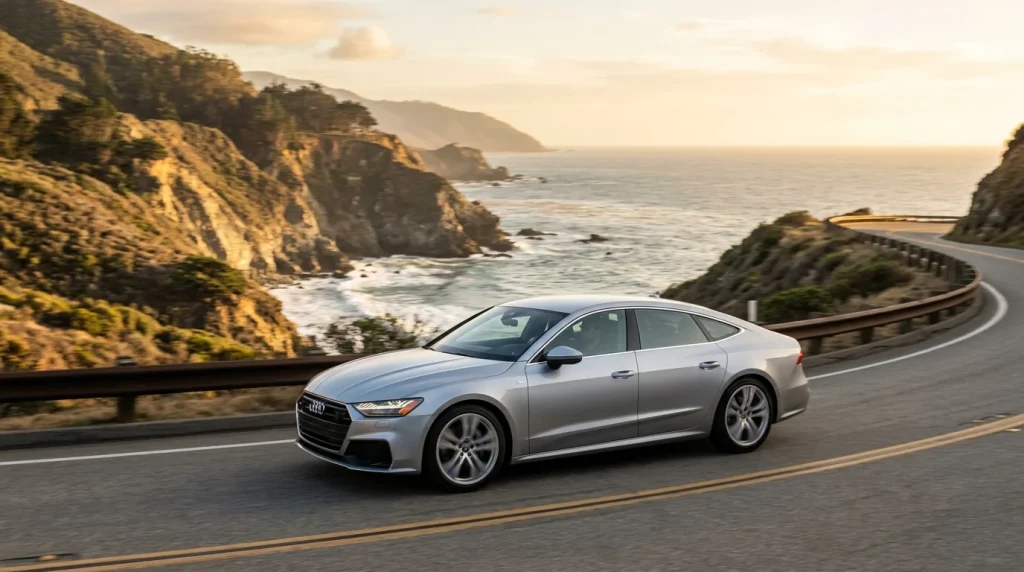
Quick answer: The 2024 Audi A7 represents the mature final stage of the C8-generation Sportback, now available on the used market with average dealer prices ranging from $45,800 for trade-ins to $58,000 for retail examples depending on mileage and condition. This luxury fastback delivers 335 horsepower from its mild-hybrid V6 engine, standard Quattro all-wheel drive, and newly standard driver assistance features. However, buyers should note that Audi is discontinuing the A7 Sportback after the 2025 model year, replacing it with the electric A6 e-tron, which will affect long-term depreciation.
Key takeaways:
- The 2024 Audi A7 trades at a 20% to 30% discount from its original $72,295 to $80,845 MSRP, making it a compelling luxury value.
- The 48-volt mild-hybrid system starter generator (BSG) remains a primary electrical failure mode, though minor glitches can also stem from CAN-bus sensors.
- Audi’s discontinuation of the Sportback body style means this model is among the last internal-combustion fastbacks in the brand’s history.
Used Market Pricing and Trim Levels
The 2024 Audi A7 entered the market with three distinct equipment packages. All three share the identical 55 TFSI powertrain, leaving luxury amenities and technology packages as the primary differentiators for used buyers within the wider Audi A7 model family catalog.
| Trim Level | Original MSRP | Used Resale Range (2025-2026) | Key Standard Equipment |
|---|---|---|---|
| Premium | $72,295 | $44,900 – $49,500 | LED headlights, power tailgate, lane departure warning, heated steering wheel |
| Premium Plus | $77,045 | $49,000 – $54,000 | Matrix-design headlights, Bang & Olufsen premium 3D sound, wireless phone charger |
| Prestige | $80,845 | $53,000 – $58,000 | Dual-pane acoustic glass, head-up display, power soft-closing doors, intersection assist |
These used market estimates assume a standard driving profile of 12,000 miles per year and clean vehicle conditions. Original retail pricing lists a starting price of $73,095 for the Premium trim when including the manufacturer’s destination charge. On the used market, the Premium Plus trim represents the value sweet spot, offering upgraded sound and lighting systems while avoiding the steepest depreciation premium associated with the Prestige package. Buyers looking to compare this model year with its successor can read the 2025 Audi A7 review to see what changes were made in the final model year.
Analysis: First-year depreciation for the A7 sits near 20%, which aligns with luxury segment norms. However, because luxury vehicles suffer high technology obsolescence, buyers should prioritize models that carry transferable factory warranties or certified pre-owned (CPO) status to mitigate out-of-pocket repair risks.
Performance and Drivetrain Specifications
The core of the 2024 Audi A7 is its modular EA839 engine family. Unlike older generations that offered multiple powertrain variants, the standard 2024 model relies entirely on a single gasoline configuration.
The 3.0L V6 Turbocharged Engine
The 55 TFSI powertrain uses a single twin-scroll turbocharger nested within the V of the 3.0-liter V6 engine block. This layout minimizes the distance exhaust gases travel, reducing turbo lag and providing immediate low-end response. The engine produces 335 horsepower at 5,000 to 6,100 rpm and 369 lb-ft of torque starting at a low 1,370 rpm up to 4,500 rpm. Power is delivered to the wheels through a seven-speed S tronic dual-clutch automatic transmission that provides rapid, mechanical gear shifts.
Acceleration and Fuel Economy
Independent testing confirms a 0-60 mph acceleration time of 4.9 seconds, slightly outperforming Audi’s conservative factory claim of 5.2 seconds. The V6 engine incorporates a 48-volt mild-hybrid (MHEV) system that recovers kinetic energy during braking and smooths the automatic engine start-stop process. This integration helps the A7 achieve EPA fuel economy ratings of 22 mpg city, 30 mpg highway, and 25 mpg combined. With a 19.3-gallon fuel tank, the vehicle provides a theoretical highway cruising range of up to 579 miles.
Standard Quattro All-Wheel Drive
Standard Quattro all-wheel drive with ultra technology optimizes traction. The system operates primarily in front-wheel-drive mode to conserve fuel, but it can engage the rear axle in a fraction of a second when sensors detect wheel slip, steering angle changes, or aggressive throttle inputs.
Common Reliability Issues and Recalls
While the C8 generation represents a mature platform, used car buyers must remain aware of specific technical failure modes documented in service bulletins and safety filings.
48V Mild-Hybrid System Faults
The most significant point of failure on the C8 platform involves the 48-volt belt-driven starter generator (BSG). The unit’s internal inverter can experience electronic circuit board degradation. When the inverter fails, the system stops charging the 12-volt battery, resulting in an “Electrical system: malfunction” message on the instrument cluster. If driven continuously after this fault, the vehicle will lose electrical power, disabling power steering and infotainment before shutting down completely. Dealing with a failed BSG out of warranty is costly, with parts and labor estimates ranging from $1,500 to $3,200 at franchised dealers.
CAN-Bus Sensor Diagnostic Nuance
According to manufacturer Technical Service Bulletin (TSB) 2073284/1 issued in March 2024, diagnostic trouble code U046900 (“Lost Communication with Starter/Generator Control Module”) does not always indicate a failed generator. If stored alongside sensor codes for the brake-servo pressure system, the root cause is a CAN-bus communications error. In this scenario, replacing the physical starter generator will not resolve the issue, as the engine computer is simply commanding the generator into a freewheel state.
MMI Infotainment Glitches
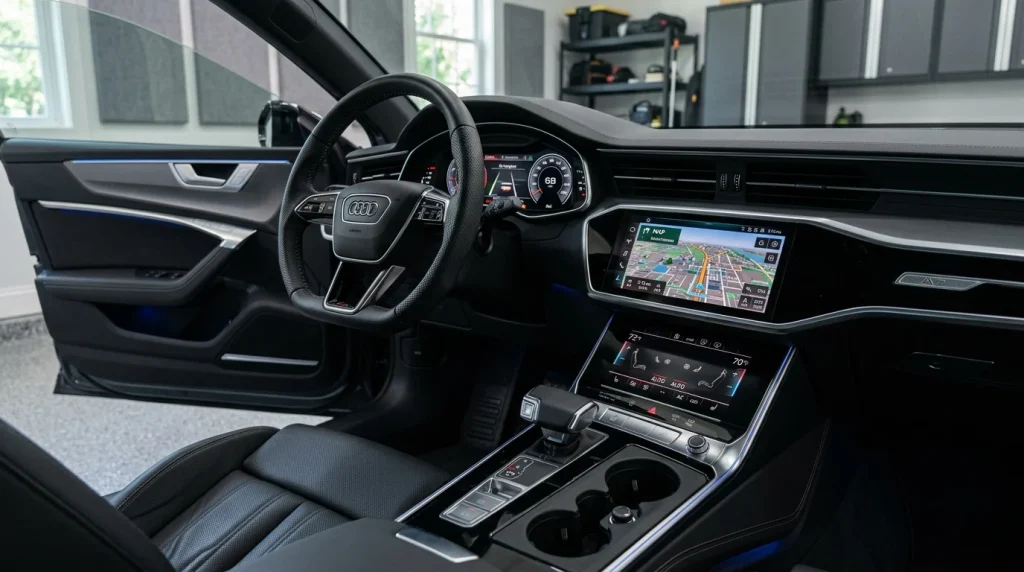
The dual-touchscreen MMI infotainment system (10.1-inch upper screen and 8.6-inch lower climate screen) occasionally suffers from screen freezing, delayed Bluetooth pairing, or rejected smartphone connections. These issues are generally software-mediated rather than hardware failures. Performing a hard system reset or having a dealer install the latest firmware updates usually resolves the pairing errors.
Safety Recalls
For the 2024 model year, the National Highway Traffic Safety Administration (NHTSA) lists recall campaign 25V900 (manufacturer code 90TV) to address rearview camera display failures. The backup camera image may fail to load on the MMI screen, reducing rear visibility. Dealers resolve this issue free of charge via a software update.
The Discontinuation Status: Why the A7 Sportback Ends
The 2025 model year marks the official end of the A7 Sportback as it has existed since its debut. This decision is driven by platform alignment and a shifting corporate model strategy.
Shift to Electric Power
Audi is phasing out the fastback-styled A7 to make room for the new Premium Platform Electric (PPE) vehicles. The indirect successor to the A7 Sportback is the all-electric 2026 Audi A6 e-tron Sportback. Built on an 800-volt architecture, the electric model promises over 400 miles of range and faster charging speeds, but it marks a complete departure from the mechanical character of the gas-powered V6.
The Great Naming Convention U-Turn
In 2023, Audi announced a strict nomenclature policy: electric models would receive even numbers (A4, A6, A8) while internal combustion models would transition to odd numbers (A3, A5, A7). Under this initial plan, the gasoline-powered successor to the A6 sedan was scheduled to be renamed the A7.
However, in early 2025, Audi reversed this strategy to maintain global brand consistency. Instead of renaming its legacy models, Audi decided that gas and electric versions would share alphanumeric names, distinguished by powertrain suffixes. As a result:
- The gasoline-powered successor retains the A6 TFSI nameplate.
- The electric model is badged as the A6 e-tron.
- The A7 Sportback fastback body style is retired completely without a gas-powered sedan replacement.
Competitor Comparisons
Used luxury buyers looking at the 2024 Audi A7 typically evaluate it against three alternative European executive models and its traditional sedan sibling.
graph TD
A[“2024 Audi A7 55 TFSI”] –>|Hatchback Utility| B[“Mercedes-Benz CLS 450 (11.9 cu ft trunk)”]
A –>|Value Comparison| C[“Audi A6 Sedan (Identical V6, $10,000 cheaper new)”]
A –>|Handling & Performance| D[“BMW 840i Gran Coupe (More driver-focused, rear-drive)”]
A –>|Price & Status| E[“Porsche Panamera (Superb resale, higher entry cost)”]
Audi A7 vs. Mercedes-Benz CLS 450
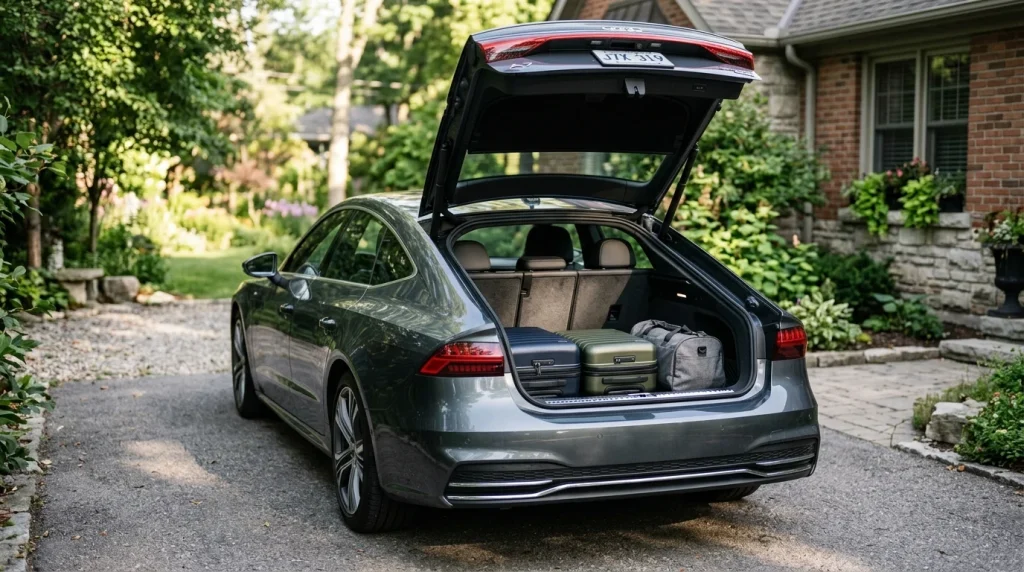
The Mercedes-Benz CLS 450 features a 362-horsepower mild-hybrid turbocharged inline-six, which feels smoother than Audi’s V6 but has a much smaller traditional trunk. The A7 offers 24.9 cubic feet of cargo capacity behind the second row, whereas the CLS provides just 11.9 cubic feet. Additionally, Mercedes discontinued the CLS class after the 2023 model year, making the CLS older on the used market.
Audi A7 vs. BMW 840i Gran Coupe
BMW’s 840i Gran Coupe is built on a sporty rear-wheel-drive platform and uses the refined 335-horsepower B58 inline-six engine. The BMW offers sharper handling and steering feedback, but its original MSRP was significantly higher, starting at $88,000. On the used market, rapid depreciation makes the 8 Series an appealing performance alternative, though its interior controls are less modern than Audi’s dual-touchscreen layout.
Audi A7 vs. Porsche Panamera
The Porsche Panamera is the performance benchmark in this class, offering a base 325-horsepower or upgraded 443-horsepower V6 that executes a 0-60 mph sprint in as little as 3.6 seconds. The Panamera retains its resale value exceptionally well, maintaining 55% to 60% of its value after five years. However, used Panamera prices start near $59,200, which is significantly higher than a comparable A7, and Porsche’s specialized maintenance costs can be double those of Audi.
Audi A7 vs. Audi A6 Sedan
The A6 sedan shares the same platform, EA839 V6 engine, and Quattro drivetrain as the A7. However, the A6 carried a starting price that was roughly $10,000 lower when new. Choosing the A7 over the A6 means paying a premium purely for the fastback styling and the practical hatchback tailgate, as the A6 sedan is limited to a 13.7-cubic-foot trunk.
Used Value Verdict: Is the 2024 Audi A7 Worth Buying?
Purchasing a used 2024 Audi A7 is a highly subjective decision that depends on a buyer’s willingness to manage out-of-warranty German luxury car costs.
Who Should Buy
The A7 is an excellent choice for buyers who want the styling of a coupe but require the everyday utility of a hatchback. It is a competent long-distance tourer that performs well in winter climates thanks to its standard Quattro system. Buying a one-year-old model allows you to avoid the steepest first-year depreciation drop while securing a modern executive car.
Who Should Skip
If your primary concern is long-term reliability and low maintenance costs, you should avoid the A7. The complexity of the 48V electrical architecture and the predicted below-average brand reliability ratings from What Car? and J.D. Power mean that ownership costs will escalate after the factory warranty expires. For those seeking basic family transportation, a conventional luxury crossover or a less complex executive sedan will offer better value.
Frequently Asked Questions
What are the most common mechanical problems with the 2024 Audi A7?
The most frequent mechanical and electrical issues involve the 48-volt belt starter generator (BSG) inverter failure, software-related MMI screen freezes, and premature wear on the liquid-cooled water pump and thermostat housing.
Is the 2024 Audi A7 being discontinued?
Yes. Audi has confirmed that the A7 and S7 Sportback models are discontinued after the 2025 model year to align the production facility for the incoming electric Audi A6 e-tron.
How much cargo space does the 2024 Audi A7 Sportback have?
The A7 provides 24.9 cubic feet of cargo volume behind the second-row seats. The rear seats fold in a 40/20/40 split to accommodate larger items, making it much more practical than a standard A6 sedan.
How does the 2024 Audi A7 compare to the 2024 Audi S7?
The standard A7 uses a 335-horsepower single-turbo V6 engine, while the performance-focused Audi S7 features a twin-turbocharged 2.9-liter V6 that produces 444 horsepower and 443 lb-ft of torque. The S7 accelerates from 0-60 mph in 4.3 seconds but carries a used price premium of over $15,000.

