

Quick answer:
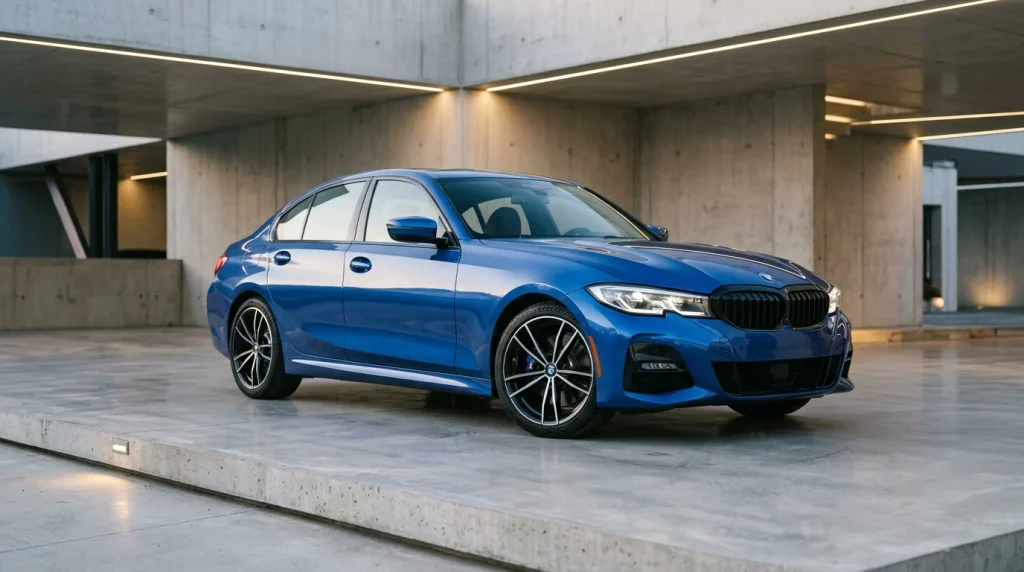
The 2025 BMW 3 Series starts at $46,675, which includes the $1,175 destination fee, for the base 330i and goes up to $62,775 for the high-performance M340i xDrive. The 2025 update brings the new iDrive 8.5 infotainment system with QuickSelect, revised suspension mounts for enhanced comfort, and a torque boost for the M340i’s mild-hybrid engine. Most notably, BMW has discontinued the 330e plug-in hybrid model in the United States market, leaving the gas-powered 330i and M340i as the sole options.
Key takeaways:
- US pricing starts at $46,675 for the rear-wheel-drive 330i, rising to $62,775 for the M340i xDrive, driven in part by a destination fee increase to $1,175.
- The plug-in hybrid 330e has been discontinued in the United States, leaving buyers who want an electrified 3 Series to look at the all-electric BMW i4 or seek remaining 2024 model year inventory.
- Engine outputs remain at 255 horsepower for the 330i, while the M340i’s B58 inline-six gets mild-hybrid refinements that bump total output to 386 horsepower and 398 pound-feet of torque.
- The interior gains BMW’s iDrive 8.5 operating system, a redesigned flat-bottom steering wheel, and new interior trim materials.
- The 3 Series remains the sport sedan handling benchmark, though reviewers continue to critique its isolated steering feel and firm M Sport ride quality.
What is New for the 2025 Model Year
BMW has implemented targeted refinements for the 2025 model year rather than conducting a full redesign. The exterior updates are subtle, comprising two new standard colors (Arctic Race Blue Metallic and Vegas Red Metallic) alongside new 19-inch M alloy wheel designs. Inside the cabin, the physical changes are dominated by redesigned steering wheels. The standard 330i features a two-spoke steering wheel with a polygonal rim, while models equipped with the M Sport package, as well as the M340i, receive a flat-bottom three-spoke M leather steering wheel featuring a colored marker stripe at the 12 o’clock position (black on the 330i M Sport and red on the M340i).
The digital experience is updated via the transition to BMW’s iDrive 8.5 operating system. This software update introduces the QuickSelect menu structure, which places frequently used functions directly on the home screen to minimize menu diving. Under the skin, the chassis benefits from stiffer mounting joints connecting the rear dampers to the body, which reduces road vibration. Additionally, BMW has adjusted the steering calibration to offer lighter effort when driving in Comfort mode.
The most significant change for the US market is the discontinuation of the 330e plug-in hybrid model. For drivers who require a plug-in hybrid option or wish to compare pricing with previous model years, seeking out a pre-owned 2024 BMW 3-Series remains the best alternative.
2025 BMW 3 Series Technical Specifications
The 2025 lineup is divided into four configurations, split by engine displacement and drive type. All models come standard with an eight-speed automatic transmission.
| Specification | 330i | 330i xDrive | M340i | M340i xDrive |
|---|---|---|---|---|
| Engine Type | 2.0L Turbocharged I4 | 2.0L Turbocharged I4 | 3.0L Turbocharged I6 | 3.0L Turbocharged I6 |
| Hybrid System | 48V Mild Hybrid | 48V Mild Hybrid | 48V Mild Hybrid | 48V Mild Hybrid |
| Horsepower | 255 hp @ 4,700 rpm | 255 hp @ 4,700 rpm | 386 hp @ 6,500 rpm | 386 hp @ 6,500 rpm |
| Torque | 295 lb-ft @ 1,600 rpm | 295 lb-ft @ 1,600 rpm | 398 lb-ft @ 1,800 rpm | 398 lb-ft @ 1,800 rpm |
| Drivetrain | Rear-Wheel Drive | All-Wheel Drive | Rear-Wheel Drive | All-Wheel Drive |
| 0-60 mph (BMW est.) | 5.6 seconds | 5.4 seconds | 4.4 seconds | 4.1 seconds |
| EPA Combined MPG | 31 mpg | 28 mpg | 29 mpg | 26 mpg |
| Trunk Capacity | 16.9 cubic feet | 16.9 cubic feet | 16.9 cubic feet | 16.9 cubic feet |
| Base MSRP (incl. dest.) | $46,675 | $48,675 | $60,775 | $62,775 |
Powertrain Performance and Driving Dynamics
The driving experience of the 2025 BMW 3 Series remains defined by its powertrains, which have both received 48-volt mild-hybrid systems to smooth out engine start-stop cycles and provide a brief electric assist at low speeds.
330i: The Practical Performance Benchmark
The standard 330i is powered by BMW’s B48 2.0-liter turbocharged four-cylinder engine. While output is unchanged at 255 horsepower and 295 pound-feet of torque, the engine features redesigned intake ports and combustion chambers. In real-world testing, the RWD 330i feels faster than its official numbers suggest, reaching 60 mph in 5.2 seconds during independent testing. Consumer Reports testers noted that the four-cylinder powertrain delivers immediate throttle response with virtually no lag, making it a highly responsive tool for daily highway merging.
M340i: Track-Ready Inline-Six Capabilities
The M340i utilizes the B58 3.0-liter turbocharged inline-six, which gains mild-hybrid modifications that raise torque output by 29 pound-feet. The updated powertrain produces a combined 386 horsepower and 398 pound-feet of torque. During track testing by Car and Driver, the M340i xDrive sprinted from 0 to 60 mph in just 3.7 seconds and cleared the quarter-mile in 12.2 seconds at 112 mph. This level of acceleration makes the M340i competitive with high-end sports cars while costing significantly less.
Steering Feedback and Suspension Firmness
Despite the class-leading performance, reviewers continue to point out a lack of tactile feedback in the steering. While the steering rack is quick and accurate, it feels isolated compared to older hydraulic systems, a trait noted by almost all automotive journalists. Additionally, the ride quality remains on the firm side. The M Sport suspension, which is heavily stocked by US dealers, can transmit noticeable road imperfections into the cabin. Buyers seeking daily comfort should consider the standard suspension setup or add the Adaptive M suspension, which uses electronic dampers to soften the ride on poor pavement.
Trim Levels, US Pricing, and Purchasing Recommendations
The starting prices for the US market have risen slightly for 2025, influenced by a $180 increase in the destination charge to $1,175.
- 330i (RWD): $46,675
- 330i xDrive (AWD): $48,675
- M340i (RWD): $60,775
- M340i xDrive (AWD): $62,775
Edmunds editors recommend the base 330i for the majority of buyers, noting that its four-cylinder engine provides more than enough power and includes the identical curved display technology as the M340i. To maximize the car’s dynamic capability without paying the inline-six price premium, buyers can add the M Sport package ($3,100) and the Dynamic Handling package ($1,050).
Options packages add up quickly. The Premium Package ($1,600) is a popular addition that adds comfort access passive entry, a heated steering wheel, and a head-up display. The Driving Assistance Professional package ($1,700) adds hands-free highway driving capability, which is a feature that many competitors include as standard equipment. Buyers who want to compare the starting prices of the 2025 model against previous iterations can check the 2023 BMW 3-Series overview for context.
Interior Design, Comfort, and Technology
The focal point of the dashboard is the BMW Curved Display, which houses a 12.3-inch digital gauge cluster and a 14.9-inch center touchscreen under a single piece of glass. The screens are high-resolution and remain legible under direct sunlight. The upgrade to iDrive 8.5 introduces QuickSelect, which provides vertical widgets on the driver’s side of the screen for quicker access to media, navigation, and vehicle settings. Standard wireless Apple CarPlay and Android Auto integrations connect reliably, and a 5G Wi-Fi hotspot is standard.
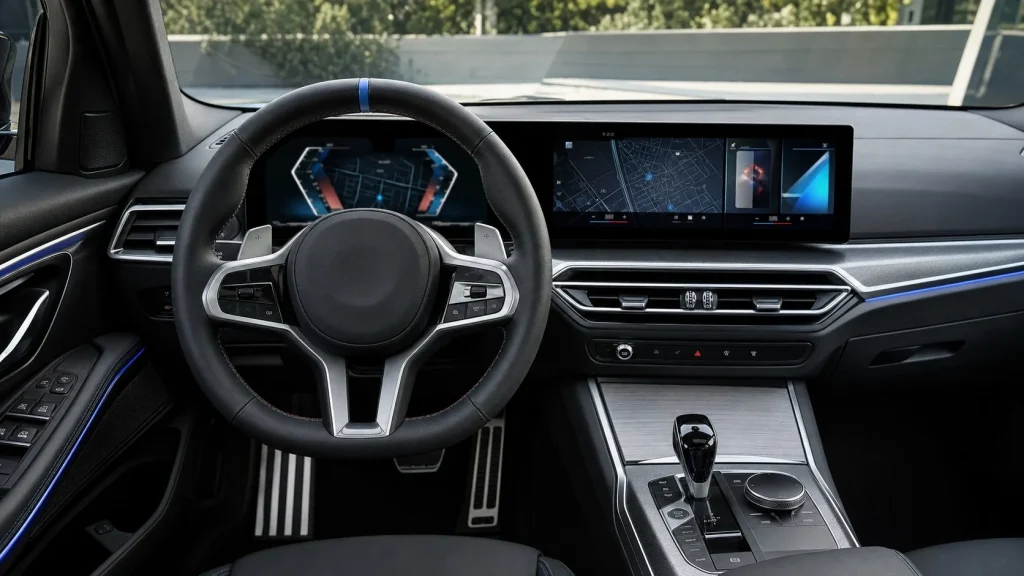
Materials throughout the cabin feel expensive and solid. The seats are highly supportive, and passenger room in both rows is adequate for adults. Storage is a clear strength, with a trunk capacity of 16.9 cubic feet that beats the German competition. In test conditions, the trunk accommodates up to six carry-on suitcases without folding down the rear seats.
Fuel Economy and Real-World MPG
According to the EPA, the RWD 330i achieves 28 mpg city, 35 mpg highway, and 31 mpg combined. The AWD 330i xDrive is rated at 25/34/28 mpg. The more powerful M340i RWD is estimated at 26/33/29 mpg, while the M340i xDrive gets 23/32/26 mpg.
In real-world highway testing at 75 mph, the RWD 330i returned 42 mpg, exceeding the EPA highway estimate by 7 mpg. The M340i xDrive achieved 33 mpg under identical highway conditions. The fuel tank capacity is 15.6 gallons, which provides a cruising range of over 500 miles on the highway for 330i models. Note that premium fuel is required across the entire lineup.
Safety Ratings and Driver-Assist Limitations
The 2025 BMW 3 Series has received a 5-star overall safety rating from the National Highway Traffic Safety Administration (NHTSA) and a Good rating in all crashworthiness evaluations conducted by the Insurance Institute for Highway Safety (IIHS).
Standard safety systems are limited to forward-collision warning and automated emergency braking. Features like blind-spot monitoring, lane-keeping assist, and adaptive cruise control require paying extra for the Driving Assistance packages, which is a disappointing omission given that these features are standard on less expensive mainstream vehicles.
Competitor Comparison: BMW vs. Mercedes, Audi, and Genesis
The compact luxury sport sedan class remains highly competitive, with the 3 Series facing updated rivals.
| Feature | 2025 BMW 330i | 2025 Mercedes C300 | 2026 Audi A5 | 2025 Genesis G70 |
|---|---|---|---|---|
| Base MSRP (US) | $46,675 | $49,600 | $50,200 | $43,750 |
| Horsepower | 255 hp | 255 hp | 268 hp | 252 hp |
| 0-60 mph Time | 5.2 seconds | 5.9 seconds | 5.4 seconds | 5.9 seconds |
| EPA Combined MPG | 31 mpg | 29 mpg | 27 mpg | 24 mpg |
| Trunk Space | 16.9 cubic feet | 12.6 cubic feet | 13.5 cubic feet | 10.5 cubic feet |
| Free Maintenance | 3 years / 36k miles | None | 1 year / 10k miles | 3 years / 36k miles |
The Mercedes C-Class offers a more luxury-oriented cabin but carries a higher base price and lacks complimentary maintenance. The new Audi A5 replaces the previous A4, bringing standard all-wheel drive and updated technology, though it has a higher entry price. The Genesis G70 remains the value leader in terms of standard equipment, but its interior design is beginning to show its age. For a broader overview of how these models compare over time, you can visit the BMW 3-Series segment hub or read our analysis of the upcoming 2026 BMW 3-Series for future updates.
Long-Term Reliability and Maintenance Realities
Consumer Reports owner surveys show below-average reliability ratings for the 2 Series and 3 Series models of this generation. The primary issues reported by owners involve infotainment screen blank-outs and minor electrical bugs rather than engine or transmission failures. The B48 and B58 engines have shown strong mechanical reliability across various BMW models.
To offset initial ownership costs, BMW includes its Ultimate Care program, which provides complimentary scheduled maintenance for three years or 36,000 miles. This is a significant advantage over Audi and Mercedes-Benz, which charge extra for prepaid maintenance plans.
Pros and Cons
What Works
- The M340i accelerates from 0 to 60 mph in 3.7 seconds, providing performance that matches cars costing thousands more.
- Fuel efficiency is outstanding, with the 330i returning 42 mpg in real-world highway testing.
- The 16.9 cubic feet trunk space is the largest in its class, offering superior cargo utility.
- Three years of complimentary maintenance is included, saving buyers money on initial services.
What Doesn’t
- Standard safety features are minimal, requiring buyers to pay extra for driver-assist technology.
- The ride quality is firm and can become busy on rough roads, particularly with the M Sport suspension.
- The steering system lacks the tactile road feedback that defined older generations.
- The discontinuation of the 330e leaves buyers without a plug-in hybrid choice.
FAQs
Is the 2025 BMW 3 Series worth buying?
Yes. The 2025 BMW 3 Series remains the handling benchmark for luxury sport sedans. No competitor matches its balance of performance, engine refinement, and trunk space. However, if standard safety features are a priority, the Genesis G70 offers better value, while the Mercedes C-Class is a better choice for drivers who prioritize ride comfort over sportiness.
Should I buy the 330i or M340i?
For the majority of buyers, the 330i is the best choice. Its 255-horsepower engine feels quick, and it saves $14,100 compared to the M340i. Choose the M340i if you want the sound and acceleration of a turbocharged inline-six or plan to track the vehicle.
What changed between the 2024 and 2025 BMW 3 Series?
The 2025 model gains iDrive 8.5 software with QuickSelect, redesigned steering wheels, stiffer rear suspension mounts, and an extra 4 horsepower for the M340i. The biggest change is the discontinuation of the 330e plug-in hybrid model in the United States.
Is the 2025 BMW 3 Series reliable?
Owner survey data from Consumer Reports indicates below-average reliability, mostly due to infotainment software glitches and electronic sensors. Mechanically, the engines and transmissions are robust.

