

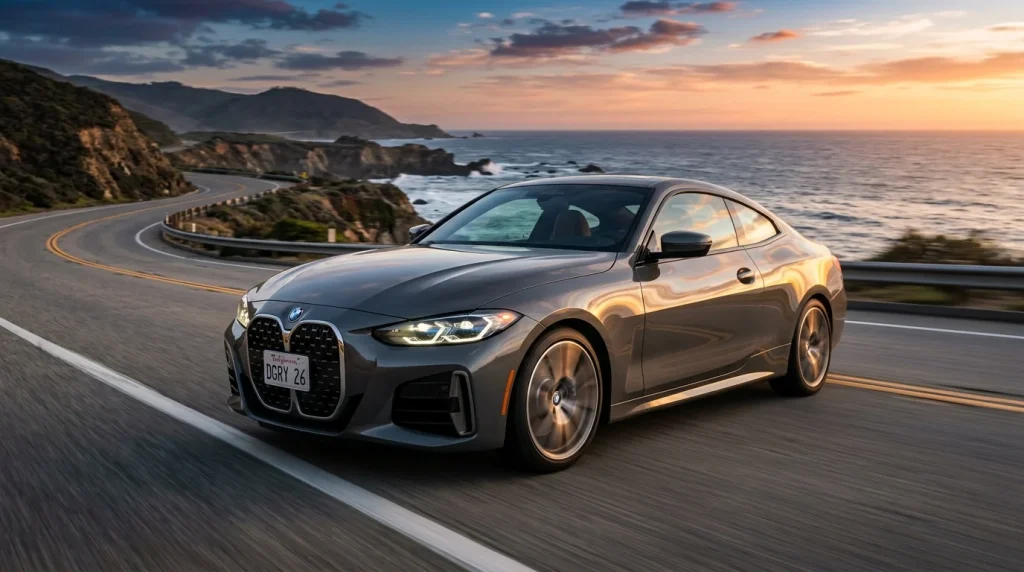
Quick answer: The 2026 BMW 4 Series starts at $51,200 for the base 430i Gran Coupe and ranges up to $77,200 for the high-performance M440i xDrive Convertible. Standardized with a 48-volt mild-hybrid powertrain, the 4 Series achieves up to 36 mpg highway while generating 255 to 386 horsepower. The lineup carries over refinements from the recent mid-cycle update, including the Curved Display and BMW Operating System 8.5.
Key takeaways:
- Coupe pricing starts at $53,300, while the Gran Coupe begins at $51,200 and the open-top Convertible starts at $61,300 before destination charges.
- The 430i features a 255-hp turbocharged four-cylinder engine, whereas the M440i gets a 386-hp turbocharged inline-six engine.
- Mild-hybrid technology enhances fuel efficiency, enabling up to 36 mpg highway on 430i Coupe models and up to 34 mpg on M440i Coupe models.
- The standard digital cockpit houses a 12.3-inch driver cluster and a 14.9-inch touchscreen running the updated iDrive 8.5 software.
What’s New for the 2026 BMW 4 Series?
Following a comprehensive mid-generation styling and interior refresh, the 2026 BMW 4 Series enters the model year with incremental refinement rather than drastic mechanical changes. BMW has focused on optimizing package content and digital usability to deliver higher standard value in the premium compact class.
Incremental Package and Equipment Updates
For the 2026 model year, BMW introduces a new optional Black Package for M Performance models of the 4 Series Gran Coupe (M440i). This package, available only in conjunction with the M Sport Package Pro, adds carbon-fiber interior trim, black exterior badging, and 19-inch M light-alloy wheels finished in black. For buyers who prefer individual styling choices without selecting the full package, these 19-inch black alloy wheels are now available as a standalone option across the Coupe, Convertible, and Gran Coupe M Performance trims. Additionally, the Tyre Repair Kit Plus (Seal and Drive) becomes standard equipment on all Coupe and Convertible models starting in summer 2026.
BMW Operating System 8.5 and QuickSelect
The digital experience is anchored by BMW Operating System 8.5, which refines the menu layout compared to the software in the 2024 BMW 4 Series. Utilizing QuickSelect technology, the home screen displays a flat menu structure that allows drivers to access media, navigation, and vehicle settings directly from the home screen. This reduces the need to navigate through complex submenus, improving safety and convenience while driving.
Engine Performance, Specifications, and Acceleration
The 2026 model year maintains a highly refined engine lineup. Both the four-cylinder and six-cylinder powertrains are paired with an eight-speed Steptronic Sport automatic transmission. Rear-wheel drive (RWD) is the standard configuration, while BMW’s xDrive all-wheel-drive system is available as an option.
430i TwinPower Turbo Four-Cylinder
The entry-level 430i is powered by a 2.0-liter TwinPower Turbo inline-four engine. This engine utilizes a twin-scroll turbocharger, high-precision direct injection, and fully variable valve control. It produces 255 horsepower at 5,000 to 6,500 rpm and 295 lb-ft of torque from 1,550 to 4,400 rpm. The 48-volt mild-hybrid system provides electric assist to smooth out the automatic stop-start function and recapture energy during deceleration.
Acceleration is quick and responsive for a base luxury model. The RWD 430i Coupe sprints from 0 to 60 mph in 5.6 seconds, while the xDrive version reduces that time to 5.4 seconds.
M440i Turbocharged Inline-Six with 48V Mild Hybrid
For performance-minded buyers, the M440i features the acclaimed B58 3.0-liter turbocharged inline-six engine. Enhanced by a 48-volt starter-generator integrated into the transmission, this powertrain delivers a robust 386 horsepower at 5,200 to 6,250 rpm and 398 lb-ft of torque at 1,900 to 4,800 rpm. The electric motor adds up to 11 horsepower of temporary boost under hard acceleration, helping eliminate turbo lag at low engine speeds.
The M440i Coupe accelerates from 0 to 60 mph in 4.6 seconds with RWD, while the M440i xDrive Coupe completes the sprint in just 4.2 seconds. Power delivery remains exceptionally smooth across the rev range, accompanied by an aggressive exhaust note.
Rear-Wheel Drive vs. xDrive All-Wheel Drive
Selecting the right drivetrain depends on climate requirements and driving preferences. The standard RWD configuration provides the classic rear-wheel handling balance and steering precision that driving enthusiasts appreciate. Opting for the xDrive system, which costs a $2,000 premium, adds an electronically controlled multi-plate clutch that dynamically distributes drive torque between the front and rear wheels. The xDrive system improves launch traction and provides added stability in slippery weather, making it a popular choice for northern regions.
EPA Fuel Economy Ratings and Driving Range
The integration of 48-volt mild-hybrid technology pays dividends in real-world fuel economy. Both engines operate efficiently on premium 91-octane gasoline, achieving competitive ratings according to data aggregated from FuelEconomy.gov and independent testing.
| Model & Drivetrain | EPA City (MPG) | EPA Highway (MPG) | EPA Combined (MPG) |
|---|---|---|---|
| 430i Coupe RWD | 28 | 36 | 31 |
| 430i Coupe xDrive | 27 | 34 | 30 |
| M440i Coupe RWD | 27 | 34 | 30 |
| M440i xDrive Coupe | 26 | 33 | 29 |
The Convertible and Gran Coupe body styles carry a slight weight penalty, reducing these figures by 1 to 2 mpg depending on the configuration. For example, the M440i Coupe RWD, with its highway rating of 34 mpg and a 15.6-gallon fuel tank, offers an estimated highway driving range of approximately 530 miles under ideal driving conditions.
Interior Space, Comfort, and Technology
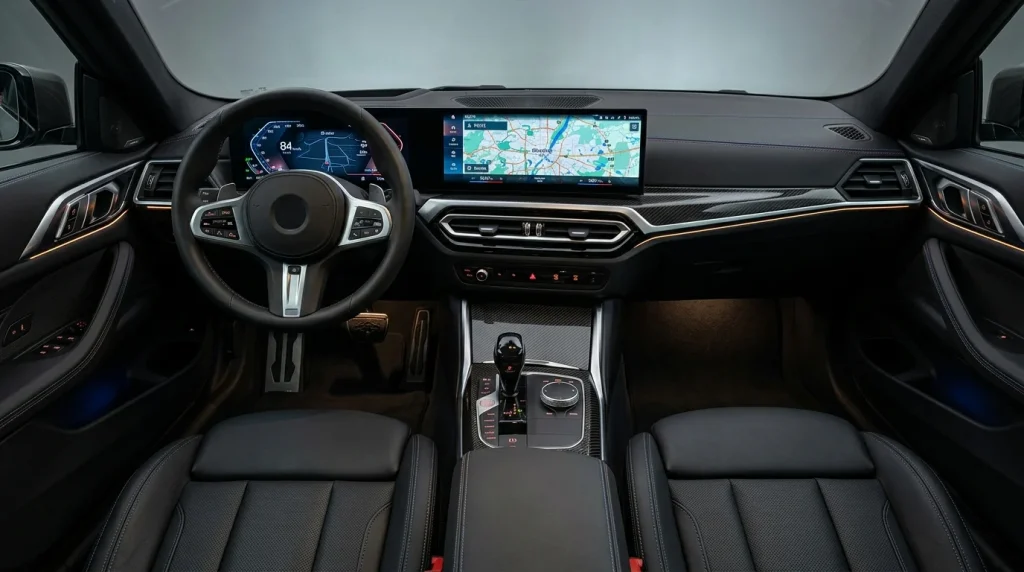
The cabin of the 2026 BMW 4 Series blends modern digitalization with premium assembly quality, carrying forward the updates introduced in the 2025 BMW 4 Series. The dashboard is dominated by the prominent Curved Display, which houses the digital instruments and infotainment controls under a single glass surface.
Cabin Materials and Seating
Standard models feature high-quality Sensatec synthetic leather upholstery, which is durable and easy to maintain. Vernasca genuine leather is available as an individual option or as part of premium packages. The front row comes standard with power-adjustable sport seats that offer strong side bolsters to keep passengers secure during cornering.
Seating capacity differs by body configuration:
- Coupe and Convertible: Seating is strictly limited to four passengers, with a rear console separating the two individual rear seats. Rear legroom is tight at 34.5 inches, making it best suited for children or short trips.
- Gran Coupe: This version features a traditional three-passenger rear bench seat, bringing total capacity to five. Rear legroom is slightly improved at 34.9 inches, though the center passenger must negotiate a large driveshaft hump in the floor.
Curved Display and Digital Cockpit
The Curved Display combines a 12.3-inch driver instrument cluster and a 14.9-inch central touchscreen. This setup is angled toward the driver to create an ergonomic command center. Standard tech features include wireless Apple CarPlay, wireless Android Auto, and a cloud-based navigation system. The physical button count is minimal, as BMW has integrated the climate controls into the lower edge of the touchscreen. The system also supports voice commands via the BMW Intelligent Personal Assistant, which responds to natural speech prompts.
Cargo Volume and Practicality
Practicality is highly dependent on the chosen body style:
- Coupe: The trunk offers 12.0 cubic feet of cargo capacity. The space is deep and flat, and standard 40-20-40 split-folding rear seats allow owners to carry longer items.
- Convertible: Cargo volume is 10.6 cubic feet when the soft top is up. Lowering the roof into the trunk reduces the available space to 8.8 cubic feet.
- Gran Coupe: The hatchback design provides 16.6 cubic feet of space behind the rear seats. Folding the rear seats flat expands the cargo capacity to 45.6 cubic feet, offering utility comparable to a small crossover.
Styling, Exterior Options, and M Sport Packages
The exterior design of the 2026 4 Series maintains its low-slung, athletic proportions. The visual signature remains the upright kidney grille, which is flanked by slim LED headlights featuring vertical daytime running light elements.
Exterior Styling and Customization
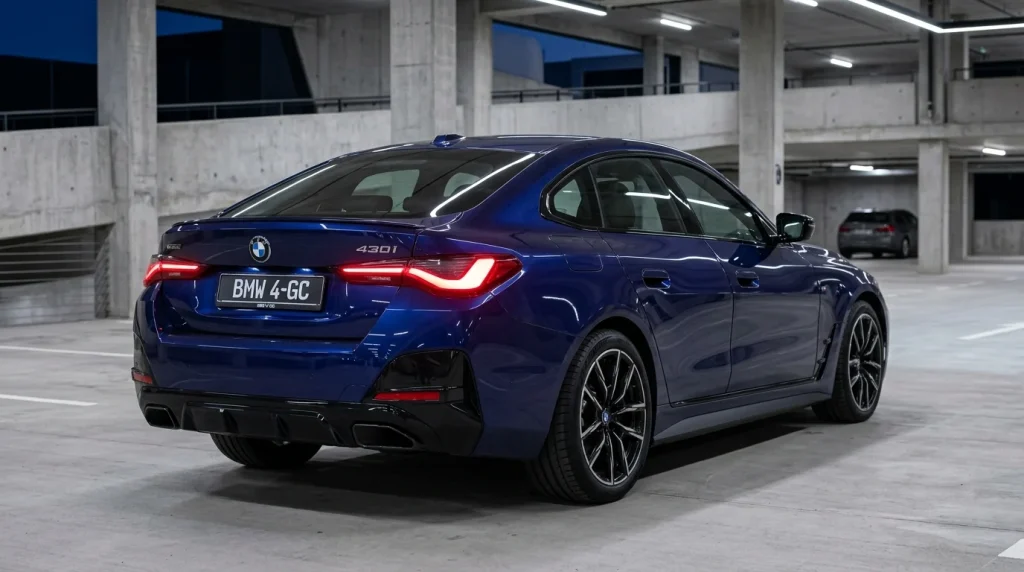
BMW offers a wide array of metallic and non-metallic paint finishes, including premium Individual colors like Dravit Grey Metallic and Tanzanite Blue II Metallic. Laserlight tail lights are standard on the M440i and optional on the 430i, utilizing illuminated glass fibers to create a distinctive three-dimensional light signature. The standard wheel size is 18 inches, with multiple 19-inch bi-color and black alloy wheels available as upgrades.
M Sport Package vs. M Sport Package Pro
For the base 430i, the M Sport Package ($2,450) is a popular option that upgrades the car’s visual and driving dynamics. It includes an aerodynamic body kit, shadowline exterior trim, a firmer M Sport suspension, and variable sport steering.
The M Sport Package Pro ($2,900) builds upon this by adding an M Sport differential, M Sport brakes with red or blue calipers, a rear spoiler, and extended shadowline trim that darkens the grille surround. These handling upgrades are standard on the M440i, which is pre-configured with M Performance tuning.
MSRP Pricing, Trim Packages, and Ownership Guide
The pricing structure for the 2026 BMW 4 Series reflects its premium positioning. Below is the official MSRP breakdown for all U.S. models, detailing the base MSRP alongside pricing that includes the destination and handling fee.
BMW’s destination and handling charge is $1,350 for the 2026 model year, representing a small increase over the previous $1,175 fee. All pricing table columns show both figures for comparison.
| Model / Configuration | Base MSRP (excl. dest.) | MSRP with older $1,175 fee | MSRP with current $1,350 fee |
|---|---|---|---|
| 430i Gran Coupe RWD | $51,200 | $52,375 | $52,550 |
| 430i Gran Coupe xDrive | $53,200 | $54,375 | $54,550 |
| 430i Coupe RWD | $53,300 | $54,475 | $54,650 |
| 430i Coupe xDrive | $55,300 | $56,475 | $56,650 |
| 430i Convertible RWD | $61,300 | $62,475 | $62,650 |
| 430i Convertible xDrive | $63,300 | $64,475 | $64,650 |
| M440i Gran Coupe RWD | $65,100 | $66,275 | $66,450 |
| M440i Coupe RWD | $67,100 | $68,275 | $68,450 |
| M440i Gran Coupe xDrive | $67,100 | $68,275 | $68,450 |
| M440i Coupe xDrive | $69,100 | $70,275 | $70,450 |
| M440i Convertible RWD | $75,200 | $76,375 | $76,550 |
| M440i Convertible xDrive | $77,200 | $78,375 | $78,550 |
Option Packages
In addition to the base MSRP, buyers can customize their vehicles with several option packages:
- Premium Package ($2,100 on 430i / $1,500 on M440i): Adds a heated steering wheel, heated front seats, a head-up display, and ambient interior lighting.
- Driving Assistance Professional Package ($1,700): Upgrades safety tech with active lane-keeping assistant, side collision avoidance, and extended traffic jam assistant for hands-free driving under 40 mph.
- Dynamic Handling Package ($1,500): Equips the M Sport brakes, the M Sport differential, and adaptive M suspension dampers.
Cost of Ownership
Ownership costs reflect the premium nature of the vehicle. Routine maintenance is covered for the first 3 years or 36,000 miles under the BMW Ultimate Care program. After this period, annual maintenance costs typically average between $1,200 and $1,800. Insurance rates are higher than average, costing approximately $2,200 annually depending on driver history and location.
Safety Technology and Driver Assistance
BMW equips the 4 Series with a robust suite of active and passive safety features. The vehicle’s structure utilizes high-strength steel reinforcements to protect the cabin in the event of an impact.
Standard Active Driving Assistant Suite
Every 2026 model comes standard with the Active Driving Assistant. This camera and radar-based safety suite includes:
- Forward Collision Warning: Warns the driver and applies the brakes if an imminent collision with a vehicle or pedestrian is detected.
- Lane Departure Warning: Alerts the driver with steering wheel vibrations if the car drifts out of its lane.
- Blind Spot Detection: Monitors adjacent lanes and warns of vehicles in the blind spots.
- Rear Cross-Traffic Alert: Detects approaching cross-traffic when backing out of parking spaces.
Advanced Safety Packages
For high-traffic commuters, the optional Driving Assistance Professional Package is highly recommended. It adds the Extended Traffic Jam Assistant, which allows for hands-free steering support on highway sections at speeds below 40 mph. It also includes Active Cruise Control with Stop and Go, which automatically maintains a set following distance from the vehicle ahead and can bring the car to a complete stop before accelerating again.
BMW 4 Series vs. Competitors: How Does It Stack Up?
The luxury coupe and sportback segment has evolved significantly, leaving the 4 Series to face a restructured list of rivals.
BMW 4 Series Coupe vs. Mercedes-Benz CLE Coupe
The Mercedes-Benz CLE Coupe represents the most direct competitor to the 4 Series Coupe. Mercedes-Benz introduced the CLE to replace both the C-Class and E-Class Coupes, resulting in a vehicle that is slightly longer than the 4 Series.
- Performance: The M440i Coupe RWD (386 hp) holds a performance advantage over the CLE 450 Coupe (375 hp), delivering quicker throttle response and a sharper steering feel.
- Comfort and Cargo: The CLE is larger and offers a slightly softer ride, along with a larger trunk capacity of 14.8 cubic feet compared to the 12.0 cubic feet in the BMW Coupe.
- Pricing: The CLE 300 Coupe starts at a higher base MSRP of approximately $56,400, making the entry-level BMW 430i Coupe ($53,300) a more accessible starting point.
BMW 4 Series Gran Coupe vs. Audi A5 Sportback
Following Audi’s decision to discontinue the A5 Coupe and Cabriolet, the Audi A5 Sportback stands as the primary competitor to the four-door 4 Series Gran Coupe.
- Drivetrain: The A5 Sportback comes standard with quattro all-wheel drive, whereas the 430i Gran Coupe comes standard with RWD, requiring a $2,000 upgrade to match the AWD configuration.
- Technology: The BMW Operating System 8.5 provides faster processing speeds and a more modern user interface than the older infotainment architecture found in the A5 Sportback.
- Utility: Both vehicles feature a practical rear liftback. The BMW Gran Coupe provides 16.6 cubic feet of trunk space, matching the cargo practicality of the Audi A5 Sportback.
Frequently Asked Questions
How reliable is the 2026 BMW 4 Series?
The 2026 model is expected to show above-average reliability. It shares its platform and powertrains with the BMW 3 Series, which has consistently earned high reliability marks from automotive analysts. The vehicle is protected by a 4-year or 50,000-mile warranty.
What is the difference between the BMW 430i and M440i?
The primary difference is the engine: the 430i utilizes a 255-hp four-cylinder engine, while the M440i uses a 386-hp inline-six engine. The M440i also comes standard with M Sport visual styling, performance brakes, sport steering, and an M Sport differential.
Is xDrive all-wheel drive worth the extra cost?
For drivers who live in areas that experience heavy snow or persistent rainfall, the $2,000 xDrive upgrade is highly recommended due to the added launch traction and driving stability it provides. Drivers in warmer climates can stick with the standard rear-wheel-drive setup to save weight and upfront costs.
How does the 4 Series compare to the 3 Series sedan?
Both cars share the same platform and engine options. The 3 Series is a traditional sedan with more rear headroom and a lower starting price. The 4 Series features a wider track, a lower center of gravity, and a sportier exterior style, sacrificing some rear-seat practicality for enhanced visual appeal and sharper handling.

