

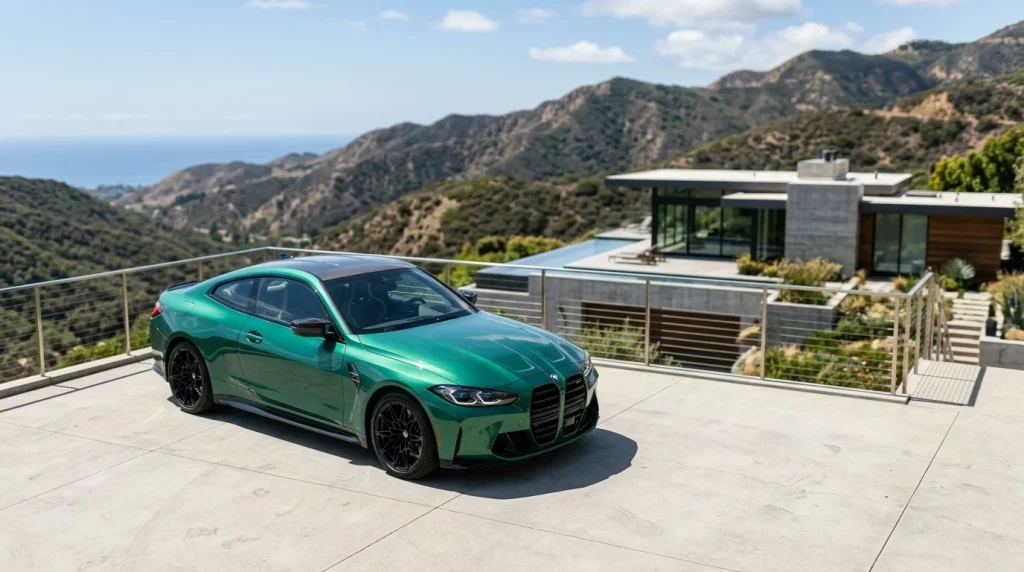
Quick answer: The 2025 BMW M4 is a premium high-performance sports car starting at $80,095 for the base manual coupe and rising to $123,500 for the limited-edition M4 CS. Key updates for the 2025 model year LCI (Life Cycle Impulse) include a 20-horsepower increase for Competition xDrive all-wheel-drive models (bringing total output to 523 horsepower), redesigned arrowhead LED headlights, standard fiber-optic laser taillights, and updated iDrive 8.5 software.
Key takeaways:
- The 2025 BMW M4 Competition xDrive coupe accelerates from 0 to 60 mph in 3.4 seconds, utilizing a rear-biased all-wheel-drive system.
- Base models retain a six-speed manual transmission paired with a 473-horsepower engine, representing a rare offering in the modern performance coupe segment.
- Exterior updates include arrowhead LED headlights, standard M4 CSL-derived laser taillights, and new flat-bottom steering wheel designs.
- Pricing ranges from $80,095 to $96,295 for standard trims, with the track-focused M4 CS priced at $123,500 before destination charges.
What is New for the 2025 BMW M4 LCI?
Answer-first: The 2025 BMW M4 introduces a mid-cycle refresh (LCI) highlighted by a 20-horsepower increase for Competition xDrive models, new Laserlight taillights, and updated interior infotainment.
BMW delivers meaningful updates to the M4 lineup for the 2025 model year, keeping it competitive against traditional rivals. These changes build on the design improvements introduced in the 2024 BMW M4, focusing heavily on performance electronics and lighting signatures.
Key 2025 LCI updates include:
- Powertrain upgrade: The Competition xDrive variants receive a 20-horsepower boost, increasing total output from 503 hp to 523 hp. Rear-wheel-drive Competition models remain at 503 hp.
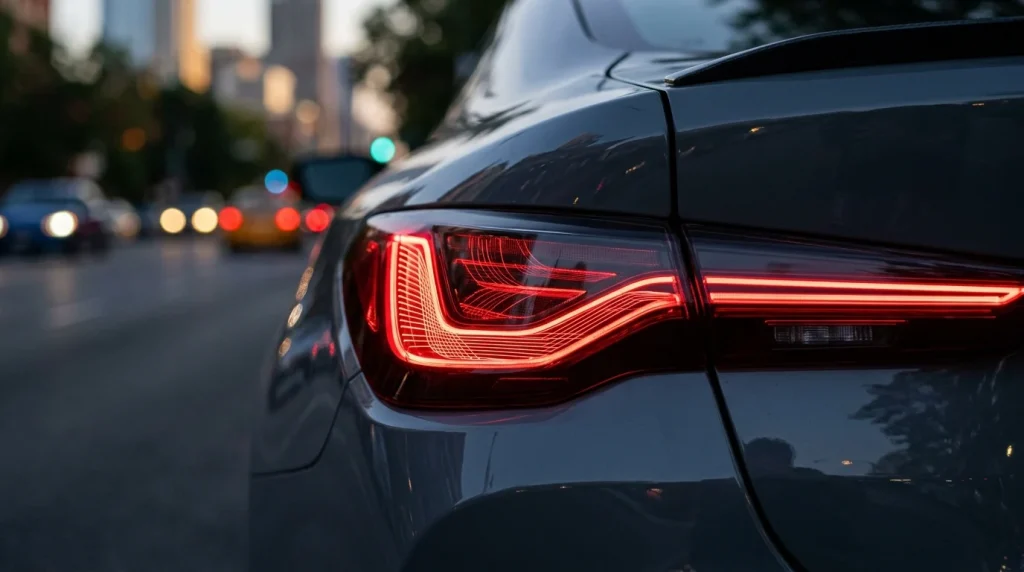
- Exterior lighting: Redesigned LED headlights feature a narrower profile with arrowhead-shaped daytime running lights that also function as turn signals. The rear adopts fiber-optic Laserlight taillights, which use laser diodes to illuminate thin glass fibers in a three-dimensional pattern, a technology inherited from the limited-run M4 CSL.
- Cabin electronics: The infotainment system shifts to BMW Operating System 8.5. Climate controls, heated seats, and steering wheel adjustments are integrated directly into the touchscreen menus, reducing physical buttons.
- Interior refinements: A new three-spoke flat-bottom steering wheel with a red 12 o’clock marker comes standard, wrapped in leather or optional Alcantara.
- Styling and customization: Updated M graphics for the hood and trunk are available in high-gloss black or red. Buyers can also opt for a steel roof with a moonroof finished in gloss black at no additional charge, replacing the standard carbon-fiber roof.
Trim Levels, Pricing, and Configurations
Answer-first: The 2025 BMW M4 is offered in four distinct versions spanning coupe and convertible body styles, with prices starting from $80,095 for the base rear-wheel-drive manual model.
To understand how standard features have evolved over the years, buyers can compare these configurations with the 2023 BMW M4. The 2025 trim lineup is structured as follows:
| Trim Level | Body Style | Drivetrain | Horsepower | Base MSRP |
|---|---|---|---|---|
| M4 Coupe | Coupe | RWD | 473 hp | $80,095 |
| M4 Competition Coupe | Coupe | RWD | 503 hp | $84,195 |
| M4 Competition xDrive Coupe | Coupe | AWD | 523 hp | $89,295 |
| M4 Competition xDrive Convertible | Convertible | AWD | 523 hp | $96,295 |
Note: All prices represent the base manufacturer’s suggested retail price (MSRP) and exclude the mandatory $995 destination and handling charge.
For collectors and track enthusiasts, the limited-run M4 CS sits at the top of the range. Priced at $123,500, the CS coupe delivers 543 horsepower and features a 70-pound weight reduction achieved through carbon-fiber-reinforced plastic components.
Optional equipment packages allow further personalization. The Driving Assistance Professional package costs $1,700 and is restricted to automatic-transmission Competition models. The Executive Package is priced at $3,550 and adds ventilated front seats, a head-up display, and a power trunklid. Performance options include M Carbon Ceramic brakes for $8,500 and M Carbon Bucket front seats for $4,000.
S58 Twin-Turbo Engine and Performance
Answer-first: The 2025 BMW M4 is powered by a twin-turbocharged 3.0-liter inline-six engine (code-named S58) that delivers linear power and revs to a 7,200 rpm redline.
The S58 engine features aluminum block construction, forged internals, a closed-deck design, and a 3D-printed cylinder head core that allows optimal routing of cooling passages. Output varies by configuration:
- Base Coupe: Generates 473 hp at 6,250 rpm and 406 lb-ft of torque between 2,650 and 6,130 rpm. This trim features a six-speed manual transmission driving the rear wheels.
- Competition RWD: Produces 503 hp at 6,250 rpm and 479 lb-ft of torque between 2,750 and 5,500 rpm. It is paired with an eight-speed M Steptronic automatic transmission.
- Competition xDrive: Delivers 523 hp at 6,250 rpm and 479 lb-ft of torque between 2,750 and 5,730 rpm, sending power to all four wheels via the eight-speed automatic.
- M4 CS: Raises output to 543 hp at 6,250 rpm and 479 lb-ft of torque from 2,750 to 5,950 rpm, utilizing standard xDrive and the automatic transmission.
Acceleration is exceptionally quick. The base manual coupe completes the 0-60 mph sprint in 4.1 seconds. Escalating to the Competition RWD drops the time to 3.8 seconds, while the Competition xDrive coupe achieves 3.4 seconds (3.6 seconds for the convertible). The limited M4 CS achieves 0-60 mph in 3.2 seconds under official testing, though real-world independent testing has registered times as low as 2.7 seconds.
Drivetrain behavior differs significantly between models. The base M4 appeals to traditionalists with its six-speed manual, which includes switchable automatic rev-matching. However, reviewers note that the manual shifter’s throw feels slightly rubbery compared to older manual gearboxes. The eight-speed M Steptronic automatic features launch control and adjustable shift speed profiles (Drivelogic). The xDrive all-wheel-drive system operates with a strong rear bias, directing torque to the front wheels only when rear slip is detected. Drivers can select 4WD, 4WD Sport (which increases rear bias), or 2WD mode, which disables the front axle entirely and shuts off stability control.
Handling, Ride Quality, and Drive Customization
Answer-first: The 2025 BMW M4 handles with high lateral grip and sharp front-end bite, though its electronic steering filters out road textures.
Chassis rigidity is reinforced by model-specific underbody bracing, a strut tower brace in the engine bay, and a standard carbon-fiber roof panel that lowers the center of gravity. Damping is managed by standard adaptive M suspension with electronically controlled valves that adjust compression and rebound at each wheel.
Steering precision is high, featuring a variable-ratio steering rack. The front end turns in immediately, but the electronic power steering provides minimal physical communication. While the car places its wheels exactly where intended, tactile road feedback through the steering rim is noticeably absent.
Braking systems are robust. Standard M compound brakes feature six-piston fixed front calipers clamping 15.6-inch ventilated rotors, paired with single-piston floating rear calipers and 15.0-inch rotors. The optional M carbon-ceramic brake package ($8,500) reduces unsprung weight by 41 pounds and eliminates brake fade under heavy track use, though replacement costs are significantly higher.
Configurability is extensive. Using the iDrive menu, drivers can customize engine response (Efficient, Sport, Sport Plus), chassis damping (Comfort, Sport, Sport Plus), steering weight (Comfort, Sport), and brake pedal feel (Comfort, Sport). These settings can be mapped to the red M1 and M2 buttons on the steering wheel for instant selection.
Daily ride quality is firm. In Comfort mode, the adaptive dampers absorb minor road imperfections, but sharp bumps and expansion joints transmit directly into the cabin. This harshness is exacerbated by the optional 19-inch front and 20-inch rear forged wheels. Commuters on poorly maintained urban roads may find the ride tiring over long distances, whereas highway cruising is composed.
Analysis: The G82 chassis prioritizes absolute track capability and cornering limits over analogue feedback. The result is a highly digital driving experience that is fast and secure but slightly insulated.
Interior Technology and Cabin Comfort
Answer-first: The 2025 BMW M4 cabin features a dual-screen BMW Curved Display running Operating System 8.5, paired with premium materials and supportive sport seats.
The dashboard layout is dominated by the Curved Display, which houses a 12.3-inch digital instrument cluster and a 14.9-inch touchscreen under a single piece of glass. The screen is angled slightly toward the driver. The transition to Operating System 8.5 introduces QuickSelect, a feature that overlays shortcuts on the map view to simplify access to frequently used menus. However, integrating the climate controls into the screen menus makes adjusting the temperature or seat heaters while driving more distracting than using physical buttons.
Standard front M Sport seats are upholstered in Merino leather and feature power adjustment, memory functions, and heavy side bolsters. They provide excellent support for spirited driving while remaining comfortable for daily use. The optional M Carbon Bucket seats ($4,000) save 21 pounds and feature aggressive thigh and torso bolsters alongside a cutout for multi-point harnesses. However, their high, rigid bolsters make entering and exiting the vehicle difficult, and the central seat divider can be uncomfortable on longer trips.
Merino leather is standard, with two-tone combinations such as Kyalami Orange and Black, Yas Marina Blue and Black, or Fiona Red and Black available at no extra charge. The dashboard is trimmed in standard dark graphite matte, with carbon fiber or polished aluminum trim optional.
Practicality is limited by the two-door coupe layout. The rear seats are heavily contoured and provide 33.1 inches of legroom, which is restrictive for adults. Climbing into the back requires waiting for the power front seats to slide forward. Trunk space is 12 cubic feet in the coupe, which is sufficient for two golf bags. The convertible trunk capacity drops to 7.5 cubic feet when the multi-layer fabric soft top is retracted, down from 11 cubic feet with the top raised.
Safety, Driver Assistance, and Reliability
Answer-first: The 2025 BMW M4 comes standard with active safety driver aids, while advanced semi-autonomous features are available through the Driving Assistance Professional package.
Standard active safety features include the BMW Active Driving Assistant suite:
- Forward collision warning with city collision mitigation.
- Active blind-spot detection.
- Lane-departure warning with active lane correction.
- Rear cross-traffic alert.
- Speed limit information.
For buyers seeking semi-autonomous driving, the optional $1,700 Driving Assistance Professional package adds Active Driving Assistant Pro. This system includes adaptive cruise control with stop-and-go functionality, lane-centering assist, and Extended Traffic Jam Assistant, which allows hands-free driving on designated highways at speeds under 37 mph.
Reliability data from Consumer Reports suggests average reliability for the 4 Series platform. Brand-wide data from RepairPal ranks BMW 30th out of 32 manufacturers, reflecting the higher maintenance costs associated with premium German vehicles. Common issues reported on S58-equipped models include turbocharger wastegate rattle and occasional PCV valve failures. Warranty coverage includes:
- Limited warranty: 4 years or 50,000 miles.
- Powertrain warranty: 4 years or 50,000 miles.
- Complimentary maintenance: 3 years or 36,000 miles (covering oil changes, brake fluid flushes, and vehicle inspections).
How the 2025 BMW M4 Compares to Key Competitors
Answer-first: The 2025 BMW M4 Competition xDrive stands as a tech-forward high-performance coupe, offering distinct advantages in weight and drivetrain layout over hybrid rivals.
The sports coupe segment includes several key alternatives. Buyers looking at other high-performance models in the brand’s portfolio can also visit the BMW M4 Category Hub for context.
- Mercedes-AMG C63 S E Performance: The Mercedes adopts a plug-in hybrid powertrain pairing a 2.0-liter turbocharged four-cylinder engine with an electric motor to produce 671 hp and 752 lb-ft of torque. However, the hybrid hardware increases curb weight to 4,649 pounds, which is over 650 pounds heavier than the M4 Competition xDrive coupe (3,990 pounds). The M4 delivers more agile handling and a more organic exhaust note from its inline-six.
- Cadillac CT4-V Blackwing: Cadillac’s rear-wheel-drive sedan starts under $63,000 and is powered by a 472-hp twin-turbo V6. It features magnetic ride control shocks that provide a better ride-and-handling balance than the M4, along with superior steering feedback. The M4 countered with higher-quality interior materials and more advanced cabin technology.
- Audi RS5 Coupe: The RS5 is powered by a 444-hp twin-turbo V6 and standard Quattro all-wheel drive. It offers a more compliant ride and classic exterior styling, but it lacks the performance focus, track-readiness, and absolute speed of the M4 xDrive LCI.
- BMW M3: The M3 sedan shares the M4’s S58 engine, suspension, and price structure. The main difference lies in practicality. The M3’s four-door layout makes accessing the rear seats easy, serving as a much better option for buyers who regularly transport passengers.
- Future Outlook: The mid-cycle LCI changes update the M4 line for the near term, bridging the gap to future iterations like the 2026 BMW M4.
Is the 2025 BMW M4 Worth It?
Answer-first: The 2025 BMW M4 is worth its price for enthusiasts seeking a track-capable daily driver with luxury amenities, but buyers prioritizing ride comfort or visceral steering feedback may find it compromised.
Selecting the optimal trim depends on driving preferences:
- Base Manual: Recommended for buyers seeking pure driving involvement via a traditional manual gearbox, representing a rare offering in this price class.
- Competition xDrive: Represents the sweet spot for most buyers. The all-wheel-drive traction ensures year-round usability, and the 20-horsepower LCI update provides maximum performance.
- M4 CS: Recommended for collectors and track regulars who prioritize lap times and weight reduction over daily ride comfort.
Analysis: The 2025 BMW M4 earns its strong position in the performance market by providing outstanding straight-line speed, premium cabin technology, and all-weather confidence. If you do not need the rear seats frequently and prefer aggressive coupe styling, the M4 Competition xDrive coupe stands out. However, if daily passenger utility is a factor, the mechanically identical M3 sedan remains the more practical recommendation.
Note: Factory orders with custom BMW Individual paint options can add 12 to 16 weeks to the vehicle production timeline, which buyers should account for during planning.
Frequently Asked Questions About the 2025 BMW M4
How much does the 2025 BMW M4 cost?
The 2025 BMW M4 starts at $80,095 for the base manual coupe. The Competition RWD is priced at $84,195, while the Competition xDrive starts at $89,295 for the coupe and $96,295 for the convertible. The limited-run M4 CS coupe is priced at $123,500. A destination charge of $995 is added to all models.
What is new on the 2025 BMW M4?
The 2025 LCI update adds 20 horsepower to the Competition xDrive models, bringing total output to 523 hp. Aesthetic updates include arrowhead LED headlights, standard fiber-optic Laserlight taillights, a flat-bottom steering wheel, and the transition to iDrive 8.5 software.
Can you get a manual transmission in the 2025 M4?
Yes, a six-speed manual transmission is standard equipment on the base rear-wheel-drive M4 Coupe. Competition models and the M4 CS are sold exclusively with the eight-speed M Steptronic automatic transmission.
What is the 0-60 mph time for the 2025 BMW M4 Competition xDrive?
BMW claims a 0-60 mph acceleration time of 3.4 seconds for the 2025 BMW M4 Competition xDrive coupe and 3.6 seconds for the convertible, although independent testers have recorded quicker runs.
Is the BMW M4 Competition worth the extra money?
Yes, for automatic transmission buyers. The $4,100 price premium over the base model adds 30 horsepower (increasing output from 473 hp to 503 hp), the eight-speed automatic transmission, forged wheels, and model-specific chassis calibrations.
How does the M4 compare to the M3 for daily driving?
Both models share identical powertrains, acceleration, and suspension tuning. The M3 sedan is a better daily driver because its four-door body style provides easy entry to the rear seat and more practical passenger space.

