

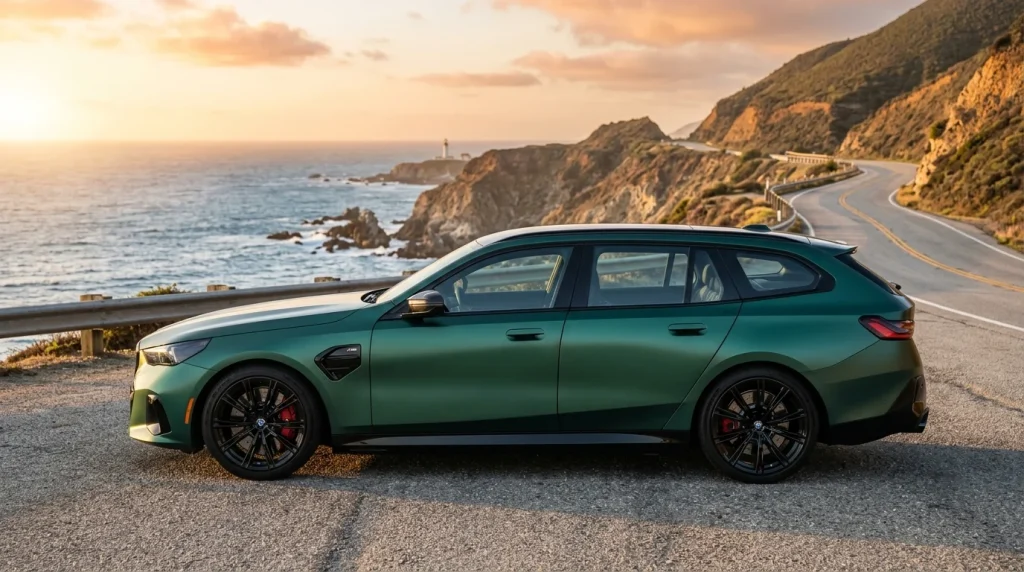
Quick answer: The 2026 BMW M5 Touring is a historic release, marking the first M5 wagon ever sold in the United States. Delivering 717 horsepower and 738 pound-feet of torque from its plug-in hybrid V8 powertrain, it accelerates from 0 to 60 mph in 3.1 seconds. Starting at $129,350 with a $1,350 destination fee, this high-performance wagon offers up to 67 cubic feet of cargo space, combining supercar speed with everyday family utility.
Key takeaways:
- The 2026 BMW M5 Touring features a hybrid powertrain combining a twin-turbo V8 with an electric motor for 717 combined horsepower.
- Car and Driver track testing recorded a 3.1-second 0-60 mph sprint and an 11.0-second quarter-mile time.
- Starting MSRP is $129,350 plus a $1,350 destination charge, undercutting the Audi RS6 Avant Performance.
- The 18.6-kWh gross battery pack delivers an EPA-rated 25 miles of electric range (29 miles in real-world testing).
- Real-world 75-mph highway testing yielded 26 mpg, significantly exceeding its 17 mpg EPA highway rating.
- Cargo capacity measures 27 cubic feet behind the rear seats, expanding to 67 cubic feet with the seats folded.
A Historic Arrival in the United States
The arrival of the 2026 BMW M5 Touring (codenamed G99) represents a major milestone for North American car enthusiasts. While BMW has produced M5 wagon variants in the past, including the E34 generation in the early 1990s and the V10-powered E61 generation in the mid-2000s, these models were European exclusives. This marks the first time that U.S. drivers can officially purchase a factory-spec M5 Touring.
This release comes at a time of renewed interest in high-performance wagons. Audi has enjoyed success with its RS6 Avant, and the smaller BMW M3 Touring has sold well in international markets. By bringing the G99 wagon to North America, BMW is directly entering a niche segment that values extreme track performance combined with the utility of a traditional estate car. The wagon is built on the same architecture as the G90 M5 sedan, sharing its hybrid engine, chassis tuning, and digital interior design.
For details on the previous model year, readers can view the 2025 BMW M5 Touring review. To browse related models, explore the complete M5 Touring category page.
Powertrain and M Hybrid System Details
The core of the M5 Touring is its M Hybrid powertrain, which pairs a traditional internal combustion engine with an electric drive system. The internal combustion element is a twin-turbocharged 4.4-liter V8 engine producing 577 horsepower and 553 pound-feet of torque. Integrated into the eight-speed automatic transmission is a permanently excited synchronous AC electric motor that contributes up to 194 horsepower and 207 pound-feet of torque.
Combined, this hybrid system produces a peak output of 717 horsepower and 738 pound-feet of torque. This makes the G99 the most powerful standard wagon in BMW history. Power is routed through the rear-biased M xDrive all-wheel-drive system. For drivers seeking classic rear-wheel-drive behavior, the system features a switchable 2WD mode that routes 100 percent of the torque to the rear axle once dynamic stability control is disabled.
Battery Capacity and Charging Speeds
The electrical side of the powertrain relies on a lithium-ion battery pack mounted low in the chassis. According to BMW USA, the battery pack has a gross capacity of 18.6 kWh, with 14.8 kWh of usable energy.
For the 2026 model year, BMW upgraded the vehicle’s onboard AC charger. The charger now supports speeds up to 11 kW, which is an increase from the 7.4 kW capacity found on earlier plug-in hybrid models. This upgrade reduces the time required to charge the battery from empty to full to roughly two hours when connected to a compatible Level 2 charger. The plug-in hybrid system offers five operating modes, including a pure Electric mode that allows for silent, zero-emission urban driving.
Instrumented Performance and Track Testing
Despite its large dimensions and hybrid hardware, the M5 Touring delivers performance figures that rival dedicated sports cars. In track tests conducted by Car and Driver, the wagon recorded a 0-60 mph acceleration time of 3.1 seconds, matching the acceleration of the M5 sedan.
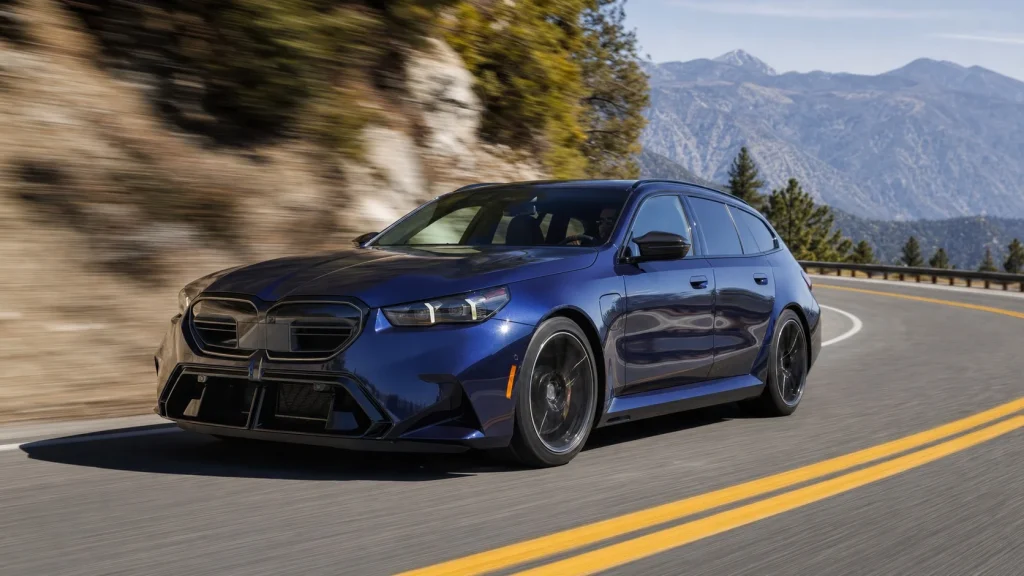
The quarter-mile sprint was completed in 11.0 seconds at a trap speed of 129 mph. The vehicle reached 100 mph in 6.9 seconds and 150 mph in 15.6 seconds. The rolling 5-60 mph start was clocked at 3.4 seconds, demonstrating the immediate torque response provided by the integrated electric motor.
Handling and Weight Management
The primary challenge for the M5 Touring is its weight. The vehicle registers a curb weight of 5,481 pounds, making it one of the heaviest performance passenger vehicles on the market. This weight is a result of the combined V8 engine, electric motor, battery pack, and all-wheel-drive components.
However, the wagon managed to record 0.92 g of lateral grip on a 300-foot skidpad, showing high cornering stability. Stopping distance from 70 mph to 0 was measured at 154 feet, and the 100-0 mph stop took 313 feet. These stopping distances are aided by optional carbon-ceramic brakes costing $18,500, which resist brake fade under high temperatures. Active rear-wheel steering, which turns the rear wheels up to 1.5 degrees, helps the wagon maneuver at low speeds and remain stable during high-speed lane changes.
Real-World Range and Fuel Economy
The EPA rates the 2026 BMW M5 Touring at 11 mpg city, 17 mpg highway, and 13 mpg combined when running on gasoline alone. When utilizing both gas and electricity, it achieves an EPA rating of 54 MPGe. The official EPA-rated electric-only range is 25 miles on a full charge.
In real-world testing, the vehicle performed differently than the EPA estimates. During a 75-mph highway test conducted by Car and Driver, the M5 Touring achieved 26 mpg in hybrid mode, which is 9 mpg higher than its EPA highway rating. Additionally, the vehicle covered 29 miles on pure electric power during the highway test, exceeding the EPA range rating by 4 miles. This real-world range allows owners to complete typical daily commutes without consuming any gasoline.
Interior Design and Cargo Utility
Inside, the M5 Touring shares its layout with the standard 5 Series but adds M-specific trim and seating. The dashboard features the BMW Curved Display, which combines a 12.3-inch digital instrument cluster and a 14.9-inch infotainment screen. The system runs on BMW iDrive 8.5 software, supporting wireless Apple CarPlay and Android Auto.
The seats are multi-function M sport seats upholstered in Merino leather. Buyers can opt for several premium color combinations, including Taupe and Deep Lagoon Merino or Violet and Black Merino. Standard features include a Bowers and Wilkins surround sound system, a panoramic Sky Lounge glass roof, and four-zone automatic climate control.
Cargo Space: Touring vs. Sedan
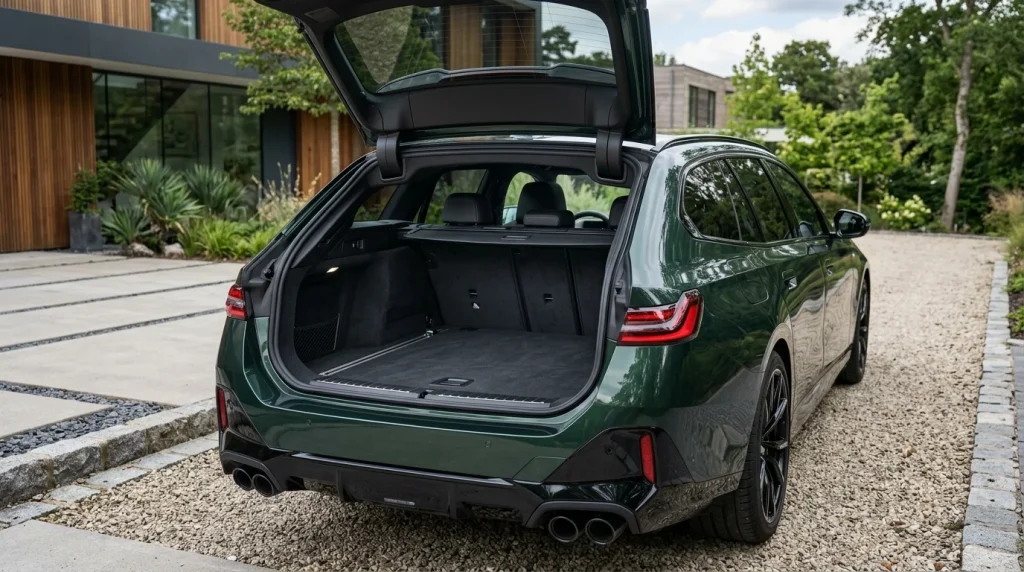
The primary reason to choose the Touring model over the sedan is the rear cargo compartment. The wagon provides 27 cubic feet of storage space behind the second row of seats. When the 40-20-40 split-folding rear seats are folded down, the total cargo capacity expands to 67 cubic feet.
This cargo area is flat and easily accessible thanks to a low liftover height and a standard power tailgate. In comparison, the M5 sedan offers only 14.3 cubic feet of trunk space, which cannot accommodate bulkier items like bicycles or large pet crates.
Original Value Insight: Weight and Track Performance
To fully understand the performance of the M5 Touring, it must be evaluated on a racetrack where its heavy curb weight meets its 717-horsepower output. During Car and Driver’s Lightning Lap testing at Virginia International Raceway, the M5 Touring completed a lap in 2:55.0.
Analysis: This lap time is significant because it makes the M5 Touring the fastest station wagon ever tested at the Lightning Lap event, beating the Audi RS6 Avant Performance by 0.8 seconds. Even though the BMW weighs nearly 5,500 pounds, its instant electric torque, active anti-roll bars, and rear-wheel steering allow it to manage its mass through tight corners. The extra weight does not slow it down on a track compared to lighter rivals, though it does accelerate tire and brake wear during extended track sessions.
2026 BMW M5 Touring vs. Audi RS6 Avant Performance
The Audi RS6 Avant Performance is the only direct rival to the M5 Touring in the U.S. market. The table below compares their primary specifications.
| Specification | 2026 BMW M5 Touring | 2026 Audi RS6 Avant Performance |
|---|---|---|
| Engine Powertrain | Plug-In Hybrid 4.4L V8 | Mild-Hybrid 4.0L V8 |
| Combined Horsepower | 717 hp | 621 hp |
| Combined Torque | 738 lb-ft | 627 lb-ft |
| 0-60 mph (Tested) | 3.1 seconds | 3.3 seconds |
| Quarter-Mile (Tested) | 11.0 sec @ 129 mph | 11.4 sec @ 121 mph |
| Curb Weight | 5,481 lbs | 4,850 lbs |
| Base MSRP | $129,350 | $130,700 |
| Destination Fee | $1,350 | $1,095 |
| EPA Electric Range | 25 miles | None |
| Cargo Capacity (Max) | 67 cu ft | 59 cu ft |
The M5 Touring offers a power advantage, delivering 96 more horsepower and 111 more pound-feet of torque than the RS6 Avant Performance. This power difference shows in track testing, where the BMW is two-tenths quicker to 60 mph and four-tenths quicker in the quarter-mile. The BMW also offers plug-in capability with a 25-mile electric range, whereas the Audi uses a mild-hybrid setup that cannot drive on electric power alone.
However, the Audi is significantly lighter, weighing 631 pounds less than the BMW. This lower weight gives the RS6 Avant a more agile steering response on winding roads. The Audi starts at $130,700 according to the Audi USA official configurator, which is slightly more expensive than the BMW’s $129,350 base price.
Buying Verdict: Who is the G99 wagon for?
The M5 Touring is designed for buyers who need the space of an SUV but want the driving dynamics of a high-performance sport sedan. Its ability to complete short trips using only electric power makes it practical for daily commutes, while its V8 engine provides high speed for highway driving.
Pros and Cons of the 2026 Wagon
Pros:
- Outstanding performance with a 3.1-second 0-60 mph time.
- Spacious cargo bay offering up to 67 cubic feet of room.
- Electric-only driving range of 25 to 29 miles.
- Cheaper base MSRP than the Audi RS6 Avant.
- Fast 11-kW charging speed for 2026.
Cons:
- Extremely high curb weight of 5,481 pounds.
- Steering feel is light and lacks road feedback.
- Complex system of driving modes and menu setups.
- Expensive optional packages, including $18,500 carbon-ceramic brakes.
Frequently Asked Questions About the 2026 BMW M5 Touring
How much does the 2026 BMW M5 Touring cost?
The 2026 BMW M5 Touring has a starting MSRP of $129,350, plus a destination charge of $1,350, bringing the base price to $130,700. Optional equipment can raise the price significantly. The Executive Package costs $3,200, which adds ventilated front seats, heated rear seats, and the illuminated Iconic Glow grille. Carbon-ceramic brakes cost $18,500, and the M Driver’s Package costs $2,500.
How fast is the 2026 BMW M5 Touring?
The M5 Touring accelerates from 0 to 60 mph in 3.1 seconds and completes the quarter-mile in 11.0 seconds at 129 mph. The top speed is electronically limited to 155 mph from the factory. If buyers opt for the M Driver’s Package, the top speed limit is raised to 190 mph.
Is the BMW M5 Touring faster than the Audi RS6 Avant Performance?
Yes, the BMW M5 Touring is faster in straight-line acceleration and on the racetrack. In instrumented testing, the M5 Touring reached 60 mph in 3.1 seconds, compared to 3.3 seconds for the RS6 Avant Performance. During Lightning Lap testing, the BMW completed a lap in 2:55.0, which was 0.8 seconds faster than the Audi’s lap time of 2:55.8.
What is the cargo space in the 2026 BMW M5 Touring?
The M5 Touring offers 27 cubic feet of cargo space behind the rear seats. When the rear seats are folded down, the cargo space increases to 67 cubic feet. This is larger than the cargo capacity of the Audi RS6 Avant, which offers 59 cubic feet with its rear seats folded.
Does the 2026 BMW M5 Touring come in rear-wheel drive?
The M5 Touring comes standard with M xDrive all-wheel drive. However, the system includes a selectable 2WD mode. When selected, this mode sends all engine power to the rear wheels and turns off the stability control system, allowing for traditional rear-wheel-drive handling characteristics.

