

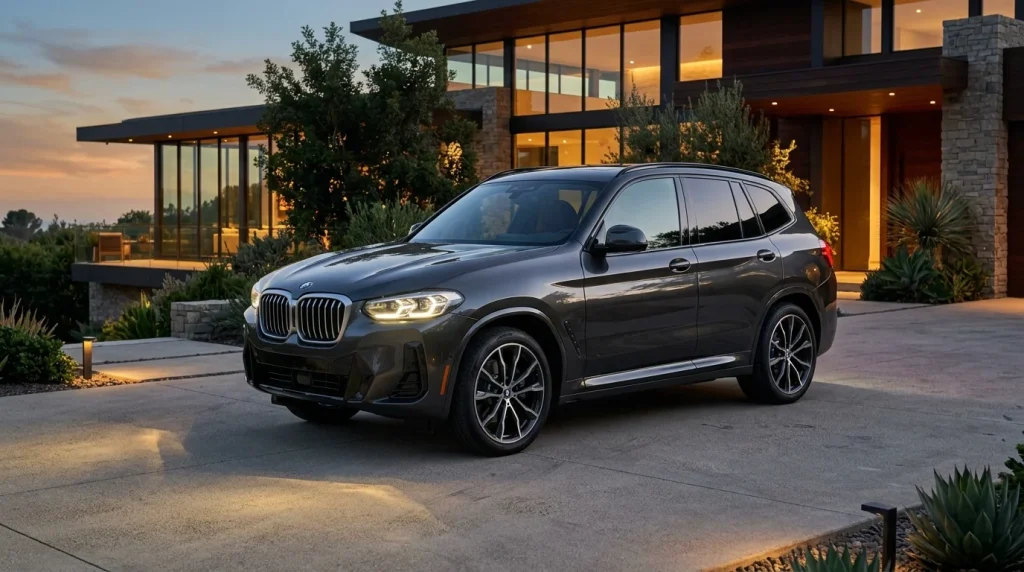
Quick answer: The 2026 BMW X3 represents a carryover model year following the significant fourth-generation G45 redesign. Pricing starts at $52,650 for the four-cylinder X3 30 xDrive and $67,850 for the six-cylinder X3 M50 xDrive, with both figures including the destination charge. The compact SUV offers a spacious interior, refined handling, and competitive fuel efficiency, though it suffers from cheaper cabin materials and less intuitive digital climate controls.
Key takeaways:
- Carryover Model: The 2026 model year introduces only minor updates, including an available tire sealant kit and YouTube integration, after the 2025 redesign.
- Updated Pricing: Base MSRP rises to $52,650 for the 30 xDrive and $67,850 for the M50, including a $1,350 destination fee.
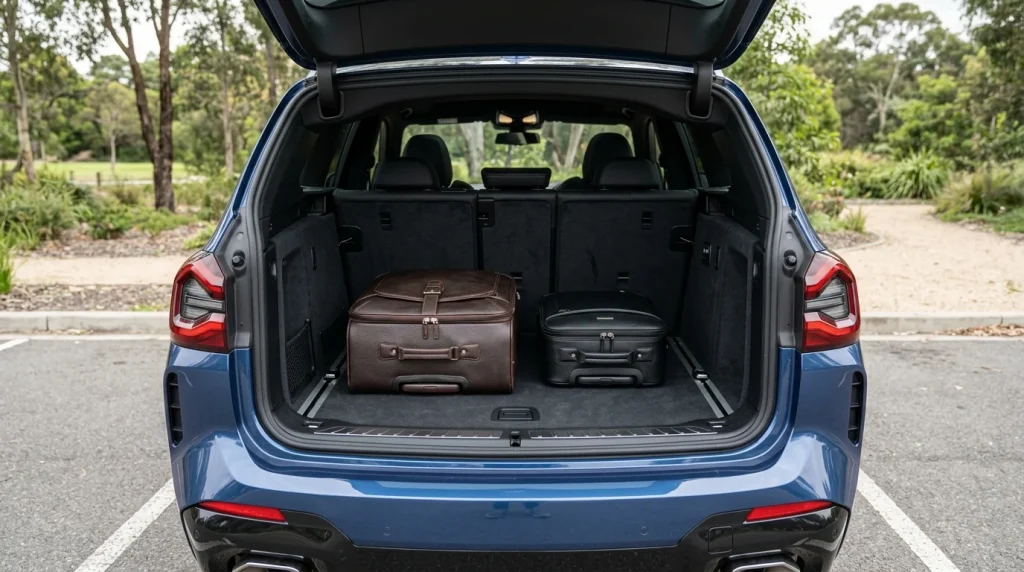
- Cargo and Practicality: Cargo volume measures 31.5 cubic feet behind the second row and expands to 67.1 cubic feet with seats folded.
- Powertrain Specs: Powertrain options include a 255-horsepower four-cylinder and a 393-horsepower inline-six, both utilizing 48-volt mild-hybrid technology.
- Safety and Tech Upgrades: Advanced driver assistance systems such as adaptive cruise control and a surround-view camera remain optional on the base model.
Why This Review Matters
The compact luxury crossover segment demands excellence across everyday usability, performance, safety, and prestige. In this highly competitive market, the BMW X3 serves as the brand’s best-selling vehicle in the United States, yet it faces formidable competition. Buyers frequently cross-shop it with the Mercedes-Benz GLC starting at $50,700, the Genesis GV70 starting at $50,480, the Audi Q5 starting at $52,000, and the Volvo XC60 starting at $50,995.
According to rankings from automotive publications, the X3 ranks fourth among the best compact luxury SUVs, trailing the Porsche Macan, Genesis GV70, and Mercedes GLC. Understanding where this German crossover excels and where its cabin compromises lie helps narrow down a purchasing decision.
Specifications Overview
Choosing between the two primary trims available for the 2026 model year depends on your budget and performance priorities. The table below outlines the core mechanical, pricing, and dimensional specifications.
| Category | X3 30 xDrive | X3 M50 xDrive |
|---|---|---|
| Engine Type | 2.0L Turbocharged 4-Cylinder | 3.0L Turbocharged Inline-6 |
| Hybrid System | 48-Volt Mild Hybrid | 48-Volt Mild Hybrid |
| Horsepower | 255 hp @ 6,500 rpm | 393 hp @ 5,200 rpm |
| Torque | 295 lb-ft @ 1,600 rpm | 428 lb-ft @ 5,200 rpm |
| Transmission | 8-Speed Automatic | 8-Speed Automatic |
| 0-60 mph Acceleration | 6.0 seconds (6.2s tested) | 4.4 seconds (4.0s tested) |
| Drivetrain | All-Wheel Drive (AWD) | All-Wheel Drive (AWD) |
| EPA Fuel Economy (City/Hwy/Comb) | 27 / 33 / 29 mpg | 25 / 30 / 27 mpg |
| Starting MSRP (incl. destination) | $52,650 | $67,850 |
| Maximum Towing Capacity | 4,000 lbs | 4,850 lbs |
| Cargo Volume (Seats Up / Folded) | 31.5 / 67.1 cu ft | 31.5 / 67.1 cu ft |
Both trims come standard with all-wheel drive, indicating BMW has eliminated the rear-wheel-drive sDrive option for the North American market. The M50’s towing capacity of 4,850 pounds ranks among the highest in the compact luxury SUV class.
Design and Practicality
The fourth-generation G45 body style represents a significant stylistic departure from previous models, such as the 2023 BMW X3 and 2024 BMW X3. It features angular body creases, flush-fitting door handles, and a large grille that has divided opinions among traditional enthusiasts. Visibility remains excellent due to thin roof pillars and a low beltline, while the optional surround-view camera system provides added confidence in narrow parking stalls.
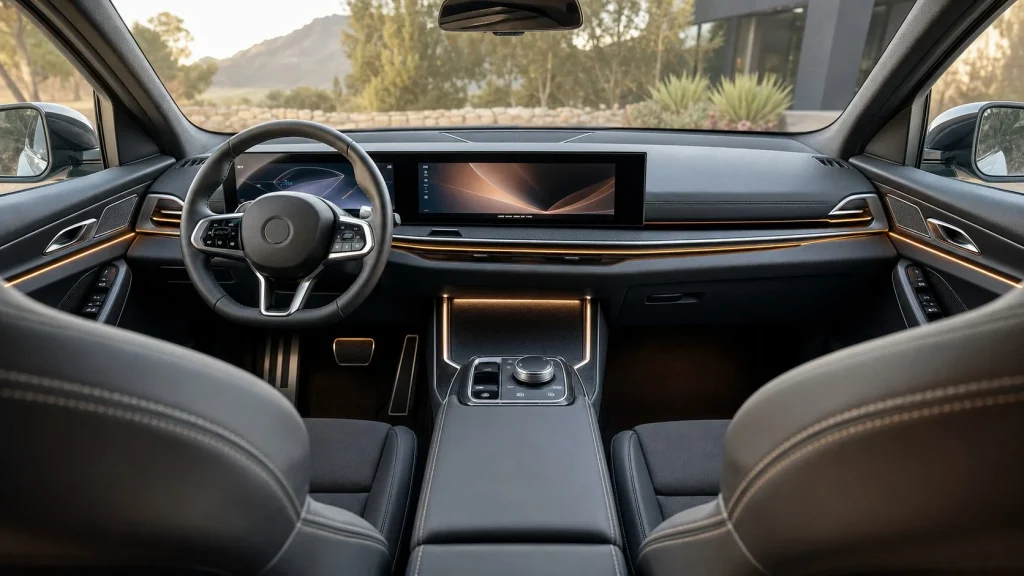
Step inside, and you are greeted by a modern cabin design. Standard equipment includes heated, power-adjustable sport seats with synthetic leather upholstery available in three color schemes. Genuine leather upholstery remains optional. BMW also offers a woven fabric dashboard trim made from recycled polyester, marking the first time this material has appeared in a production BMW vehicle.
However, the interior materials face criticism. Testing from Edmunds notes that interior plastics lower in the cabin are not as luxurious as they should be for a vehicle in this price class. The door panel plastics and lower dash area lack the soft-touch surfaces found in the Genesis GV70.
On the utility front, cargo volume measures 31.5 cubic feet behind the second row, which represents a 10 percent improvement over the older generation. Folding the rear seats opens up 67.1 cubic feet of total volume. Real-world cargo tests demonstrate that the trunk accommodates 8 carry-on suitcases with the rear seats up and up to 24 suitcases with the seats folded. Rear-seat passengers enjoy dedicated air vents, but they lack independent fan speed and temperature controls unless you purchase the optional tri-zone climate package.
Performance and Efficiency
The base 30 xDrive features a turbocharged 2.0-liter four-cylinder engine generating 255 horsepower. Supported by the 48-volt hybrid system, it accelerates from zero to 60 mph in 6.0 seconds. The powertrain is quiet and responsive, making it an excellent daily driver.
For drivers seeking a more traditional sports-sedan feel, the M50 xDrive delivers outstanding performance. Its turbocharged 3.0-liter inline-six engine, known internally as the B58, generates 393 horsepower and accelerates the SUV to 60 mph in 4.4 seconds (tested at 4.0 seconds in independent tests). Three drive modes (Personal, Efficient, and Sport) alter throttle response and steering weight, while an adaptive suspension comes standard on the M50 to help balance ride comfort and body control. The transition between these modes is immediate, though some drivers may find the simulated engine noise pumped through the cabin speakers artificial and annoying.
The mild-hybrid system excels in fuel efficiency. In real-world highway testing, the M50 xDrive returned 29 mpg on a 75-mph highway loop, outperforming its official EPA highway estimate of 30 mpg under ideal conditions. The base 30 xDrive achieves 27 mpg city and 33 mpg highway, resulting in a 29 mpg combined rating that easily outpaces the 2025 BMW X3 models and older iterations. Premium fuel is required for both engines.
The stop-start system, however, has drawbacks. The engine shutoff is abrupt when coasting to a stop, occasionally cutting the air conditioning compressor momentarily on hot summer days before the engine restarts.
Infotainment and Driver Assistance
BMW Operating System 9 powers the curved glass display, which merges a 12.3-inch digital instrument cluster and a 14.9-inch center touchscreen. Fortunately, the classic iDrive rotary control knob remains on the center console, unlike in the smaller X1 and X2 crossovers. Drivers can navigate menus using the controller, touchscreen, steering wheel buttons, or voice commands.
An active BMW Digital Premium subscription unlocks third-party apps, video streaming, and casual gaming when the vehicle is parked. For 2026, YouTube joins Spotify and Amazon Music in the infotainment system’s app library. Two USB-C ports sit in both rows, accompanied by a vertical wireless charging pad in the front console.
However, the user interface poses ergonomic challenges. The physical buttons for climate control have been removed, meaning you must navigate touchscreen menus to adjust fan speed, air direction, and heated seats. This setup increases driver distraction compared to the physical buttons of previous years.
BMW is also conservative with standard safety features. While blind-spot alert, forward-collision warning, and lane-keeping assist are standard, adaptive cruise control with stop-and-go functionality and a surround-view camera are optional extras on the 30 xDrive. By comparison, these driver assists are standard equipment on rivals like the Acura RDX and Genesis GV70.
Pricing and Value Comparison
With a base price of $52,650, the 2026 BMW X3 costs more than the Genesis GV70 and Acura RDX, but it represents a more affordable starting point than the Mercedes-Benz GLC. Transaction data shows that buyers pay an average of 4.8% below MSRP on the 30 xDrive (a discount of approximately $2,454) and 3.2% below MSRP on the M50 (a discount of about $2,090).
BMW offers competitive financial incentives, including promotional APR rates starting at 0.9% for up to 60 months. Military members and recent college graduates qualify for an additional $1,000 discount. Lease deals for the base model typically average $741 per month for 36 months with $5,741 due at signing.
The warranty coverage consists of a 4-year or 50,000-mile basic and powertrain warranty. While this matches Mercedes-Benz and Audi, it falls short of the 5-year or 60,000-mile basic and 10-year or 100,000-mile powertrain coverage offered by Genesis. To offset this, BMW includes 3 years or 36,000 miles of complimentary scheduled maintenance, matching Volvo and Genesis.
Pros and Cons
Strengths:
- Sporty handling and comfortable ride balance make it highly engaging to drive.
- Strong fuel economy ratings of up to 29 mpg combined reduce annual fuel costs.
- Impressive towing capacity of 4,850 pounds on the M50 leads the compact luxury class.
- Cargo volume increased by 10 percent, offering excellent utility.
- Average market discounts of 4.8% below MSRP provide immediate savings.
Weaknesses:
- Hard cabin plastics in the lower dashboard and doors reduce the premium feel.
- Touchscreen-dependent climate controls are distracting to use while driving.
- Advanced driver assists like adaptive cruise control require expensive option packages.
- Intrusive auto stop-start system occasionally interrupts air conditioning performance.
- Simulated engine noise in the cabin sounds artificial under hard acceleration.
Final Verdict
The 2026 BMW X3 remains a strong competitor in the compact luxury crossover segment, offering a polished driving experience that serves as a cornerstone of the BMW X3 family. It is an excellent choice for drivers who value handling precision, engine refinement, and cargo utility.
However, buyers seeking traditional cabin luxury with soft-touch materials and standard active safety suites may want to consider other options.
- Choose the X3 30 xDrive if: You want the best balance of fuel economy, cargo practicality, and sporty driving dynamics, and you plan to take advantage of current market discounts.
- Choose the X3 M50 if: You demand six-cylinder performance, want adaptive suspension, and have the budget to absorb the $15,200 premium.
- Consider alternatives if: You want standard adaptive cruise control, a longer warranty period, or a cabin lined with genuine leather and soft-touch plastics.
FAQs
Is the 2026 BMW X3 reliable?
Consumer reliability scores for this fourth-generation G45 model are not yet fully established since the redesign launched recently. However, the X3 includes 3 years or 36,000 miles of complimentary maintenance, which helps manage upkeep costs. Historically, the X3 has demonstrated average reliability for the German luxury segment.
Which 2026 X3 trim is best?
Most buyers will find the X3 30 xDrive to be the best value. The M50’s $15,200 price premium is difficult to justify unless straight-line performance is your primary goal. The 30 xDrive delivers adequate acceleration and allows you to add optional packages while keeping the price below $60,000.
What’s new for the 2026 BMW X3?
Because BMW redesigned the X3 for the 2025 model year, updates for 2026 are minimal. The only additions are a standard tire sealant and repair kit, plus the integration of the YouTube app into the optional Digital Premium infotainment package. All mechanical hardware and engine specs carry over unchanged.
How does the 2026 X3 compare to the 2025 BMW X3?
The 2026 X3 shares its engines, chassis, and body panels with the 2025 model. The primary differences are the $575 price increase on the base MSRP and the minor infotainment updates. Shoppers looking for a deal may want to search for remaining 2025 inventory, which offers identical performance.
What is the fuel economy of the 2026 X3?
The EPA rates the 30 xDrive at 27 mpg city, 33 mpg highway, and 29 mpg combined. The six-cylinder M50 xDrive is rated at 25 mpg city, 30 mpg highway, and 27 mpg combined. Both configurations utilize mild-hybrid technology to maximize efficiency and require premium fuel.

