

Quick answer: The best overall tires for an Audi depend on your vehicle type and climate. The Michelin Pilot Sport 4S is the premier choice for summer performance, while the Continental ExtremeContact DWS06 Plus serves as the top ultra-high-performance all-season tire. For winter climates, the Continental VikingContact 8 offers unmatched snow traction, and the Pirelli Scorpion AS Plus 3 is the ideal choice for Q-series SUVs. Regardless of your pick, all four tires on an Audi Quattro drivetrain must maintain nearly identical tread depths (within 4/32 of an inch) to prevent severe center differential damage.
Key takeaways:
- The Michelin Pilot Sport 4S delivers elite summer handling but must not be driven or stored below 40 degrees Fahrenheit.
- Audi Quattro models require all four tires to have tread depths within 4/32 of an inch of each other.
- Homologated “AO” and “RO1” sidewall stamps indicate tires designed in partnership with Audi engineers for specific vehicle chassis.
- Tire shaving is a cost-effective dealer service that saves worn Quattro drivetrains when only one tire is damaged.
Quick Recommendations: Top Tires for Audi by Category
Choosing the right tires for your Audi requires matching the rubber compound to your local climate and your specific vehicle platform. Premium Audi models feature complex suspension systems and advanced all-wheel-drive dynamics that rely heavily on tire consistency to deliver a quiet, comfortable ride.
The table below summarizes our top recommendations across the most popular driving categories:
| Category | Recommended Tire Model | Key Performance Feature | Target Audi Platforms |
|---|---|---|---|
| Max Summer Performance | Michelin Pilot Sport 4S | Elite steering precision and dry cornering grip | Audi S/RS models (S4, RS5, R8) |
| UHP All-Season | Continental ExtremeContact DWS06 Plus | Excellent wet traction and daily comfort | A-series sedans and sportbacks (A4, A6) |
| All-Weather | Michelin CrossClimate 2 | Severe snow certification (3PMSF) with summer durability | Commuter models in varied climates |
| Nordic Winter | Continental VikingContact 8 | Maximum grip on ice and snow with low cabin noise | All models in heavy winter regions |
| Premium SUV | Pirelli Scorpion AS Plus 3 | Enhanced tread life and noise-dampening tech | Q-series SUVs (Q3, Q5, Q7) |
To get the most out of your vehicle’s capabilities, it is best to align your tire selection with the specific category of your vehicle. For instance, drivers researching the best Audi cars often find that pairing high-torque sportbacks with proper UHP rubber is critical for retaining handling dynamics.
Detailed Reviews of the Best Tires for Audi
Michelin Pilot Sport 4S (Best Summer Performance)
The Michelin Pilot Sport 4S is the benchmark summer tire for high-performance Audi models. Designed for sport-tuned chassis, it features a unique multi-compound tread pattern. The outer shoulder uses a hybrid elastomer compound that maximizes dry grip during aggressive cornering, while the inner ribs utilize a silica-infused compound to shed water quickly and reduce stopping distances in wet conditions.
This tire translates the immediate torque of Audi’s turbocharged engines into forward momentum. However, because this is a dedicated summer tire, the compound will harden and lose adhesion when temperatures drop. Driving on these tires below 40 degrees Fahrenheit can cause permanent tread cracking and unsafe braking performance.
- Pros: Unmatched dry braking, precise steering feedback, excellent wet grip.
- Cons: Hardens in temperatures below 40 degrees Fahrenheit, shorter tread life compared to all-season tires.
Continental ExtremeContact DWS06 Plus (Best UHP All-Season)
For drivers who want year-round performance without seasonal tire swaps, the Continental ExtremeContact DWS06 Plus is the industry leader. It is particularly well-suited for popular daily commuters like the A4 and A6, balancing aggressive traction with highway refinement.
Continental uses a specialized SportPlus technology that enhances casing stiffness for better cornering stability on heavy luxury cars. The tread features unique “DWS” indicators molded into the rubber. As the tire wears down, these letters disappear to show if the tire is no longer optimized for dry, wet, or snow conditions. Compared to other ultra-high-performance all-season tires, the DWS06 Plus is notably smooth over pavement joints and generates very little cabin vibration, making it a natural fit for best Audi sedans.
- Pros: Excellent wet braking, pliable compound for light winter flurries, quiet highway ride.
- Cons: Soft sidewalls can feel slightly less responsive under hard cornering compared to summer tires.
Michelin CrossClimate 2 (Best All-Weather Tire)
The Michelin CrossClimate 2 represents the all-weather category, which bridges the gap between standard all-season tires and dedicated winter tires. Marked with the Three-Peak Mountain Snowflake (3PMSF) symbol, this tire is officially certified for severe snow service while remaining durable enough to run in the middle of summer.
The CrossClimate 2 uses a distinctive V-shaped directional tread pattern that aggressively evacuates water and slush from beneath the contact patch, preventing hydroplaning. For Audi owners living in regions with unpredictable transition seasons, it serves as an excellent set-it-and-forget-it solution that provides confident traction on snow-covered roads.
- Pros: Certified severe snow performance, excellent wet traction, long-lasting tread compound.
- Cons: Directional tread design limits rotation options to front-to-rear only.
Continental VikingContact 8 (Best Dedicated Winter Tire)
When winter weather brings deep snow, packed ice, and freezing temperatures, dedicated winter tires are necessary. The Continental VikingContact 8 is engineered specifically to maintain flexibility in sub-zero climates where normal tires harden into hard plastic.
The VikingContact 8 stands out because of its refinement. Traditional winter tires are notorious for producing loud cabin hums on dry pavement. Continental addresses this with a specialized block design that cancels out common road harmonics. This ensures a quiet luxury cabin while maintaining phenomenal grip on black ice.
- Pros: Exceptional stopping power on packed snow and ice, pliable sub-zero compound, quietest winter tread in its class.
- Cons: Rapid tread wear if driven on warm pavement above 45 degrees Fahrenheit.
Pirelli Scorpion AS Plus 3 (Best for Audi SUVs)
Audi SUVs like the Q5, Q7, and Q8 weigh significantly more than their sedan counterparts. This extra mass requires tires with reinforced sidewalls to manage body roll and maintain steering stability. The Pirelli Scorpion AS Plus 3 is engineered to handle these requirements while prioritizing tread longevity.
Pirelli incorporates a specialized polymer compound that distributes pressure evenly across the contact patch. The result is a highly durable tire that resists uneven wear on heavy, all-wheel-drive platforms. The tire also features unique tread grooves designed to absorb impact harshness, keeping the cabin quiet.
- Pros: Outstanding tread life, reinforced casing for heavy luxury SUVs, excellent dry and wet grip.
- Cons: Not designed for off-road trails or deep mud.
The Quattro Tread Depth Rule: Protecting Your Audi’s Drivetrain
The most important maintenance rule for any Audi owner relates to the Quattro all-wheel-drive system. Unlike front-wheel-drive cars where tires can be replaced in pairs, the Audi Quattro drivetrain requires all four tires to have nearly identical rolling circumferences.
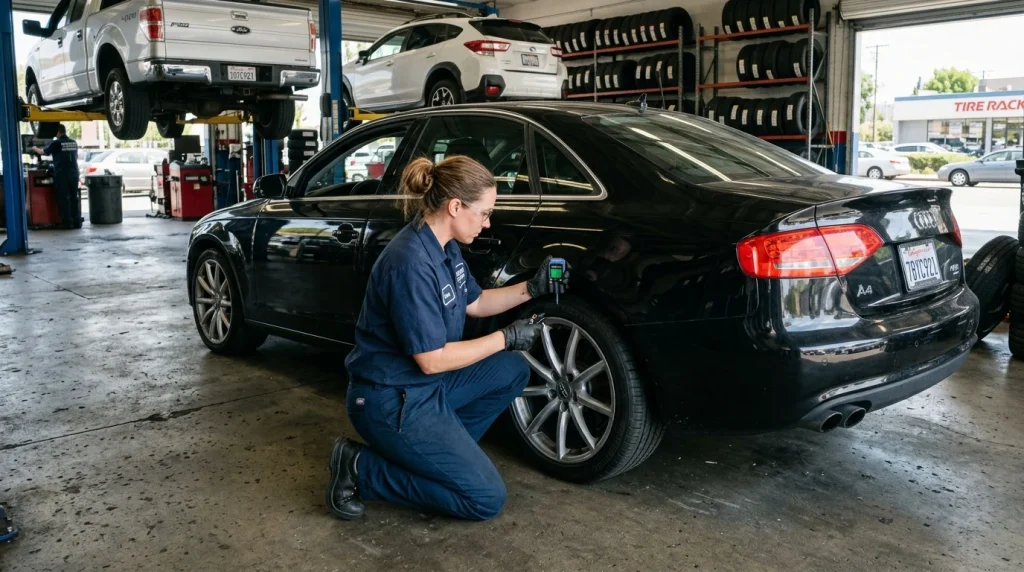
According to Audi’s official ElsaWin service documentation, the average tread depth difference between the front and rear axles must not exceed 2 mm (approximately 4/32 of an inch) to prevent severe mechanical stress. Some North American owner’s manuals publish this tolerance as 4/32 of an inch of remaining tread depth between all four tires.
If you get a flat tire that cannot be repaired and install a single brand-new tire, its larger rolling diameter will cause it to rotate slightly slower than the other three worn tires. The Quattro system’s speed sensors will interpret this difference as wheel slippage. As a result, the center differential or Haldex clutch pack will continuously engage and disengage to compensate for a loss of traction that is not actually occurring. This constant activity generates extreme friction and heat, eventually burning out the differential gears. Fixing a damaged differential can result in repair bills exceeding $5,000.
Analysis: The tight tolerance on tread depth is a byproduct of Audi’s mechanical Quattro engineering. Newer Audi models equipped with “Quattro with Ultra Technology” utilize electronic clutch packs that disconnect the rear axle to save fuel. While these clutch packs are slightly more forgiving under light loads, they are still highly sensitive to diameter mismatches over long distances. Keeping all four tires matched is the only way to guarantee drivetrain longevity.
Note: If you experience a blowout but your remaining three tires still have significant tread life, you do not have to purchase a full set of four new tires. You can buy a single matching tire and request a professional tire shaving service. Specialist retailers like Tire Rack can shave new rubber off a brand-new tire down to the exact 32nd of an inch required to match your remaining three tires, saving you hundreds of dollars.
Woody Rogers, Senior Vice President of Marketing and former Testing Director at Tire Rack, notes that matching tires is critical for all-wheel-drive systems. Rogers states that street tire shaving services, which typically cost between $25 and $35 per tire, allow owners with a single damaged tire to safely match the tread depth of their existing set. This process sacrifices a small amount of new rubber but successfully protects the vehicle’s transfer case and differential components from expensive, premature failure.
Understanding Audi Original (AO) and RO1 Homologation
When shopping for replacement tires, you may notice some models have an “AO” or “RO1” designation stamped on the sidewall. These markings indicate that the tire has been officially homologated by Audi engineers for original equipment use.
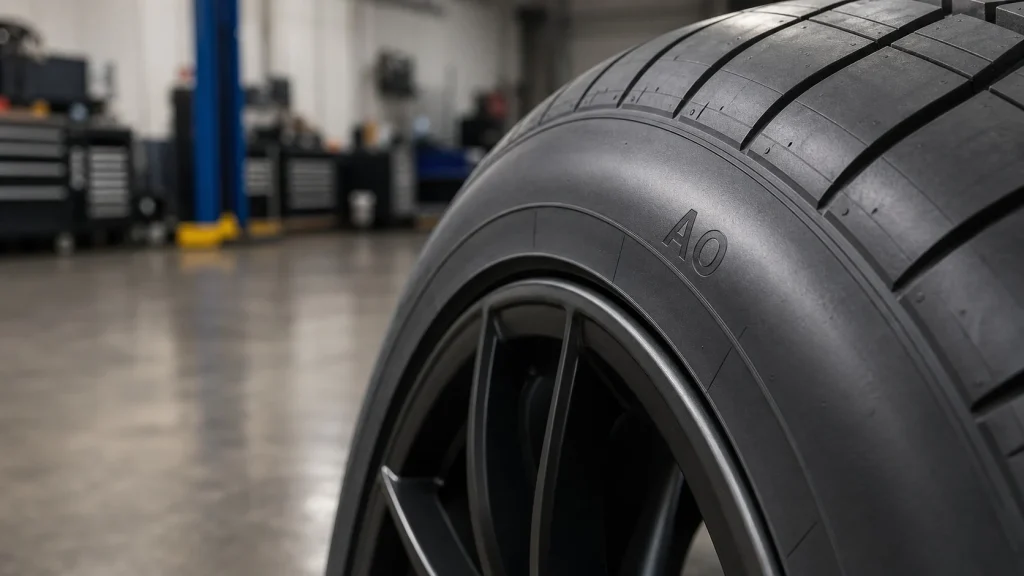
To earn these stamps, tire manufacturers work directly with Audi to modify the internal construction of off-the-shelf tires. These changes can include:
- Stiffness Adjustments: Altering the angle of the internal steel belts to match Audi’s specific suspension geometry and damping rates.
- Compound Tweaks: Modifying the silica and polymer blend to reduce rolling resistance and understeer.
- Noise Damping: Changing the tread block sequencing or adding internal foam linings to prevent tire cavity vibrations from transmitting into the passenger cabin.
The “AO” stamp is standard for A and Q models, while the “RO1” stamp is reserved specifically for ultra-high-performance Audi Sport (RS) models. While you can technically run standard non-homologated tires of the same size, choosing AO or RO1 tires guarantees that your Audi retains the exact handling characteristics, steering response, and noise levels intended by the factory.
Frequently Asked Questions about Audi Tires
Can you replace just two tires on an Audi Quattro?
No, it is highly discouraged. Replacing only two tires on a Quattro vehicle creates a significant tread depth difference between the front and rear axles. If the difference exceeds the official 2 mm (4/32-inch) threshold, the center differential will overheat due to constant speed compensation. Always replace all four tires at once, or use tire shaving to match a single replacement.
What tires come standard on Audi vehicles?
Audi equips its factory vehicles with tires from premium manufacturers like Michelin, Continental, Pirelli, and Bridgestone. The specific model varies by trim; base A-series sedans typically arrive on premium all-season tires, while S and RS sport packages are delivered on max-performance summer tires.
Should I use summer or all-season tires on my Audi?
If you live in a climate where temperatures consistently drop below 40 degrees Fahrenheit, you should use all-season or all-weather tires. Summer tire compounds harden in cold weather, reducing traction and risking tread cracking. However, if you drive a high-performance Audi Sport model in a warm climate, summer tires will maximize cornering grip and braking performance.
Are Audi Original (AO) tires worth the extra cost?
Yes. AO-marked tires undergo extensive custom tuning to match Audi’s chassis and suspension characteristics. They are engineered to minimize road noise and optimize fuel economy. Choosing AO tires is the best way to maintain the original factory ride quality of your vehicle.

