

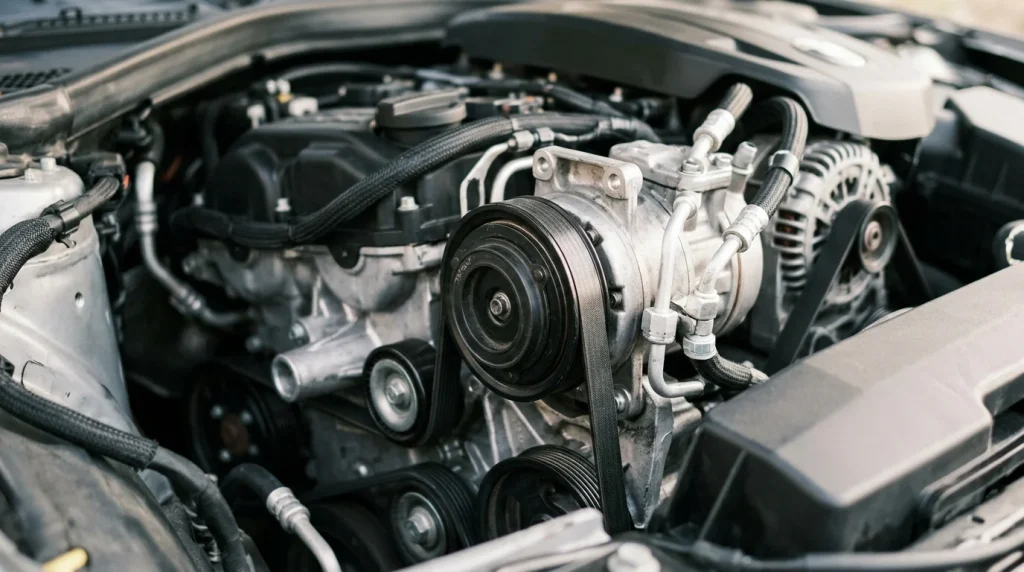
Quick answer: To check if your car AC compressor is working, start the engine, turn the air conditioning to maximum cold, and check under the hood. For traditional compressors, listen for an audible click and verify that the center hub of the compressor pulley spins along with the outer belt ring. For modern clutchless compressors, you must use manifold pressure gauges or a diagnostic scanner to verify compressor engagement, as their pulleys spin continuously.
Key takeaways:
- Visually inspect the compressor clutch and serpentine belt for physical damage before testing.
- Verify refrigerant pressure because low gas levels trigger safety switches that disable the compressor.
- Measure clutch coil resistance with a multimeter; a healthy coil reads between 3 and 5 ohms.
- Modern clutchless compressors do not click; they require pressure gauges or OBD2 scanners to diagnose.
What Does the AC Compressor Do?
The air conditioning compressor acts as the pump that circulates refrigerant throughout your vehicle’s climate control system. Driven by the engine serpentine belt, it draws in low-pressure, cool gaseous refrigerant from the evaporator, compresses it into a high-pressure, hot gas, and pushes it toward the condenser.
This compression process raises the temperature of the refrigerant, allowing the condenser to shed heat to the outside air. The refrigerant then changes into a liquid state, flows through the expansion valve, and returns to the evaporator as a cold, low-pressure liquid to absorb heat from the cabin. Without a functional compressor, the refrigeration cycle stalls, and the vents will only blow warm air.
Common Signs of a Bad AC Compressor
Recognizing the early symptoms of a failing compressor can prevent minor issues from turning into catastrophic system damage. According to diagnostic guidelines published by AutoZone (https://www.autozone.com/diy/climate-control/signs-of-a-bad-a-c-compressor), the primary indicators of a failing AC compressor include:
- AC is blowing hot air: When the compressor fails to compress the refrigerant, the system cannot absorb cabin heat.
- Loud screeching or grinding noises: Grinding sounds indicate worn internal bearings, while screeching often points to a failing clutch or a glazed belt.
- Non-engaging clutch: The center plate of the pulley remains stationary when the AC is commanded on.
- Visible oil leaks: Refrigerant carries lubricating oil. A greasy, dust-covered film on the compressor body or shaft seal indicates a leak.
How to Test Your Car AC Compressor
Determining the state of your compressor requires a systematic approach. Denso, a leading original equipment manufacturer, emphasizes this diagnostic philosophy in their technical guide (https://www.densoautoparts.com/reference-ac-compressor-troubleshooting/): “Following a set procedure to base your troubleshooting on will help find the root cause of a problem and prevent unnecessary repeat repairs.”
Follow these steps to diagnose your AC compressor.
Step 1: Perform a Visual and Mechanical Pre-Check
Before starting the vehicle, inspect the compressor under the hood. Locate the compressor unit, which is typically bolted to the front of the engine block and driven by the serpentine belt. Look for cracks or wear on the belt. Check the compressor housing for green-colored UV dye or oily residue, which indicates a seal leak. Try to rotate the front clutch hub by hand. If it is completely seized and will not budge, the internal compressor components have suffered mechanical lockup.
Step 2: Conduct the AC Compressor Clutch Test
Start the engine, set the AC system to maximum cold, and set the fan speed to high. Observe the compressor pulley. You should hear a sharp metallic click as the electromagnetic clutch engages. The center hub of the pulley should begin spinning smoothly. If the outer pulley rotates with the belt but the center hub remains stationary, the compressor is not engaging.
Step 3: Verify Electrical Signals with a Multimeter
If the clutch fails to engage, you must determine if the fault is inside the clutch coil or in the control circuit. Locate the electrical connector on the compressor and unplug it. Set your digital multimeter to measure resistance (ohms). Place the probes on the two terminals of the clutch coil.
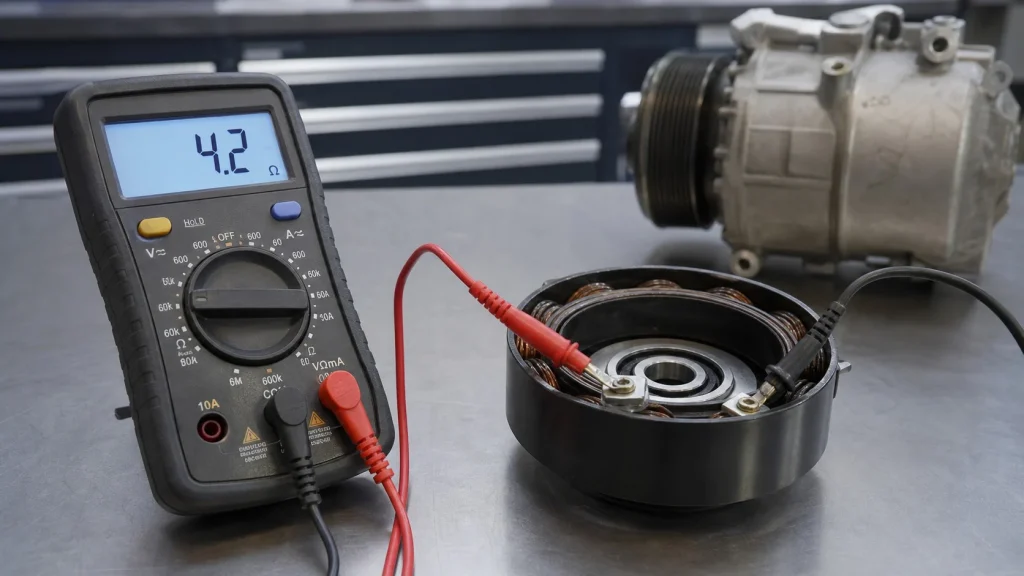
According to multimeter testing specifications from Kaiweets (https://kaiweets.com/blogs/news/how-to-test-car-ac-compressor-with-multimeter), a functional clutch coil should show a resistance reading between 3 and 5 ohms. A reading of zero ohms indicates a short circuit, while a reading of infinity (open loop) indicates a broken wire inside the coil.
Next, set the multimeter to DC volts. Measure the voltage on the vehicle-side harness connector with the engine running and the AC turned on. It should show battery charging voltage, typically between 12.0 and 14.5 volts. If there is no voltage, the control circuit is open, indicating a blown fuse, a bad relay, or a triggered safety switch.
Step 4: Measure Refrigerant Pressures
AC systems feature low-pressure and high-pressure safety switches. If the refrigerant level drops too low, the low-pressure switch opens the circuit to protect the compressor from running without oil. Connect a manifold gauge set to the service ports. If the static pressure reads below 30 psi, the system is low on charge, and the safety switch has disabled the compressor.
Dave Hobbs, a technical correspondent for the Mobile Air Climate Systems Association (MACS), notes in the MACS Service Reports (https://www.macsw.org/common/Uploaded%20files/MACS%20Service%20Reports/2021%20MSR/2021_05msr4web.pdf) that on Toyota vehicles equipped with Denso flow sensors, a failed sensor reading above 3.7 volts will actively block the AC amplifier from commanding the compressor clutch to engage, setting diagnostic trouble code DTC B1479.
Analysis: A common mistake is attempting to top off refrigerant without recovering the old charge. MACS data shows that reducing the refrigerant charge by just 6 ounces can raise the compressor outlet temperature from 150 F to 182 F, while an 8-ounce deficit pushes it to 204 F. This extreme heat degrades the lubricating oil and destroys the compressor from the inside, even if system pressures seem close to normal on basic gauges.
Note: Working around a running engine poses severe safety risks. Ensure your clothing, hair, and test wires are kept far away from the spinning serpentine belt and electric cooling fans.
Diagnosing Modern Clutchless AC Compressors
Many modern vehicles use clutchless variable displacement compressors instead of electromagnetic clutches. These units use a pulley that spins constantly whenever the engine is running. Internally, a pulse-width modulated (PWM) control valve adjusts the stroke of the pistons to regulate refrigerant flow.
Because these compressors do not click or show a visible clutch engagement, you cannot diagnose them using visual checks. Instead, you must use a diagnostic OBD2 scanner to verify the duty cycle signal (measured in percentage) sent to the control valve. You must also use manifold gauges to monitor the pressure differential. A healthy variable compressor should quickly drop low-side pressure to 25-35 psi and raise high-side pressure to 150-220 psi when activated.
Repairing vs. Replacing a Failed AC Compressor
If your diagnostics point to a failed compressor, you must decide between repairing the clutch assembly or replacing the entire unit.
If the internal compressor mechanism rotates smoothly by hand and the system has no leaks, but the coil is electrically dead, you can replace the clutch coil assembly. This repair keeps the refrigerant loop sealed, avoiding the cost of reclaiming and recharging the refrigerant.
However, if the compressor has seized internally or is leaking oil from the shaft seal, you must replace the entire unit. The AC compressor replacement cost ranges from 800 to 1500 dollars, depending on vehicle make and model.
According to MACS service standards (https://www.aa1car.com/library/macs_service_procedures.pdf), when an internal mechanical failure occurs, you must also replace the receiver-drier or accumulator, the expansion valve, and any hose assemblies with inline mufflers. Internal failures release fine metal debris throughout the system, and failure to replace these parts will contaminate and destroy the new compressor.
Frequently Asked Questions
Can a car run with a bad AC compressor?
Yes, a car can run with a bad AC compressor as long as the pulley bearing spins freely. However, if the compressor pulley seizes completely, it will create friction against the belt. This can snap the serpentine belt, disabling the alternator and steering system. If you notice steering stiffness or belt noise, check the power steering system (https://autvex.com/news/how-much-power-steering-fluid-does-a-car-need/) and replace the pulley immediately.
How long does a car AC compressor last?
A typical car AC compressor lasts between 8 and 12 years, or between 100,000 and 150,000 miles. To reach this lifespan, ensure your refrigerant charge is correct and run the AC system for 10 minutes every week to keep the seals lubricated. If you suspect electrical issues while troubleshooting, learn about basic automotive electrical safety (https://autvex.com/news/can-you-jump-start-a-car-in-the-rain/) before testing.
What does a bad AC compressor sound like?
A failing compressor typically makes a loud metallic grinding, rattling, or squealing noise. A grinding noise indicates worn internal bearings or pistons. A loud squeal when you turn on the AC suggests a slipping clutch plate or a worn drive belt.

