

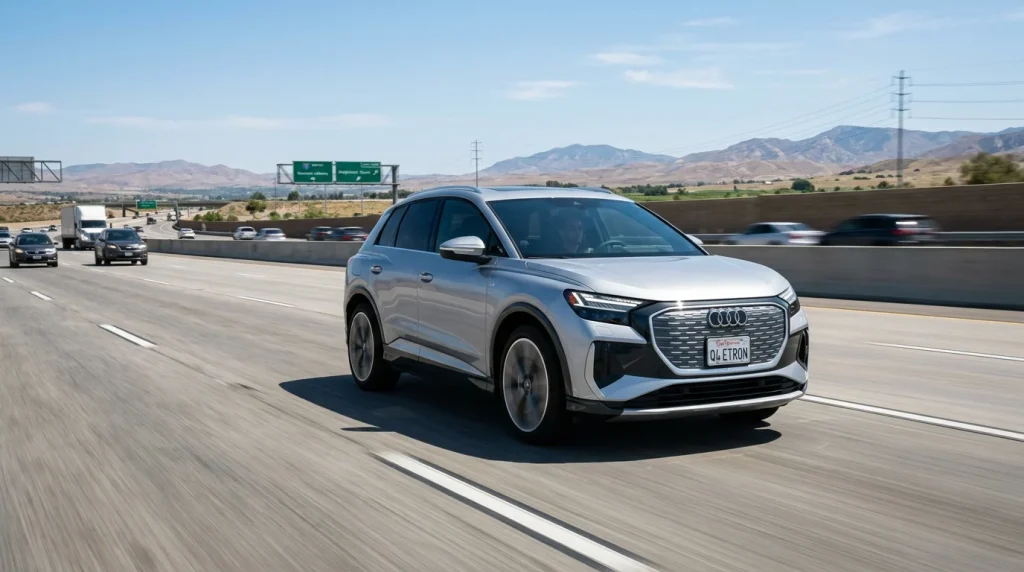
Quick answer: The 2024 Audi Q4 e tron (also written as the 2024 Audi Q4 e-tron) is a highly competent compact luxury electric SUV that received a massive midyear refresh, replacing the early 201-hp Q4 40 and 295-hp Q4 50 versions with the much-improved 335-hp Q4 55 e-tron. With a starting MSRP of $55,200 for the AWD 55 quattro Premium trim, it offers up to 258 miles of EPA-estimated range and can DC fast charge at 175 kW from 10% to 80% in 28 minutes.
Key takeaways:
- The midyear Q4 55 e-tron update brings 335 hp, a 258-mile range, retuned suspension, and faster 175 kW charging.
- Early 2024 models (Q4 40 and Q4 50) have slower charging, less range, and previous ride/steering flaws; check production dates carefully.
- Safety remains a major strength with IIHS Top Safety Pick+ potential and Good crash ratings across the board.
- The Q4 e-tron is currently not eligible for the federal EV tax credit, but sells for an average of 11.4% below MSRP.
Why This Review Matters
The compact electric luxury SUV segment is one of the most competitive in the industry, and the 2024 Audi Q4 e-tron represents a tale of two distinct model lines: early-production versions and the much-improved midyear update. Major competitors like the Tesla Model Y, Genesis GV60, Mercedes-Benz EQB, Volvo EX30, and Volkswagen ID.4 all compete for the same buyers, forcing Audi to address early shortcomings.
Understanding these differences is crucial for shoppers because used prices for early 2024 models now start in the $24,000 to $28,000 range. Meanwhile, new models sell with substantial average discounts of approximately 11.4% below MSRP. Evaluating whether to buy a discounted new Q4 55 e-tron or seek out used inventory requires a clear look at the structural and hardware updates introduced midyear.
Specifications Overview: Q4 40, 50, and 55 e-tron
Audi simplified and upgraded the Q4 e-tron lineup midyear by retiring the rear-wheel-drive 40 and dual-motor 50 quattro, making the dual-motor 55 quattro the new standard powertrain. The Q4 e-tron shares its underlying MEB platform with the Volkswagen ID.4 but features distinct Audi styling, a more premium interior, and unique suspension tuning. The table below details the specifications of the three versions available during the 2024 model year:
| Category | Q4 40 e-tron (Early 2024) | Q4 50 e-tron (Early 2024) | Q4 55 e-tron (Midyear Update) |
|---|---|---|---|
| Powertrain | Single rear motor | Dual motors (AWD) | Dual motors (AWD) |
| Horsepower | 201 hp | 295 hp | 335 hp |
| Drivetrain | RWD | AWD (quattro) | AWD (quattro) |
| Battery Capacity | 82 kWh gross (77 kWh net) | 82 kWh gross (77 kWh net) | 82 kWh gross (77 kWh net) |
| EPA Range | 265 miles | 236 miles | 258 miles |
| DC Fast Charging Rate | 150 kW | 150 kW | 175 kW |
| Steering/Suspension | Previous calibration | Previous calibration | Updated tuning |
| Original MSRP | From $49,800 | From $55,200 | From $55,200 |
| Production Status | Ended November 2023 | Ended November 2023 | Current production |
According to Edmunds, buyers should keep their eyes open for the 55 version when shopping because it is highly recommended to get a 55 instead of the older 40 or 50 models. The midyear Q4 55 e-tron dual-motor setup incorporates a new permanently excited synchronous motor on the rear axle (the APP550 unit), which delivers higher efficiency and greater power without increasing the battery capacity.
Design, Cabin Quality, and Practicality
The Q4 e-tron drives and looks like a conventional gasoline-powered SUV, making the switch to electric less jarring for first-time EV buyers. Compared to the larger Q8 e-tron, the Q4 measures about a foot shorter in length, though passenger room is only marginally smaller. A sleeker Sportback version is also available for those prioritizing styling over maximum cargo utility, though it slightly reduces rear-seat headroom and maximum hauling capacity.
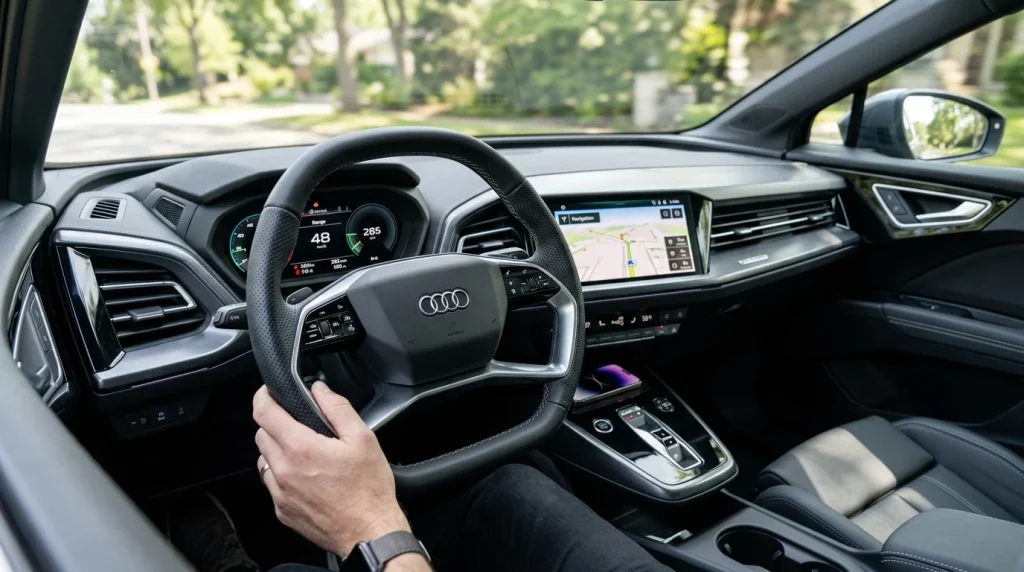
Interior design elevates the Q4 above its Volkswagen ID.4 sibling, featuring a standard 10.25-inch digital instrument cluster and an 11.6-inch center touchscreen. However, certain cabin elements fall short of luxury expectations. Reviews from Edmunds note that parts like the plastic on the center console and wood trim pieces look a bit low-budget for the price.
Where the Q4 disappointed initially was ride quality, at least on early 2024 models. The front seats lacked lateral support and felt slightly flat, and seat ventilation remained unavailable even as an option. Initial impressions of the early models suggested decent bump absorption, but on bumpier highway sections, the ride became busy and choppy. The midyear 55 version addresses this directly. Audi retuned the suspension to deliver the taut-but-comfortable ride expected from a luxury brand, resolving the busy highway ride of early versions.
Analysis: The Sportback version offers a sleeker roofline but reduces rear headroom and maximum cargo utility compared to the standard SUV body style. Buyers prioritizing practicality should opt for the standard SUV layout, while those seeking a coupe-like profile will find the Sportback visually distinctive.
Performance, Driving Dynamics, and Charging Efficiency
The midyear Q4 55 e-tron update transforms the driving experience by replacing the older, numb steering and squishy brakes with a linear, direct setup and retuned suspension. In reviews by MotorTrend, the previous steering was described as unnatural and unpredictable, paired with a squishy brake pedal and suspension that was oversprung and underdamped. The Q4 55 e-tron fixes these flaws. Audi updated the steering to feel far more linear and direct, and adjusted brake modulation for better responsiveness and predictable stopping distances.
In terms of acceleration, the older Q4 50 e-tron achieved 0-60 mph in 5.7 seconds, which is respectable but slower than direct competition. The upgraded 335-hp Q4 55 e-tron drops the 0-60 mph sprint to approximately 5.0 seconds. The Q4 55’s EPA-rated 258-mile range positions it competitively within the segment, representing a 22-mile increase over the older 50 quattro SUV.
One significant weakness persists: regenerative braking remains lighter than expected. You can adjust strength using steering wheel paddles (which became standard for 2024), but there is no full one-pedal driving mode. The Q4 will not come to a complete stop using regenerative braking alone. Audi deliberately avoids one-pedal driving, believing that coasting is more efficient than aggressive automatic regeneration.
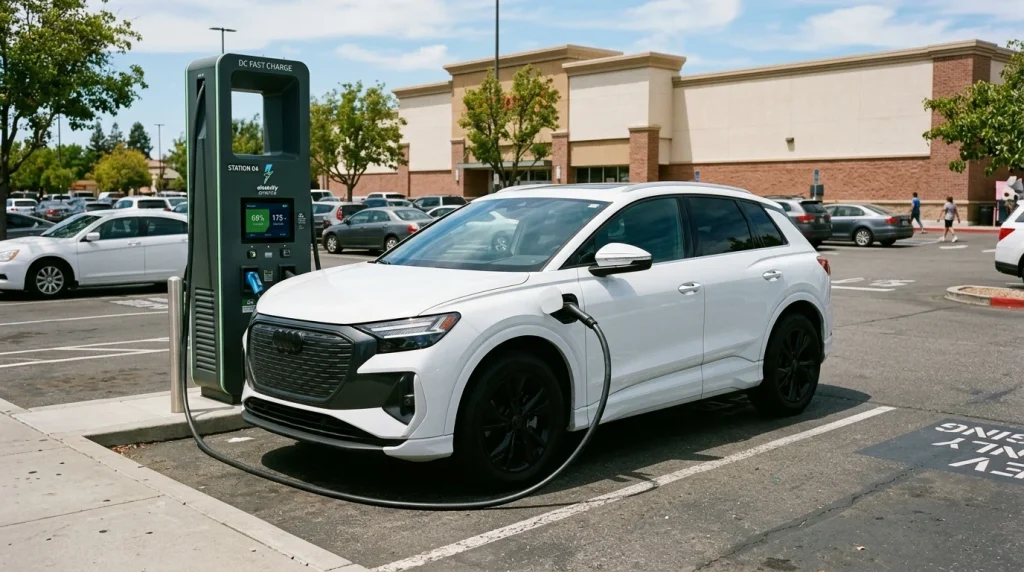
DC fast charging has also improved with the midyear update. The Q4 55 e-tron achieves a maximum DC fast charging rate of 175 kW, up from 150 kW on the 40 and 50 versions. According to specifications from the EV Database, this allows the Q4 55 to charge from 10% to 80% in approximately 28 minutes under optimal conditions. By comparison, older versions required 36 minutes to charge from 5% to 80%. The table below compares the charging efficiency of the Q4 55 e-tron against its key competitors:
| Competitor | Peak DC Fast Charge Rate | 10% to 80% Charging Time | Charging Network Access |
|---|---|---|---|
| Audi Q4 55 e-tron | 175 kW | 28 minutes | CCS & Tesla Supercharger (with adapter) |
| Tesla Model Y | 250 kW | 27 minutes | Tesla Supercharger (native NACS) |
| Genesis GV60 | 350 kW | 18 minutes | CCS & Tesla Supercharger (with adapter) |
For home charging, most owners install a 240V Level 2 charger. According to the Clean Fleet Report, the 11.0 kW on-board charger allows a full charge in approximately 7.5 to 9 hours.
Technology and Trims: Premium, Premium Plus, and Prestige
The 2024 Q4 e-tron is available in Premium, Premium Plus, and Prestige trim levels. Standard equipment now includes adaptive cruise control with lane centering and steering wheel paddles for regenerative braking adjustment, features that were previously optional or unavailable on base models.
| Trim Level | Starting MSRP (55 quattro) | Headlights | Key Technology Features |
|---|---|---|---|
| Premium | $55,200 | LED Reflector | Audi smartphone interface, lane guidance, power tailgate |
| Premium Plus | $59,900 | LED Reflector | Audi virtual cockpit plus, SONOS premium sound system, wireless phone charger |
| Prestige | $62,200 | Matrix-design LED Projector | Head-up display with augmented reality, animation headlights |
Touch-sensitive steering wheel controls remain frustrating. The haptic pads are not as easy to use as physical buttons, leading to frequent fumbled inputs. The touchscreen menu also requires a learning curve, though it represents a huge upgrade from the software in the closely related Volkswagen ID.4.
The adaptive cruise system is highly impressive, sensing when a hand is on the steering wheel without requiring periodic steering jiggles to prove driver engagement. A surround-view camera remains notably absent from the lower trims despite being standard on most competitors. The Premium Plus trim represents the sweet spot for most buyers, bundling the Audi virtual cockpit plus, SONOS audio system, and driver memory settings for a moderate price increase over the base model.
Safety Ratings and Recalls
Safety remains a significant strength for the Q4 e-tron. The 2024 model maintains excellent safety credentials, earning top crash test ratings from the Insurance Institute for Highway Safety (IIHS), as verified on the official IIHS rating page:
| IIHS Test Category | Rating (2024 Audi Q4 e-tron) |
|---|---|
| Small Overlap Front (Driver Side) | Good |
| Small Overlap Front (Passenger Side) | Good |
| Moderate Overlap Front (Original Test) | Good |
| Side Impact (Updated Test) | Good |
| Roof Strength | Good |
| Head Restraints & Seats | Good |
| Front Crash Prevention (Vehicle-to-Vehicle) | Superior |
| Front Crash Prevention (Vehicle-to-Pedestrian, Day) | Advanced |
| Headlights (Prestige Trim) | Good |
| Headlights (Premium / Premium Plus Trims) | Acceptable |
The Q4 avoided collisions in both the 12 mph and 25 mph vehicle-to-vehicle tests. Pedestrian detection performance earned Advanced ratings in both daytime and nighttime scenarios. The National Highway Traffic Safety Administration (NHTSA) has not released comprehensive crash test ratings for 2024 models.
However, three safety recalls affect the 2024 model year, and buyers should verify recall completion before purchase:
- Headlight Control Module Software: Incorrect software may have been installed, potentially disabling the high beams or headlights.
- Charging Cable Overheating: The industrial 240V charging cable could overheat, presenting a potential fire hazard.
- High-Voltage Battery Module Short-Circuit: Certain 2024 models were recalled due to a potential short-circuit within the battery cell modules, which could lead to a loss of propulsion or fire.
Ownership Costs, Depreciation, and Market Value
Audi provides a 4-year or 50,000-mile basic warranty, accompanied by an 8-year or 100,000-mile EV battery warranty. Roadside assistance covers 4 years with unlimited miles. The warranty coverage is solidly average for the luxury EV class.
According to transaction data from TrueCar, new Q4 e-trons sell for an average of 11.4% below MSRP, translating to savings of over $6,362 depending on the configuration. The Prestige trim offers the highest average savings at 11.6% off the sticker price. Used 2024 Q4 e-trons start around $24,000 to $28,000 for early Premium trims, representing steep initial depreciation that benefits pre-owned buyers.
The vehicle is not eligible for the federal EV tax credit because it is assembled in Germany. However, lease options may pass on the credit value through promotional incentives. For public charging, complimentary Electrify America charging sessions may be available depending on current dealer promotions.
Pros and Cons
Pros:
- The midyear 55 version delivers significantly improved steering, suspension, and brake feel.
- High transaction discounts averaging 11.4% below MSRP provide immediate savings of over $6,362.
- Standard adaptive cruise control with lane centering is now included on all trims.
- Premium interior styling and Audi virtual cockpit plus elevate the cabin above the Volkswagen ID.4.
- Excellent IIHS safety ratings and standard driver assistance systems.
Cons:
- Early 2024 production models (40 and 50 versions) retain previous ride quality and steering flaws.
- DC fast charging takes 28 minutes (10% to 80%), which lags behind the Genesis GV60’s 18-minute time.
- Regenerative braking lacks a true one-pedal driving mode.
- Touch-sensitive steering wheel controls can be frustrating to use.
- Ineligible for the federal EV tax credit due to overseas assembly.
Final Verdict: Is the 2024 Q4 e-tron Worth Buying?
The 2024 Audi Q4 e-tron represents a tale of two vehicles. Early-production 40 and 50 models retain the shortcomings that limited the Q4’s initial appeal, specifically disappointing ride quality, vague steering, and slower charging. The midyear 55 version, however, delivers meaningful upgrades that transform the driving experience.
MotorTrend concluded that while they would have struggled to recommend the Q4 Sportback e-tron to buyers in the past, Audi did a commendable job with its targeted updates. The upgraded Q4 now competes more effectively against the Tesla Model Y, Mercedes-Benz EQB, and Volvo EX30.
- Choose the Q4 55 e-tron if: You want Audi’s entry-level electric luxury with the improved steering, suspension, and 175 kW charging updates, can take advantage of current 11%+ discounts below MSRP, and prioritize a familiar driving experience.
- Consider alternatives if: You want the quickest acceleration, the fastest charging speeds (Genesis GV60 at 18 minutes), federal EV tax credit eligibility, or one-pedal driving capability.
If you are looking at other model years, you can read our reviews of the 2022 Audi Q4 e-tron, the 2023 Audi Q4 e-tron, or the 2025 Audi Q4 e-tron to see how specs and pricing compare. You can also explore the Audi Q4 e-tron category hub for additional buyer resources.
FAQs
Is the 2024 Audi Q4 e-tron reliable?
Owner reviews on Edmunds average 2.6 out of 5 stars with mixed feedback, primarily citing software issues. Three recalls affect 2024 models, including charging cable overheating concerns. The 8-year or 100,000-mile battery warranty provides significant coverage for the most expensive component, which benefits both new and used buyers.
What’s the difference between the 2024 Q4 40, 50, and 55 e-tron?
Audi simplified the lineup midyear by discontinuing the 40 (RWD, 201 hp, 265 miles) and 50 (AWD, 295 hp, 236 miles) versions and replacing them with the 55. The Q4 55 e-tron features all-wheel drive, more power (335 hp), 258 miles of range, improved charging speeds (175 kW), and retuned steering/suspension. Edmunds recommends specifically seeking out the 55 version rather than leftover 40 or 50 inventory.
How long does it take to charge the 2024 Q4 e-tron?
Using a DC fast charger at 175 kW, the updated Q4 55 e-tron charges from 10% to 80% in approximately 28 minutes under optimal conditions, while older 40 and 50 versions take about 36 minutes at 150 kW. A full charge using a 240V Level 2 outlet takes about 7.5 to 9 hours.
Does the 2024 Audi Q4 e-tron qualify for the federal EV tax credit?
No, the 2024 Audi Q4 e-tron does not qualify for the $7,500 federal EV tax credit because it is assembled in Zwickau, Germany. This reduces its overall value proposition compared to qualifying competitors, though leasing options may offer workarounds.

