

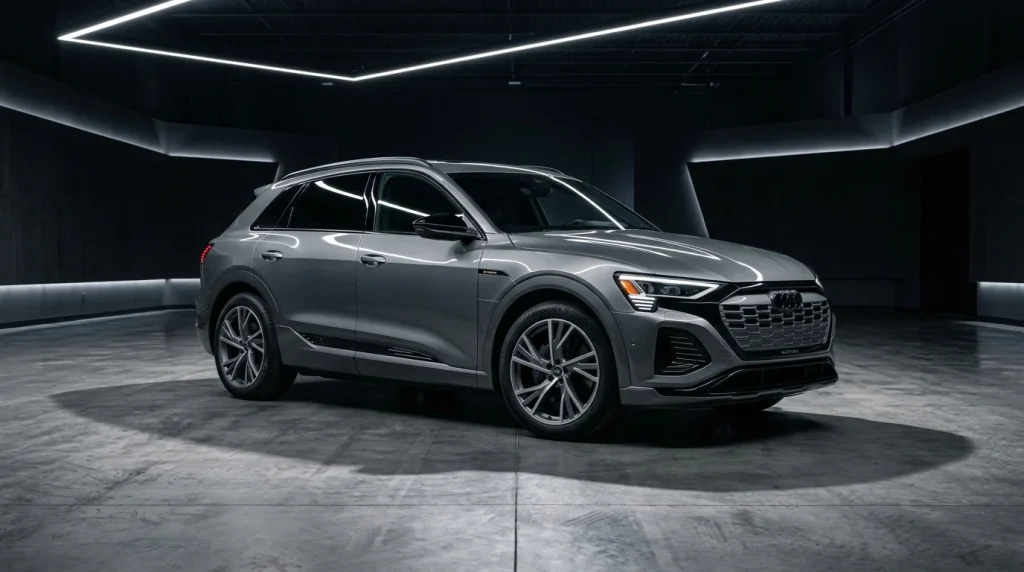
Quick answer: The 2023 Audi e-tron is a highly refined luxury electric SUV offering an EPA-estimated range of 218 to 226 miles and 402 horsepower. While its range trails newer competitors, its steep depreciation makes it a compelling used purchase. Originally priced between $70,800 and $89,300, used 2023 models now transact between $28,000 and $37,500 in 2026, offering premium German engineering at compact car pricing.
Key takeaways:
- Steep depreciation makes the 2023 model an exceptional used value, retaining only 40% to 45% of its original MSRP after three years.
- Real-world highway range sits close to 220 miles, which is suitable for local commuting but limits long-distance road trips.
- Outstanding safety profile with an IIHS Top Safety Pick+ award and advanced night-time pedestrian collision avoidance.
- Key reliability concerns include premature battery cell failures and coolant leaks into the electric motors, making a pre-purchase diagnostic scan essential.
The Rebranding Context: Transition to Q8 e-tron
The 2023 model year represents a historical milestone for Audi electric vehicle development. As the final production year of the original e-tron nameplate, this vehicle serves as the bridge to the modernized rebranded era. Starting in the 2024 model year, Audi renamed its flagship midsize electric SUV to align with its traditional internal combustion naming conventions.
For buyers researching the broader Audi Q8 e-tron lineup, understanding this nomenclature transition is critical. The 2023 e-tron is the direct predecessor to the newer versions, sharing the basic architecture but utilizing older battery chemistry and electric motor configurations. Shoppers comparing model years will note that the transition from the 2022 Audi e-tron to the 2023 model involved minor trim adjustments, while the subsequent leap to the rebranded 2024 Audi Q8 e-tron brought more substantial range and hardware upgrades.
Technical Specs: Dual-Motor vs. Tri-Motor Performance
The 2023 e-tron utilizes Audi’s MLB evo platform, adapted from gasoline-powered models. Rather than relying on a dedicated EV skateboard platform, Audi engineered the battery and motor systems into a traditional chassis layout. This architecture delivers standard luxury SUV proportions and driving dynamics, but results in a heavy curb weight of approximately 5,765 pounds for the SUV and 5,800 pounds for the e-tron S.
Power delivery depends on the drivetrain configuration:
- e-tron 55 (Premium, Premium Plus, Chronos): Equipped with two asynchronous electric motors (one per axle) providing standard quattro all-wheel drive. Total output is 355 horsepower and 414 pound-feet of torque. Activating Boost mode temporarily increases output to 402 horsepower and 490 pound-feet of torque for up to eight seconds, enabling a 0-60 mph acceleration time of 5.5 seconds.
- e-tron S (Premium Plus, Prestige): Features a tri-motor configuration with one motor on the front axle and two on the rear axle. This layout allows for active electric torque vectoring. Total output is 429 horsepower and 717 pound-feet of torque, increasing to 496 horsepower and 718 pound-feet in Boost mode. The 0-60 mph sprint drops to 4.3 seconds.
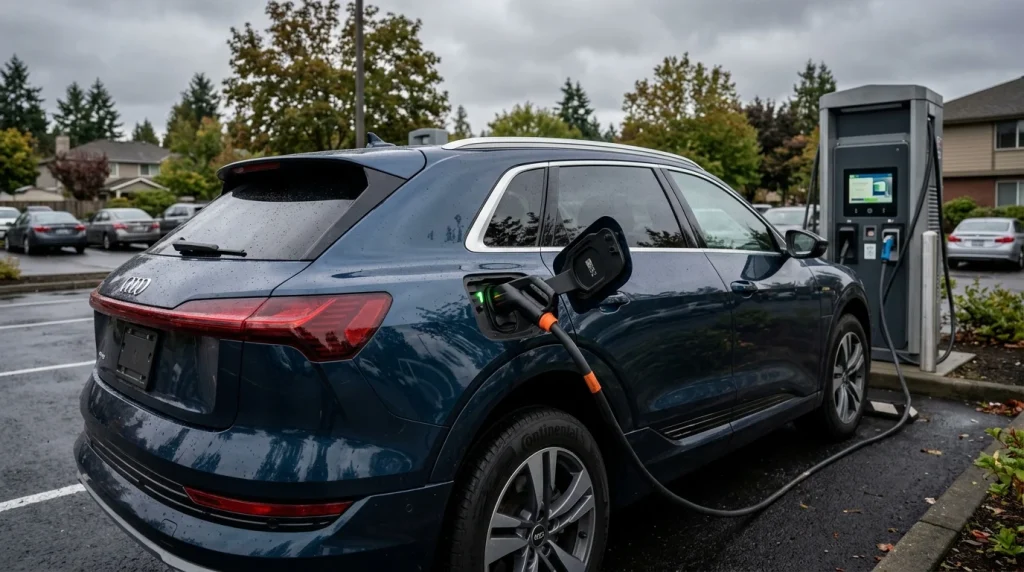
Both variants utilize a liquid-cooled 95 kWh lithium-ion battery pack (86.5 kWh usable net capacity). Charging performance is managed by a 150 kW DC fast-charging system, allowing the battery to charge from 5% to 80% in approximately 30 minutes under optimal conditions. Home charging via the onboard 9.6 kW charger requires approximately 10 hours using a 240V Level 2 connection. The vehicle also boasts a towing capacity of 4,000 pounds when properly equipped.
| Specification | e-tron 55 Drivetrain | e-tron S Drivetrain |
|---|---|---|
| Drivetrain Configuration | Dual-Motor quattro AWD | Tri-Motor quattro AWD |
| Battery Capacity (Gross / Net) | 95.0 kWh / 86.5 kWh | 95.0 kWh / 86.5 kWh |
| Horsepower (Standard / Boost) | 355 hp / 402 hp | 429 hp / 496 hp |
| Torque (Standard / Boost) | 414 lb-ft / 490 lb-ft | 717 lb-ft / 718 lb-ft |
| 0-60 mph Acceleration Time | 5.5 seconds (Boost) | 4.3 seconds (Boost) |
| DC Fast Charging Speed (Max) | 150 kW | 150 kW |
| Towing Capacity | 4,000 lbs | 4,000 lbs |
| Curb Weight | 5,765 lbs | 5,820 lbs |
EPA Range and Real-World Highway Efficiency
The adapted platform structure and heavy curb weight impact the overall efficiency of the vehicle. The EPA efficiency ratings for the dual-motor SUV sit at a modest 78 MPGe combined, which is lower than dedicated EV platform competitors.
EPA-estimated driving ranges vary depending on the body style, drivetrain, and wheel options:
- e-tron SUV (Standard): 222 to 226 miles of range on standard 19-inch or 20-inch wheels.
- e-tron Sportback (Standard): 218 to 225 miles of range, benefiting slightly from a more aerodynamic roofline.
- e-tron S SUV: 208 miles on standard 20-inch wheels, dropping to 181 miles when equipped with larger 21-inch or 22-inch wheels.
- e-tron S Sportback: 212 miles on 20-inch wheels, decreasing to 185 miles on 21-inch or 22-inch configurations.
In real-world highway testing conducted by automotive publications at a constant 75 mph, the standard SUV achieved approximately 220 miles of range. Unlike many newer electric vehicles that show significant highway range drop compared to their EPA estimates, the e-tron’s conservative battery management system delivers highly predictable real-world highway range that closely mirrors its official rating.
Used Market Pricing & Depreciation Analysis in 2026
Luxury electric vehicles are subject to steep depreciation, and the 2023 e-tron is one of the most prominent examples. The combination of rapid battery technology improvements, the introduction of the longer-range Q8 e-tron models, and shifting consumer demand has lowered the entry price in the pre-owned market.
Original MSRP pricing for the 2023 model year excluded the federal tax credit due to battery assembly regulations that took effect during production. In 2026, average transaction prices for clean, dealer-purchased vehicles show that the model has lost between 55% and 60% of its original value.
| Trim Level | Original MSRP (Excl. Dest.) | 2026 Used Retail Price (Clean) | 2026 Private Party Range |
|---|---|---|---|
| Premium SUV | $70,800 | $28,100 | $26,600 – $28,500 |
| Premium Plus SUV | $77,800 | $32,200 | $29,800 – $32,500 |
| Chronos Edition SUV | $86,400 | $37,500 | $34,000 – $37,800 |
| e-tron S Premium Plus | $88,200 | $39,800 | $36,200 – $40,500 |
| e-tron S Prestige | $95,300 | $44,500 | $41,000 – $45,200 |
Values compiled from national dealer transactions and industry evaluation platforms for vehicles with average mileage (~12,000 miles per year) in good cosmetic and mechanical condition.
Federal Used EV Tax Credit Eligibility: Under current United States IRS regulations, used electric vehicles purchased from licensed dealers are eligible for a tax credit of 30% of the sale price (up to a maximum of $4,000) if the sale price is $25,000 or lower. Because clean, low-mileage 2023 e-tron models currently transact above this $25,000 limit, they generally do not qualify for this credit. However, buyers shopping for high-mileage Premium trims priced below $25,000 may leverage this incentive to lower their net cost.
Used Reliability & Known Common Issues
While the driving dynamics of the e-tron remain highly rated, pre-owned buyers must evaluate several documented failure points. Reviewing owner feedback and dealer service records reveals several patterns:
- Battery Cell Failures: Certain vehicles have experienced premature degradation of individual battery cells within the 36-module pack. Audi dealers typically address this by dropping the battery pack and replacing the individual failing modules rather than the entire pack. While covered under the 8-year or 100,000-mile warranty, this repair can require significant shop time.
- Coolant Ingress in Electric Motors: A known issue involves coolant leaking past internal seals into the electric motor housings. This can cause electrical shorts and trigger catastrophic motor failure, requiring complete replacement of the motor assembly. Buyers should check for any service records showing motor replacement or coolant pressure testing.
- Tailgate Proximity Sensor Malfunctions: The hands-free kick-to-open tailgate sensor can operate erratically, sometimes opening the tailgate unexpectedly without key fob proximity. Clean sensors and software updates resolve most instances.
- Infotainment and Virtual Cockpit Glitches: The dual-screen MMI system can experience black screens, Apple CarPlay disconnects, and occasional reset loops. Ensuring the latest dealer-installed software version is present minimizes these electronic glitches.
Buyers should verify that the factory battery warranty (8 years or 100,000 miles from the original in-service date) is fully active and request a certified battery state of health report from an Audi dealer before completing a purchase.
Trim Levels & Standard Features
The 2023 model year was structured into three main configurations for the standard e-tron 55 SUV and Sportback, each adding progressive luxury features:
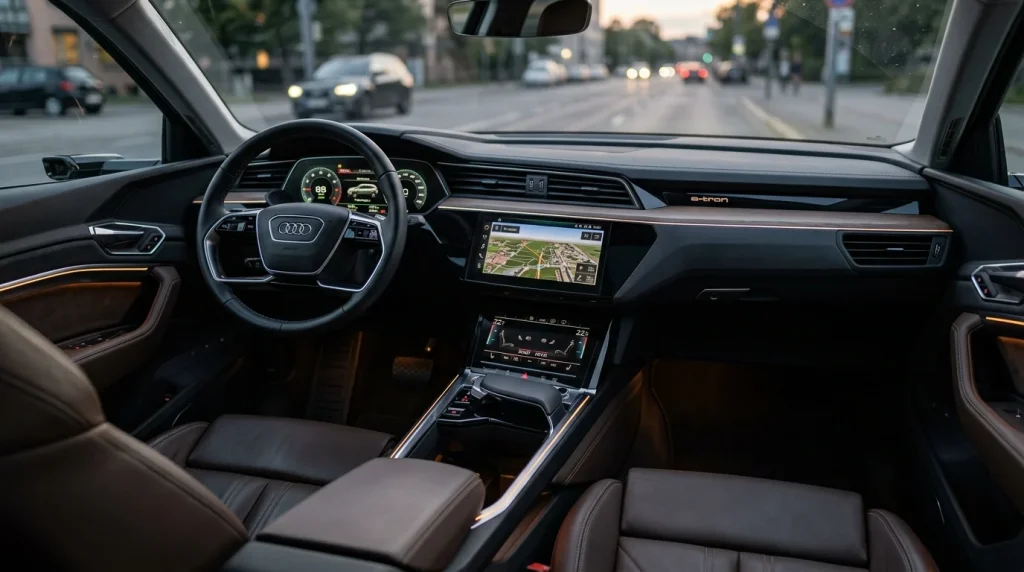
- Premium: Standard equipment includes leather upholstery, heated front seats, 8-way power front seats with driver memory, a panoramic sunroof, adaptive air suspension, 20-inch wheels, lane departure warning, and blind-spot monitoring. Infotainment is managed by the dual-touchscreen MMI system with a 10.1-inch upper and 8.6-inch lower display, paired with the 12.3-inch Virtual Cockpit.
- Premium Plus: Adds ventilated front seats, heated rear seats, a 16-speaker Bang & Olufsen 3D sound system, a 360-degree top-view camera system, ambient LED interior lighting, and matrix-design LED headlights.
- Chronos Edition: Replaced the previous Prestige trim. It features unique Chronos gray metallic paint, black exterior trim elements, Valcona leather seats, individual contour front seats with massage functions, dual-pane acoustic glass for reduced cabin noise, intersection assist, and a head-up display.
Safety Standards & IIHS Ratings
Safety engineering is a primary strength of the 2023 e-tron, which earned the highest Top Safety Pick+ award from the Insurance Institute for Highway Safety (IIHS). This rating applies to both the standard SUV and the Sportback models, matching the safety achievements of the larger 2025 Audi Q8 e-tron models.
According to the official crash test database from the IIHS Safety Rating for 2023 Audi e-tron, the vehicle scored top marks across all evaluated areas:
- Small overlap front (driver and passenger side): Good
- Moderate overlap front (original test): Good
- Side crash test (updated high-energy test): Good
- Roof strength and head restraints: Good
- Front crash prevention (vehicle-to-pedestrian): Superior (daytime) and Advanced (night-time).
In night-time pedestrian collision avoidance tests, the standard Audi pre-sense front system avoided collisions in both the 25 mph parallel and crossing adult scenarios under high and low beams. At 37 mph, the system reduced speed by 36 mph using high beams, preventing high-energy impacts. The vehicle also comes standard with lane departure warnings and rear cross-traffic alert.
The Final Verdict: Is a Used 2023 Audi e-tron Worth Buying?
The 2023 Audi e-tron represents a specific trade-off in the used EV market. It does not offer the cutting-edge efficiency or the 300-mile range of newer platforms, but it delivers traditional luxury construction at a heavily discounted price point.
Who Should Buy It?
It is an ideal choice for buyers who want a premium German luxury vehicle with excellent cabin isolation, comfortable air suspension, and high-end safety features, and whose driving patterns fit within a 150-mile daily limit. If you have access to Level 2 home charging and rarely take road trips longer than 200 miles, the 2023 e-tron offers exceptional value.
Who Should Avoid It?
Avoid this vehicle if you regularly drive long distances, rely heavily on public DC fast-charging infrastructure, or require at least 250 miles of highway range in winter conditions. In these cases, newer models or competitors with larger battery capacities are more appropriate options.
Frequently Asked Questions
What is the real-world range of a 2023 Audi e-tron?
The EPA-estimated range is 218 to 226 miles for standard models. In real-world highway driving at 75 mph, the SUV delivers a consistent 220 miles of range. In cold winter climates, range can drop by 20% to 30%, resulting in a practical winter range of 150 to 170 miles.
How much is a used 2023 Audi e-tron worth today?
Used prices range from approximately $26,500 for higher-mileage Premium trims to $37,500 for a clean, dealer-certified Chronos Edition SUV. Drivetrain S performance upgrades command higher prices, transacting between $39,800 and $44,500 in 2026.
What are the most common reliability issues with a 2023 Audi e-tron?
The most frequent issues reported by owners are premature battery cell degradation, coolant leaking into the electric motor housings, tailgates opening unexpectedly, and minor software glitches in the MMI screens.
How does the 2023 Audi e-tron differ from the 2024 Audi Q8 e-tron?
The 2024 model year brought a name change to Q8 e-tron and a larger 106 kWh net battery pack. This increased the EPA range from 222 miles to 285-300 miles. DC fast charging speed also improved from 150 kW to 170 kW, and the front electric motor was redesigned for higher efficiency.
Is the 2023 Audi e-tron eligible for used EV tax credits?
Most clean 2023 models do not qualify for the federal used EV tax credit in 2026 because their sale prices exceed the IRS limit of $25,000. Only high-mileage examples priced under $25,000 purchased through certified dealers qualify for the 30% credit (up to $4,000).

