

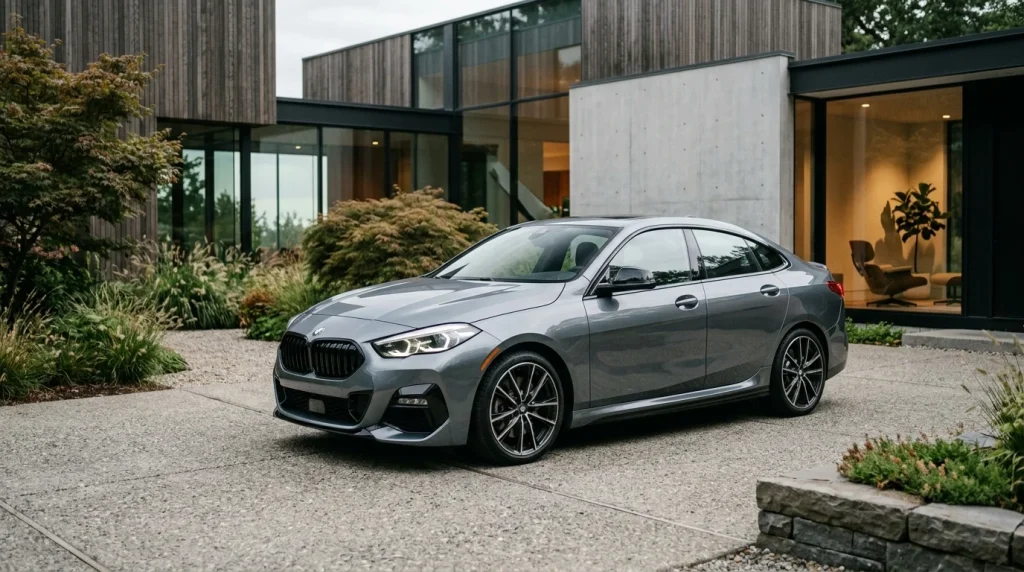
Quick answer: The 2026 BMW 2 Series Gran Coupe starts at $39,600 for the new front-wheel-drive 228 model, while the all-wheel-drive 228 xDrive is priced at $41,600 and the high-performance M235 xDrive starts at $49,500. Standard features include the BMW Curved Display running iDrive 9, adaptive suspension, and heated sport seats, all backed by a segment-leading three-year complimentary maintenance program.
Key takeaways:
- The addition of the front-wheel-drive 228 base model lowers the starting price by $2,000 compared to the previous all-wheel-drive entry point.
- The 228 trims feature a 241-horsepower 2.0-liter turbocharged four-cylinder engine, while the M235 xDrive ups output to 312 horsepower.
- BMW replaces the older torque-converter automatic with a seven-speed dual-clutch transmission across all models.
- The cabin upgrades to premium Veganza synthetic leather and a unified curved display, though rear-seat headroom remains limited.
- Direct competitors include the Audi A3 and the redesigned Mercedes-Benz CLA, which now offers both electric and gasoline-hybrid options.
What is New for the 2026 Model Year?
The headline update for the 2026 model year is the introduction of a budget-friendly, front-wheel-drive base model. Named simply the 228 Gran Coupe, this new entry-level trim skips the xDrive all-wheel-drive system to lower the starting MSRP to $39,600. It retains the same 241-horsepower engine and rich standard equipment list as its all-wheel-drive counterpart, making it an attractive choice for buyers in warm climates who do not require extra winter traction.
Aside from the new front-drive option, the 2026 model is a direct carryover of the major generation refresh introduced recently. To understand the foundations of this current styling and mechanical package, buyers can compare it to the older 2024 BMW 2-Series Gran Coupe which featured the previous exterior layout, standard torque-converter automatic, and different engine tunes. The comprehensive updates that debuted on the redesigned 2025 BMW 2-Series Gran Coupe continue to define the 2026 model, including the sharper headlights, vertical kidney grille elements, standard adaptive suspension, and the dual-screen infotainment system.
Detailed Specifications and Trim Levels
BMW keeps the ordering process simple for the 2026 lineup by offering three primary configurations. The base pricing and mechanical layouts are structured as follows:
| Trim | Engine | Horsepower | Torque | Drivetrain | Base MSRP |
|---|---|---|---|---|---|
| 228 Gran Coupe | 2.0L Turbo I4 (B48) | 241 hp @ 4,500 rpm | 295 lb-ft @ 1,500 rpm | FWD | $39,600 |
| 228 xDrive | 2.0L Turbo I4 (B48) | 241 hp @ 4,500 rpm | 295 lb-ft @ 1,500 rpm | AWD | $41,600 |
| M235 xDrive | 2.0L M Turbo I4 (B48) | 312 hp @ 5,750 rpm | 295 lb-ft @ 2,000 rpm | AWD | $49,500 |
Note: Base MSRP figures do not include the standard $995 destination and handling fee.
2026 BMW 228 Gran Coupe (FWD and xDrive)
The 228 trims serve as the value leaders of the range. Standard equipment is remarkably generous for an entry-level luxury vehicle. Every 228 comes equipped with M adaptive suspension, heated front sport seats, a 12-speaker Harman Kardon premium sound system, wireless charging, and wireless Apple CarPlay and Android Auto. Choosing the xDrive model adds $2,000 to the price, giving drivers the peace of mind that comes with active all-wheel drive.
To see how these trims stack up against earlier layouts, buyers can explore the full history in the BMW 2-Series Gran Coupe HUB which catalogs dimensions, pricing trends, and equipment packaging across several model years. For 2026, option packages remain structured around the Technology Package (adding a head-up display, 360-degree camera, and automated parking assistant for $1,750) and the Premium Package (offering a panoramic sunroof and keyless entry for $1,600).
2026 BMW M235 xDrive Gran Coupe
For drivers seeking maximum performance, the M235 xDrive sits at the top of the hierarchy. Starting at $49,500, it upgrades the 2.0-liter engine to produce 312 horsepower. Additional standard performance hardware includes M Sport brakes, a mechanical limited-slip front differential, unique 19-inch alloy wheels, and an M Sport steering rack. The interior of the M235 also features distinct styling elements, including an M steering wheel with red accent stitching and optional sport seats trimmed in Alcantara.
Performance, Ride Quality, and Driving Dynamics
Under the hood, both versions of the 2026 Gran Coupe utilize BMW’s durable B48 2.0-liter turbocharged four-cylinder engine. A key change across the lineup is the transmission: BMW has retired the previous eight-speed torque-converter automatic in favor of a quick-shifting seven-speed dual-clutch transmission (DCT).
Acceleration and Braking Performance
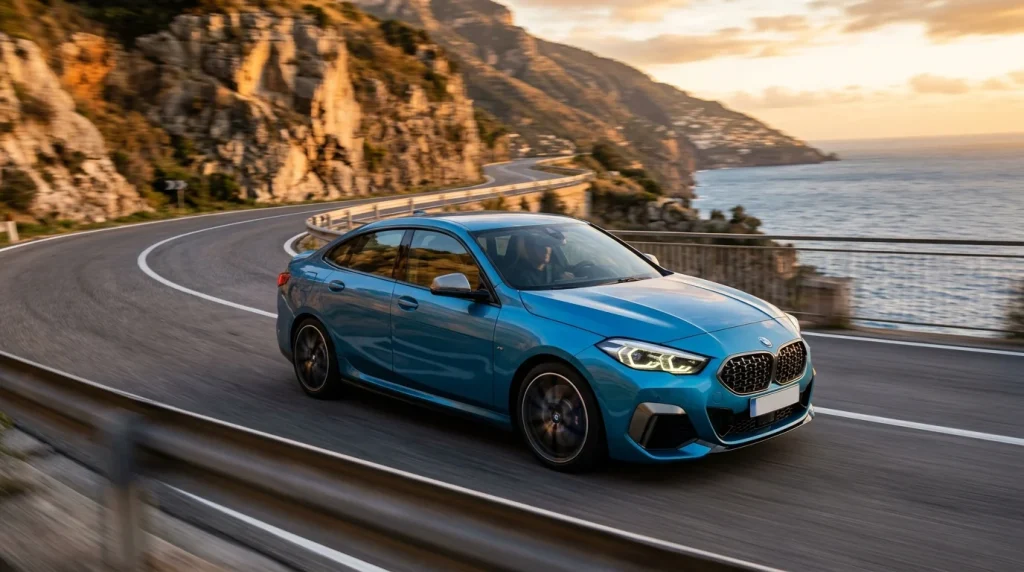
In independent instrumented testing, the M235 xDrive proves to be faster than BMW’s conservative performance estimates. While the manufacturer claims a 0-60 mph sprint of 4.7 seconds, test results from MotorTrend recorded a swift 4.4 seconds, with the quarter-mile cleared in 13.0 seconds at 107.6 mph. Car and Driver achieved an even quicker 0-60 mph time of 4.2 seconds. The standard 228 models are no slouches either, with the FWD version hitting 60 mph in an estimated 6.1 seconds, and the 228 xDrive clocking a tested 6.3 seconds in Consumer Reports testing.
Braking is equally impressive, particularly on the M235 xDrive. Thanks to its standard M Sport brakes and high-performance tires, the top-tier Gran Coupe can come to a stop from 60 mph in just 106 feet, putting it on par with dedicated sports cars.
Suspension, Steering, and Road Manners
While the dual-clutch transmission provides rapid upshifts under acceleration, it does introduce some compromises in daily driving. Road testers have noted low-speed power delays and occasional lurching when starting from a complete stop, which can become annoying in heavy stop-and-go traffic.
The standard adaptive suspension keeps the car flat and composed through high-speed corners. The M235 xDrive recorded a strong 0.94 g of lateral grip on the skidpad. However, this handling capability comes at the expense of ride comfort. Both testers and owners describe the ride quality as overly stiff, meaning you will feel every pothole and crack on broken urban streets. Furthermore, because the vehicle is built on a front-wheel-drive architecture, aggressive drivers may notice a tendency to understeer near the handling limits, lacking the traditional rear-wheel-drive rotation found in larger BMW sedans.
Interior Comfort, Tech, and Cargo Practicality
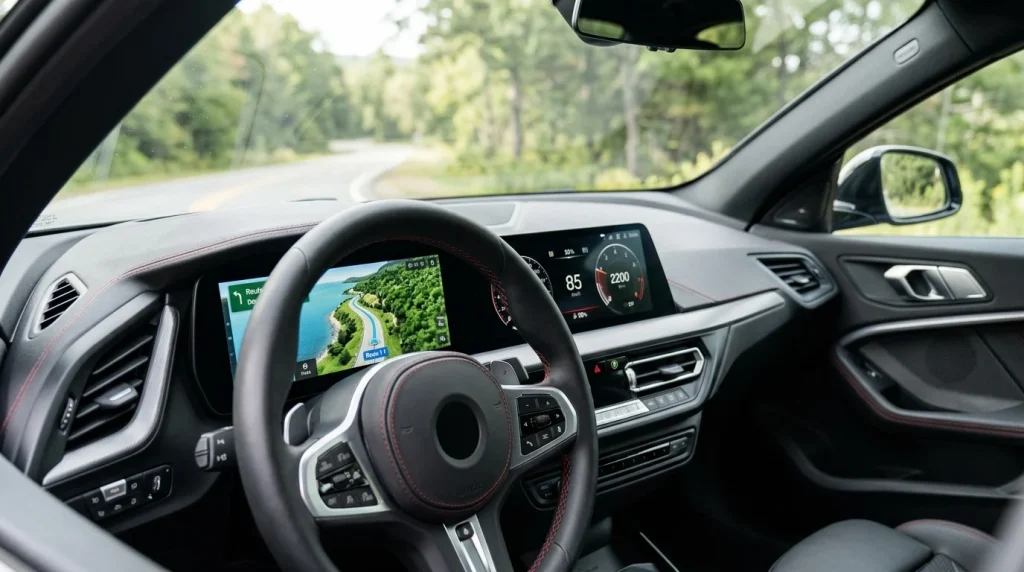
BMW has modernised the interior of the 2-Series Gran Coupe by removing almost all physical buttons and knobs from the dashboard, moving those functions into the digital screens.
The Curved Display and iDrive 9 Infotainment
The focal point of the dashboard is the BMW Curved Display, which houses a 10.25-inch digital instrument cluster and a 10.7-inch central infotainment screen under a single piece of glass. The system runs on BMW Operating System 9 (iDrive 9). While the screens are bright, sharp, and highly responsive, the interface can feel overwhelming at first. Consumer Reports noted that the menu structure has a steep learning curve, as drivers must navigate multiple touch menus to adjust simple settings like climate controls or air vent flow.
On the positive side, technology integration is seamless. Wireless CarPlay and Android Auto connect quickly, and the standard wireless charging pad keeps devices secure. BMW has also included the AirConsole gaming platform, which allows passengers to use their smartphones as controllers to play casual games on the central screen while the vehicle is parked.
Seating Space and Cargo Capacity
For the seats, BMW has replaced animal leathers with Veganza, a high-quality synthetic leather that feels soft and durable. Front-seat occupants enjoy excellent support, with deep side bolsters that hold passengers in place during cornering.
The rear seat, however, remains a major weak point. The sloping, coupe-like roofline reduces rear headroom significantly. Taller adults will find their heads brushing the headliner, and legroom is tight. The rear bench is far better suited for children and teenagers than for adults on long road trips. Cargo capacity is also compact: the trunk provides 12.0 cubic feet of space, which is adequate for grocery bags or a couple of carry-on suitcases, but falls short of larger sedans. The standard 40/20/40 split-folding rear seats do allow for longer items to be loaded when needed.
Fuel Economy, Range, and Real-world Efficiency
Thanks to its slippery aerodynamic profile and the efficiency of the seven-speed dual-clutch transmission, the 2026 model delivers competitive fuel economy ratings:
- 228 FWD: 27 mpg city / 38 mpg highway / 31 mpg combined
- 228 xDrive: 26 mpg city / 38 mpg highway / 30 mpg combined
- M235 xDrive: 24 mpg city / 33 mpg highway / 27 mpg combined
In real-world testing, Consumer Reports recorded an impressive 30 mpg overall with the 228 xDrive, representing a 3-mpg improvement over the previous-generation model. With its 13.2-gallon fuel tank, the FWD 228 can easily exceed 400 miles of highway range on a single fill-up. Drivers should note that premium unleaded gasoline is required for all models to prevent engine knock and maintain full power output.
Safety Ratings and Driver Assistance Systems
While the Insurance Institute for Highway Safety (IIHS) has not finalized crash-test evaluations for the newest model year, the previous iteration earned top “Good” scores across all primary crashworthiness categories. In Europe, the redesigned platform received a four-star safety rating from Euro NCAP, performing exceptionally well in side-impact protection but losing minor points in child occupant protection and active safety system evaluations.
Standard safety equipment is comprehensive under BMW’s Active Driving Assistant suite. Every model features:
- Forward collision warning with automated emergency braking and pedestrian detection
- Lane-departure warning with lane-keeping assist
- Blind-spot monitoring with rear cross-traffic alert
- Speed limit information
For buyers who want hands-free highway driving capability, the optional Driving Assistance Professional Package is available for $1,700, though it requires adding the Technology and Premium packages first.
Competitor Comparison: BMW 2-Series vs. Audi A3 vs. Mercedes CLA
The luxury entry-level segment has undergone notable shifts. The comparison below highlights how the base FWD BMW 228 compares to its closest German rivals:
| Specification | 2026 BMW 228 Gran Coupe | 2026 Audi A3 40 TFSI | 2026 Mercedes-Benz CLA 250+ |
|---|---|---|---|
| Engine Type | 2.0L Turbo Gas I4 | 2.0L Turbo Gas I4 + 48V Hybrid | Single Electric Motor (EV) |
| Horsepower | 241 hp | 201 hp | 268 hp |
| Torque | 295 lb-ft | 236 lb-ft | 247 lb-ft |
| Drivetrain | FWD (AWD optional) | AWD Standard (quattro) | RWD (AWD optional) |
| 0-60 mph (Est.) | ~6.1 sec | ~6.0 sec | 6.6 sec |
| EPA Efficiency | 31 mpg combined | 28 mpg combined | 374 miles range (EV) |
| Base MSRP | $39,600 | $40,100 | $48,500 (incl. destination) |
2026 BMW 2-Series Gran Coupe vs. 2026 Audi A3
The Audi A3 remains the most traditional competitor. Audi updated the A3 by making its quattro all-wheel-drive system standard at its base price of $40,100. However, the Audi’s mild-hybrid engine produces only 201 horsepower, trailing the base BMW 228 by 40 horsepower. The BMW also delivers better highway fuel economy and offers a more aggressive suspension setup, though the Audi provides a slightly more comfortable, compliant ride over bad pavement.
2026 BMW 2-Series Gran Coupe vs. 2026 Mercedes-Benz CLA
Mercedes-Benz has rewritten the rules for the CLA-Class by moving the vehicle onto the new MMA (Mercedes Modular Architecture) platform. The launch models, such as the CLA 250+ starting at $48,500, are fully electric (EV) and feature an 800-volt charging system with up to 374 miles of range. However, this platform is not electric-only: Mercedes will introduce 48-volt gasoline mild-hybrid variants powered by a new 1.5-liter turbocharged engine at a later date. Compared to the electric CLA, the BMW 228 is much lighter (roughly 3,500 pounds versus the CLA EV’s 4,500 pounds) and costs nearly $9,000 less, though the Mercedes offers a more futuristic cabin and a quieter cabin environment.
Warranty, Ownership Costs, and Maintenance Value
BMW covers the 2026 Gran Coupe with a four-year or 50,000-mile limited warranty, along with four years of unlimited-mileage roadside assistance. The standout ownership benefit, however, is BMW Ultimate Care, which provides three years or 36,000 miles of complimentary scheduled maintenance. This package covers engine oil changes, cabin air filter replacements, brake fluid services, and standard vehicle inspections.
This complimentary maintenance program offers substantial savings over rivals. Audi provides only one year of free maintenance, while Mercedes-Benz does not offer any complimentary scheduled maintenance. For long-term reliability context, buyers can look back at the older 2023 BMW 2-Series Gran Coupe to review historical owner reports and check service milestones.
Pros and Cons of the 2026 BMW 2-Series Gran Coupe
Pros
- New Base Pricing: The FWD 228 model lowers the entry price to $39,600, offering strong value.
- Strong Engine Output: The 241-horsepower base engine easily outpowers the Audi A3.
- Excellent Maintenance Coverage: Three years of free maintenance beats Mercedes and Audi.
- Generous Standard Equipment: Features like adaptive suspension and Harman Kardon audio are included without extra cost.
Cons
- Stiff Ride Quality: The suspension is tuned tightly, causing a harsh ride on broken pavement.
- Low-Speed DCT Behavior: The dual-clutch transmission can lurch or delay in heavy traffic.
- Restricted Rear Headroom: The sloping roofline makes the rear seat uncomfortable for taller adults.
- Price Overlap: A loaded M235 xDrive can easily cross $55,000, overlapping with the larger and better-handling 3-Series.
Frequently Asked Questions
Is the 2026 BMW 2-Series Gran Coupe worth buying?
Yes, for buyers seeking a modern, high-tech luxury sedan with a starting price under $40,000. The generous standard features and three years of free maintenance make the base 228 a strong value. However, if back-seat space or classic rear-wheel-drive BMW handling are priorities, stepping up to a base 3-Series is a wiser long-term choice.
Should I buy the 228 FWD or 228 xDrive?
If you live in a region that does not experience heavy winter snow, the front-wheel-drive 228 is the best choice, allowing you to save $2,000. For drivers in cold-weather states, the 228 xDrive is worth the upgrade for its increased traction on slippery roads and improved wet-weather acceleration.
What is the difference between the 2025 and 2026 BMW 2-Series Gran Coupe?
The only mechanical difference is the addition of the front-wheel-drive 228 model for the 2026 model year. All other specifications, engines, transmissions, interior curved screens, and design elements are identical to the redesigned model that launched for the 2025 model year.

