

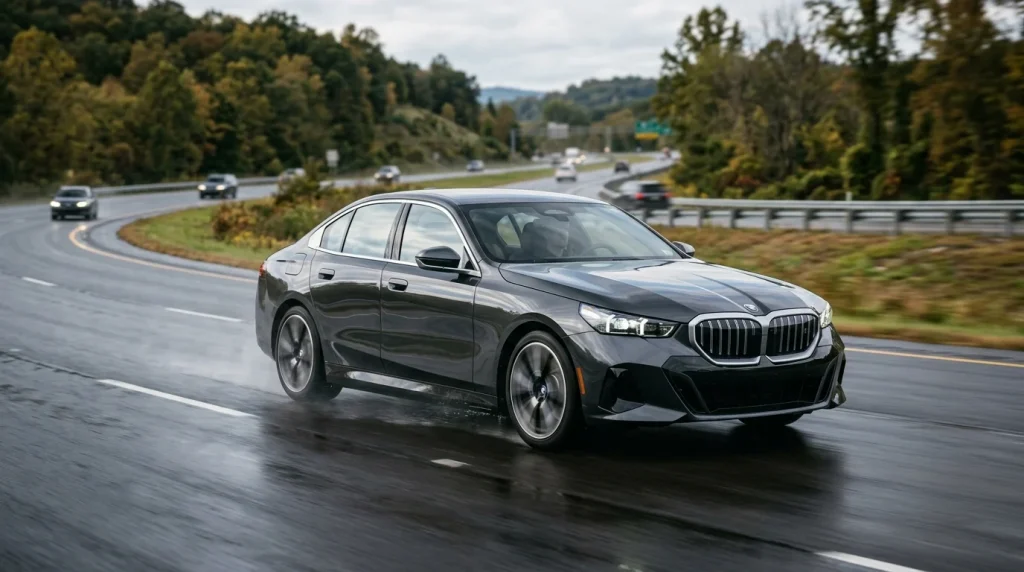
Quick answer: The 2025 BMW 5 Series is a comfortable, technologically advanced midsize luxury sedan that prioritizes highway refinement over the athletic handling dynamics of its predecessors. Trims range from the fuel-efficient four-cylinder 530i starting at $58,700 MSRP to the newly introduced 550e xDrive plug-in hybrid at $73,400 MSRP, which delivers 483 hp and up to 34 miles of all-electric range.
Key takeaways:
- High-end cabin refinement featuring a Curved Display running the latest iDrive 8.5 software.
- Expanded powertrain choices, highlighted by the new 483 hp 550e xDrive plug-in hybrid.
- Numb steering feel that sacrifices the classic driving engagement traditional BMW buyers expect.
- Touchscreen-based controls for climate settings and air vents complicate cabin usability.
- Outstanding crashworthiness safety ratings and pedestrian collision avoidance scores from the IIHS.
What’s New for the 2025 BMW 5-Series?
BMW introduced targeted mechanical and equipment updates for the 2025 model year rather than overhaul the vehicle, which was fully redesigned just one year prior. The headline addition is the 550e xDrive plug-in hybrid (PHEV) sedan, which provides high-performance electrified driving. Standard heated front seats are also now included on all gasoline and plug-in hybrid trims, a convenient feature that previously required purchasing optional packages.
Buyers who are cross-shopping a used 2024 BMW 5-Series will find that the physical differences between the two model years are minimal. Because the platform was fully redesigned last year, opting for a late-model pre-owned vehicle can offer substantial financial savings. However, the 2025 inventory remains the only choice for buyers who specifically want the plug-in hybrid powertrain or value factory-standard heated seats.
The full spectrum of powertrains now covers every buyer preference. Fans of traditional combustion engines can choose between the four-cylinder 530i and the six-cylinder 540i, while those dipping into electrification have the 550e xDrive plug-in hybrid.
2025 BMW 5-Series Pricing, Trims, and Engine Specs
The gasoline and plug-in hybrid 5-Series models use an eight-speed automatic transmission. Drivetrains include rear-wheel drive (RWD) and all-wheel drive (xDrive). MSRP pricing spans from $58,700 to $73,400.
| Trim | Base MSRP | Engine Type | Output (Horsepower / Torque) | 0-60 mph (Seconds) | EPA Fuel Economy (Combined) |
|---|---|---|---|---|---|
| 530i | $58,700 | 2.0L Turbo I4 + 48V Mild Hybrid | 255 hp / 295 lb-ft | 5.9 sec | 31 mpg |
| 530i xDrive | $61,000 | 2.0L Turbo I4 + 48V Mild Hybrid | 255 hp / 295 lb-ft | 5.8 sec | 30 mpg |
| 540i xDrive | $65,800 | 3.0L Turbo I6 + 48V Mild Hybrid | 375 hp / 398 lb-ft | 4.4 sec | 28 mpg |
| 550e xDrive | $73,400 | 3.0L Turbo I6 + PHEV System | 483 hp / 516 lb-ft (combined) | 4.3 sec | 24 mpg / 67 MPGe |
According to retail market reports, buyers can find dealer inventory sitting longer on lots, with 530i models averaging 328 to 358 days of market supply. This translates into negotiating leverage for buyers, with average transaction prices settling below MSRP. Special promotional financing rates also help lower ownership costs.
While the base 530i serves as an efficient commuter, experts recommend upgrading to the 540i xDrive. The 3.0-liter turbocharged inline-six engine provides linear power delivery and pairs with excellent real-world efficiency that frequently beats EPA highway estimates.
Performance, Handling, and Driving Dynamics
The 2025 BMW 5-Series delivers a planted, silent, and highly controlled ride at highway speeds. The cabin remains isolated from road vibrations, and the firm suspension setup manages body roll without feeling harsh over bumps. However, the driving experience marks a significant departure from older generations.
The steering feel is the main drawback for driving enthusiasts. Drew Dorian, Associate Editor at Car and Driver, noted that the sedan “sacrifices some of the athletic personality found in smaller Bimmers,” listing “numb steering” as one of the primary negatives of the vehicle.
The Consumer Reports Auto Test Team shared a similar disappointment during their track evaluation, stating: “it turns into corners more quickly than before, but the power assist effort is overly light and it gives little feedback to the driver about road texture or tire grip.”
While the chassis is highly capable and brakes deliver impressively short stopping distances, the lack of communication through the steering wheel makes the 5-Series feel like a comfortable grand touring machine rather than a traditional sports sedan.
The 550e xDrive Plug-In Hybrid Experience
The new 550e xDrive plug-in hybrid pairs BMW’s B58 3.0-liter turbocharged inline-six engine with a 14.4 kWh usable battery pack and an electric motor. The electric motor is integrated directly into the transmission housing. This configuration yields a combined output of 483 horsepower and 516 lb-ft of torque, enabling the sedan to reach 60 mph in 4.3 seconds.
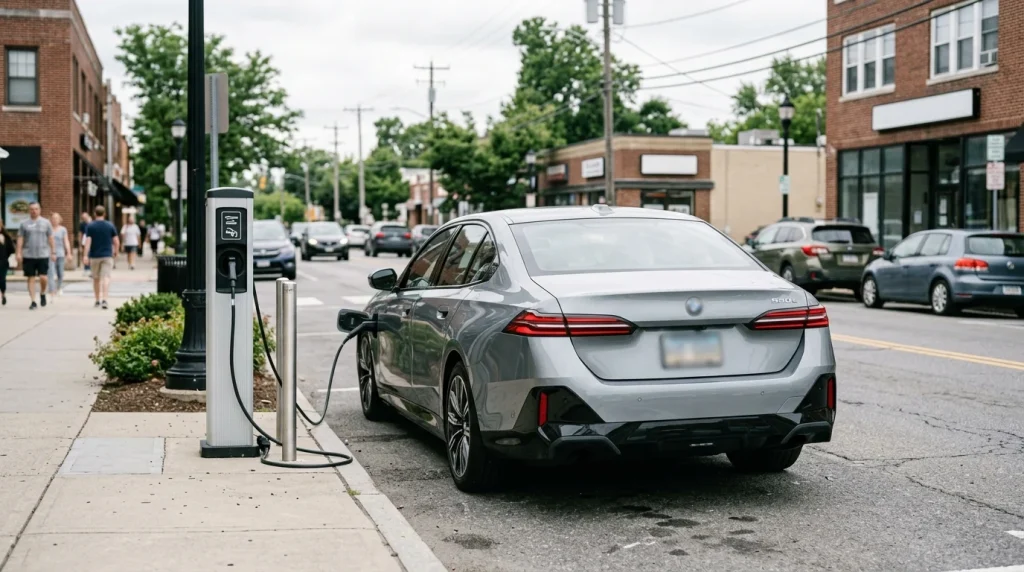
In real-world testing, the hybrid system transitions smoothly between gas and electric modes. Drivers rarely feel any physical jolt when the gasoline engine ignites. The vehicle delivers up to 34 miles of electric-only range on a full charge. When the battery is depleted, the vehicle operates as a standard hybrid, returning respectable fuel economy.
Technology Controls and Interior Usability
The cabin of the 2025 5-Series is highly modern, drawing design cues from the premium 7-Series. A single Curved Display housing a 12.3-inch instrument cluster and a 14.9-inch touchscreen dominates the dashboard, running iDrive 8.5 software. The system features wireless Apple CarPlay and Android Auto, a wireless charging pad, and an optional Bowers & Wilkins surround-sound system.
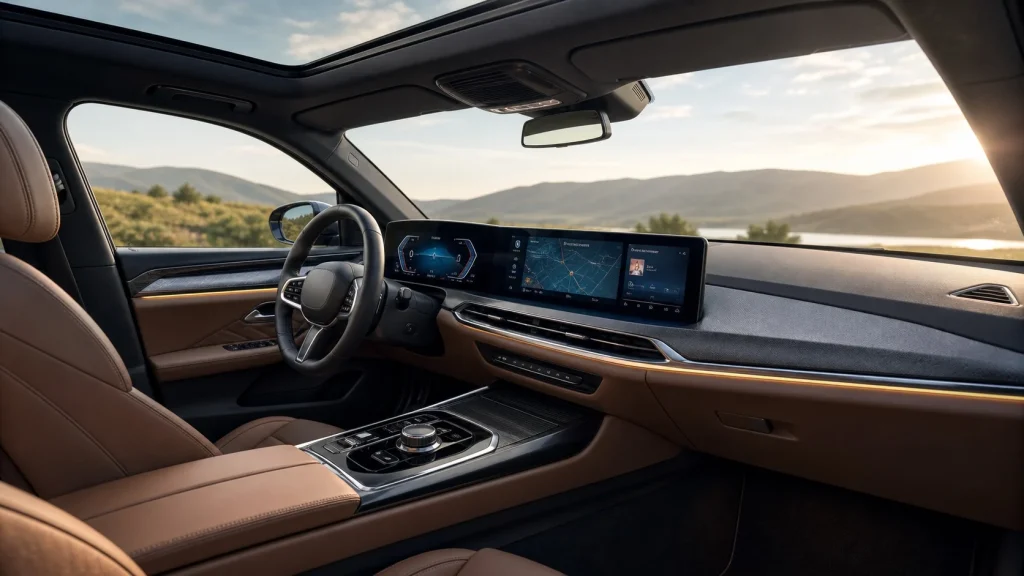
Rear-seat passengers enjoy generous legroom and wide door openings, making the cabin highly practical. Gasoline models also boast 18.4 cubic feet of trunk space, which is larger than most competitor trunks.
However, the layout suffers from usability issues due to the removal of physical buttons. The climate controls, heated seats, and air vent directions are operated through the touchscreen. Adjusting basic functions requires navigating submenus, which can distract the driver from the road.
The Edmunds Expert Review Team criticized this setup during their instrumented tests, stating: “The climate system is powerful but is a little more complicated to operate than it should be. The air vents are needlessly difficult to adjust and fine-tune, and the touchscreen-based controls can be distracting to use while driving.”
Analysis: Moving high-frequency physical controls like climate adjusters and seat heaters into digital menus increases cognitive load for the driver, making simple adjustments complex during highway travel.
Note: The current generation has grown significantly in size compared to older models like the 2023 BMW 5-Series. The vehicle measures nearly 200 inches in length, which makes parking and garage storage more challenging.
Safety Ratings and Driver Assistance Features
The 2025 BMW 5-Series earned top safety honors, receiving a “Good” rating in all crashworthiness evaluations conducted by the Insurance Institute for Highway Safety (IIHS). The evaluations included the small overlap front, moderate overlap front, and side-impact tests. Both the standard and optional LED headlight systems also scored “Good” marks.
The standard Active Driving Assistant includes forward collision warning, automatic emergency braking, lane departure warning, and blind-spot monitoring. During official IIHS safety evaluations, the vehicle’s standard pedestrian crash prevention system avoided collisions across multiple testing speeds:
- Crossing child during daylight: The collision was completely avoided at 12 mph and 25 mph.
- Crossing adult at night: The vehicle avoided impact at 12 mph and 25 mph using both low and high-beam headlights.
- Parallel adult at night: The collision was avoided at 25 mph, and the system issued a collision warning 1.6 to 1.9 seconds before impact at 37 mph, slowing the vehicle to mitigate severity.
The optional Highway Assistant package allows for hands-free driving on designated highways at speeds up to 85 mph. The package uses driver-facing cameras to monitor attentiveness, requiring the driver to keep their eyes on the road.
Reliability Concerns and Common Owner Complaints
Consumer Reports ranks the 2025 5-Series below average for reliability compared to other new luxury vehicles. The main trouble areas involve in-car electronics, software glitches in the curved display, and electrical accessories.
Other common owner complaints include:
- Frequent punctures of the standard run-flat tires, which lack a spare tire in the trunk.
- High-gloss piano black trim on the center console showing fingerprints, dust, and micro-scratches easily.
- The overall length of the vehicle making tight parking spots and narrow lanes difficult to negotiate.
For owners transitioning from older generations like the 2023 BMW 5-Series, the larger physical footprint of the newer platform is immediately noticeable. Parking in tight garages requires extra care due to the extended wheelbase and width.
Comparing the 2025 BMW 5-Series to Key Rivals
The midsize luxury sedan segment features fierce competition. The table below compares the base 2025 BMW 530i to the Mercedes-Benz E350 and the Genesis G80.
| Specification | 2025 BMW 530i | 2025 Mercedes-Benz E350 | 2025 Genesis G80 |
|---|---|---|---|
| Base MSRP | $58,700 | $62,300 | $57,100 |
| Engine Output | 255 hp / 295 lb-ft | 255 hp / 295 lb-ft | 300 hp / 311 lb-ft |
| EPA Combined Fuel Economy | 31 mpg | 27 mpg | 25 mpg |
| Cargo Space | 18.4 cu ft | 13.1 cu ft | 13.1 cu ft |
| Bumper-to-Bumper Warranty | 4 years / 50,000 miles | 4 years / 50,000 miles | 5 years / 60,000 miles |
The BMW 530i stands out by delivering 31 mpg combined, beating both German and South Korean competitors. It also offers a much larger trunk capacity than the Genesis G80. However, the Mercedes E-Class provides a quieter cabin and optional air suspension, while the Genesis G80 offers superior engine power and a longer warranty period.
Pros and Cons
Advantages:
- Class-leading fuel economy on the base 530i, returning 31 mpg combined.
- Generous trunk capacity measuring 18.4 cubic feet on gasoline-only trims.
- Smooth integration of the gasoline engine and electric motor in the new 550e hybrid.
- Advanced driver assistance systems, including the hands-free Highway Assistant.
- Standard four-year or 50,000-mile complimentary scheduled maintenance package.
Disadvantages:
- Numb steering dynamics that offer minimal feedback from the road surface.
- Overly complicated touchscreen controls for basic climate and air vent adjustments.
- Below-average reliability ratings from Consumer Reports due to software bugs.
- Substantial footprint that makes parking in tight urban spaces challenging.
- Lack of a spare tire, relying on run-flat tires that are prone to punctures.
Final Verdict: Is the 2025 BMW 5-Series Worth Buying?
The 2025 BMW 5-Series is an excellent purchase for luxury buyers who prioritize highway comfort, passenger space, fuel economy, and advanced cabin technology. Commuters and long-distance drivers will find it to be an exceptionally quiet and stable companion. The 540i xDrive offers the best balance of combustion power and efficiency, while the 550e xDrive plug-in hybrid serves as the ideal bridge to electrification without range anxiety.
However, driving enthusiasts looking for the sporty, communicative dynamics of older models will be disappointed. The steering simply does not communicate like it used to. If driving engagement is your top priority, you may want to explore preceding generations in the BMW 5-Series lineup or wait to see how the platform evolves with the upcoming 2026 BMW 5-Series.
Frequently Asked Questions about the 2025 BMW 5-Series
Is the 2025 BMW 5-Series reliable?
Consumer Reports rates the 2025 BMW 5-Series below average in predicted reliability, highlighting potential glitches in the in-car electronics and display screens. However, the standard four-year or 50,000-mile factory warranty and complimentary maintenance help mitigate initial repair costs.
What is the difference between the BMW 530i and 540i?
The 530i uses a 2.0-liter turbocharged four-cylinder engine making 255 hp and returns up to 31 mpg combined. The 540i xDrive features a 3.0-liter turbocharged inline-six producing 375 hp, dropping fuel economy to 28 mpg combined but lowering the 0-60 mph time to 4.4 seconds.
How does the 2025 BMW 550e compare to the M5?
The 550e xDrive plug-in hybrid produces 483 combined horsepower, sprints to 60 mph in 4.3 seconds, and starts at $73,400 MSRP with 34 miles of electric range. The track-focused M5 produces over 700 horsepower, utilizes a plug-in hybrid V8 system, costs well over $100,000, and is built for extreme performance rather than comfortable daily efficiency.
Does the 2025 BMW 5-Series support wireless Apple CarPlay?
Yes, wireless Apple CarPlay and wireless Android Auto are standard features across all 2025 BMW 5-Series configurations. The connection works alongside a standard wireless smartphone charging tray and charges no subscription fees.

