

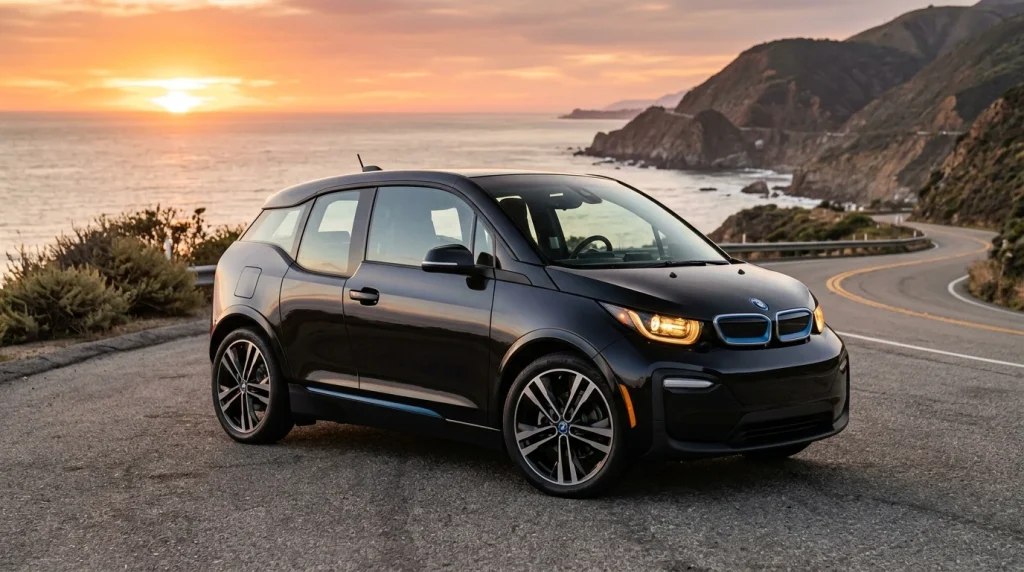
Quick answer:
The 2021 BMW i3 represents the final production year of BMW’s pioneering electric city car. Built with a unique carbon fiber reinforced plastic chassis, it features an agile urban handling profile. In 2026, used market values for a base battery-electric model (BEV) typically range from a trade-in value of $12,034 to a private resale value of $14,868. While its electric range (126 to 153 miles depending on variant) and 50 kW fast charging speeds trail modern EV alternatives, it remains a distinctive, low-maintenance commuter.
Key takeaways:
- The 2021 i3 has experienced significant depreciation, offering an affordable premium entry point to the used EV market in 2026.
- Pure battery-electric (BEV) models feature a 42.2 kWh battery pack rated for a 153-mile EPA range.
- Range Extender (REx) variants add a 647 cc gasoline generator that increases total EPA-rated range to 200 miles, though all-electric range drops to 126 miles due to the added weight.
- Specialized design elements like the rear-hinged coach doors and tall, narrow tires provide unique style but introduce daily practical limitations and high replacement costs.
Used Market Pricing: Original MSRP vs. 2026 Values
The 2021 BMW i3 was positioned as a premium subcompact electric vehicle during its launch. Originally, U.S. buyers faced a steep starting manufacturer’s suggested retail price (MSRP) structure. The base battery-electric model (BEV) launched with an original MSRP of $44,450. Upgrading to the Range Extender (REx) variant pushed the starting price to $48,300. The performance-focused i3s trims carried even higher price tags, starting at $47,650 for the i3s BEV and topping out at $51,500 for the flagship i3s REx. These base prices excluded the standard $995 destination charge, local dealership documentation fees, and applicable state taxes.
By mid-2026, the used market landscape for this unique vehicle looks vastly different. Due to the rapid pace of battery technology development and the discontinuation of the model line, the i3 has experienced a heavy depreciation rate of approximately 56% over three years. This sharp decline in residual value makes the late-model i3 an exceptional value proposition for second-hand buyers. According to guidebook estimates from Kelley Blue Book (KBB), a 2021 BMW i3 BEV in average condition holds a trade-in value of approximately $12,034 and a private party resale value of around $14,868.
For retail consumers shopping at used car dealerships, actual asking prices vary based on regional supply, vehicle condition, and mileage. Lower-spec BEV models with moderate mileage generally list for $17,000 to $20,000. Well-preserved REx and sportier i3s variants, which are highly sought after by enthusiasts, command higher prices, typically listing between $20,000 and $29,000. Low-mileage, certified pre-owned examples of the i3s REx in outstanding condition can still reach up to $31,000.
These current used price bands represent a major discount compared to brand-new electric alternatives. Buyers looking for older models can check the 2020 BMW i3 Review to compare price points, or browse the overall BMW i3 category page to track the market history of this model.
| Trim Level (U.S. Spec) | Original MSRP (Excl. Destination) | 2026 Used Retail Price Range | Est. 2026 Private Party Value |
|---|---|---|---|
| i3 BEV (120 Ah) | $44,450 | $17,000 – $20,000 | $14,868 |
| i3 REx (120 Ah) | $48,300 | $20,000 – $24,000 | $18,200 |
| i3s BEV (120 Ah) | $47,650 | $19,000 – $23,000 | $16,900 |
| i3s REx (120 Ah) | $51,500 | $23,000 – $29,000 | $21,500 |
Battery Specifications, Real-World Range, and Charging Speeds
The core drivetrain of the 2021 BMW i3 centers around a 120 Ah lithium-ion battery pack. This battery has a nominal or gross capacity of 42.2 kWh. To preserve battery health and ensure long-term durability, BMW reserves a safety buffer, leaving a net usable capacity of 37.9 kWh. The standard i3 BEV and the sportier i3s BEV receive an official EPA rating of 153 miles of all-electric range on a single charge. Official efficiency data published on fueleconomy.gov rates the pure electric BEV at 113 MPGe combined (124 MPGe city and 102 MPGe highway), with an energy consumption of 30 kWh per 100 miles.
Real-world range differs based on driving habits and external conditions. In moderate urban environments, drivers frequently exceed the EPA estimate, achieving up to 165 miles due to slow speeds and regenerative braking. However, cold winter weather reduces battery efficiency, dropping highway range to 110-120 miles when running the cabin heater.
For buyers experiencing range anxiety, the REx (Range Extender) variant provides a practical fallback. The REx model retains the same 42.2 kWh battery pack but adds a rear-mounted 647 cc two-cylinder gasoline generator. The system utilizes a fuel tank with a usable capacity of 2.4 gallons in the U.S. market. The small engine does not drive the wheels directly. Instead, it turns on automatically when the battery charge drops to 6.5% to generate electricity and maintain the battery’s state of charge. This hybrid setup increases the total EPA-rated driving range of the REx to 200 miles. However, because the REx hardware adds roughly 265 pounds of weight, its all-electric range drops to 126 miles, and its electric-mode efficiency is rated lower at 100 MPGe combined.
Charging the 2021 i3 is straightforward but limited by outdated hardware parameters. For daily home charging, the vehicle is equipped with a 7.4 kW onboard charger. When plugged into a 240V Level 2 charger, the battery replenishes from empty to full in approximately 4 to 5 hours. When traveling longer distances, the i3 is compatible with public CCS DC fast charging networks. However, fast charging speeds are capped at a maximum rate of 50 kW. Under ideal temperature conditions, a 50 kW DC fast charger charges the i3 battery from 10% to 80% capacity in 42 minutes. This charging rate is slow compared to modern electric vehicles, making the i3 less suitable for frequent long-distance road trips.
| Drivetrain Parameter | Pure Electric (BEV) Model | Range Extender (REx) Model |
|---|---|---|
| Gross Battery Capacity | 42.2 kWh | 42.2 kWh |
| Net Usable Capacity | 37.9 kWh | 37.9 kWh |
| EPA Electric Range | 153 miles | 126 miles |
| EPA Total Range | 153 miles | 200 miles (Battery + Gas) |
| REx Fuel Capacity | Not Applicable | 2.4 gallons usable |
| REx Gas-Only Fuel Economy | Not Applicable | 31 MPG combined |
| DC Fast Charging Max | 50 kW | 50 kW |
| 10% to 80% DC Charge Time | 42 minutes | 42 minutes |
| Level 2 Home Charge Time | 4.5 hours | 4.5 hours |
Performance Metrics and Urban Driving Dynamics
BMW engineered the i3 to excel in tight urban environments. The standard 2021 BMW i3 BEV utilizes a rear-mounted synchronous electric motor that generates 170 horsepower and 184 lb-ft of torque. Because electric motors deliver torque instantly, the base i3 accelerates briskly, sprinting from 0 to 60 mph in 7.2 seconds. The sport-tuned i3s model receives a modified motor that boosts output to 181 horsepower and 199 lb-ft of torque. This extra power trims the 0 to 60 mph sprint time down to 6.9 seconds.
Adding the REx package increases curb weight due to the weight of the gasoline generator and fuel tank. The range extender hardware adds roughly 265 pounds, which increases the standard i3 REx 0 to 60 mph time to approximately 8.0 seconds.
Urban driving dynamics are the i3’s primary strength. Thanks to a short 101.3-inch wheelbase and a rear-wheel-drive layout, the standard model has an exceptionally tight turning circle of 32.3 feet. This tight turning radius makes parallel parking and U-turns in city streets effortless. The vehicle features a low center of gravity because the heavy lithium-ion battery pack is mounted low in the aluminum drive module. This weight distribution creates flat cornering and highly responsive steering at lower speeds. The i3’s one-pedal driving system is aggressive. When the driver lifts off the accelerator, the motor immediately switches to regenerative braking, recovering kinetic energy and slowing the vehicle to a complete stop without using the brake pedal.
However, the chassis design that makes the i3 agile in the city compromises highway performance. The short wheelbase and tall, narrow body make the car sensitive to crosswinds at speeds above 65 mph. Drivers often report that highway lane tracking feels nervous, requiring frequent steering corrections when passing large semi-trucks. The ride quality on uneven pavement is stiff, especially in the i3s trim, which features a sport suspension that is 10 millimeters lower and rides on wider, low-profile tires.
LifeDrive Architecture: Interior Design, Sustainable Materials, and Coach Doors
The cabin of the 2021 BMW i3 showcases BMW’s LifeDrive architecture. The passenger compartment, or Life module, is constructed entirely of carbon fiber reinforced plastic (CFRP). This advanced construction is incredibly strong and lightweight, allowing BMW to offset the weight of the battery pack. Because the carbon fiber shell is self-supporting, BMW eliminated the traditional B-pillar, which is the structural post between the front and rear doors. This design decision enabled the implementation of rear-hinged coach doors, commonly referred to as suicide doors.
The coach doors create a wide, unobstructed opening when both the front and rear doors are open. This layout makes entering and exiting the front seats easy. However, the design introduces daily inconveniences. The rear doors cannot open independently. The front seat occupant must unbuckle their seatbelt and open their door before the rear passenger can exit. Additionally, in tight parking spots, the open front and rear doors can trap occupants between them, making loading cargo or passengers difficult. The door design also complicates the installation of child safety seats, as the rear-hinged doors restrict access in tight spaces.
Inside, the i3 features a minimalist, loft-like design layout. BMW focused heavily on sustainable materials, which comprise about 25% of the interior plastics. The dashboard and door panel trims are made from renewable kenaf plant fibers, which have a unique, textured gray appearance. The accent strips feature open-pore eucalyptus wood sourced from certified sustainable forests, which ages naturally over time. Buyers could choose from four interior design worlds: Atelier, Loft, Lodge, and Tera. The top-tier Tera package features natural leather tanned with olive leaf extract to prevent chemical pollution.
The tall roofline gives the cabin an open feel, providing 40.9 inches of front headroom and 37.7 inches of rear headroom. Front legroom is generous at 41.8 inches, though rear legroom is tight at 35.1 inches, making it best suited for children or short trips for adults. Cargo capacity is modest, offering 15.1 cubic feet behind the rear seats, which expands to 36.9 cubic feet when the 50/50 split rear seats are folded flat.
| Cabin Dimension | Front Seats | Rear Seats |
|---|---|---|
| Headroom | 40.9 inches | 37.7 inches |
| Legroom | 41.8 inches | 35.1 inches |
| Shoulder Room | 53.0 inches | 49.2 inches |
| Cargo Volume (Behind Seats) | Not Applicable | 15.1 cubic feet |
| Cargo Volume (Seats Folded) | Not Applicable | 36.9 cubic feet |
2026 Used Ownership Cost Analysis: Tires, Insurance, and Maintenance
When purchasing a used electric vehicle, understanding the total cost of ownership is critical. The 2021 i3 offers notable operational savings, but these are balanced by high fixed costs. In 2026, running a used i3 costs between $3,400 and $4,900 annually, depending on insurance rates and maintenance needs.
The biggest operational advantage of the i3 is electricity efficiency. Charging the i3 costs roughly $500 to $800 annually, assuming 10,000 miles driven. In comparison, a traditional gasoline-powered luxury compact car costs $2,000 to $2,800 annually in fuel.
However, these savings are offset by higher insurance premiums. Because the i3 is constructed with a carbon fiber chassis, accident repairs are expensive. Most conventional body shops lack the specialized training and equipment required to repair carbon fiber structural panels. As a result, minor accidents that would require simple metal pull repairs on traditional cars can cause insurance companies to write off the i3 as a total loss. This repair risk results in high insurance premiums, averaging $1,800 to $2,400 annually in 2026.
Tire replacement is another unique expense. To maximize aerodynamics and reduce rolling resistance, BMW partnered with Bridgestone to design custom, tall, narrow tires specifically for the i3. The standard model uses 155/70R19 tires, while the i3s uses wider versions like 175/60R19 or 175/55R20. Because these sizes are unique to the i3, there are few alternative options. A set of replacement Bridgestone Ecopia tires costs $800 to $950 in parts alone, and they wear out faster than average due to the instant torque of the electric motor.
For buyers planning ahead, comparing the 2021 model’s cost profile with the future concepts, which are completely revised in the 2026 BMW i3 design, helps illustrate how ownership costs are shifting with newer platforms.
Key Reliability Concerns, Common Problems, and Recalls
The 2021 model year represents the final refinement of the i3 platform, avoiding many of the teething issues that affected early 2014-2016 production models. Consumer Reports and other reliability databases give the late-model i3 a high reliability rating of 94.5%. However, used buyers should remain aware of several known issues.
For the pure electric BEV model, the most common hardware failure involves the high-voltage charging port lock motor. Over time, road grime and moisture penetrate the locking mechanism, causing the charging cable to stick or prevent the vehicle from starting a charge. Replacing the charge port assembly at a dealership costs $800 to $1,500.
Additionally, the standard 12V accessory battery has a lifespan of 3 to 4 years. When the 12V battery drops in voltage, it triggers various warning lights and false drivetrain error codes on the dashboard. Replacing this battery costs $200 to $350 and resolves most minor electrical glitches.
Range Extender (REx) models introduce more mechanical complexity. REx owners often face check engine lights related to the fuel system. Because REx drivers rarely run the gasoline generator, fuel can sit in the tank for months and spoil. This stale fuel clogs the injectors and causes rough idling or starting failures. BMW also added a pressurized fuel tank system with a temperamental vapor sensor. This sensor frequently fails, preventing the fuel door from unlocking and requiring manual release cord intervention. The front oxygen sensor on i3 REx models has also been noted to trigger check engine warnings sporadically.
In terms of steering, BMW issued service bulletins in December 2020 noting that steering assistance could sporadically reduce under certain driving conditions. While steering control is never fully lost, it may require more driver effort. It is important to clarify that the major safety recall (NHTSA campaign 21V031) regarding a loose steering column universal joint applies to 2021 BMW X5, X6, and X7 models, not the i3.
Routine maintenance for the i3 BEV is minimal, requiring cabin air filter changes annually and a brake fluid flush every 2 years. REx models require regular engine maintenance, including annual oil changes and spark plug inspections, which add $300 to $500 to annual service budgets.
| Common Repair / Service Item | Average Repair Cost | Occurrence Frequency | Drivetrain Affected |
|---|---|---|---|
| 12V Accessory Battery Replace | $200 – $350 | High (Every 3-4 years) | Both BEV and REx |
| Charging Port Lock Motor Replace | $800 – $1,500 | Moderate | Both BEV and REx |
| REx Fuel Vapor Sensor & Door Lock | $400 – $700 | Moderate | REx Only |
| Bridgestone Ecopia Tire Set (4) | $800 – $950 | High (Every 20k miles) | Both BEV and REx |
| REx Engine Oil & Filter Service | $150 – $250 | High (Annual) | REx Only |
Used EV Comparison: 2021 BMW i3 vs. Tesla Model 3 and Chevrolet Bolt
To evaluate if the 2021 BMW i3 is the right used EV, comparing it to other options from the same model year is helpful. The primary competitors are the 2021 Tesla Model 3 Standard Range Plus and the mass-market 2021 Chevrolet Bolt EV.
The Tesla Model 3 is the benchmark for range and charging performance. With an EPA-rated range of 263 miles and compatibility with Tesla’s Supercharger network at speeds up to 170 kW, the Model 3 handles long-distance road trips easily. In contrast, the i3’s 126 to 153-mile range and 50 kW charging speed limit it to regional driving.
However, the i3 holds a clear price advantage on the used market in 2026. A used 2021 Model 3 averages $22,000 to $28,000, while a used i3 BEV can be purchased for $13,000 to $17,000, providing an affordable entry point to EV ownership.
The Chevrolet Bolt EV represents the practical value option. It features a conventional hatchback design with a large 66 kWh battery pack that provides 259 miles of range. While the Bolt offers more range for a similar used price, it lacks the luxury feel of the BMW.
The i3 features a premium cabin with open-pore eucalyptus wood and soft fabrics, standing out against the Bolt’s hard plastic interior. The i3’s carbon fiber chassis also ensures it will not rust, unlike the steel frame of the Bolt. For buyers prioritizing cargo space and daily driving range over style, the Bolt is the practical choice. However, for those seeking a unique design and premium materials, the i3 is the superior option.
| Feature / Specification | 2021 BMW i3 BEV (120 Ah) | 2021 Tesla Model 3 SR+ | 2021 Chevrolet Bolt EV |
|---|---|---|---|
| EPA Electric Range | 153 miles | 263 miles | 259 miles |
| Max Charging Power | 50 kW | 170 kW | 55 kW |
| 0-60 mph Time | 7.2 seconds | 5.3 seconds | 6.5 seconds |
| Curb Weight | 2,972 lbs | 3,582 lbs | 3,580 lbs |
| Chassis Material | Carbon Fiber & Aluminum | Steel & Aluminum | Steel |
| Est. 2026 Used Price | $13,000 – $17,000 | $22,000 – $28,000 | $14,000 – $18,000 |
| Winner (Range & Tech) | Third Place | First Place (Winner) | Second Place |
| Winner (Interior Quality) | First Place (Winner) | Second Place | Third Place |
Frequently Asked Questions
Is the 2021 BMW i3 a reliable used EV?
Yes, the 2021 BMW i3 is a reliable used EV. It represents the final model year of production, and BMW resolved most of the electrical issues that affected earlier models. It has a high 94.5% class reliability rating, and the battery pack is covered by an 8-year or 100,000-mile warranty.
What is the real-world range of the 2021 BMW i3 REx?
The real-world range of the 2021 BMW i3 REx is approximately 200 miles. It provides 126 miles of all-electric driving range from the battery, and the 2.4-gallon gasoline generator adds about 74 miles of backup range once the battery is depleted.
How long does it take to charge a 2021 BMW i3?
It takes 42 minutes to charge a 2021 BMW i3 from 10% to 80% using a 50 kW CCS DC fast charger. For daily home charging on a 240V Level 2 charger, a full charge from empty takes 4 to 5 hours.
What are the most common problems with the 2021 BMW i3?
The most common problems include rapid wear on the custom Bridgestone Ecopia tires, charging port locking mechanism failures, and gasoline sensor errors in the REx engine fuel system.

