

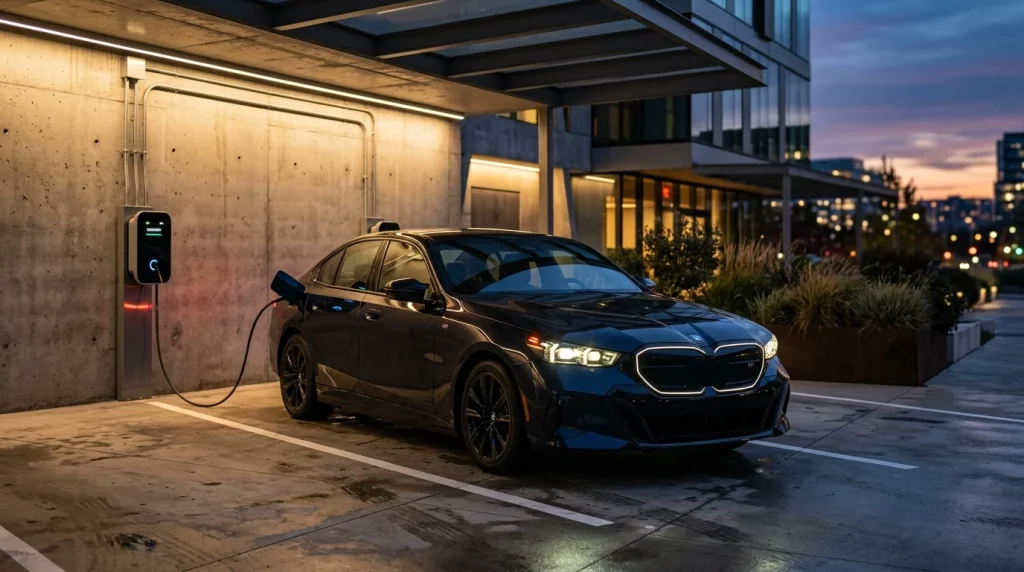
Quick answer: The 2025 BMW i5 is an outstanding mid-size luxury electric sedan that combines BMW’s traditional driving dynamics with a refined cabin and modern technology. Starting at $67,100, it offers up to 295 miles of EPA-estimated range, though independent testing has shown it can exceed 320 miles. It serves as a highly composed daily driver that competes directly with the Mercedes-Benz EQE and Tesla Model S.
Key takeaways:
- The new xDrive40 all-wheel-drive trim joins the lineup at $70,100, providing 389 horsepower and bridging the gap between the base and performance models.
- Real-world range is highly conservative, with the base eDrive40 exceeding its EPA estimate by 19% in professional testing to achieve 321 miles.
- U.S. Federal EV Tax Credits expired on September 30, 2025, meaning no federal incentives remain for purchasing or leasing the vehicle in 2026.
- The lack of standard adaptive cruise control on the base eDrive40 is a notable omission for a vehicle at this price point.
What is New for the 2025 BMW i5?
The primary update for the 2025 model year is the introduction of the mid-tier xDrive40 trim. During its inaugural model year, the vehicle was only available as the rear-wheel-drive eDrive40 or the high-performance, all-wheel-drive M60. The addition of the xDrive40 bridges the product gap that existed in the 2024 BMW i5 model year by combining dual-motor all-wheel traction with a more accessible price point than the flagship model.
Beyond the new trim level, changes are minimal. The BMW iDrive 8.5 infotainment system received minor software refinements to improve menu transition speeds and personalization options. Because this is only the second model year for the current generation, the styling, dimensions, and battery chemistry remain identical to the previous year. For buyers planning ahead, the current platform is expected to undergo similar evolutionary updates for the 2026 BMW i5 release.
Trim Levels, Pricing, and Federal Tax Credit Status
BMW offers the i5 in three distinct configurations to suit different performance and budget needs. The base eDrive40 starts at $67,100, the new xDrive40 is priced at $70,100, and the top-tier M60 xDrive commands $84,100. These prices represent base manufacturer suggested retail prices and do not include destination fees or optional packages.
Buyers should note the current status of tax incentives. Under the One Big Beautiful Bill Act, all federal clean vehicle tax credits, including the clean commercial vehicle credit that previously allowed lease incentives, expired on September 30, 2025, as documented by the U.S. Alternative Fuels Data Center.
Because the vehicle is assembled at the BMW Group Plant Dingolfing in Germany, it did not qualify for the purchase tax credit even before the program ended. In 2026, buyers and lessees must rely on state-level incentives or manufacturer promotions rather than U.S. federal tax write-offs.
Analysis: The $3,000 premium to step from the eDrive40 to the xDrive40 represents the best value in the lineup. It provides all-wheel drive and a significant power bump without the steep price increase or range penalty of the M60.
Electric Powertrain, Performance, and Driving Dynamics
The i5 utilizes BMW’s fifth-generation electric drive unit technology, which integrates the electric motor, power electronics, and transmission into a single compact housing. The base eDrive40 uses a single rear-mounted motor producing 335 horsepower and 295 pound-feet of torque. This enables a 0-60 mph acceleration time of 5.7 seconds.
The mid-tier xDrive40 adds a front motor to achieve all-wheel drive, raising combined output to 389 horsepower and 435 pound-feet of torque, which drops the 0-60 mph sprint to 5.2 seconds. The performance flagship M60 xDrive features dual motors tuned to deliver 593 horsepower and 586 pound-feet of torque, or up to 605 pound-feet when Launch Control or the Sport Boost paddle is engaged. The M60 accelerates from 0-60 mph in a rapid 3.7 seconds, though independent testing by Car and Driver achieved a time of 3.3 seconds.
On the road, the sedan maintains the balanced handling characteristics typical of a gas-powered 5 Series. The heavy battery pack is mounted low in the chassis, lowering the center of gravity and minimizing body roll during cornering. Steering is precise and heavily weighted, providing good feedback. The M60 features standard adaptive M suspension with electronically controlled dampers, which significantly sharpens handling while maintaining ride compliance.
Note: Regenerative braking is highly customizable. The adaptive mode adjusts deceleration automatically based on traffic conditions and navigation data, while a high regeneration setting allows for comfortable one-pedal driving in city traffic.
Battery Capacity, Charging Speed, and Real-World Range
All models share a high-voltage lithium-ion battery pack with a gross capacity of 84.3 kilowatt-hours, of which 81.2 kilowatt-hours is usable. The vehicle utilizes a 400-volt electrical architecture that supports DC fast charging up to 205 kilowatts. Under optimal conditions, this allows the battery to charge from 10% to 80% in approximately 30 minutes.
For home charging, the vehicle is equipped with a 7.4-kilowatt onboard charger. A standard Level 2 home charger can replenish the battery from empty to full in roughly 9 to 10 hours. BMW also includes two years of complimentary 30-minute charging sessions at Electrify America stations, which helps offset early operating costs.
Range estimates vary by configuration and wheel selection:
- eDrive40: 270 to 295 miles EPA-estimated range.
- xDrive40: 248 to 287 miles EPA-estimated range.
- M60 xDrive: 239 to 253 miles EPA-estimated range.
In real-world testing, the vehicle consistently outperforms its official ratings. According to testing by Edmunds, the base eDrive40 with 19-inch wheels traveled 321 miles on a single charge, representing a 19% improvement over its EPA estimate. Under similar testing conditions, the M60 xDrive achieved 264 miles, which is 10% better than its rating. Cold weather testing indicates that range drops by roughly 20% to 25% when temperatures fall below freezing, which is typical for modern luxury EVs.
Exterior Styling and Wheel Selection Impacts
The styling of the electric sedan is deliberately conservative, sharing its sheet metal and proportions with the internal combustion engine variants of the 5 Series. This stands in contrast to the cab-forward design of the Mercedes-Benz EQE. The drag coefficient is highly competitive at 0.23, aided by flush door handles and active air flaps behind the kidney grille.
The kidney grille itself is closed off to improve airflow, and it can be optioned with the Iconic Glow illuminated outline. The headlights are adaptive LED units that adjust their beam pattern based on steering input and vehicle speed.
Wheel choice has a substantial impact on range. Standard 19-inch aerodynamic wheels provide the lowest rolling resistance and the highest range. Upgrading to optional 20-inch or 21-inch wheels improves visual presence but reduces range by approximately 10 to 17 miles. Paint options include standard Alpine White and Carbon Black, alongside metallic options priced at $650 and premium Frozen matte finishes costing up to $3,300.
Interior Luxury, Comfort, and Digital Technology
The cabin features a modern, tech-forward layout dominated by the Curved Display. This hardware combines a 12.3-inch digital instrument cluster and a 14.9-inch center touchscreen under a single piece of glass. The system runs iDrive 8.5, which includes wireless Apple CarPlay, Android Auto, and over-the-air update capability.
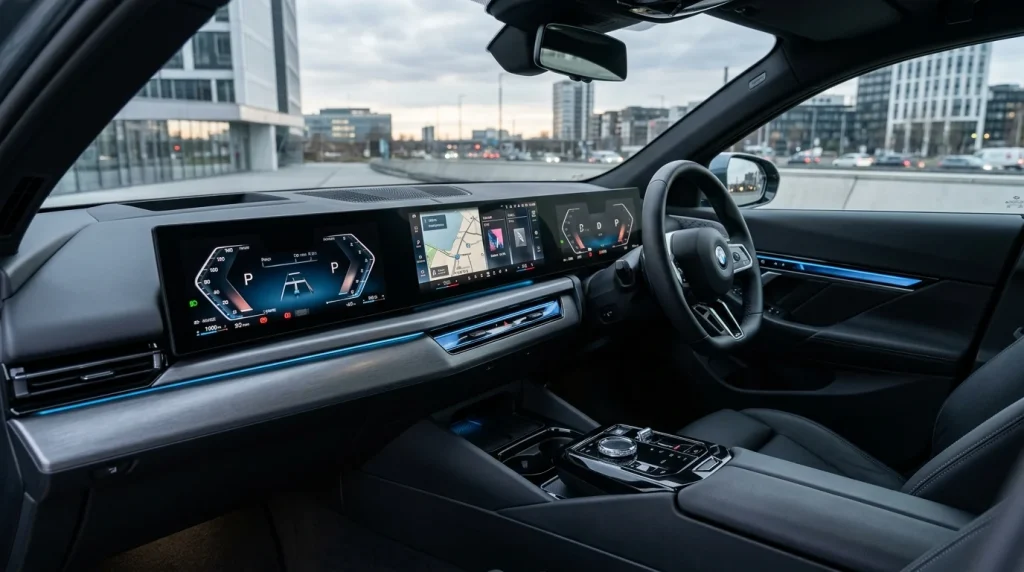
Materials are premium throughout the cabin. BMW offers standard Veganza synthetic leather, which is durable and soft to the touch. Extended Merino leather is available for $2,450, offering premium natural leather on the seats, dashboard, and upper door panels. Headroom and legroom are generous in both rows, accommodating adults comfortably.
However, because the vehicle shares its platform with gas models, it retains a large central transmission tunnel on the floor. This tunnel encroaches on the footwell of the middle rear seat, making it less comfortable for a fifth passenger.
Safety Ratings and Driver Assistance Packages
The vehicle is built with a high-strength steel passenger cell and reinforced side sills that protect the floor-mounted battery pack. Standard safety features include forward collision warning, automatic emergency braking, blind-spot monitoring, and lane-keeping assist.
For crashworthiness, the Insurance Institute for Highway Safety awarded the vehicle top marks across its main testing categories, including side-impact and roof-strength tests. The pedestrian crash avoidance system successfully stopped the vehicle in day and night tests at speeds up to 37 mph.
The optional Driving Assistance Professional Package ($2,500) adds BMW Highway Assistant. This system allows hands-free driving on designated highways at speeds up to 85 mph, provided the driver’s eyes remain focused on the road, which is monitored by an infrared camera on the instrument panel.
Analysis: Base trims omit standard adaptive cruise control, requiring buyers to purchase optional packages to get radar-guided distance control. For a luxury vehicle starting at $67,100, this should be standard equipment.
Cargo Space and Practicality
The cargo capacity of the sedan is slightly smaller than that of its gas-powered counterpart due to the packaging of the rear electric motor and battery components. The trunk offers 17.3 cubic feet of volume, which is still larger than the 15.0 cubic feet found in the Mercedes-Benz EQE.
The rear seats fold down in a 40/20/40 split to accommodate longer items. There is a small underfloor compartment in the trunk to store charging cables, but the vehicle lacks a front trunk. The space under the hood is entirely occupied by power electronics and the front electric motor on all-wheel-drive models, which may disappoint buyers transitioning from a Tesla.
BMW i5 vs. Key Competitors
Prospective buyers often compare the electric sedan against two major rivals in the luxury EV space: the Mercedes-Benz EQE and the Tesla Model S.
According to a review by Car Magazine, the BMW offers a more traditional driving experience and better interior build quality than the Mercedes-Benz EQE. The EQE starts at a higher MSRP of $77,900 and uses a dedicated EV platform that provides a flat rear floor, but its styling is highly polarizing, and its base powertrain produces only 288 horsepower.
The Tesla Model S starts at $76,380 and holds a clear advantage in range (405 miles EPA) and cargo capacity (25.0 cubic feet plus a frunk). The Model S also benefits from the extensive Supercharger charging network. However, the BMW i5 features vastly superior cabin assembly, physical buttons for key functions, and a more comfortable ride with lower cabin noise levels.
Pros and Cons Summary
Key Advantages
- Conservative, traditional styling that appeals to classic luxury sedan buyers.
- Refined, exceptionally quiet cabin with premium standard Veganza materials.
- Highly conservative EPA range ratings, with real-world tests exceeding estimates by up to 19%.
- Excellent handling dynamics that hide the vehicle’s 4,900-pound weight.
- Competitive starting price compared to the Mercedes-Benz EQE.
Notable Drawbacks
- No federal EV tax credits remain for buyers or lessees as of 2026.
- Lack of a front trunk (frunk) limits overall cargo flexibility.
- Middle rear seat comfort is compromised by the central transmission tunnel.
- Adaptive cruise control is not standard on the base trim.
- 400-volt architecture results in slower peak charging than 800-volt competitors.
Final Verdict: Is the 2025 BMW i5 Worth Buying?
The 2025 BMW i5 is one of the most well-rounded luxury electric vehicles on the market. It succeeds by refusing to compromise on traditional luxury qualities, choosing instead to feel like a premium BMW first and an electric vehicle second. It is best suited for drivers who want a comfortable, quiet, and engaging daily commuter and have access to home Level 2 charging.
For details on the broader lineup and related models, refer to the parent BMW i5 section on Autvex. While range-focused buyers might still prefer a Tesla, the i5 remains a highly recommended purchase for those seeking conventional automotive luxury and build quality.
Frequently Asked Questions
What is the real-world range of the 2025 BMW i5?
The base eDrive40 has an EPA-estimated range of 270 to 295 miles. However, independent testing by Edmunds achieved 321 miles on a single charge. The xDrive40 offers up to 287 miles of EPA range, while the M60 xDrive ranges between 239 and 253 miles.
Does the BMW i5 qualify for the federal EV tax credit?
No. Because the vehicle is assembled in Germany, it did not qualify for the U.S. federal clean vehicle purchase credit. Furthermore, under the OBBBA, all U.S. federal EV tax credits, including lease loop-holes, expired on September 30, 2025.
How fast can the BMW i5 charge?
The vehicle supports DC fast charging up to 205 kilowatts, allowing it to charge from 10% to 80% capacity in about 30 minutes. Home Level 2 charging requires approximately 9 to 10 hours for a full charge.
Does the BMW i5 have a front trunk (frunk)?
No. The space under the hood is used for steering gear, power electronics, and the front electric motor on all-wheel-drive trims. All cargo must be stored in the 17.3 cubic-foot rear trunk.
How does the i5 cargo capacity compare to the Mercedes EQE and Tesla Model S?
The BMW i5 offers 17.3 cubic feet (490 liters) of trunk space, which is larger than the Mercedes-Benz EQE (15.0 cubic feet). However, the Tesla Model S offers significantly more space with a 25.0 cubic-foot rear trunk and an additional 3.1 cubic-foot frunk.

