

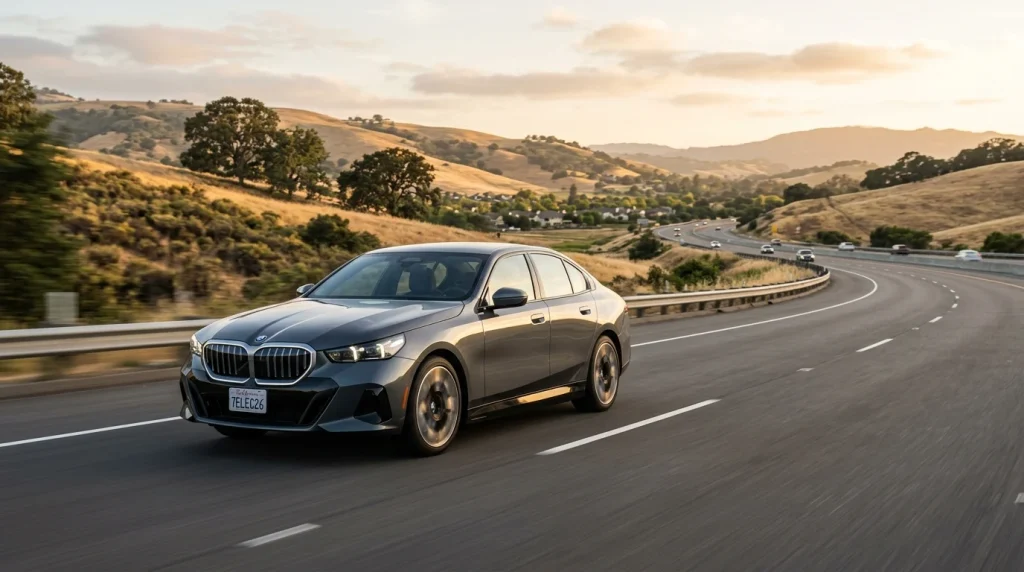
Quick answer: The 2026 BMW i5 electric sedan starts at $67,100 for the base eDrive40 model and offers up to 310 miles of EPA-estimated range. Key updates for the 2026 model year include a transition to the native Tesla-style NACS charging port, upgraded standard features like a Harman Kardon sound system, and powertrain efficiency gains that add up to 15 miles of driving range.
Key takeaways:
- Base pricing remains unchanged for 2026, starting at $67,100 for eDrive40, $70,100 for xDrive40, and $84,100 for the M60.
- A native NACS charging port is standard on all models produced from March 2026 onward, offering direct Tesla Supercharger access.
- EPA range rises to 310 miles for RWD models and up to 278 miles for AWD models thanks to silicon-carbide inverter upgrades.
- Charging benefits switch to a capped 1,000 kWh Electrify America credit over two years, replacing the previous unlimited plan.
2026 BMW i5 Overview and What’s New
The 2026 BMW i5 electric luxury sedan carries forward the brand’s midsize EV strategy with practical engineering refinements. Rather than introducing drastic styling alterations, BMW focuses its 2026 updates on charging accessibility and powertrain optimization. The i5 shares its basic structure with the conventional gasoline-powered 5 Series, meaning it retains the proportions, cabin layout, and driving posture of a traditional premium sedan.
For the 2026 model year, BMW introduces several updates that improve overall value. First-time EV buyers can compare the new model’s package directly against the previous 2025 BMW i5 and the original 2024 BMW i5 to see how the platform has matured. The most notable updates for 2026 include:
- Charging Hardware: Transition to a standard native NACS charging connector.
- Range Enhancements: Up to 15 miles of additional range on specific trims due to reduced mechanical and electrical losses.
- Standard Audio Upgrade: The Harman Kardon premium sound system is now standard across all trims.
- Interior Comfort: Enhanced standard four-way power lumbar support for the front seats.
- New Aesthetic Options: Frozen Portimao Blue Metallic exterior paint and new Merino leather color choices.
NACS Charging Port Integration
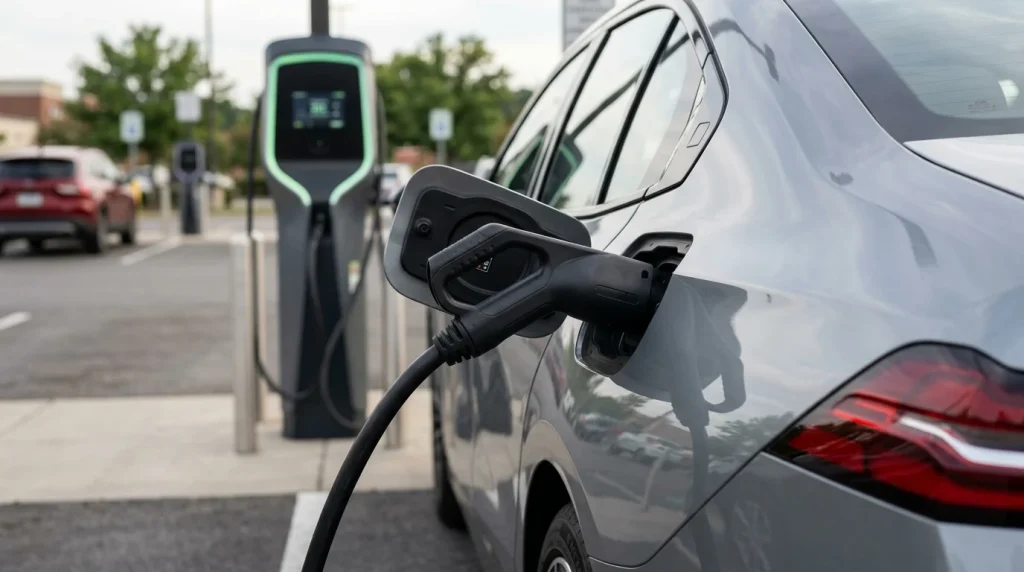
The shift toward the North American Charging Standard (NACS) J3400 port is the most significant logistical update for the 2026 model year. Previously, U.S. market BMW electric vehicles relied entirely on the CCS1 port. The transition occurred in phases during the 2026 production run.
At the start of the model year, only the performance-focused M60 trim shipped from the factory with a native NACS port. However, starting with March 2026 production, all U.S. market i5 models, including the eDrive40 and xDrive40, feature the native NACS port. This hardware change allows drivers to plug directly into the Tesla Supercharger network without using a physical adapter.
For vehicles delivered with the older CCS1 port prior to the March 2026 cutover, BMW provides compatibility through a remote software update. This update allows the vehicle to communicate with NACS stations. To plug in, owners must purchase a Lectron adapter approved by BMW, priced at approximately $180. Models produced after March 2026 with the native port include two adapters: a NACS-to-CCS1 adapter for older public DC fast chargers and a NACS-to-J1772 adapter for conventional Level 2 AC chargers.
Powertrain Efficiency and Range Gains
BMW engineers improved the efficiency of the electric drive units for 2026. The 84.3 kWh lithium-ion battery pack (81.2 kWh usable capacity) remains unchanged, but the powertrain draws less energy. The range gains stem from three key engineering upgrades:
- Silicon-Carbide Semiconductors: New inverter components reduce thermal energy losses during the conversion of DC battery power to AC motor power.
- Lower-Friction Wheel Bearings: Revised mechanical components reduce rolling resistance.
- Aerodynamic Wheel Designs: Updated wheel structures decrease wind drag at highway speeds.
Due to these refinements, the EPA-estimated range rises across the lineup. The rear-wheel-drive eDrive40 climbs from 295 miles to 310 miles on standard 19-inch wheels. The dual-motor AWD xDrive40 increases to 278 miles on 19-inch wheels. Range values vary based on the selected wheel size, as larger wheels create more drag and rolling resistance.
2026 BMW i5 Pricing and Trim Levels
The 2026 i5 lineup maintains the same base manufacturer’s suggested retail price (MSRP) as the 2025 model year. This pricing stability, combined with the upgraded standard equipment, increases the value proposition for buyers. The lineup consists of three distinct trim levels: the rear-wheel-drive eDrive40, the all-wheel-drive xDrive40, and the high-performance M60 xDrive.
| Trim Level | Base MSRP | Drivetrain | Horsepower | Torque (lb-ft) | Max EPA Range (mi) |
|---|---|---|---|---|---|
| eDrive40 | $67,100 | Single-motor RWD | 335 | 295 | 310 |
| xDrive40 | $70,100 | Dual-motor AWD | 389 | 435 | 278 |
| M60 xDrive | $84,100 | Dual-motor AWD | 593 | 586 | 277 |
Note: Prices exclude the standard $1,175 destination and handling fee. Configured dealer inventory often ranges higher based on optional packages.
BMW i5 eDrive40
Starting at $67,100, the eDrive40 is the entry point to the lineup. It utilizes a single electric motor mounted on the rear axle. Producing 335 horsepower and 295 lb-ft of torque, the eDrive40 accelerates from 0 to 60 mph in 5.7 seconds.
For 2026, the eDrive40 achieves its maximum 310-mile range when equipped with the standard 19-inch wheels. Upgrading to 20-inch wheels drops the estimate to 300 miles, while 21-inch wheels reduce the range to 278 miles. Standard equipment is generous, featuring the BMW Curved Display, Veganza synthetic leather upholstery, dual-zone climate control, and a panoramic moonroof.
BMW i5 xDrive40
The mid-tier xDrive40 starts at $70,100, representing a $3,000 premium over the base model. This trim adds a second electric motor to the front axle, providing all-wheel-drive traction. The dual-motor system raises total output to 389 horsepower and 435 lb-ft of torque.
The extra power drops the 0-60 mph acceleration time to 5.2 seconds. The maximum range for the xDrive40 on 19-inch wheels is 278 miles, which falls to 259 miles on 21-inch wheels. This variant balances RWD efficiency with all-weather traction, making it popular in northern regions.
BMW i5 M60 xDrive
The M60 xDrive is the performance flagship, starting at $84,100. It features a heavily upgraded dual-motor AWD system that produces 593 horsepower and 586 lb-ft of torque. In standard driving, it matches the acceleration of high-end sports cars, reaching 60 mph in 3.7 seconds according to BMW – though Car and Driver testing recorded times as low as 3.3 seconds per hour from a standstill.
Standard performance equipment on the M60 includes adaptive M suspension, M Sport brakes, and active roll stabilization. It achieves an EPA-rated range of 277 miles on 19-inch wheels, 266 miles on 20-inch wheels, and 259 miles on 21-inch wheels.
Performance and Charging Capabilities
The driving dynamics of the i5 emulate the traditional characteristics of the 5 Series. By integrating the heavy battery pack low in the chassis floor, BMW engineers achieved a lower center of gravity than in the gasoline model. This placement helps control body roll during cornering.
The steering is precise, though it relies on electronic assist that filters out some road feedback. Drivers can choose between multiple drive modes, including Personal, Sport, and Efficient. One-pedal driving is supported through an adaptive recuperation setting that modulates regenerative braking based on traffic flow and navigation data.
On the charging front, the i5 handles home charging and public fast charging through standardized inputs:
- AC Level 2 Charging: Standard home charging runs through an 11 kW onboard charger, adding roughly 38 miles of range per hour of charging. A full charge takes approximately 8 hours.
- DC Fast Charging: The i5 uses a 400-volt charging architecture that accepts peak DC fast-charging rates of up to 205 kW. Under optimal conditions, the battery can charge from 10% to 80% in approximately 30 minutes.
Analysis: The 400-volt charging system of the i5 is a notable limitation compared to newer 800-volt architectures. The Audi A6 e-tron, for example, supports peak DC fast charging up to 270 kW, allowing it to charge from 10% to 80% in 21 minutes. Drivers who frequently embark on long-distance road trips may find the extra charging time in the BMW to be a drawback.
For public charging, BMW has updated its incentives. Instead of the unlimited charging plan offered in previous years, 2026 models include a credit of 1,000 kWh of complimentary charging at Electrify America stations, valid for the first two years of ownership. This package provides roughly 3,000 to 3,500 miles of free driving.
Interior Design, Comfort, and Technology
The cabin of the 2026 i5 is distinguished by the BMW Curved Display, which houses a 12.3-inch instrument screen and a 14.9-inch infotainment touchscreen under a single glass surface. The system runs on BMW iDrive Operating System 8.5, which features a customizable home screen and QuickSelect shortcuts to reduce menu diving.
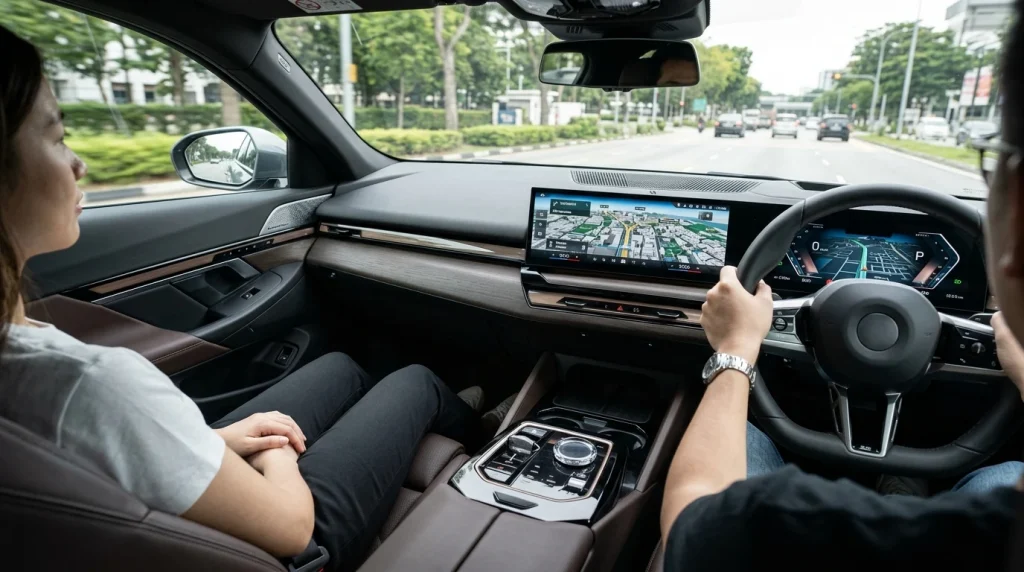
Standard interior materials include Veganza, a synthetic vegan leather that offers a soft texture and high durability. Extended Merino leather is available as a $2,450 option. For 2026, the door panels feature updated gloss black switchgear that replaces the matte plastic trim used in earlier model years.
Front seat passenger comfort is enhanced by standard four-way power lumbar adjustments. Rear seat passengers have 37 dặm of legroom, which is competitive for the midsize class. However, because the i5 shares its platform with an internal combustion vehicle, the floor is slightly higher than in dedicated EVs to accommodate the battery pack, which raises the passenger’s knees slightly. The rear trunk provides 17.3 cubic feet of space, and the rear seatbacks fold in a 40-20-40 split to accommodate longer cargo.
Note: Home charging setup costs vary. Installing a Level 2 home charger requires a dedicated 240-volt circuit. Installation costs typically range from $500 to $2,000, depending on the condition of the home’s electrical panel.
Is the 2026 BMW i5 Worth It? Autvex Buying Advice
The 2026 BMW i5 offers a compelling entry into the luxury EV segment, especially for buyers transitioning from traditional gasoline sedans. By maintaining its base MSRP while adding NACS charging compatibility and efficiency upgrades, BMW has strengthened the vehicle’s position against premium rivals.
Who Should Buy the 2026 BMW i5
- Traditional Luxury Seekers: The i5 looks, feels, and drives like a conventional premium sedan. It avoids the polarizing styling of some dedicated EVs.
- BMW Loyalists: Drivers who appreciate BMW’s handling balance, chassis tuning, and steering weight will find the EV model familiar.
- Suburban Commuters: Those who primarily charge at home overnight can take full advantage of the 310-mile range and the 11 kW AC charger.
Who Should Consider Alternatives
- Frequent Road-Trippers: The 205 kW DC fast-charging limit means the i5 charges slower than 800-volt competitors like the Audi A6 e-tron.
- Value-Oriented Buyers: The i5 does not qualify for the federal $7,500 EV tax credit when purchased outright due to its overseas assembly. However, leasing remains an option to pass the credit through.
- Max Cargo Users: The 17.3-cubic-foot trunk is smaller than some SUV alternatives, and there is no front trunk (frunk) under the hood.
Analysis: When comparing the trims, the mid-tier xDrive40 at $70,100 represents the sweet spot of the lineup. For $3,000 more than the base model, it adds dual-motor all-wheel-drive traction and 389 horsepower, while maintaining a respectable 278-mile range. The performance premium of the M60 is impressive but unnecessary for daily driving.
Frequently Asked Questions About the 2026 BMW i5
Does the 2026 BMW i5 have a front trunk (frunk)?
No, the 2026 BMW i5 does not feature a front trunk. The space under the hood is used to house power electronics, thermal management equipment, and the front electric motor on all-wheel-drive models.
Can the 2026 BMW i5 use Tesla Superchargers?
Yes, all 2026 i5 models can use compatible Tesla Supercharger stations. Models produced from March 2026 onward feature a native NACS port that plugs directly into Tesla chargers. Models produced prior to March 2026 require a CCS1-to-NACS adapter.
What is the real-world range of the BMW i5 in winter?
Electric vehicle range decreases in cold weather. In temperatures below freezing, the i5 typically loses 20% to 30% of its rated range, resulting in a real-world highway range of approximately 210 to 230 miles for the eDrive40. Pre-conditioning the battery pack while plugged in helps minimize this loss.
How much does it cost to charge the BMW i5 at home?
Charging costs depend on local utility rates. Based on the U.S. average electricity rate of 16 cents per kilowatt-hour, a full charge of the usable 81.2 kWh battery pack at home costs approximately $13. This represents a significant savings compared to fueling a gasoline-powered midsize luxury sedan.

