

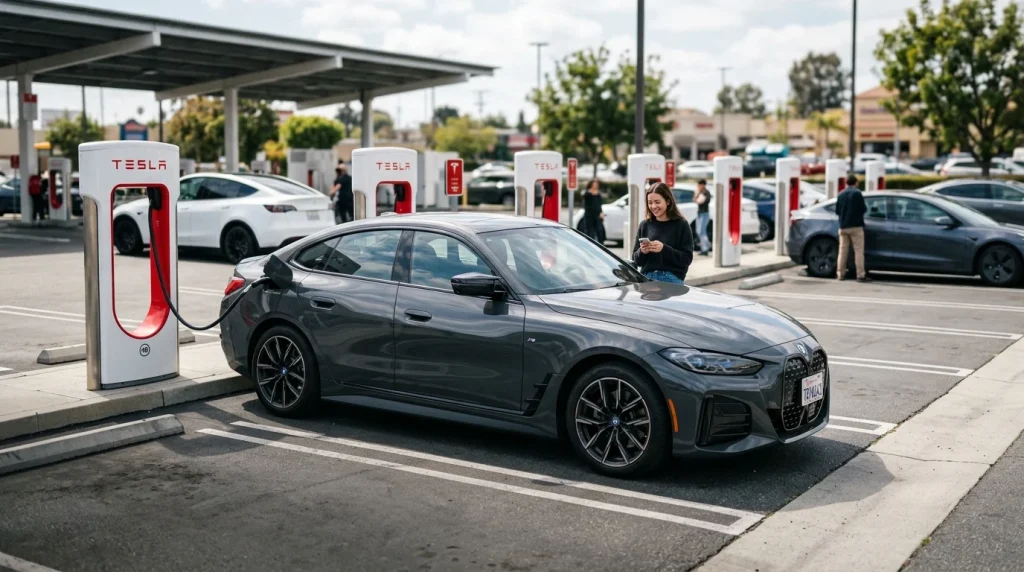
Quick answer: Yes, BMW electric vehicle owners in the United States and Canada can charge at compatible Tesla Superchargers. BMW officially gained access to the Tesla Supercharging network on December 10, 2025. Supported models, including the BMW i4, i5, i7, and iX, require a NACS-to-CCS1 adapter to charge at V3 and V4 Supercharger stations, while Tesla stations equipped with Magic Docks do not require any adapter.
Key takeaways:
- BMW officially gained access to over 25,000 Tesla Superchargers in North America on December 10, 2025.
- Current BMW EVs (i4, i5, i7, iX) use CCS1 ports and need a certified NACS-to-CCS1 adapter, such as the Lectron Vortex Plus or A2Z Typhoon Pro.
- BMW i5 models produced starting March 2026 come equipped with native NACS charging ports directly from the factory.
- Older BMW i3 models are not compatible with NACS adapters and can only charge at Magic Dock-equipped Supercharging stations.
- Billing is integrated directly into the My BMW App through Shell Recharge, enabling Plug and Charge automatic authorization.
Which BMW EV Models are Compatible with Tesla Superchargers?
BMW electric vehicles gained official access to designated Tesla Superchargers in the United States, as confirmed by CleanTechnica. However, compatibility varies depending on the specific model and production year. The majority of BMW’s modern battery electric vehicles (BEVs) can utilize the network, but hardware differences dictate whether you will need an adapter.
To check if your vehicle can use the network, review the compatibility breakdown below:
| BMW Model | Model Years | Port Type | Adapter Required? | Access Details |
|---|---|---|---|---|
| BMW i4 | 2022 to 2026 | CCS1 | Yes | Full access at V3 and V4 stations |
| BMW i5 | 2024 to 2025 | CCS1 | Yes | Full access at V3 and V4 stations |
| BMW i5 | 2026 (Post-March 2026) | NACS | No | Native port, plugs in directly |
| BMW i7 | 2023 to 2026 | CCS1 | Yes | Full access at V3 and V4 stations |
| BMW iX | 2022 to 2026 | CCS1 | Yes | Full access at V3 and V4 stations |
| BMW i3 | All Years | CCS1 | No (Adapter unsupported) | Restricted to Magic Dock stations only |
For BMW i4 drivers wondering about the specific models, the access covers all trims, including the eDrive35, eDrive40, and the dual-motor M50 variant. Similarly, the flagship SUV lineup, including the BMW iX xDrive50 and iX M60, can charge at Superchargers using a compatible adapter.
A notable exception is the BMW i3. Because the i3 uses an older electronics architecture, it does not support NACS adapters. Owners of the i3 cannot use standard Tesla Superchargers and must search for Tesla Magic Dock locations to fast charge. Furthermore, some early 2026 model year vehicles may require a software update to enable the NACS charging communication protocol before accessing Tesla stations.
Choosing the Right NACS-to-CCS1 Adapter for Your BMW
Since current BMW electric vehicles are built with the Combined Charging System (CCS1) port, you need a physical adapter to plug into Tesla’s North American Charging Standard (NACS) cable. BMW has verified that safety-certified third-party adapters can be used until the official OEM adapter is widely distributed.
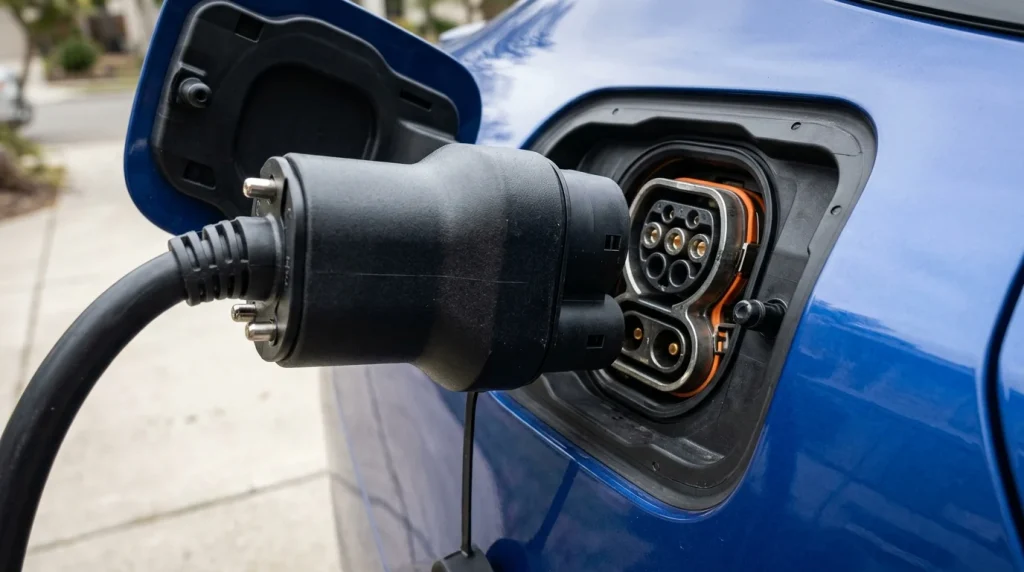
The table below outlines the primary adapter options available for BMW owners:
| Adapter Name | Price (USD) | Max Charging Amps | Safety Certification | Availability |
|---|---|---|---|---|
| Lectron Vortex Plus | $174.99 | 500A | UL 2252 | Available Now |
| A2Z Typhoon Pro | $189.00 | 500A | UL 2252 | Available Now |
| Official BMW Adapter | TBD | 500A | UL 2252 | Delayed / Limited |
The Lectron Vortex Plus is highly regarded by EV owners due to its robust design and official UL 2252 safety rating. It is rated for 500 amps and 1,000 volts, matching the maximum power delivery of Tesla V3 and V4 Supercharger stations. The A2Z Typhoon Pro offers similar heavy-duty specifications and is also widely used by non-Tesla drivers.
Using cheap, uncertified adapters found on online marketplaces is highly discouraged. Charging at high speeds (up to 200 kW) creates significant thermal load. Non-certified adapters lack built-in temperature sensors and automatic interlock mechanisms, which could lead to melted charging ports or damage to your vehicle’s onboard battery management system.
Expert view: Always ensure the adapter has a physical locking mechanism that secures the NACS connector before inserting it into your BMW’s CCS1 port. This mechanical safety feature prevents the high-voltage connection from being interrupted mid-session, which can cause electrical arcing and damage the electrical pins.
The Real-World Challenge: Tesla’s Short Cable Issue for BMW Drivers
While access to the Supercharger network is a massive win, drivers face a physical hurdle at the charging stall: the short length of Tesla’s charging cables. Tesla designed its V3 Superchargers specifically for Tesla vehicles, which feature charging ports on the rear-left corner. Consequently, the cables are only about six feet long, designed to reach a vehicle backed straight into the stall.
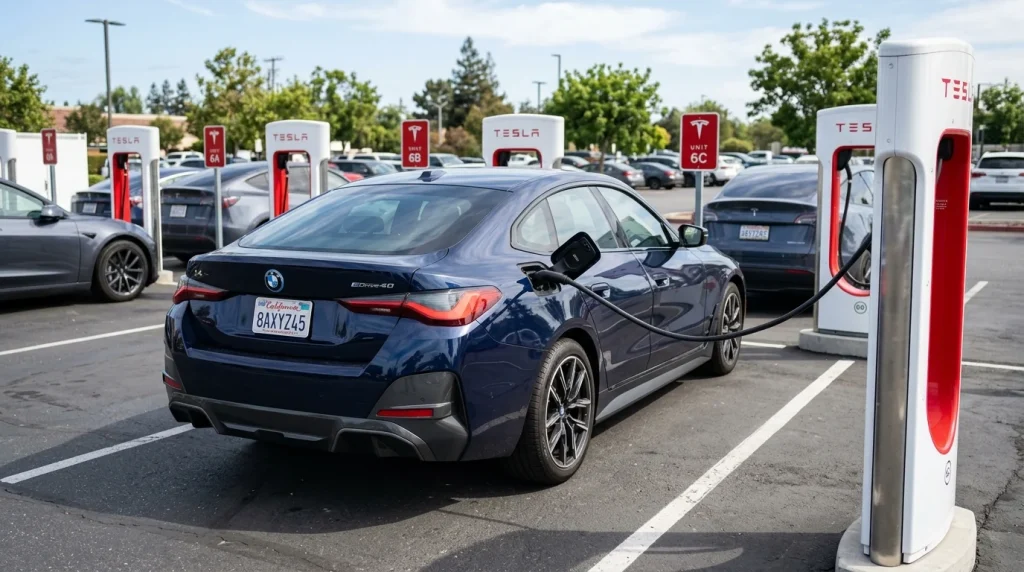
BMW designs its EVs with the charging port on the rear-right side (passenger side rear). When a BMW backs into a Tesla charging space, the short cable cannot reach the passenger side. To charge, the BMW driver must park in the space to the right of the intended charger. This means the BMW occupies one parking space while using the charging cable belonging to the adjacent space, effectively blocking that neighboring spot for other drivers.
To maintain charging etiquette and avoid conflicts, BMW drivers should follow these practices:
- Look for end stalls: If a Supercharger station has a stall on the far right end, park there. Using this spot allows you to access the cable without blocking an adjacent charger.
- Prioritize V4 Superchargers: Tesla’s newer V4 cabinets feature ten-foot cables that easily reach the passenger side of any EV, regardless of where you park.
- Check My BMW App first: The app clearly indicates the layout of the station and whether it is a newer V4 site or an older V3 installation.
How to Set Up and Start Charging via the My BMW App
BMW has integrated the Tesla network directly into its software ecosystem. You do not need to download the Tesla app or create a Tesla account to charge your vehicle. Billing and activation are routed through the My BMW App under the Shell Recharge charging network profile.
Follow these steps to set up your account and initiate charging:
- Open the My BMW App and navigate to the Charging section.
- Select the Shell Recharge integration and link a valid credit card.
- Enable the Plug and Charge option in your vehicle settings to allow automated authorization.
- Drive to a compatible Supercharger and park.
- Plug the Tesla cable into your NACS-to-CCS1 adapter, then plug the adapter into your BMW’s charging port.
- The charger will automatically communicate with your vehicle and start the session.
- To stop charging, press the release button on your BMW’s connector or terminate the session in the My BMW App.
If Plug and Charge is not working, you can manually activate the station. Open the map in the My BMW App, select the Supercharger location, choose the specific stall number you are parked at, and click “Start Charging” before plugging in.
Cost to Charge: Supercharger Rates vs. BMW Charging Partnerships
Tesla charges a premium for non-Tesla vehicles using its network. According to industry tracking by InsideEVs, the pricing structure is dynamic and depends heavily on the specific station location and the time of day.
Typical costs for non-Tesla drivers at US Superchargers are detailed below:
| Charging Option | Average Rate (Off-Peak) | Average Rate (Peak Hours) | Monthly Membership Fee |
|---|---|---|---|
| Standard Non-Tesla Rate | $0.40 – $0.55 / kWh | $0.48 – $0.61 / kWh | None |
| Tesla Supercharger Member | $0.30 – $0.42 / kWh | $0.36 – $0.48 / kWh | $12.99 |
Peak hours typically run from 4:00 PM to 8:00 PM, during which rates are at their highest. If you plan to use Tesla Superchargers frequently, purchasing the monthly Supercharger Membership is highly economical. The $12.99 monthly fee reduces the per-kWh rate by roughly 30%, meaning the membership pays for itself after just one or two highway charging sessions.
When calculating ownership costs, understanding vehicle service coverage like what is GearUp helps EV owners balance their overall maintenance budget alongside public charging fees. For example, charging a BMW i4 with an 84 kWh battery from 10% to 80% (adding roughly 58 kWh of energy) costs around $26 at off-peak rates, but can rise to $35 during peak hours. BMW owners should weigh this cost against other networks. For instance, BMW provides two years of complimentary 30-minute charging sessions at Electrify America for new vehicle purchases, making EA the preferred option for daily driving. While fast public charging is ideal for road trips, installing one of the best Level 2 home EV chargers remains the most cost-effective solution for routine daily charging.
Note: Tesla charges idle fees (up to $1.00 per minute) if your vehicle remains plugged in after charging is complete. Move your car immediately once it reaches your target charge level to avoid extra penalties.
Future Outlook: Native NACS Integration on the Neue Klasse Platform
The need for CCS1-to-NACS adapters is a temporary phase in the EV transition. BMW is moving toward native compatibility, eliminating adapters entirely for future models.
According to the latest industry updates on Auto News, this hardware transition represents a broader shift toward charging standardization across North America. A significant step in this transition occurred in March 2026, when BMW quietly updated its US-market assembly lines. Every BMW i5 produced starting March 2026 ships with an integrated NACS charge port directly from the factory, making it the first BMW model to eliminate the need for adapters at Tesla stations.
BMW will expand native NACS ports to other models, including the updated iX3 and the upcoming Neue Klasse vehicle platform launching in late 2026. The Neue Klasse vehicles will feature a next-generation 800-volt battery architecture designed to maximize charging speeds. While older BMW BEVs will continue to use adapters, the native NACS integration ensures that future BMW buyers will plug directly into V3 and V4 Supercharger cables just like Tesla owners.
Frequently Asked Questions
Can you charge a BMW at any charging station?
Yes, BMW electric vehicles are compatible with the majority of public charging stations in North America. They utilize the standard CCS1 connector for DC fast charging and the J1772 connector for Level 2 home charging. With the official integration active, BMW drivers can also access over 25,000 V3 and V4 Tesla Superchargers using a certified adapter.
Are all Tesla Superchargers open to BMW?
No. Only Tesla V3 (250 kW) and V4 Superchargers are open to BMW electric vehicles. Older V1 and V2 Supercharger stations (150 kW) use an outdated communication protocol that is incompatible with non-Tesla vehicle systems. You can verify compatible stations using the map in the My BMW App.
Can the BMW i3 use Tesla Superchargers?
The BMW i3 can only charge at Tesla Superchargers that feature integrated Magic Dock adapters. Because the i3 platform does not support the software protocols required for standalone NACS-to-CCS1 adapters, i3 owners cannot use standard Supercharger stalls even if they purchase a third-party adapter.
What charging speed does BMW get at Tesla Supercharger?
BMW EVs can charge at their maximum supported DC speeds on V3 and V4 Superchargers. The BMW i4 peaks at 195 to 205 kW under optimal conditions, which can add approximately 100 miles of range in 10 minutes. Charging speed will decrease once the battery state of charge exceeds 80%.
When will BMW have built-in Tesla charging ports?
BMW began integrating native Tesla-style NACS ports into its US-market vehicles in March 2026, starting with the i5 sedan. The rest of the EV lineup, including the high-performance Neue Klasse platform, will transition to native NACS ports starting in late 2026.

