

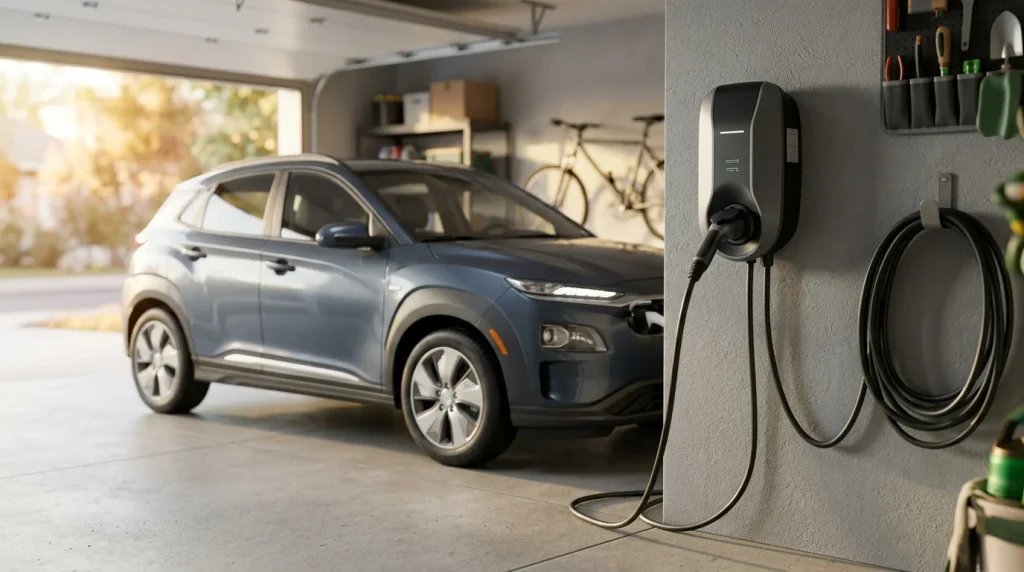
Quick answer: The best overall home EV charger is the IYILO Level 2 due to its unique plug-in heat sensor safety design and competitive pricing. For households with mixed-vehicle fleets, the Tesla Universal Wall Connector represents the best future-proof option because of its integrated dual-port design, while the Grizzl-E Ultimate 48 remains the most rugged choice for extreme weather.
Key takeaways:
- High-voltage Level 2 wall chargers are essential for daily EV drivers, adding 25 to 40 miles of range per charging hour.
- The North American Charging Standard (SAE J3400/NACS) is becoming the dominant port, making connector compatibility a key decision.
- Safety certification from nationally recognized testing laboratories like UL or ETL is crucial for preventing electrical hazards.
- Professional installation costs for residential Level 2 chargers typically range between $500 and $1,500.
How We Rated the Best Home EV Chargers
Choosing a home charging station requires looking beyond marketing claims. We evaluated the leading chargers on the market by analyzing data from EnergySage’s ChargerRater testing system, which scores equipment across performance, smart features, and value, alongside long-term reliability surveys from Consumer Reports.
According to Consumer Reports, Level 2 wall chargers (technically called Electric Vehicle Supply Equipment or EVSE) are practically a must for drivers who use their vehicles daily. Consumer Reports notes that among owners of recent electric models surveyed, charging units from Tesla and ChargePoint were the most popular, installed in nearly 50 percent of respondents’ homes.
Our rating system factors in hardware durability, software usability, cold-weather cable flexibility, and safety protections to identify the top home units for 2026.
Top 5 Level 2 EV Chargers of 2026
The table below summarizes the key specifications, pricing, and ratings for the top five residential Level 2 chargers.
| Rank | Charger Model | Base Price | Max Amperage / Power | Connector Options | Enclosure Rating | Warranty |
|---|---|---|---|---|---|---|
| 1 | IYILO Level 2 | $339 | 48A / 11.5 kW | J1772 or NACS | NEMA 4 (Plastic) | 3 Years |
| 2 | Tesla Wall Connector Gen 3 | $485 | 48A / 11.5 kW | NACS Native | NEMA 3R (Plastic) | 4 Years |
| 3 | Grizzl-E Ultimate 48 | $480 | 48A / 11.5 kW | J1772 or NACS | NEMA 4 (Aluminum) | 3 Years |
| 4 | Emporia Pro | $599 | 48A / 11.5 kW | J1772 or NACS | NEMA 4 (Plastic) | 3 Years |
| 5 | ChargePoint Home Flex | $549 | 50A / 12.0 kW | J1772 or NACS | NEMA 3R (Plastic) | 3 Years |
IYILO Level 2 (Best Overall & Value)
The IYILO Level 2 ranks at the top of our list because it combines advanced safety features with affordability. Priced at $339, it is the most cost-effective smart 48-amp charger available.
The standout feature of the IYILO is its plug-in thermal safety sensor. This sensor monitors the temperature at the wall outlet and automatically slows or stops the charging session if it detects overheating. This is a critical safety feature that prevents melted outlets. It also features a highly flexible cable that does not stiffen in cold weather. The main trade-off is the plastic enclosure, which is less rugged than metal housings, and the brand is relatively new to the market.
Tesla Wall Connector Gen 3 (Best Warranty & Design)
The Tesla Wall Connector Gen 3 is the benchmark for NACS-native vehicles. Priced at $485, it offers a sleek glass-faced design and coordinates perfectly with Tesla vehicles.
Tesla stands out by offering a four-year warranty, which is a full year longer than the industry standard. However, testing shows that the cable on the Gen 3 unit can become stiff in sub-zero temperatures. It is hardwired-only and native NACS, meaning non-Tesla drivers with older vehicles will need to use a separate adapter.
Grizzl-E Ultimate 48 (Most Durable Enclosure)
The Grizzl-E Ultimate 48 is built in Canada and designed specifically for extreme outdoor conditions. Housed in a thick cast-aluminum IP67-rated enclosure, it is nearly indestructible.
EnergySage notes that the company’s chief executive officer famously drove an all-terrain vehicle over a Grizzl-E unit on a frozen lake and submerged it in water, and the charger still functioned perfectly. This unit is ideal if you must mount your charger outdoors in areas with heavy snow, rain, or physical vulnerability. It does not focus heavily on complex smart app features, serving instead as a reliable plug-and-play workhorse.
Emporia Pro (Best Solar & Load Management)
The Emporia Pro is the most sophisticated option for home energy management. Priced at $599, it integrates directly with the Emporia Vue energy monitoring system.
This unit features PowerSmart load-management technology. By monitoring your home’s total electrical consumption in real time, the Emporia Pro automatically dials back the charger’s power if you turn on other heavy appliances, preventing panel overloads. This load sharing can help homeowners avoid expensive electrical service upgrades. Additionally, if you have solar panels, you can program the charger to draw power exclusively from excess solar generation.
ChargePoint Home Flex (Most Convenient Holster)
The ChargePoint Home Flex is a premium, highly popular choice priced at $549. It can deliver up to 50 amps when hardwired, making it the fastest charger on our list.
A key highlight of the ChargePoint Home Flex is its backlit, swivel connector holster, which makes plugging in your vehicle in a dark garage much easier. The companion app is widely regarded as the best in the industry, allowing you to link your local utility rate plan to track charging costs down to the penny. The unit carries a NEMA 3R rating, which is slightly less weather-resistant than the NEMA 4 ratings of the IYILO, Grizzl-E, and Emporia units.
Key Factors to Choose a Home EV Charger
Evaluating your vehicle’s requirements and your home’s electrical capacity before purchasing a charger will prevent installation delays.
Hardwired vs. Plug-In (NEMA 14-50)
Level 2 chargers are installed either as plug-in units or hardwired directly into your home’s electrical panel.
- Hardwired: Hardwiring is required if you want the maximum charging speed of 48 amps or 50 amps. Hardwired units are permanently fixed to the wall and require a dedicated 60-amp circuit breaker.
- Plug-In: Plug-in units connect to a 240-volt NEMA 14-50 outlet (similar to an electric stove outlet). National Electrical Code regulations limit plug-in chargers to a maximum of 40 amps on a 50-amp circuit. Plug-in units offer more flexibility, allowing you to unplug the charger for travel or relocation.
The J1772 to NACS Connector Transition
The charging port landscape in North America is transitioning. Older non-Tesla electric vehicles use the J1772 plug standard, while Tesla uses the NACS standard (standardized as SAE J3400).
Most automakers are transitioning to native NACS ports on new vehicles.
According to EV expert Tom Moloughney, the integration of dual-connector designs solves this transition for multi-EV households. Regarding the Tesla Universal Wall Connector, Moloughney states: “The ‘universal’ in Universal Wall Connector stands for its industry-first integrated J1772 adapter… It’s the perfect choice for a household that has two EVs; one with an NACS connector and one that uses the J1772.”
If you purchase a single-connector J1772 charger today, you can still charge a NACS vehicle using a simple adapter.
Analysis: While adapters are widely available, Consumer Reports recommends purchasing adapters directly from your vehicle’s manufacturer. Using uncertified third-party adapters can compromise safety and potentially void your vehicle’s warranty if electrical damage occurs.
Matching Amperage and Home Electrical Capacity
More power is not always better. Your charging speed is limited by your vehicle’s onboard charger capacity. For example, a vehicle with an 11-kW onboard charger benefits from a 48-amp charging station. However, a vehicle with a 6.6-kW onboard charger will not charge any faster on a 48-amp station than on a 32-amp station.
Additionally, a 48-amp charger requires a dedicated 60-amp breaker. If your home has a 100-amp main electrical service, your electrical panel may not have enough capacity to support a 60-amp charging circuit without a costly upgrade to 200-amp service.
Safety Certifications (UL and ETL)
Always ensure the charger you buy features a safety certification mark from an independent testing laboratory, such as Underwriters Laboratories (UL) or Intertek (ETL). These marks prove the hardware has undergone rigorous testing to prevent overheating, short circuits, and electrical fires. Avoid purchasing cheap, uncertified chargers online, as they lack these safety assurances.
Professional EV Charger Installation and Costs
Installing a Level 2 charging station requires professional electrical work. The national average cost to install a home charger ranges from $500 to $1,500, but can vary widely depending on your home’s layout.
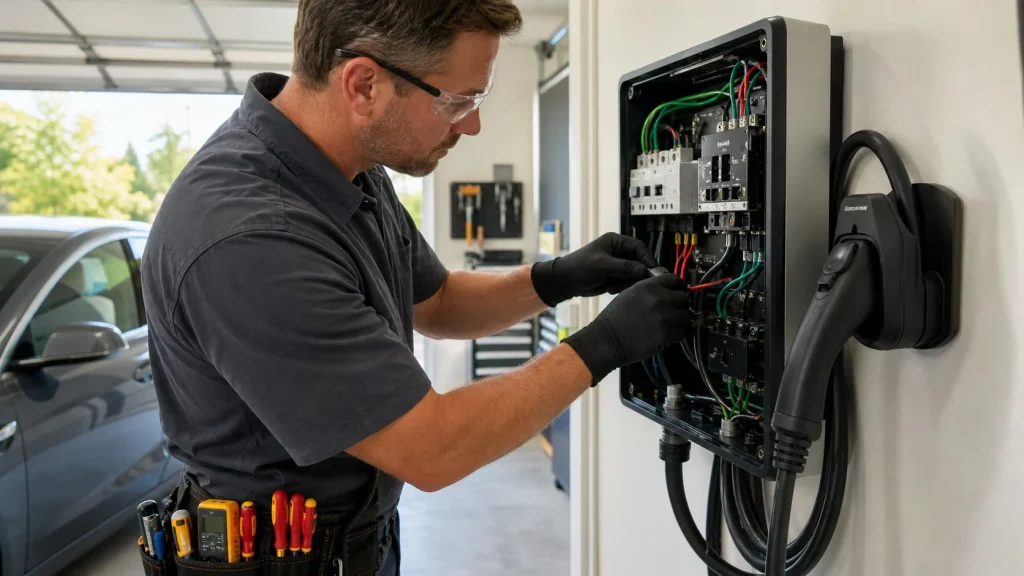
If your electrical panel is located on the opposite side of the house from your garage, the cost of running heavy-gauge copper wire will increase the price. Furthermore, if your panel is fully loaded, upgrading your home’s electrical service from 100 amps to 200 amps can add $1,500 to $4,000 to the total installation cost.
Fortunately, home charging equipment and installation costs qualify for financial incentives. The federal alternative fuel vehicle refueling property tax credit covers 30 percent of the total cost of the charger and installation, up to a maximum of $1,000. Under current legislation, this tax credit is available for eligible residents in non-urban or low-income census tracts through June 30, 2026.
Safety is also a primary concern for outdoor installations. While Level 2 chargers are weather-sealed to operate safely in rain or snow, outdoor electrical work must meet strict safety codes. For comparison, you can read about the precautions required for other wet-weather vehicle procedures, such as whether you can jump start a car in the rain, which highlights how moisture impacts automotive electrical safety.
Note: Level 2 charging stations are designed to remain plugged in outdoors during rain. The electrical contacts are recessed, and power does not flow through the cable until the charger and the car establish a digital handshake, ensuring no live voltage is exposed to wet elements.
Frequently Asked Questions about Home EV Chargers
What is the best EV charger for home use?
The best overall home charger is the IYILO Level 2 due to its plug-in temperature safety sensors and low price. If you want a premium smart charger with extensive energy tracking, the ChargePoint Home Flex is a top choice, while the Tesla Universal Wall Connector is ideal for mixed-vehicle households.
Do I need a 40-amp or 48-amp EV charger?
A 40-amp charger is sufficient for most drivers, adding approximately 30 miles of range per hour. A 48-amp charger is faster, adding about 36 to 40 miles of range per hour, but it must be hardwired and requires a 60-amp circuit breaker, which may require a panel upgrade.
How much does it cost to install a Level 2 EV charger?
Standard installation costs generally range from $500 to $1,500. However, if your home’s electrical service is outdated and requires an upgrade to a 200-amp panel, the total cost can rise by $1,500 to $4,000.
Can you charge an EV in the rain?
Yes, charging an EV in wet weather is completely safe. Home charging stations are weather-rated (NEMA 3R or NEMA 4), and the system is designed so that electricity only flows once the connector is locked into the car’s inlet. This protocol is much safer than working with exposed battery terminals, such as when you jump start a car in the rain.
How should I manage charging if my EV sits unused for weeks?
If your electric vehicle will sit idle for a long period, you should avoid leaving it at 100 percent or letting it drain to zero. Manufacturers recommend keeping the battery charged between 50 percent and 80 percent. Leaving the vehicle plugged into a smart charger allows the car’s battery management system to maintain optimal cell temperatures and voltage. For general guidelines on vehicle storage, read our analysis on how long a car can sit without being driven.

