

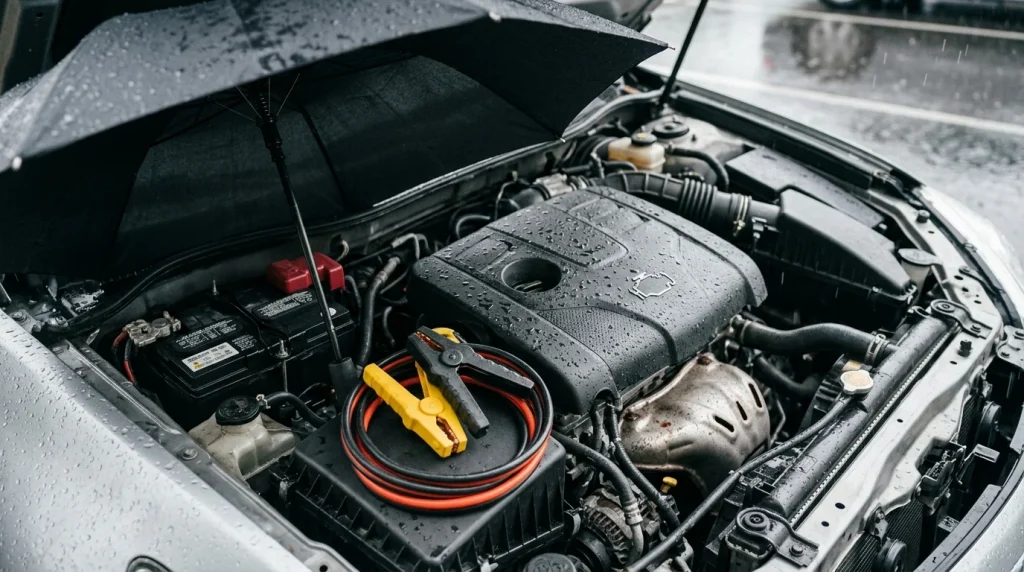
Quick answer: Yes, you can safely jump start a car in the rain. Most car batteries operate on 12 volts, which does not generate enough voltage to overcome human skin resistance and cause electrocution. However, while electrocution is not a risk, wet weather increases other hazards like short circuits, spark-induced hydrogen gas explosions, and slippery equipment. Following a strict connection sequence and drying the terminals are crucial for a safe jump start.
Key takeaways:
- Electric shock is not a threat because a standard 12-volt car battery lacks the voltage to push dangerous current through your body.
- The main risks in wet weather are electrical short circuits, hydrogen gas explosions from sparks, and slipping clamps.
- Never attempt a jump start during active thunderstorms, in standing water or floods, or if the battery is frozen, cracked, or leaking acid.
- Connect the jumper cables in the correct sequence (Positive to Dead, Positive to Donor, Negative to Donor, Negative to Ground on the dead vehicle’s unpainted metal frame).
- Keep connections as dry as possible, wear rubber-soled shoes, and work efficiently to limit moisture exposure.
- Portable jump starters with IP65 water resistance provide a safer, faster alternative to traditional jumper cables in wet conditions.
Why Jump Starting a Car in the Rain is Physically Safe
The fear of electrocution while jump starting a vehicle in the rain is a common misconception. Many drivers associate car batteries with high-voltage electrical outlets found in homes, but the physics of automotive electrical systems are fundamentally different.
A standard automotive battery operates at approximately 12 volts (V). According to Ohm’s Law, the electrical current (measured in amperes) that flows through a conductor depends on the voltage divided by the resistance of that conductor. For an electric shock to harm a human body, a sufficient electrical current must pass through internal organs.
Ohm’s Law and Human Skin Resistance
Under dry conditions, human skin resistance is very high, typically ranging from 100,000 ohms to over 600,000 ohms. When your skin is wet, this resistance drops significantly, sometimes to around 1,000 ohms. Even with wet hands, applying a 12V voltage source to a 1,000-ohm resistance results in a current of only 0.012 amperes (12 milliamperes).
This current is barely perceptible and falls far below the threshold of danger, which generally starts at 50 milliamperes for a harmful shock. Therefore, touch contact with 12V battery terminals in wet weather will not cause electrocution. According to the explanation of why a 12V battery cannot electrocute you from Electrical Technology, the human body’s resistance is simply too high to allow a lethal current to flow at such a low voltage.
Additionally, pure water is actually an insulator. While rainwater contains dissolved minerals and impurities that allow it to conduct electricity, its conductivity remains relatively low compared to salt water or specialized electrolyte solutions.
The Real Hazards of Jump Starting in Wet Weather
While electrocution is not a concern, jump starting in wet weather is not entirely without risk. The presence of water introduces secondary hazards that require careful attention.
Short Circuits and Electrical Damage
Water on the battery terminals or exposed metal surfaces can create unintended pathways for electrical current. If water bridges the positive and negative terminals, it can cause a short circuit. Short circuits can damage the vehicle’s alternator, fuses, or sensitive onboard computers.
Electrical shorts in modern vehicles can trigger complex faults, similar to an Audi drive system malfunction guide where voltage spikes disrupt sensitive control modules.
Hydrogen Gas Ignition and Battery Explosion
Lead-acid car batteries release highly flammable hydrogen gas during operation and charging. When jumper cables are connected or disconnected, minor sparks can occur at the contact points.
If these sparks occur near the battery venting ports, they can ignite the accumulated hydrogen gas, causing a catastrophic battery explosion that sprays sulfuric acid. Water droplets on battery cases do not stop gas formation; instead, rain can make handling cables clumsy, increasing the risk of accidental sparking.
Physical Hazards: Slippery Grips and Dropped Clamps
Rain makes tools, hands, and jumper cable clamps slippery. A common error in wet weather is dropping a live clamp onto a metal part of the car chassis or allowing the positive and negative clamps to touch. This creates a direct short circuit, causing massive sparks, melted cable insulation, and potential damage to the vehicle’s electrical system.
When to Avoid Jump Starting (Critical Red Flags)
There are specific weather conditions and vehicle states where you must abort the jump start process immediately and call for professional roadside assistance.
- Active Thunderstorms and Lightning: Jumper cables act as excellent conductors, and standing next to two large metal vehicles with hoods open during a thunderstorm makes you a prime target for lightning strikes. Jumper cables should never be connected when lightning is present.
- Standing Water or Flooding: If either vehicle is parked in a puddle that reaches the undercarriage, do not attempt to jump start the car. Water can submerge starter components, creating a major electrical path to the ground and destroying electrical systems.
- Frozen Batteries: In extreme cold and wet weather, a discharged battery’s electrolyte solution (which becomes mostly water as it discharges) can freeze. Attempting to jump start a frozen battery can cause the outer casing to rupture or explode.
- Cracked or Leaking Battery Casings: If you spot wetness around the battery that looks oily or smells like rotten eggs, it may be leaking sulfuric acid. Do not touch it or connect cables, as acid is highly corrosive and conductive.
Step-by-Step Guide: How to Jump Start Safely in the Rain
If the rain is light to moderate and none of the critical red flags are present, you can proceed by following this safety-focused procedure.
Step 1: Pre-Jump Inspection and Preparation
Before handling any cables, prepare your workspace to minimize water exposure:
- Turn off the ignition, lights, and all electrical accessories in both vehicles. Set the parking brakes.
- Inspect the jumper cables. Jumper cables must have intact rubber insulation. If the rubber is cracked, brittle, or shows exposed copper wire, do not use them.
- Position the donor vehicle close to the dead vehicle, but ensure the metal bodies of the two cars do not touch.
- Use a clean, dry cloth or towel to wipe away water droplets from the battery terminals, surrounds, and the cable clamps.
- If possible, have an assistant hold an umbrella over the engine bays to prevent rain from directly hitting the batteries while you make the connections.
Step 2: The Precise Connection Sequence
Connecting the clamps in the correct order is vital. This sequence ensures that the final connection, which always produces a small spark, occurs far away from the battery’s flammable hydrogen gas. Following the proper connection order guidelines from TP Auto Repair is key to preventing hazardous sparks.
- First Connection: Attach the red positive (+) clamp to the positive (+) terminal of the dead battery.
- Second Connection: Attach the other red positive (+) clamp to the positive (+) terminal of the donor battery.
- Third Connection: Attach the black negative (-) clamp to the negative (-) terminal of the donor battery.
- Fourth Connection (Ground): Attach the remaining black negative (-) clamp to an unpainted metal part of the dead car’s engine block, such as a bolt or bracket. Do not connect this clamp to the negative terminal of the dead battery.
Step 3: Starting the Vehicles and Charging
Once all four clamps are secure:
- Start the engine of the donor vehicle and let it idle for 2 to 3 minutes. This allows the alternator of the donor vehicle to transfer a surface charge to the dead battery.
- Attempt to start the engine of the dead vehicle. If it starts, let both vehicles idle together for a few minutes.
- If the dead vehicle fails to start after three attempts, stop. The battery may have a dead cell, or the starter motor might be faulty.
Step 4: Safe Disconnection Sequence
Remove the cables in the exact reverse order of connection, keeping the clamps from touching each other or any wet metal surfaces:
- Remove the black negative (-) clamp from the engine block of the previously dead vehicle.
- Remove the black negative (-) clamp from the donor battery.
- Remove the red positive (+) clamp from the donor battery.
- Remove the red positive (+) clamp from the revived vehicle’s battery.
Traditional Jumper Cables vs. Portable Jump Starters
Portable jump starters (also called battery booster packs) contain lithium-ion batteries and eliminate the need for a donor vehicle. Many modern units are sealed and carry Ingress Protection (IP) ratings, indicating their resistance to dust and moisture.
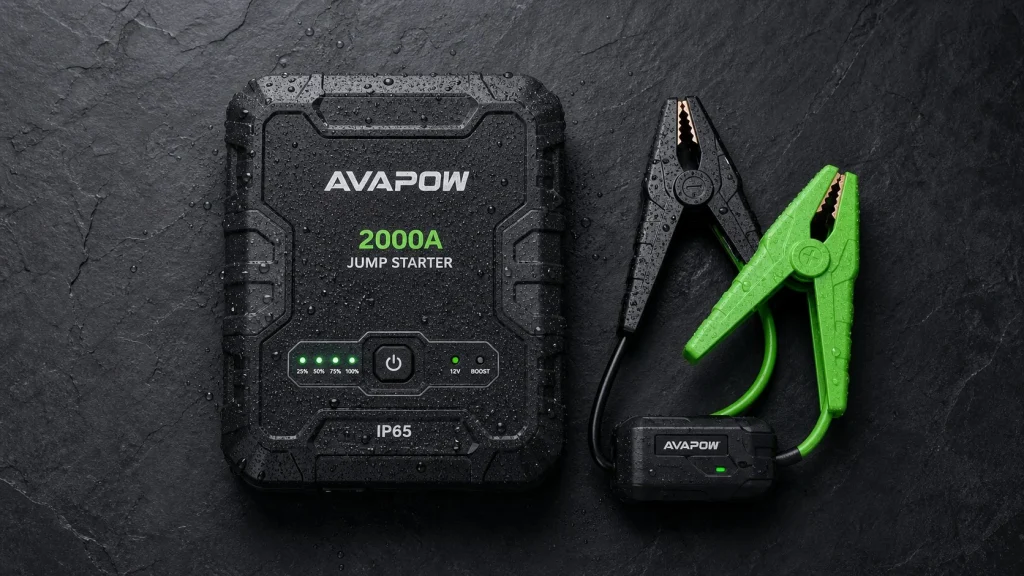
For example, an IP65 rated device is protected against water jets, making it far safer and easier to use in wet weather than traditional jumper cables. For step-by-step instructions on standard jumping procedures using booster packs, you can reference the breakdown assistance advice from The AA.
| Feature | Traditional Jumper Cables | Portable Jump Starter (IP65+) |
|---|---|---|
| Donor Vehicle Required | Yes | No |
| Spark Risk | Moderate (minimized by proper sequence) | Low (built-in reverse polarity protection) |
| Cable Length & Handling | Long, heavy, difficult to keep dry | Short cables, easy to shield |
| Water Resistance | Low (exposed metal clamps) | High (sealed casing, protected ports) |
| Safety in Rain | Requires careful attention | Highly recommended |
Using a portable jump starter is often the preferred choice in inclement weather, as it limits the time you spend standing in the rain and simplifies the connection process. For general auto advice, you can check out the Autvex news section for tips on vehicle maintenance and electrical safety.
Post-Jump Care and Dashboard Warnings
After successfully jump starting your vehicle, keep the engine running for at least 30 minutes by driving the vehicle. This gives your alternator enough time to recharge the battery.
During this initial drive, it is common for temporary warning lights to appear on your dashboard due to the sudden voltage fluctuation. If you notice an exclamation point dashboard warning after starting the car, it is often a temporary low-voltage alert that clears once the alternator fully recharges the battery. However, if the warning light persists, it may indicate a permanent charging system failure or a damaged battery that needs replacement.

