

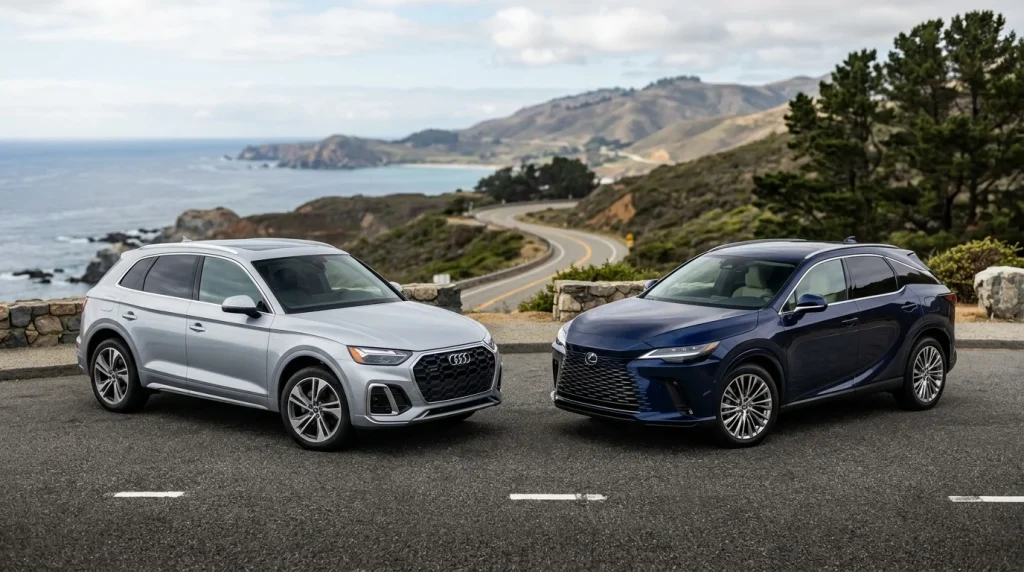
Quick answer: For 2026, the Lexus RX 350 is the more practical buy for families prioritizing cabin space, long-term reliability, and lower maintenance costs, starting at a base MSRP of $51,225. However, if you prefer sharp handling, cutting-edge technology, and standard all-wheel drive, the completely redesigned third-generation 2026 Audi Q5 (starting at $52,800) is the superior choice for driving enthusiasts.
Key takeaways:
- In a major shift for 2026, the newly redesigned Audi Q5 starts at $52,800, which is higher than the base FWD Lexus RX 350 ($51,225) and nearly identical to the AWD Lexus RX 350 ($52,825).
- The Lexus RX 350 is a midsize SUV offering more rear legroom, whereas the Audi Q5 is a compact SUV designed for tighter maneuverability.
- Despite its smaller external footprint, the Audi Q5 offers more maximum cargo space with the rear seats folded down (56.9 cubic feet) compared to the Lexus RX 350 (46.2 cubic feet).
- Lexus continues to lead industry reliability rankings, offering lower estimated maintenance costs over a five-year ownership period compared to Audi.
2026 Specs and Pricing: The Flipped MSRP Dynamic
For the 2026 model year, the completely redesigned Audi Q5 arrives with a pricing restructure that alters its traditional value proposition. Historically, the compact Audi Q5 undercut the larger, midsize Lexus RX 350 by a noticeable margin. For 2026, the entry-level Audi Q5 Premium starts at $52,800 (excluding a $1,295 destination charge). This base price sits above the front-wheel-drive Lexus RX 350, which starts at $51,225, and matches the all-wheel-drive Lexus RX 350 at $52,825.
Audi has repositioned the all-new Q5 further upmarket, reflecting its position in the brand’s lineup of best Audi cars. The vehicle now features standard Quattro all-wheel drive and a mild-hybrid powertrain across all standard trims. Meanwhile, Lexus offers a wider array of configurations, keeping front-wheel drive standard on base trims to lower the entry price.
The baseline specifications for the entry-level trims show how these two luxury SUVs compare:
| Feature | 2026 Audi Q5 Premium | 2026 Lexus RX 350 Base |
|---|---|---|
| Vehicle Class | Compact SUV | Midsize SUV |
| Engine Type | 2.0-liter Turbo 4-Cylinder (MHEV) | 2.4-liter Turbo 4-Cylinder |
| Horsepower | 268 hp | 275 hp |
| Torque | 295 lb-ft | 317 lb-ft |
| Transmission | 7-speed dual-clutch automatic | 8-speed automatic |
| Drivetrain | Quattro AWD (Standard) | FWD (Standard) / AWD (Optional +$1,600) |
| Starting MSRP | $52,800 | $51,225 (FWD) / $52,825 (AWD) |
| Length / Wheelbase | 185.7 in / 111.0 in | 192.5 in / 112.2 in |
At comparable price points, the value equation depends on your drivetrain needs. If you require all-wheel drive, the base AWD RX 350 at $52,825 directly competes with the standard Quattro AWD on the Q5 Premium at $52,800.
Driving Dynamics and Powertrains: Autobahn Agility vs. Highway Serenity
The mechanical configurations of the Audi Q5 and Lexus RX 350 produce contrasting behaviors on the road. The Audi Q5 emphasizes control, quick directional changes, and high-speed stability. The Lexus RX 350 focuses on isolating passengers from road vibrations and maintaining a quiet cabin.
Audi Q5 Powertrain and Suspension
The 2026 Audi Q5 is powered by a 2.0-liter turbocharged four-cylinder engine assisted by a 48-volt mild-hybrid system. This setup generates 268 horsepower and 295 pound-feet of torque, managed by a 7-speed dual-clutch transmission. The dual-clutch unit provides rapid gear shifts, enabling the Q5 to accelerate from 0 to 60 mph in approximately 5.8 seconds.
Audi utilizes a multi-link front and rear suspension architecture, which keeps the body flat during cornering. To ensure optimal performance in all weather conditions, equipping the vehicle with the best tires for Audi maximizes the mechanical grip provided by the standard Quattro system.
Analysis: The Q5’s chassis tuning is firm but controlled. Billy Rehbock, associate editor at MotorTrend, noted that the redesigned Q5’s “suspension and steering tuning…keep the Q5 quite nice to drive but don’t greatly increase the fun factor.” This balanced tuning prevents the SUV from feeling overly stiff while maintaining European handling characteristics.
Lexus RX 350 Powertrain and Suspension
The Lexus RX 350 is equipped with a 2.4-liter turbocharged four-cylinder engine producing 275 horsepower and 317 pound-feet of torque. It is paired with an 8-speed automatic transmission. Although the RX 350 has a slight horsepower advantage and significantly more torque than the Q5, it is a heavier vehicle and its 8-speed transmission is tuned for smooth transitions rather than speed. As a result, its 0 to 60 mph time is slower, taking roughly 7.2 seconds in AWD configuration.
Lexus employs a MacPherson strut front suspension and a multi-link rear suspension. This setup is optimized for compliance, absorbing harsh road surfaces and highway expansion joints with minimal cabin disruption.
Analysis: The RX 350’s powertrain lacks the immediate response found in its European competitors. MotorTrend editors noted that the RX 350’s “base powerplant and its automatic transmission leave a lot to be desired in terms of pep and refinement,” leading them to recommend hybrid variants of the RX for smoother power delivery.
Size and Cargo Space: The Compact vs. Midsize Paradox
The comparison between the Audi Q5 and Lexus RX 350 presents a dimensional paradox. The Lexus RX 350 is a midsize vehicle that is roughly 6.8 inches longer and has a 1.2-inch longer wheelbase than the compact Audi Q5. This larger footprint gives the Lexus a clear advantage in rear-seat passenger comfort. Passengers in the second row of the RX 350 benefit from a wider cabin and more legroom, making it the preferred vehicle for carrying adults or rear-facing car seats.
However, the compact packaging of the Audi Q5 yields superior cargo versatility when the seats are folded:
- Cargo Space (Seats Up): The Lexus RX 350 offers 29.6 cubic feet of space behind the second row, compared to the Audi Q5’s 27.6 cubic feet. This makes the Lexus slightly more practical for daily grocery runs with a full passenger load.
- Cargo Space (Seats Folded): When you fold the rear seats flat, the Audi Q5 provides 56.9 cubic feet of total cargo volume. Due to the sloping roofline and interior packaging of the Lexus RX 350, its maximum cargo volume is limited to 46.2 cubic feet.
The Q5 offers more total utility volume for carrying bulky items, while the RX 350 excels at carrying people and rear luggage simultaneously.
Interior Tech and Cabin Aesthetics
The cabin designs of the 2026 Audi Q5 and 2026 Lexus RX 350 showcase different approaches to luxury. Audi leans heavily into a high-tech, minimalist environment, while Lexus prioritizes soft materials and traditional ergonomics.
Audi’s Digital Lounge
The 2026 Q5 cabin features the brand’s new curved panorama display. This display houses an 11.9-inch digital instrument cluster and a 14.5-inch central MMI touchscreen under a single curved pane of glass. The infotainment system runs on an Android Automotive OS base, providing fast response times and integrated navigation features. The design minimizes physical buttons, delegating climate and audio controls to the touchscreen or voice commands. The overall aesthetic is clean, sharp, and centered on screen real estate.
Lexus’s Ergonomic Sanctuary
The Lexus RX 350 comes standard with a 9.8-inch touchscreen, with a larger 14.0-inch display available on higher trims. Lexus retains physical dials for temperature and volume controls, which many drivers find easier to operate while driving. The dashboard design is warm, utilizing high-quality synthetic leather, open-pore wood trims, and soft-touch plastics. The seats are highly cushioned and designed for long-distance comfort, creating a relaxed, living-room-like atmosphere.
Reliability, Maintenance Costs, and Resale Value
For buyers keeping their vehicles beyond the standard warranty period, the long-term cost of ownership is a key factor. Lexus consistently leads the luxury segment in long-term reliability metrics.
Reliability Ratings
Lexus routinely secures the top position in dependability studies, such as the J.D. Power U.S. Vehicle Dependability Study. The turbocharged 2.4-liter engine and transmission are engineered with a focus on longevity. In contrast, Audi generally ranks in the middle of the pack. The Q5’s complex mild-hybrid electrical systems and dual-clutch transmission require precise maintenance.
Maintenance Costs
According to cost-of-ownership data from automotive aggregators, the estimated maintenance and repair costs for an Audi Q5 over the first five years are roughly 30% to 40% higher than those of a Lexus RX 350. Audi parts are imported and labor rates at German auto specialists are higher. Skipping scheduled services on a Q5 can lead to expensive component failures, whereas the Lexus is more tolerant of wear and shares parts with the broader Toyota catalog.
Resale Value
Due to its reputation for reliability, the Lexus RX 350 retains its value better than the Audi Q5. A five-year-old Lexus RX typically retains around 50% to 55% of its original MSRP, whereas an Audi Q5 of the same age drops closer to 40% to 45% due to buyers’ concerns over out-of-warranty repair costs.
Note: The lower depreciation and maintenance costs of the Lexus RX 350 make it the more financially conservative asset over a standard five-year ownership cycle. The Audi Q5 is best leased under warranty rather than purchased for ten-year ownership.
Final Verdict: Which Luxury SUV Should You Buy?
Choose the 2026 Audi Q5 if:
- You want standard all-wheel drive: Every Q5 comes equipped with Quattro AWD at no extra cost.
- You prefer sporty handling: The multi-link suspension and quick dual-clutch transmission make the Q5 engaging to drive.
- You appreciate minimalist tech: The dual-screen dashboard and tech-forward interior appeal to buyers who want the latest infotainment features.
- You need to maximize folded cargo space: The Q5 offers 56.9 cubic feet of cargo room with the seats folded.
Choose the 2026 Lexus RX 350 if:
- You prioritize passenger space: The midsize cabin provides significantly more legroom and shoulder room for rear-seat passengers.
- You value long-term reliability: Lexus’s reputation for durability offers peace of mind for long-term ownership.
- You want lower ownership costs: Lower maintenance fees and higher resale values save money over time.
- You prefer a plush, quiet ride: The soft suspension and isolated cabin are built to reduce highway commuting stress.
For more detailed model comparisons and automotive updates, visit the Autvex news hub.
Frequently Asked Questions
Is the Audi Q5 or Lexus RX 350 bigger?
The Lexus RX 350 is larger. It is classified as a midsize luxury SUV, measuring 192.5 inches in length. This makes it 6.8 inches longer than the compact Audi Q5, which measures 185.7 inches. The Lexus also has a longer wheelbase and a wider cabin, providing more legroom for rear-seat passengers.
Which is more reliable, Audi or Lexus?
Lexus is significantly more reliable. Lexus consistently scores near the top of independent dependability studies, while Audi typically ranks in the middle. The Lexus RX 350 has lower projected repair costs and a less complex mechanical design than the mild-hybrid Audi Q5.
Which has better resale value, Audi Q5 or Lexus RX?
The Lexus RX retains its value better over a five-year period. Its reputation for durability creates high demand in the pre-owned market, resulting in slower depreciation compared to the Audi Q5.

