

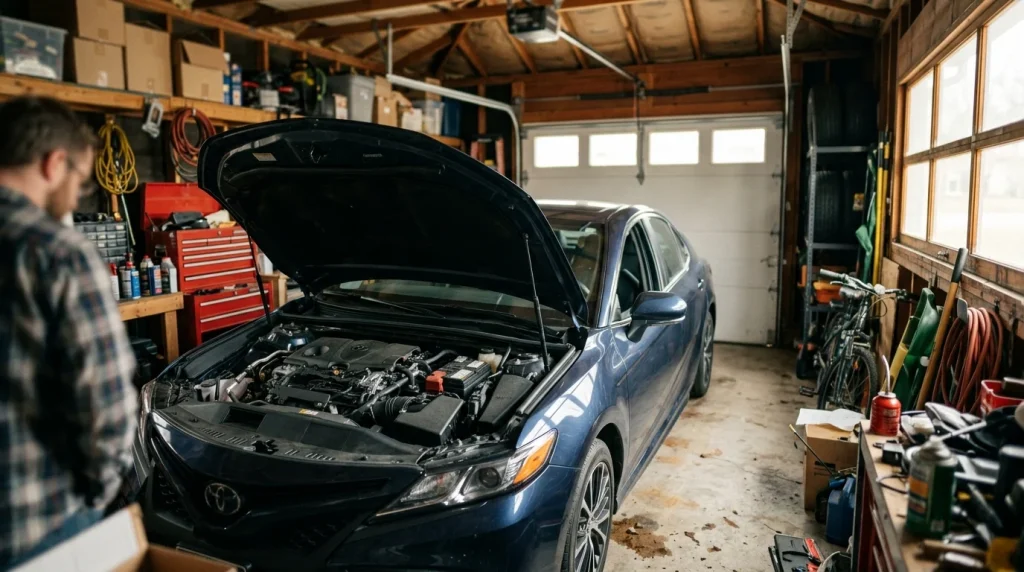
Quick answer: A car engine typically takes 30 to 45 minutes to cool down enough for safe basic inspection. Complete cooling to ambient temperature requires 1 to 2 hours under moderate weather conditions, though hot summer days can extend this timeline to over 4 hours. Safety precautions require waiting at least 30 minutes before inspecting an overheated engine to prevent severe burn risks.
Key takeaways:
- A standard engine takes 30 to 45 minutes to cool for basic tasks and 1 to 2 hours to reach ambient temperature.
- Overheated systems demand a minimum 30-minute cooling period before popping the hood latch to release trapped heat.
- Checking oil requires only a 10 to 15-minute wait, whereas opening a radiator cap safely takes 1 to 2 hours.
- Extreme summer heat extends cool-down timelines, while freezing winter temperatures accelerate natural heat dissipation.
- Turn the cabin heater to high and park in the shade to help draw heat away from the engine bay faster.
Average Engine Cool-Down Timelines by Task
Understanding how long it takes for a car engine to cool down depends heavily on what maintenance task you plan to perform. Different components retain heat differently, meaning some inspections are safe much sooner than others. While checking the dipstick requires a brief pause, working on pressurized cooling lines or replacing deep engine parts demands patience to prevent severe workplace injuries.
The table below outlines the minimal recommended wait times for common automotive maintenance tasks under standard driving and weather conditions:
| Maintenance Task | Minimum Recommended Wait Time | Technical Reason for the Wait Time |
|---|---|---|
| Checking or adding engine oil | 10 to 15 minutes | Allows oil to drain back into the oil pan for an accurate dipstick reading. |
| Changing engine oil | 15 to 30 minutes | Warm oil flows faster, but hot oil causes severe skin burns. |
| Checking coolant reservoir level | 15 to 20 minutes | Safe to inspect visually without opening the pressurized cap. |
| Opening the radiator cap | 1 to 2 hours | Releases pressure safely; prevents scalding steam blowouts. |
| Replacing spark plugs | 30 to 45 minutes | Prevents stripping threads in aluminum cylinder heads. |
| Working on brake components | 20 to 30 minutes | Rotors and calipers retain immense heat from friction. |
| Inspecting the exhaust system | 45 to 60 minutes | Catalytic converters and exhaust manifolds run extremely hot. |
These estimates are designed for vehicles driven under normal operating conditions. If you have recently traveled through heavy stop-and-go city traffic, towed a heavy trailer, or climbed steep mountain passes, you should add at least 15 to 20 minutes to each wait time. Taking these precautions ensures that you do not come into accidental contact with metal surfaces that remain hot enough to cause second-degree burns.
Pop the Hood: Safety Timelines for an Overheated Engine
An overheated engine represents a severe safety hazard that requires a different approach than standard post-driving cooling. When a vehicle overheats, the coolant temperature often rises well above 260 degrees Fahrenheit, causing the entire cooling system to operate under extreme pressure, typically around 15 to 16 pounds per square inch. At this point, the radiator cap behaves like a household pressure cooker, trapping superheated steam and boiling liquid that is ready to erupt.
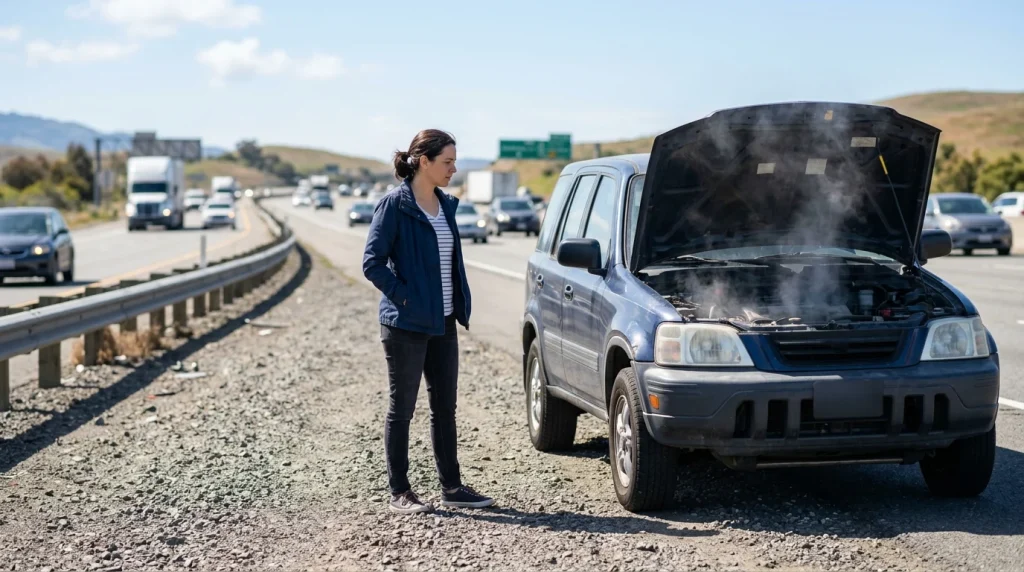
If your vehicle suffers from overheating, follow this strict step-by-step safety protocol:
- Pull over immediately: Find a safe location on the shoulder, park the car, and shut down the engine. Continuing to drive can cause permanent mechanical destruction.
- Release the hood latch only: Pull the interior hood release lever. This pops the hood slightly to create a gap for hot air to escape, but do not lift the hood yet. Leaving the hood closed traps heat, while opening it immediately exposes you to sudden bursts of steam.
- Wait at least 30 minutes: Do not touch the vehicle or attempt to open the hood fully for at least half an hour. In high ambient temperatures, wait 45 to 60 minutes.
- Monitor the temperature gauge: Only approach the front of the car once the dashboard temperature gauge has returned to the cold mark.
- Protect your hands: Use a thick rag or heavy-duty gloves when lifting the hood and handling any components.
- Release radiator pressure slowly: If you must open the radiator cap, place a thick towel over it and turn it slowly counterclockwise to the first click. Wait for the audible hissing sound of escaping pressure to stop completely before removing the cap.
According to automotive safety manuals, opening a hot radiator cap prematurely is one of the most common causes of radiator-related burn injuries reported in repair shops. By waiting for the system to depressurize, you eliminate the risk of boiling fluids spraying onto your skin.
Critical Factors Influencing Engine Cool-Down Times
A car engine does not cool down at a uniform rate. Several physical and environmental factors influence how quickly thermal energy dissipates from the engine block into the surrounding atmosphere.
Ambient Weather Conditions
The temperature difference between the engine and the outside air dictates the rate of heat transfer. According to basic thermodynamic principles, a larger temperature differential results in faster cooling. On a freezing winter day with ambient temperatures around 32 degrees Fahrenheit, an engine block sitting at 210 degrees Fahrenheit will cool down significantly within 30 minutes. Conversely, during a summer heatwave with temperatures reaching 95 degrees Fahrenheit, the reduced temperature difference slows heat dissipation, keeping the engine warm for 3 to 4 hours.
Engine Displacement and Construction Materials
The size and mass of the engine block play a major role in heat retention. Large V8 engines made of heavy cast iron possess a high thermal mass, meaning they absorb and store a large amount of heat, taking much longer to cool down than compact 4-cylinder engines with aluminum blocks. Additionally, turbocharged engines feature turbochargers that operate at extreme temperatures. The oil and coolant lines running through the turbocharger continue to radiate heat into the engine bay long after the ignition is turned off.
Driving Habits and Load
The severity of your recent drive directly affects the thermal load on the cooling system. Highway cruising allows a steady flow of air to pass through the radiator, keeping operating temperatures stable. However, towing a heavy trailer, hauling cargo, or driving up steep grades forces the engine to run at higher loads, generating immense internal heat. Stop-and-go city driving also limits the natural airflow through the engine bay, causing heat to build up and extending the necessary cool-down period.
Cooling System Integrity
A healthy cooling system dissipates heat much faster than a neglected one. If your vehicle has low coolant levels, a failing thermostat, a worn water pump, or a radiator clogged with road debris, the system cannot circulate or release heat effectively. In these scenarios, the engine remains hot for an extended period after shutdown. Regular maintenance of these components is crucial for maintaining normal cool-down rates.
Normal Operating Temperatures vs. Residual Heat
To safely gauge when your vehicle is ready for service, it helps to understand normal operating temperatures. Dashboard gauges display coolant temperatures, but they do not reflect the residual heat trapped in other metal parts.
| Component | Normal Operating Temperature | Residual Heat Characteristics |
|---|---|---|
| Engine Coolant | 195 to 220 degrees Fahrenheit | Pressurized; cools slowly inside the closed system. |
| Engine Oil | 195 to 250 degrees Fahrenheit | Thickens as it cools; drains back to the pan in 15 minutes. |
| Exhaust Manifold | 400 to 600 degrees Fahrenheit | Made of thick metal; retains high heat for over 45 minutes. |
| Catalytic Converter | 600 to 800 degrees Fahrenheit | Can exceed 1,000 degrees Fahrenheit under load; cools slowly. |
| Brake Rotors | 200 to 400 degrees Fahrenheit | Can spike to 600 degrees Fahrenheit; cools via air exposure. |
While your temperature gauge might show that the coolant has cooled down, the exhaust manifold and catalytic converter can remain hot enough to cause severe burns. Always assume these metal parts are hot until you have verified their temperature safely.
How to Safely Cool Down Your Engine Faster
If you are on a tight schedule and need to work on your vehicle, you can use several safe techniques to accelerate the cooling process.
Turn on the Cabin Heater
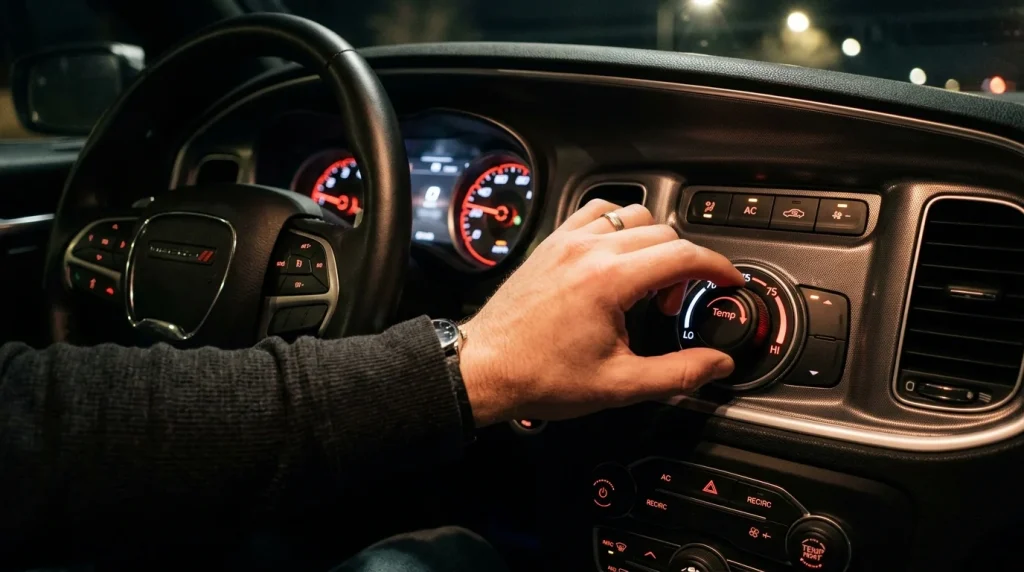
If you notice your engine temperature gauge climbing while driving, or if you want to cool the system down right before parking, turn your cabin heater to the maximum temperature and set the fan speed to high. Open the windows to let the hot air escape. The heater core acts as a secondary radiator, drawing hot coolant away from the engine block and blowing the heat into the cabin, which quickly lowers the overall coolant temperature.
Safely Open the Hood Latch
After parking the car in a safe area, release the hood latch to open the hood fully. This allows the hot air trapped in the engine bay to rise and escape, replaced by cooler ambient air. Ensure you stand to the side when opening the hood to avoid the initial rush of rising heat.
Seek Shade and Airflow
Park your vehicle in a shaded area away from direct sunlight. Shaded spots can have ambient temperatures that are 20 to 30 degrees Fahrenheit cooler than asphalt in direct sunlight, speeding up convective heat transfer. If you are in a garage, using a household box fan pointed directly at the radiator can cut the necessary cooling time in half.
Dangerous Mistakes to Avoid
Never attempt to speed up cooling by pouring cold water directly onto a hot engine block. The sudden temperature drop causes rapid contraction of the metal, resulting in thermal shock. This can warp cylinder heads, crack the engine block, and ruin your engine permanently. Additionally, do not spray cold water on hot brake rotors, as this causes them to warp, leading to brake pedal pulsation and reduced braking efficiency.
Why checking and changing oil requires specific wait times
Oil level and quality checks require strict timing to ensure both personal safety and accurate measurements. According to the official guides by Firestone Complete Auto Care, checking your motor oil level should be done approximately 10 to 15 minutes after shutting off the engine.
When the engine runs, the oil pump circulates oil through the cylinder head, camshafts, and pistons. Turning off the engine stops this circulation, allowing the oil to drain back down into the oil pan. Checking the dipstick immediately after driving will show an artificially low level because a large volume of oil is still coating the upper engine components. Waiting 10 to 15 minutes ensures that the oil has fully settled, giving you an accurate reading.
For an oil change, the oil should be warm but not scalding. Cold motor oil is thick and viscous, making it drain slowly and leave contaminants behind in the oil pan. Warm oil flows easily, carrying dirt and debris out of the engine block. However, waiting 15 to 30 minutes after driving ensures the oil has cooled enough to prevent serious burns when removing the oil drain plug.
Before perform maintenance, checking the latest automotive news is helpful. Understanding how many quarts of oil a car takes is essential before adding fresh oil to prevent overfilling, which can cause crankshaft frothing and engine damage.
Original Analysis: The Cost of Neglecting an Overheated Engine
When an engine begins to overheat, drivers are often faced with a critical choice: pull over immediately and wait for the system to cool, or try to drive a few more miles to reach their destination. From a financial perspective, ignoring the cooling timeline is an extremely expensive gamble.
If you continue to drive an overheated car, the metal components expand beyond their design tolerances. This quickly leads to a blown head gasket, which allows coolant to leak into the combustion chambers. Replacing a blown head gasket is a labor-intensive repair that costs between $1,500 and $3,000 in U.S. repair shops.
If the engine is pushed even further, the extreme heat can warp the aluminum cylinder head or crack the cast-iron engine block. A cracked block cannot be repaired and requires a complete engine replacement. A new or remanufactured engine installation typically ranges from $4,000 to $8,000, depending on the vehicle make and model.
In contrast, calling a professional towing service to transport your vehicle to a local shop costs between $100 and $200 under standard conditions. Choosing to wait 30 to 45 minutes for the engine to cool down, or spending a small fee on a tow truck, protects you from thousands of dollars in avoidable engine repair bills. The table below compares these real-world financial outcomes:
| Driver Choice | Immediate Cost | Potential Consequence | Repair Cost Range |
|---|---|---|---|
| Pull over and wait 45 minutes | $0 (Lost time) | None; engine cools safely | $0 |
| Call a professional tow truck | $100 to $200 | Vehicle transported safely | $100 to $200 |
| Drive home with hot engine | $0 | Blown head gasket | $1,500 to $3,000 |
| Ignore dashboard warning lights | $0 | Cracked block / Engine seizure | $4,000 to $8,000 |
Frequently Asked Questions
How long does it take for an engine to cool completely?
Complete cooling to ambient temperature takes 1 to 2 hours under moderate weather conditions. In hot summer weather exceeding 90 degrees Fahrenheit, this timeline can extend to 3 or 4 hours. In freezing winter temperatures, the engine may cool completely within 30 to 45 minutes.
Can I add coolant to a hot engine?
No, you should never add coolant to a hot engine. Pouring cold coolant into a hot engine block causes rapid temperature changes, potentially cracking the engine block. Always wait at least 30 to 60 minutes for the engine to cool down before opening the radiator cap.
How long should I wait to check oil after driving?
You should wait 10 to 15 minutes after shutting off the engine before checking the oil. According to Chloe’s Auto Repair, this brief pause allows the oil circulating in the upper engine to drain back into the oil pan, ensuring an accurate dipstick measurement.
Why does my car take longer to cool down in summer?
Engines take longer to cool down in the summer because the temperature difference between the engine (around 210 degrees Fahrenheit) and the outside air is smaller. A smaller temperature differential reduces the rate of heat transfer, keeping the engine hot for a longer period.
Is it bad to let a car idle to cool down?
For normal daily driving, idling to cool down is unnecessary. However, if you have been driving hard, towing, or climbing steep hills, letting the engine idle for 30 to 60 seconds allows the cooling system to circulate coolant and oil, preventing localized heat soak.

