

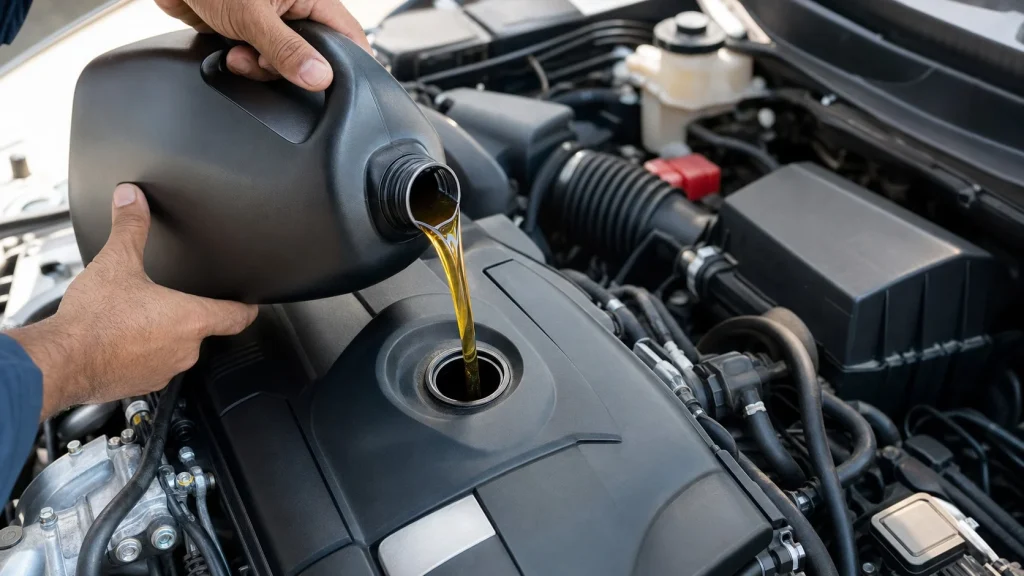
Quick answer: Most passenger car engines require 4.0 to 6.0 quarts of oil, depending on engine displacement and cylinder configuration. Smaller 4-cylinder engines typically use 4.0 to 5.0 quarts, mid-size V6 engines need 5.0 to 6.5 quarts, and larger V8 engines demand 6.0 to 8.0 quarts (or up to 10.0 quarts for modern high-performance models).
Key takeaways:
- Engine displacement and cylinder count are the primary factors that dictate oil capacity, ranging from 4.0 quarts up to 10.0 quarts.
- Turbocharged and European performance engines require additional oil volume for lubrication and cooling of their turbo units.
- Always refer to the “with filter” specification because the oil filter reservoir holds up to 0.5 quarts of oil.
- Underfilling causes friction wear and overheating, whereas overfilling leads to oil foaming and seal damage.
Oil Capacity by Engine Size (1.5L to 6.2L)
Engine displacement is the primary factor determining how many quarts of oil your car needs. As a general rule, the larger the engine, the more oil it requires to lubricate its moving parts and control internal temperatures. However, cylinder configuration also plays an important role. For instance, a flat Boxer engine or a V-shaped engine has different oil pan dimensions compared to an inline engine of similar displacement.
Modern passenger vehicles are engineered with specific oil sump capacities designed to support their lubrication needs. The table below outlines the typical oil capacities associated with common engine types:
| Engine Type | Typical Displacement | Typical Oil Capacity | Common Models |
|---|---|---|---|
| Inline-4 (I4) | 1.5L to 2.5L | 4.0 to 5.0 quarts | Civic, Corolla, Camry |
| V6 Engine | 3.0L to 4.0L | 5.0 to 6.5 quarts | F-150, 4Runner, Accord V6 |
| V8 Engine | 5.0L to 6.2L | 6.0 to 10.0 quarts | Silverado, Mustang GT, Challenger |
| Turbocharged I4 | 1.5L to 2.0L | 3.7 to 5.8 quarts | Audi A4, BMW 3 Series, Civic Turbo |
| Diesel Sump (Light-Duty) | 3.0L to 6.7L | 8.0 to 15.0 quarts | Silverado Duramax, F-250 Power Stroke |
Trucks and larger utility vehicles feature much larger oil pans compared to passenger cars. These heavy-duty vehicles have high-capacity sumps because their engines work under heavier loads, generate higher operating temperatures, and must sustain lubrication during towing or hauling.
Engine Oil Capacities for Popular Vehicle Models
Engine oil capacity varies significantly by make, model, and manufacturing year. Even within the same model lineup, a redesign or an engine update can change fluid requirements. Always check your exact vehicle specifications before performing service.
Compact and Midsize Cars
Compact and midsize vehicles usually feature efficient 4-cylinder engines that keep oil capacities relatively low, typically between 3.5 and 5.0 quarts.
For example, a modern Toyota Corolla 1.8L non-hybrid (utilizing the 2ZR-FE engine, from 2009 to 2025) requires exactly 4.4 quarts of oil with a filter change. Midsize sedans require slightly more. A Toyota Camry 2.5L 4-cylinder (A25A-FKS engine, from 2018 to 2025) requires 4.8 quarts, while a Camry Hybrid 2.5L (A25A-FXS) has a capacity of 4.5 quarts.
Similarly, a Honda Civic 1.5L Turbo requires 3.7 quarts of oil. For a midsize sedan like the Honda Accord with a 1.5L turbocharged engine, the capacity is also 3.7 quarts. If you are shopping for a pre-owned model, check the Honda Accord years to avoid to ensure you choose a reliable year that is not prone to oil dilution issues. Another popular midsize competitor, the Nissan Altima 2.5L, requires 4.6 quarts of oil.
| Compact/Midsize Model | Engine Specification | Oil Capacity (with filter) | Viscosity Grade |
|---|---|---|---|
| Toyota Corolla (2009-2025) | 1.8L Inline-4 (2ZR-FE) | 4.4 quarts | SAE 0W-20 |
| Honda Civic (2016-2025) | 1.5L Turbo | 3.7 quarts | SAE 0W-20 |
| Toyota Camry (2018-2025) | 2.5L Inline-4 (A25A-FKS) | 4.8 quarts | SAE 0W-20 |
| Honda Accord (2018-2025) | 1.5L Turbo | 3.7 quarts | SAE 0W-20 |
| Nissan Altima (2019-2025) | 2.5L Inline-4 | 4.6 quarts | SAE 0W-20 |
Trucks and SUVs
Trucks and sport utility vehicles require larger oil capacities to handle tough driving conditions. When selecting a utility vehicle, understanding drivetrain specifications like what 4×2 means on a truck is as important as checking its fluid capacities.
For example, a Ford F-150 equipped with the 3.5L V6 EcoBoost engine requires 6.0 quarts of oil. In contrast, V8-powered trucks hold much more. The Chevrolet Silverado 1500 5.3L V8 (2014 to 2026 EcoTec3 L82/L84 engines) requires 8.0 quarts of oil with filter. However, older Vortec 5.3L V8 engines (2007 to 2013) only require 6.0 quarts. This distinction is crucial, as putting 6.0 quarts in a newer model will leave the engine severely underfilled.
For SUVs, the Toyota 4Runner with a 4.0L V6 engine holds 6.6 quarts. The Subaru Outback 2.5L Boxer engine has a capacity that shifted from 5.1 quarts (2015 to 2019) to 4.4 quarts (2020 to 2026 models).
| Truck/SUV Model | Engine Specification | Oil Capacity (with filter) | Viscosity Grade |
|---|---|---|---|
| Ford F-150 (2015-2025) | 3.5L V6 EcoBoost | 6.0 quarts | SAE 5W-30 |
| Chevrolet Silverado (2007-2013) | 5.3L Vortec V8 | 6.0 quarts | SAE 5W-30 |
| Chevrolet Silverado (2014-2026) | 5.3L EcoTec3 V8 | 8.0 quarts | SAE 0W-20 |
| Toyota 4Runner (2010-2025) | 4.0L V6 (1GR-FE) | 6.6 quarts | SAE 0W-20 |
| Subaru Outback (2020-2026) | 2.5L Boxer (FB25) | 4.4 quarts | SAE 0W-20 |
European and Luxury Models
European car manufacturers often design their engines with high-capacity oil sumps. This design choice accommodates extended oil change intervals (up to 10,000 miles or more in Europe) and provides extra thermal protection for high-performance turbochargers.
An Audi A4 2.0L TFSI (B9 generation, 2017 to 2025) requires 5.5 US quarts of oil with filter, compared to 4.9 quarts in older B8 models. The Mercedes-Benz C300 2.0L Turbo requires 6.5 quarts. The BMW 3 Series 2.0L Turbo (B48 engine) has a capacity of 5.8 quarts (5.5 liters). For high-end sports cars, a Porsche 911 3.0L Twin-Turbo (Flat-6) demands a substantial 8.5 quarts.
| European/Luxury Model | Engine Specification | Oil Capacity (with filter) | Oil Specification |
|---|---|---|---|
| Audi A4 (2017-2025) | 2.0L TFSI (EA888) | 5.5 quarts | VW 508.00 / 504.00 |
| BMW 3 Series (2016-2025) | 2.0L Turbo (B48) | 5.8 quarts | BMW Longlife-01 FE |
| Mercedes-Benz C300 (2015-2025) | 2.0L Turbo | 6.5 quarts | MB-Approval 229.5 |
| Porsche 911 (2017-2025) | 3.0L Twin-Turbo Flat-6 | 8.5 quarts | Porsche C40 / A40 |
European engines require oil that meets specific manufacturer standards. Standard passenger car oil may degrade quickly under the operating conditions of these high-performance sumps.
How to Find Your Vehicle’s Exact Oil Capacity
Never guess your engine’s oil capacity. Overfilling or underfilling can lead to costly mechanical damage. Use these reliable methods to find the exact specification for your year, make, model, and engine variant.
Method 1: Owner’s Manual Specifications
The most reliable source for fluid specifications is your owner’s manual. Look in the index under “Capacities,” “Specifications,” or “Maintenance.” Most manufacturers list two distinct capacity figures:
- Capacity with filter change: This is the total volume required when replacing both the oil and the oil filter. This is the correct number to use during a standard maintenance service.
- Capacity without filter change: This is a slightly lower volume (usually 0.3 to 0.5 quarts less) required if you are only draining and refilling the oil pan while leaving the old filter in place.
You should always replace the oil filter at every service interval and fill the engine to the “with filter” capacity.
Method 2: Under-Hood Oil Filler Cap
Pop the hood and inspect the oil filler cap on top of the engine block. While it primarily lists the recommended viscosity grade (such as 0W-20 or 5W-30), some manufacturers print the total oil capacity directly on the cap. This serves as a quick reference point when refilling.
Method 3: Online VIN Lookup and Dealer Databases
If you do not have the owner’s manual, use an online Vehicle Identification Number (VIN) lookup or visit an auto parts database. Websites like AutoZone, O’Reilly Auto Parts, or fluid lookup tools provided by major oil brands allow you to input your VIN to receive exact specifications. You can also stay updated on the latest automotive news at the Autvex news portal to track manufacturer recalls or updates concerning engine designs.
Why the Correct Oil Amount Matters for Engine Health
Maintaining the precise oil volume is vital for engine durability. Engine oil forms a thin protective barrier between metal components, prevents friction, and carries away heat from the combustion chamber.
Risks of Having Too Little Oil (Underfilling)
When an engine is low on oil, the oil pump cannot maintain consistent pressure. This leads to several problems:
- Friction and Wear: Metal components like pistons and bearings rub directly against one another, causing rapid wear.
- Overheating: Low oil volume cannot carry heat away from the engine block, leading to elevated temperatures.
- Oil Starvation: During hard cornering or braking, the remaining oil sloshes to one side of the oil pan, leaving the oil pump dry and causing immediate engine damage.
Risks of Having Too Much Oil (Overfilling)
Overfilling is equally hazardous. When the oil level in the pan is too high, it rises above the windage tray and makes contact with the spinning crankshaft.
- Oil Foaming: The crankshaft beats air into the oil, turning it into a frothy foam. The oil pump cannot pump foamy oil effectively, resulting in a sudden drop in oil pressure.
- Blown Seals: Excessive oil volume raises pressure inside the crankcase, which can blow out oil seals and gaskets.
- Combustion Clogging: Excess oil can seep past piston rings into the combustion chamber, leading to spark plug fouling and catalytic converter damage.
Original Owner’s Analysis: Wet Sump vs. Dry Sump & Operating Costs
Sump design affects total oil capacity and overall maintenance costs. Most standard passenger vehicles use a wet sump system. In a wet sump engine, the oil pool sits directly in a pan at the bottom of the engine block, where the crankshaft resides. This is a simple, cost-effective design that keeps oil capacity between 4.0 and 6.0 quarts.
In contrast, high-performance sports cars like the Porsche 911 use a dry sump system. Instead of storing oil in a pan beneath the engine, dry sump systems store oil in an external reservoir tank. A scavenger pump pulls oil out of the engine block and returns it to the tank, while a pressure pump feeds oil back to the engine. This layout prevents oil starvation during high-speed cornering and allows the engine to sit lower in the chassis.
However, dry sump systems require a massive oil volume, typically between 8.5 and 12.0 quarts. This double capacity directly increases DIY oil change expenses. The table below compares the maintenance costs between standard wet sump and dry sump systems:
| Sump Type | Typical Capacity | Oil Jugs Needed (5-Quart) | Est. Parts Cost (Oil + Filter) | Service Complexity |
|---|---|---|---|---|
| Wet Sump (Standard Car) | 4.5 quarts | 1 jug (5 Quarts) | $35 to $45 | Low (Single drain plug) |
| Wet Sump (V8 Truck) | 8.0 quarts | 2 jugs (10 Quarts total) | $65 to $80 | Moderate (Large volume) |
| Dry Sump (Sports Car) | 10.0 quarts | 2 jugs + 2 quarts | $120 to $160 | High (Multiple drain plugs) |
For drivers purchasing pre-owned performance vehicles, evaluating miles on a used car helps estimate how much life remains in its sump gaskets and oil pump. A dry sump system offers excellent performance but comes with double the material costs for every oil change.
How to Check Your Oil Level and Top Off Safely
Checking engine oil level requires parking on flat ground, waiting 5 to 10 minutes for oil to settle, and using the dipstick. Clean the dipstick, reinsert it fully, and pull it to confirm the oil line lies between the minimum and maximum markers.
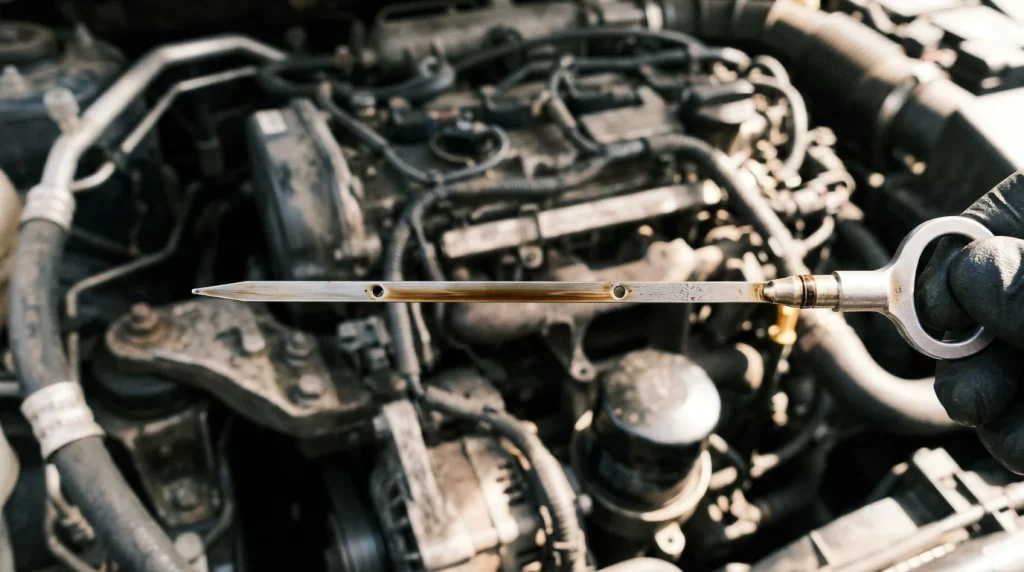
To keep your engine running smoothly, follow the step-by-step instructions on how to check your car’s oil outlined by Car and Driver.
If the oil level is below the minimum marker, add fresh oil through the oil filler cap. To avoid overfilling, add oil in small 0.5-quart increments. Recheck the dipstick level after each addition, waiting a minute for the new oil to settle into the oil pan.
Expert view: Regular dipstick inspections are the best defense against engine damage. Even if your dashboard features a digital oil level monitor, checking the physical dipstick once a month helps you catch oil leaks or consumption early.
Note: Never check your oil immediately after driving or while the engine is running. The reading will be inaccurate because a significant portion of the oil is still circulating through the upper engine passages.
Oil Change Purchasing: How Much Oil Should You Buy?
For a standard DIY oil change, buy one quart more than your vehicle’s engine capacity. This extra quart provides a safety buffer in case of minor spills, and ensures you have extra oil on hand for top-offs between scheduled services.
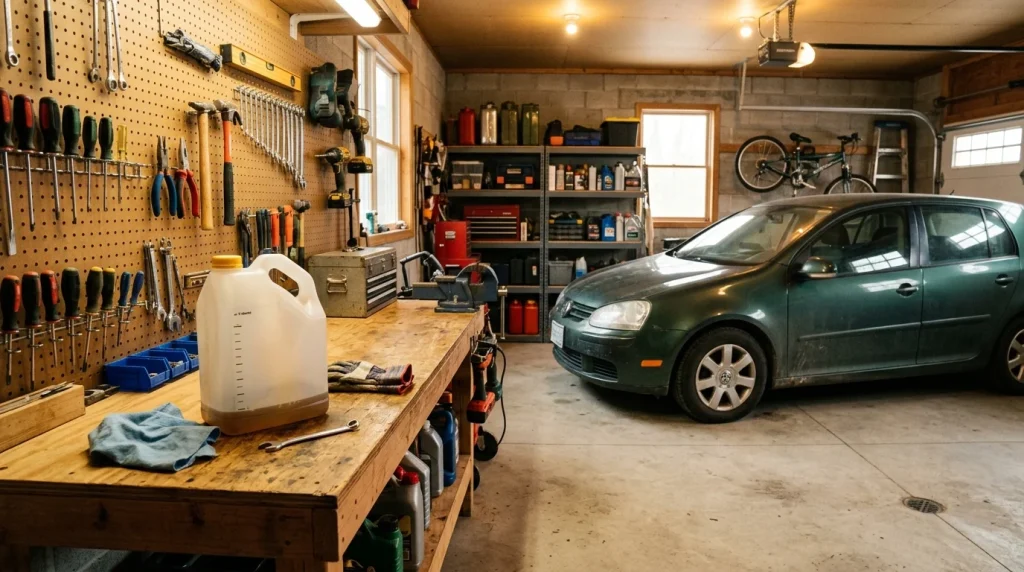
Buying a 5-quart jug is typically 30 percent more cost-effective than purchasing individual 1-quart bottles. For a vehicle that requires 4.4 quarts (like a Toyota Corolla), a single 5-quart jug is perfect. For a vehicle requiring 5.8 quarts (like a BMW 3 Series), purchase one 5-quart jug plus one individual 1-quart bottle.
Oil Type and Service Interval Relationship
The oil type does not affect total engine capacity, but it determines service frequency.
- Conventional Motor Oil: Typically requires replacement every 3,000 to 5,000 miles. It is less expensive but degrades faster under extreme heat.
- Synthetic Blend Motor Oil: Lasts between 5,000 and 7,500 miles. It offers a balance of wear protection and value.
- Full Synthetic Motor Oil: Provides protection for 7,500 to 10,000 miles. It is highly resistant to thermal breakdown and flow restrictions.
While switching from conventional to full synthetic oil does not alter the physical capacity of your engine’s oil sump, it provides superior protection for high-performance turbochargers and extends the time between services.
Frequently Asked Questions
How many quarts of oil does a 4-cylinder car take?
Most 4-cylinder passenger car engines require 4.0 to 5.0 quarts of oil with a filter change. Smaller displacement engines under 1.5L typically use 3.5 to 4.5 quarts, while larger 2.0L or 2.5L 4-cylinder models need 4.5 to 5.5 quarts.
How many quarts of oil does a V6 engine take?
Mid-size V6 engines typically require 5.0 to 6.5 quarts of oil. Performance V6 engines or V6 trucks with larger oil pans may hold up to 7.0 quarts. Always check the owner’s manual to verify specifications.
How many quarts of oil does a truck take?
Full-size light-duty trucks with V8 engines typically require 6.0 to 8.0 quarts of oil. Heavy-duty diesel trucks feature much larger sumps and can require 10.0 to 15.0 quarts of oil or more.
Does with filter and without filter capacity matter?
Yes. The “with filter” oil capacity includes the oil held inside the filter reservoir, which is usually 0.3 to 0.5 quarts. You should always reference the “with filter” number because the filter must be changed during every oil change.
Can I use 5 quarts if my car takes 4.5 quarts?
It is not recommended to overfill your engine by half a quart. While a slight excess might not cause instant engine failure, it can raise crankcase pressure. Add 4.5 quarts, check the dipstick, and top off only if necessary.

