

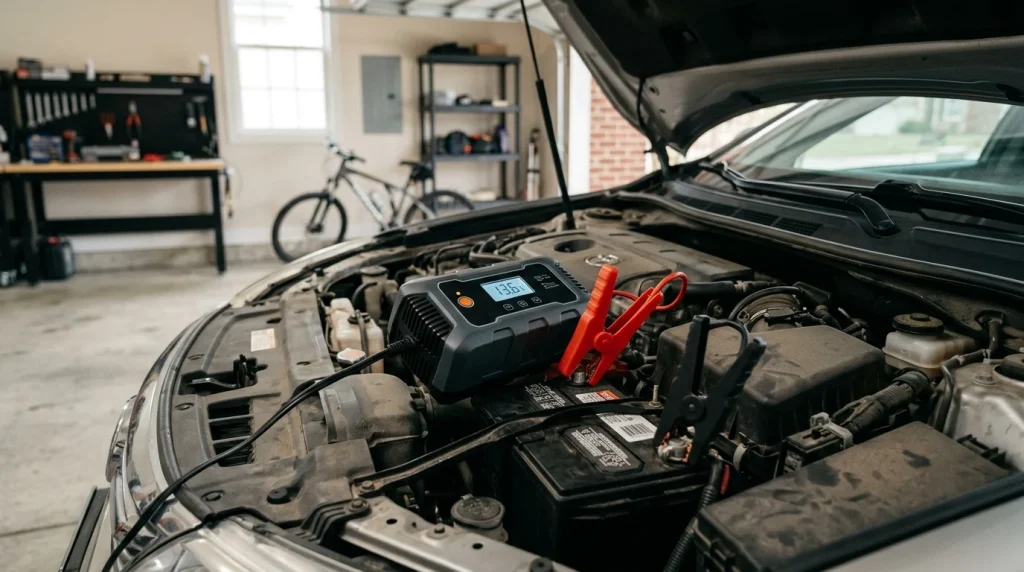
Quick answer:
Recharging a completely dead car battery takes between 3 to 24 hours depending on the charger’s speed (amperage) and the battery’s capacity. A standard 10-amp fast charger can supply enough starting power in 3 to 5 hours, whereas a low-current 2-amp trickle charger will take 24 to 48 hours to reach a full 100% state of charge. Alternators are built to maintain a healthy battery, not to recharge a dead one; doing so by driving is highly inefficient and requires hours of continuous highway speed.
Key takeaways:
- Charger speed (amperage) and battery capacity in amp-hours are the primary factors that dictate the total charging duration.
- Trickle chargers (1-2A) provide a slow charge that minimizes heat and maximizes the long-term lifespan of battery cells.
- Fast chargers (10-15A) are excellent for emergency preparation, but frequent fast charging can accelerate cell degradation.
- Recharging a dead battery by driving requires at least 4 to 8 hours of highway driving; a 30-minute trip only provides a temporary surface charge.
- Extreme cold slows down chemical reactions, extending charging times, while old or sulfated batteries may never reach a full charge.
How Long to Charge a Car Battery by Charger Speed (Amperage)
The time required to recharge a 12-volt automotive battery is determined by the output current of your charger and the size of the battery itself. Battery capacity is measured in amp-hours (Ah). Standard passenger vehicle batteries typically range from 45 Ah to 80 Ah.
To calculate the theoretical charging time, you divide the discharged capacity (Ah) by the charger’s amperage output, then multiply by 1.25 to account for the standard 80% charging efficiency of lead-acid batteries. For example, charging a fully discharged 50 Ah battery with a 10-amp charger takes approximately 6.25 hours: (50 Ah / 10 A) * 1.25 = 6.25 hours.
| Charger Type | Current Output | Time to 80% Charge (50 Ah Battery) | Best Use Case |
|---|---|---|---|
| Trickle Charger / Maintainer | 1 to 2 Amps | 24 to 48 Hours | Long-term winter storage, battery maintenance |
| Standard Smart Charger | 4 to 8 Amps | 6 to 12 Hours | Safe overnight home recharging |
| Fast Charger | 10 to 15 Amps | 3 to 5 Hours | Rapid recovery before driving |
| Professional Booster / Starter | 20+ Amps | 1 to 2 Hours | Commercial diagnostics and quick starts |
While conventional vehicles utilize standard 12-volt starting systems, electric vehicles are powered by massive high-voltage battery packs. To understand how larger battery systems are structured and charged, you can explore our guide on the best Audi electric cars to compare electric vehicle battery platforms.
Trickle Chargers (1 to 2 Amps)
Trickle chargers deliver a low, steady current of 1 to 2 amps. They are designed to offset natural self-discharge during storage rather than rapidly recover a dead battery. Recharging a fully depleted 50 Ah battery at a 2-amp rate takes 24 to 48 hours. According to the Interstate Batteries’ charging instructions, trickle chargers can take several days to reach 100% capacity, but this slow pace prevents excessive heat build-up and is the gentlest method for preserving cell health.
Standard Chargers (4 to 8 Amps)
Standard chargers operating at 4 to 8 amps are the most common choice for home maintenance. An 8-amp charger can recharge a standard 50 Ah battery to 80% capacity in approximately 6 to 8 hours, making it ideal for overnight use. These units balance charging speed with thermal safety, ensuring the battery does not overheat during a standard cycle.
Fast Chargers (10 to 15 Amps)
Fast chargers operating at 10 to 15 amps cut charging times significantly. A 10-amp charger can recharge a depleted 50 Ah battery to a starting charge in 3 to 5 hours, while a 15-amp unit will reach 80% in about 3 to 4 hours. According to Optima Batteries’ official specification, their 55 Ah AGM batteries can be safely charged at a maximum of 10 amps, taking approximately 6 to 12 hours for a complete 100% recharge. Jim McIlvaine, Tech Specialist at Optima Batteries, notes that charging an AGM battery requires a charger that delivers a constant voltage between 13.8 and 15.0 volts, and warns that exceeding a 10-amp current limit during standard home charging can lead to severe outgassing and permanent damage to the sealed cells.
Professional Boosters and Rapid Chargers (20+ Amps)
Professional shop chargers can output 20 to 50+ amps. These heavy-duty units can restore a starting charge in 1 to 2 hours. However, rapid charging must be monitored carefully. High amperage causes rapid heat generation, which can warp battery plates and cause active lead paste to shed from the grids, permanently reducing battery capacity.
Why Car Battery Charging Times Vary (Key Factors)
Theoretical calculations assume ideal laboratory conditions. In the real world, several environmental and mechanical variables will alter the charging duration:
- State of Charge (State of Depletion): A battery that has been drained slightly (e.g., from leaving interior lights on overnight) will charge much faster than one that has been sitting completely dead for weeks.
- Battery Capacity: Larger vehicles, such as trucks and SUVs, use batteries with higher amp-hour ratings (70 Ah to 100 Ah). These take longer to charge than compact car batteries (40 Ah to 50 Ah) using the same charger.
- Ambient Temperature: According to the CTEK’s battery charging guide, charging times are calculated based on a standard temperature of 77 degrees Fahrenheit (25 degrees Celsius). Cold temperatures slow down the chemical actions inside the battery, increasing resistance and extending charge times.
- Battery Age and Sulfation: As batteries age, lead sulfate crystals build up on the plates, a process called sulfation. This increases internal resistance. A sulfated battery takes longer to charge, generates more heat, and will eventually fail to hold a charge altogether.
Analysis: High-quality smart chargers utilize a multi-stage charging process (bulk, absorption, and float) to mitigate these variables. During the bulk phase, the charger constant-currents the battery to 80%. The remaining 20% is charged during the absorption phase, where current is gradually tapered to prevent damage, which is why the final stages of charging always take the longest.
Note: If a battery has been completely discharged below 10.5 volts for an extended period, standard chargers might not recognize it, as detailed in the Optima Batteries’ dead battery recovery guide. Specialized chargers with a force-charge mode or a recovery cycle are required to attempt a rescue.
Can You Recharge a Dead Car Battery by Driving?
A common automotive myth is that jumpstarting a flat battery and driving the vehicle for 30 minutes will fully recharge it. In reality, this practice only provides a surface charge, leaving the battery vulnerable to dying again the next time you turn off the ignition.
Automotive alternators are designed to maintain a healthy battery and power the vehicle’s electrical systems while the engine is running. They are not built to act as heavy-duty battery chargers. Recharging a deeply depleted battery via the alternator forces the alternator to run at maximum output for extended periods, generating extreme heat that can burn out its internal diodes.
According to technical specifications from alternator and battery manufacturers, it takes at least 4 to 8 hours of continuous highway driving (maintaining engine speeds above 2,000 RPM) to restore a dead battery to an 80% charge. Idling the engine is even less effective, as low RPMs restrict the alternator’s current output. A dedicated plug-in smart charger is always the safest and most efficient tool to recover a dead battery.
Safe Charging Practices and Checking Charge Levels
To charge your battery safely and verify that the process is complete, follow these steps:
- Work in a Well-Ventilated Area: Charging lead-acid batteries releases highly flammable hydrogen gas. Ensure you work away from open flames or spark sources.
- Connect the Charger Correctly: With the charger unplugged from the wall, connect the positive (red) clamp to the positive terminal of the battery first. Then, connect the negative (black) clamp to a clean, unpainted metal ground on the vehicle’s frame or engine block, away from the battery, to avoid spark risks.
- Set the Charger: Choose the correct voltage (usually 12V) and chemistry (standard lead-acid, gel, or AGM). Match the battery type to prevent overcharging.
- Monitor the Charge: Modern smart chargers will automatically shut off or transition to a low-current float mode once full.
- Disconnect Safely: Once complete, unplug the charger from the wall first. Then disconnect the negative clamp followed by the positive clamp.
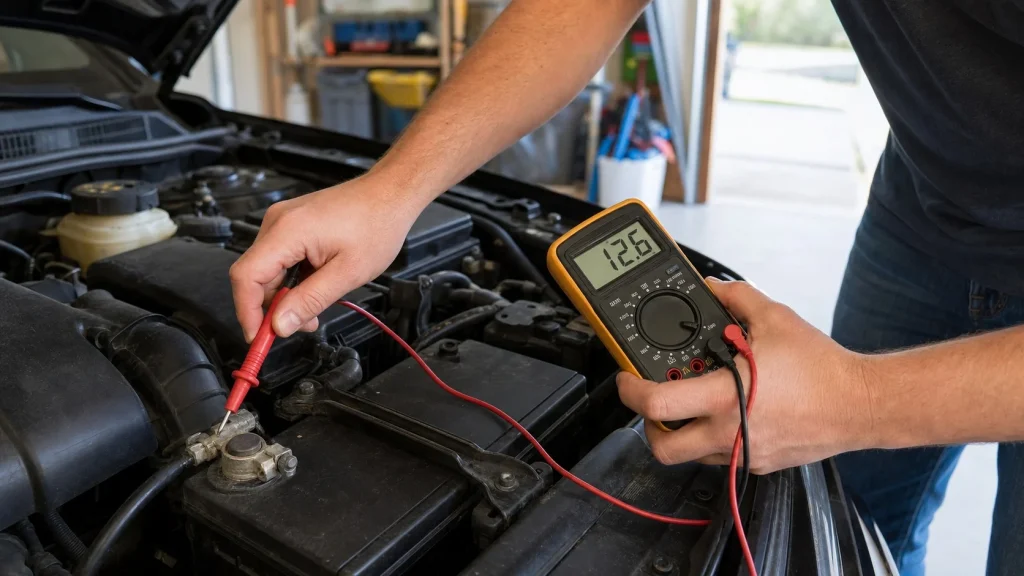
- Verify the Voltage: After charging, let the battery rest for a few hours to dissipate the surface charge. Test it with a digital multimeter. A fully charged 12-volt battery should read between 12.6V and 12.8V. A reading of 12.4V indicates a 75% charge, while 12.0V or lower indicates a dead or failing battery.
FAQs about Charging Car Batteries
Can I drive my car while the battery is charging?
No, you cannot drive or start the car while an external plug-in battery charger is connected. Doing so can damage the charger, strip the cables, or trigger electrical surges that damage your vehicle’s sensitive electronic control units. The vehicle must remain parked with the ignition turned off throughout the entire charging cycle.
Is it safe to leave a car battery charger on overnight?
It is safe to leave a modern smart charger or battery maintainer connected overnight. These devices feature automatic voltage detection that cuts off the current or drops to a safe float charge once the battery is full. However, older manual chargers do not shut off automatically; leaving them connected overnight can overcharge the battery, boiling the electrolyte and permanently destroying the cells.
Why does my car battery keep dying after being fully charged?
If your battery continues to lose charge shortly after a full recharge, the battery cells are likely worn out and can no longer hold charge due to sulfation or grid corrosion. Other potential culprits include a failing alternator that fails to maintain charge while driving, or a parasitic draw where a malfunctioning electrical accessory drains power while the vehicle is parked.
How long does it take to charge a car battery at AutoZone?
AutoZone and other major auto parts retailers offer free battery testing and rapid charging services. Their commercial-grade fast chargers can test, recover, and fully charge a healthy automotive battery in 30 minutes to 2 hours, depending on the battery’s size and level of depletion.

