

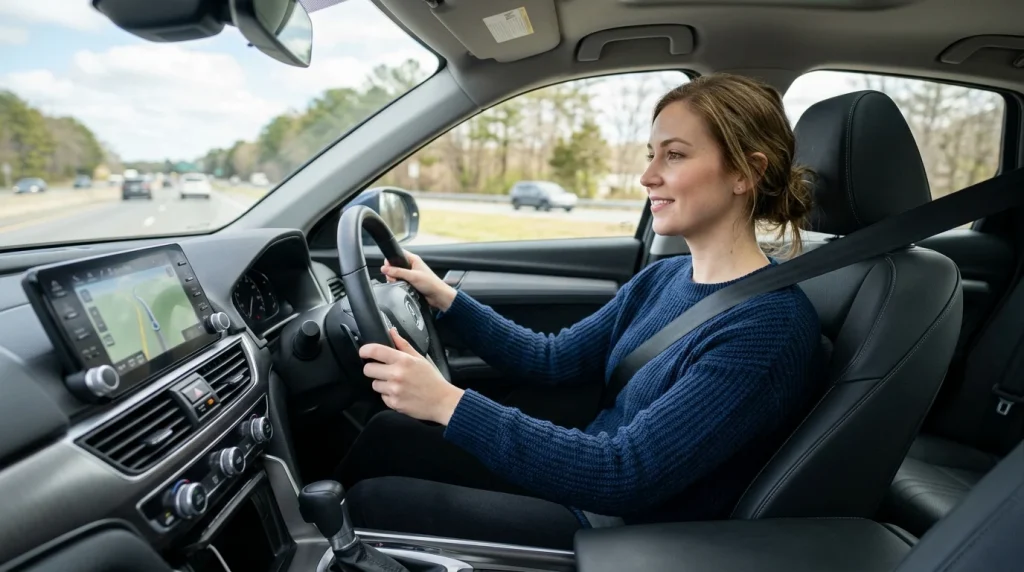
Quick answer: An active restraint in a car is a safety device that requires the occupant to manually engage it before driving to function properly. The most common example is the standard three-point seat belt, which provides zero protection during a collision unless the passenger physically pulls the webbing across their body and buckles it into the latch.
Key takeaways:
- Active restraints depend entirely on conscious manual action by the passenger before travel.
- Passive restraints like airbags and crumple zones operate automatically during a crash.
- Buckling a seat belt reduces front-seat passenger car fatality risk by 45 percent.
- Active head restraints move automatically in crashes, making them passive devices despite the name.
What Is an Active Restraint System?
An active restraint system is an occupant protection mechanism that depends on the driver or passenger to activate it. If you do not physically engage the device, it remains completely inactive and provides no safety protection during an accident. This system places the responsibility of safety compliance directly on the vehicle occupants, relying on human action rather than vehicle automation to save lives in a collision.
Unlike automated safety features, active restraints require a conscious effort from the user. They must be adjusted and secured before the vehicle begins moving. If an occupant bypasses the system or leaves it unused, the safety hardware installed by the manufacturer serves no protective purpose.
Common Examples of Active Restraints in Modern Cars
Modern passenger vehicles feature several active safety mechanisms designed to secure occupants against crash forces. These devices must be adjusted manually to fit the occupant’s body shape and height.
- Three-Point Seat Belts: These combine lap and shoulder belts to secure the chest and pelvis. They have been the standard active restraint in U.S. passenger cars since 1974.
- Child Safety Seats: Rear-facing car seats, forward-facing harnesses, and belt-positioning booster seats require correct manual installation and securing of the child by a caregiver. Caregivers can learn about installing infant car seats safely to prevent common installation errors.
- Adjustable Shoulder Anchors: The sliding belt anchors located on the vehicle’s B-pillars are active devices. Occupants must manually slide the anchor up or down to align the shoulder strap properly across the center of the chest.
Active vs. Passive Restraints: Key Differences
The difference between active and passive restraints is determined by user action. An active restraint requires manual engagement before driving, while a passive restraint deploys automatically during a collision without any input from the driver.
Airbags, crumple zones, and automatic seat belt pretensioners are passive restraints. While active restraints anchor the occupant to the seat frame, passive restraints cushion the impact and absorb kinetic energy during deceleration. These systems are designed to operate together. Your seat belt keeps you positioned correctly so that when the airbags deploy, they absorb the forces without causing secondary injuries.
| Feature | Active Restraint | Passive Restraint |
|---|---|---|
| Activation Requirement | Manual action by the occupant | Automatic deployment by the vehicle |
| Primary Examples | Seat belts, child seats, adjustable anchors | Airbags, crumple zones, automatic pretensioners |
| Operating Timing | Must be engaged before driving | Activates during a collision event |
| Human Factor Dependency | High (useless if ignored or bypassed) | Low (functions regardless of user action) |
Active Head Restraints: Are They Actually Active or Passive?
Automotive safety terminology can sometimes be confusing. A prime example is the active head restraint. Despite using the word “active” in its name, an active head restraint is classified as a passive safety device. This classification is because the system activates automatically during a rear-end collision, requiring no action or manual setting from the vehicle occupant.
Conventional headrests are passive static devices that remain fixed. In contrast, an active head restraint moves automatically during a crash to reduce whiplash injury.
Whiplash Injury Prevention and Mechanics
During a rear-end collision, a vehicle is pushed forward abruptly. The seatback pushes the occupant’s torso forward, but the head lags behind due to inertia. This difference in movement causes the neck to bend backward, resulting in whiplash.
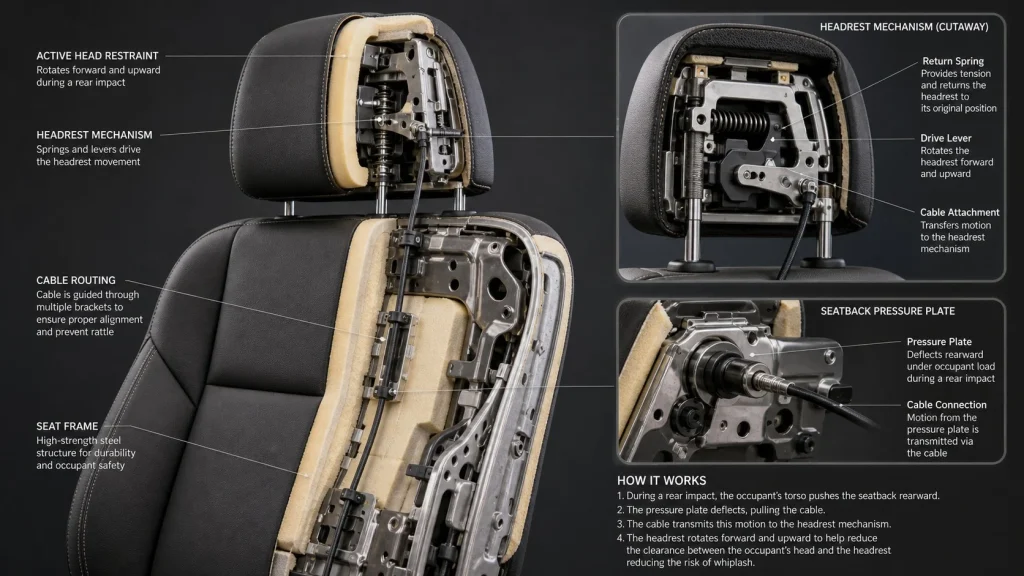
An active head restraint prevents whiplash by reducing the horizontal gap, known as the backset, between the occupant’s head and the headrest. The mechanism uses a lower pressure plate built into the seatback. When the occupant’s torso is pressed backward into the seat during an impact, the pressure activates a mechanical cable linkage. This linkage pushes the headrest diagonally upward by approximately 30 millimeters and forward by 25 millimeters to catch the head early in the collision sequence.
Biomechanical Limitations and Safety Standards
While active head restraints improve safety, they have limitations. A biomechanical study published in PubMed indicates that these systems may not activate fully during peak spinal movement if the occupant is positioned poorly. The researchers noted that a static head restraint backset exceeding 8.0 centimeters increases the risk of hyperextension injuries in the cervical spine.
In the United States, head restraints must comply with Federal Motor Vehicle Safety Standard No. 202a, also known as FMVSS 202a. This standard sets strict height, width, and backset requirements. Manufacturers can meet FMVSS 202a using static designs or dynamic active systems that deploy during crash tests to satisfy backset retention criteria.
The Real-World Effectiveness of Active Restraints
Using active restraints is the most effective safety choice a driver can make. Decades of data show that manual safety belts save thousands of lives annually.
According to the National Highway Traffic Safety Administration (NHTSA), properly worn seat belts reduce the risk of fatal injury to front-seat passenger car occupants by 45 percent. For front-seat occupants of light trucks and SUVs, the risk of fatal injury is reduced by 60 percent.
The National Safety Council (NSC) reports that seat belts saved an estimated 374,276 lives between 1975 and 2017. Additionally, child safety seats reduce the risk of death in passenger cars by 71 percent for infants under one year old and by 54 percent for toddlers aged one to four.
NHTSA states: “Seat belts are the single most effective safety technology in the history of the automobile. They saved more lives than all other vehicle technologies combined, including air bags, energy-absorbing steering assemblies, and electronic stability control.”
Limitations of Active Restraint Systems
Despite their proven effectiveness, active restraints have two major limitations: human compliance and the potential for misuse.
- Reliance on Human Compliance: If an occupant refuses to wear a seat belt, the system provides zero protection. According to safety data, unrestrained occupants consistently account for nearly half of all passenger vehicle deaths in the United States.
- Risks of Improper Use: Misusing a seat belt reduces its effectiveness and can cause injury. For example, tucking the shoulder harness under the arm or behind the back concentrates crash forces onto the abdomen and ribs, which can cause severe internal injuries during a collision. Proper alignment is essential for active systems to protect the occupant.
Analysis of Occupant Safety Technology
Analysis
Modern vehicle safety has evolved into an integrated model where the boundary between active and passive restraints is increasingly blurred. While the seat belt is categorized as an active restraint because it must be buckled manually, it contains passive elements like pretensioners and load limiters. These components activate automatically during a crash to tighten the webbing and manage load forces on the chest. This integration shows that occupant safety relies on a synergistic relationship between human compliance and automated technology.
Summary of Vehicle Restraint Systems
Active restraints require manual action from vehicle occupants to function, whereas passive systems operate automatically. Understanding the role of both systems help occupants stay protected on the road. Securing seat belts and ensuring child seats are installed correctly remain the most important safety steps before driving. To learn more about automotive safety guides and reviews, you can browse the Autvex news hub.
Frequently Asked Questions about active restraints
Is a seat belt an active or passive restraint?
A seat belt is an active restraint because it requires the passenger to manually buckle it across their body. Without this manual engagement, the belt cannot secure the occupant during a collision.
What is an example of a passive restraint system?
Airbags are the most common example of a passive restraint system. Other examples include crumple zones, automatic seat belt pretensioners, and laminated windshield glass, all of which function automatically without any action from the driver.
Why do I need to wear a seat belt if my car has airbags?
Airbags are designed to supplement seat belts, not replace them. The active restraint (seat belt) holds you in the correct posture so that the passive restraint (airbag) can cushion your head and torso safely; hitting a deploying airbag while unrestrained can cause severe injury.
Are active head restraints active or passive?
Despite their name, active head restraints are passive safety devices because they deploy automatically during a rear-end collision, requiring no manual action from the occupant.

