

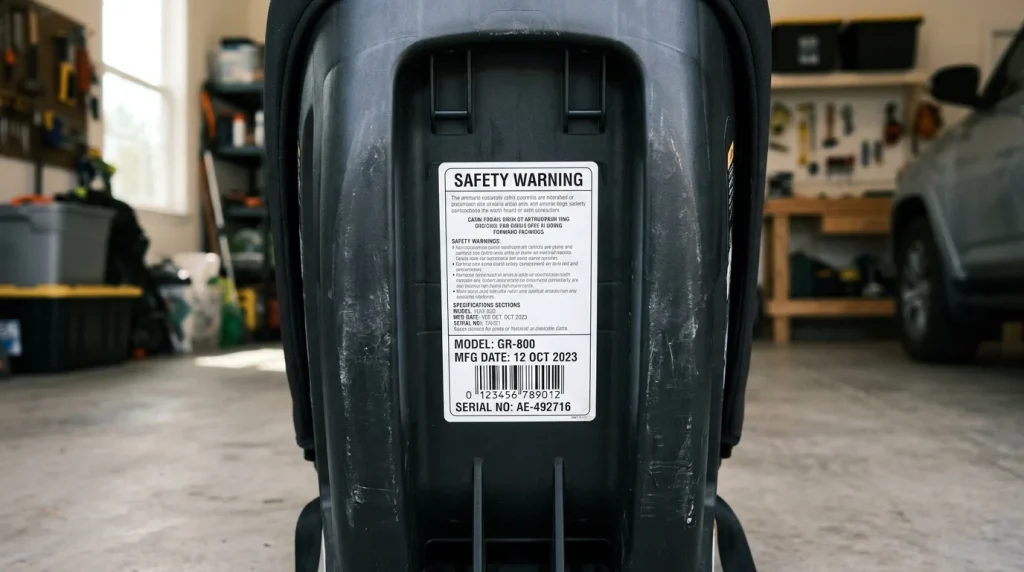
Quick answer: The expiration date on a car seat is typically printed on a white rectangular paper label (often called the serial label) located on the bottom or back of the hard plastic shell. If the label only displays the Date of Manufacture (DOM), you must calculate the expiration date by adding the manufacturer’s specified useful life – which generally ranges from 6 to 10 years – to the manufacturing date.
Key takeaways:
- The expiration label (serial label) is usually found on the underside, back, or side of the hard plastic seat shell or carrier base.
- For seats showing only the Date of Manufacture, calculate expiration by adding the brand’s designated useful life (usually 6 to 7 years for infant seats, 10 years for steel-reinforced convertibles).
- Critical components like plastic shells and energy-absorbing EPS or EPP foam degrade over time due to extreme temperatures inside vehicles.
- Never use a car seat that has passed its expiration date or has been involved in a moderate-to-severe crash.
How to Find the Expiration Label on a Car Seat
Every child car seat sold in the United States must have a manufacturing label, commonly referred to as the serial label. This label is typically a white or silver rectangular sticker affixed to the bottom, back, or side of the hard plastic seat shell. It contains critical information, including the manufacturer’s name, model number, serial number, date of manufacture, and in many newer models, an explicit expiration date.
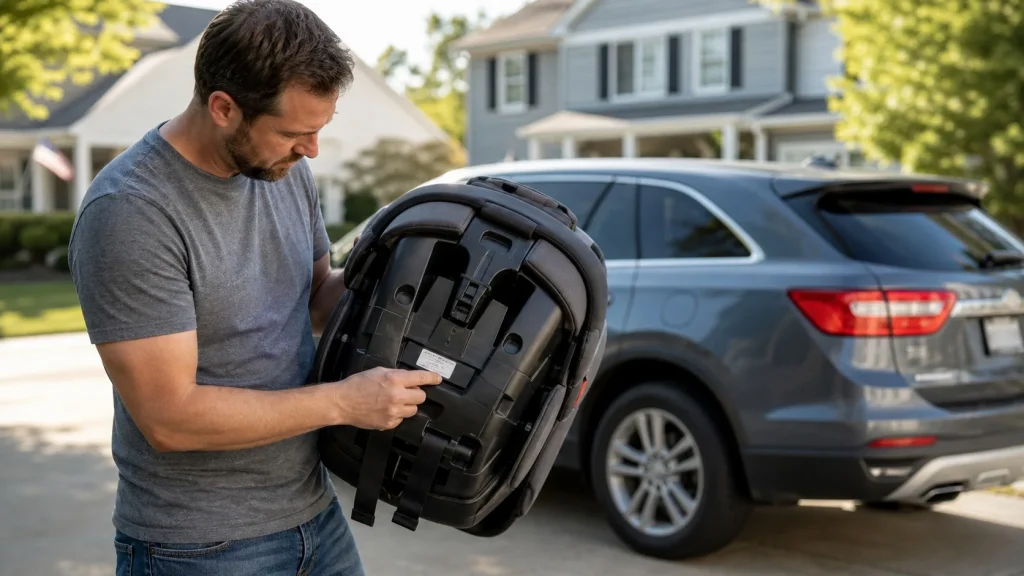
Depending on the brand, you may need to look closely at different parts of the seat:
- Graco: Graco car seats generally place the white label on the bottom or back of the seat shell. For infant carriers, it is often near the harness adjustment slots.
- Britax: The serial label is usually found on the underside of the seat, next to the harness adjustment slots, or on the back under the tether hook.
- Chicco: The label is located on the underside of the seat shell or on the base.
- Baby Trend: The label is typically affixed to the underside of the carrier or the base.
If you cannot find a physical paper sticker, run your fingers over the back of the seat. Many manufacturers emboss or mold the date of manufacture directly into the plastic molding to prevent the information from fading or peeling off over time.
When managing infant car seat safety – including knowing how to put an infant car seat on a shopping cart safely – checking the manufacturing label is the critical first step to ensure the equipment is still structurally sound.
Calculating the Expiration Date (Date of Manufacture + Lifespan)
If the label on your car seat only shows the Date of Manufacture (DOM) and does not state a clear “Do Not Use After” date, you must calculate the expiration date manually. The standard calculation formula is:
Date of Manufacture + Useful Life Lifespan = Expiration Date
For example, if the label states a manufacture date of March 15, 2020, and the owner’s manual specifies a 10-year useful life, the seat will expire on March 15, 2030.
Lifespans vary significantly by brand and seat type:
- Infant Car Seats: Typically have a useful life of 6 to 7 years from the Date of Manufacture.
- Convertible & All-in-One Seats: Usually last 7 to 10 years.
- Booster Seats: Generally last 6 to 10 years.
The table below outlines the typical lifespans and label locations for major brands:
| Brand | Seat Type | Useful Life (from DOM) | Typical Label Location |
|---|---|---|---|
| Graco | Infant (e.g., SnugRide) | 7 Years | Bottom or back of the shell |
| Graco | Convertible / All-in-One (e.g., 4Ever) | 10 Years (steel-reinforced) | Back or underside of the shell |
| Graco | Convertible (e.g., Contender) | 7 Years (plastic-reinforced) | Bottom or back of the shell |
| Chicco | Infant (e.g., KeyFit) | 6 Years | Underside of the seat shell |
| Chicco | Booster | 8 Years | Bottom or back of the shell |
| Britax | ClickTight Convertible (e.g., One4Life) | 10 Years | Back under tether hook or under seat cover |
| Britax | Harness-2-Booster | 9 Years | Outside of the headrest shell |
| Baby Trend | All Models | 6 Years | Underside of the seat or base |
Note: Graco determines its 7-year vs. 10-year useful life based on the belt-path reinforcement. Steel-reinforced belt paths and belt-positioning boosters get 10 years, whereas plastic-reinforced belt paths get 7 years.
Why Do Car Seats Expire? Material Decay and Safety Upgrades
It might seem unusual that a hard plastic safety device has an expiration date, but car seats are subject to harsh conditions. Car seats expire primarily due to material degradation and evolving safety regulations.
Over several years, a vehicle’s interior experiences extreme temperature cycles, baking under the summer sun and freezing during winter. This constant temperature fluctuation causes the hard plastic shell of the seat to become brittle. The internal energy-absorbing foam – usually Expanded Polystyrene (EPS) or Expanded Polypropylene (EPP) – can harden and lose its shock-absorbing capacity. Additionally, the harness webbing straps can fray, stretch, or weaken due to daily tension, UV exposure, food spills, and chemical breakdown from cleaning agents.
Beyond material wear, safety standards continuously improve. Older seats may not meet the latest crash protection designs. According to Cass Herring, CPSTI, a Child Passenger Safety Technician and Senior Director of Road Safety and Child Occupant Protection at Safe Kids Worldwide, if you want a car seat to do everything it is advertised to do – like protect your child in a car accident – manufacturers do not guarantee it will perform that job past its expiration date.
Furthermore, Kirsten Urso, a Child Passenger Safety expert with the American Academy of Pediatrics, warns that for older seats, the seat may not hold up the way it is supposed to in an accident, making a six-year expiration from the manufacture date (not the purchase date) a standard safety recommendation when brand-specific details are unclear.
Analysis: Even if a car seat looks physically pristine, invisible micro-fractures in the plastic shell or microscopic tears in the harness webbing can compromise its structural integrity. In a high-speed collision, these hidden weak points can lead to catastrophic structural failure, failing to distribute crash forces away from the child.
What to Do If You Cannot Find the Expiration Date
If your car seat’s label has peeled off, faded, or become unreadable, do not guess the expiration date. Take these proactive steps to verify the seat’s safety:
- Check for Embossed Dates: Inspect the back or bottom of the plastic shell. Many manufacturers stamp a clock-like date dial directly into the plastic molding indicating the year and month of production.
- Retrieve the Owner’s Manual: If you have lost the paper manual, locate the model name on the seat and download the official PDF from the manufacturer’s website. The manual contains a diagram showing the exact label placement.
- Contact the Manufacturer: Call the brand’s customer service team with any remaining serial numbers or model identifiers. Graco customer support can be reached at 1-800-345-4109.
- Follow the CPST Default Rule: If the date of manufacture cannot be verified through any means, the National Highway Traffic Safety Administration (NHTSA) and Child Passenger Safety Technicians recommend assuming a maximum 6-year lifespan from manufacture as the default limit. If the seat is older than 6 years, or if the age is completely unknown, it must be retired immediately.
Safety Guidelines for Expired or Unknown-History Car Seats
Using a secondhand car seat from a thrift store, garage sale, or an online marketplace is highly discouraged. You cannot verify if the seat has been involved in a prior crash, cleaned with harsh chemicals that degrade the harness webbing, or stored in conditions that accelerated plastic aging.

To prevent an expired or crashed car seat from being retrieved and reused by someone else, you must dispose of it safely:
- Cut the Straps: Use scissors to cut the harness straps, chest clip, and crotch buckle off the seat.
- Remove the Cover: Strip away the fabric cover, foam padding, and accessories.
- Label the Shell: Use a permanent marker to write “EXPIRED – DO NOT USE” or “TRASH – NOT SAFE” in large letters on the plastic shell.
- Separate the Parts: Place the plastic shell, foam, and fabric cover in separate dark trash bags so they are not recognizable as a complete car seat at the curb.
For more vehicle safety tips and guides, visit the latest auto news updates at the main news section.
FAQs About Car Seat Expiration
Do all car seats have expiration dates?
Yes. Every reputable car seat sold in the U.S. has a designated lifespan established by the manufacturer, typically ranging from 6 to 10 years, based on material durability and crash testing.
Can you use a car seat after it expires?
No. Using an expired car seat is highly dangerous because the aged plastic shell and foam padding may fail to protect the child during a crash.
Is the manufacture date the same as the expiration date?
No. The Date of Manufacture (DOM) is when the seat was produced at the factory. The expiration date is calculated by adding the seat’s useful life lifespan to the DOM.
How do I dispose of an expired car seat safely?
Dismantle the seat completely by cutting the harness straps, removing the fabric cover, marking the plastic shell as “EXPIRED,” and placing the separated pieces in dark trash bags.

