

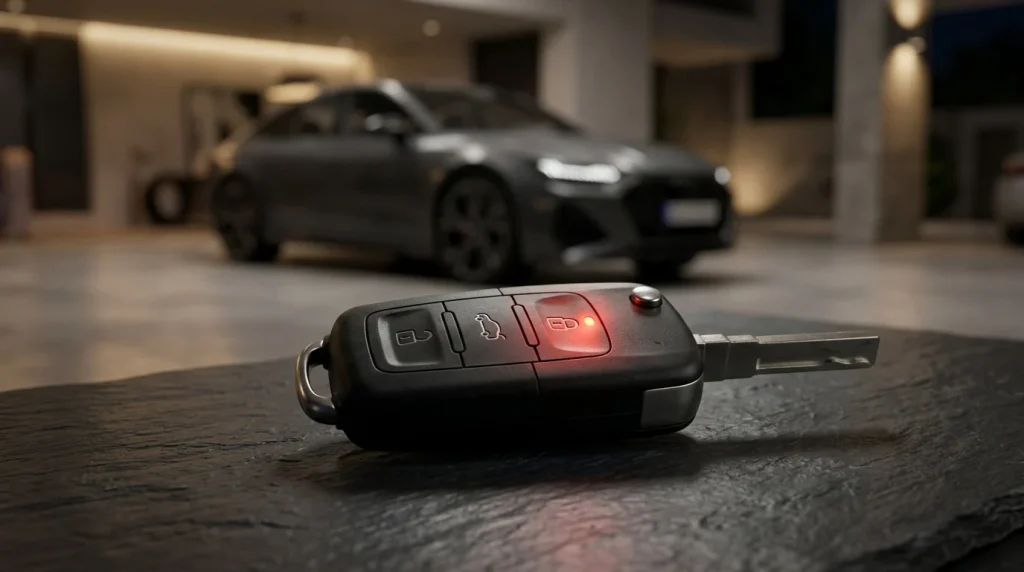
Quick answer: Your Audi key fob red light blinks to confirm a button press, but the car does not unlock when the CR2032 transmitter battery is too weak to send a signal, the key has lost synchronization, the car 12V battery is depleted, or local radio frequency interference blocks the signal. Replacing the battery and performing a door lock resync resolves most issues.
Key takeaways:
- A blinking red LED only confirms battery contact, not signal transmission strength.
- DIY battery replacement often causes temporary fob desynchronization.
- Car battery voltage below 12.4V disables the keyless entry receiver module.
- Radio interference from metallic structures or chargers blocks key fob signals.
- Physical lock actuator failures prevent individual door doors from unlocking.
Most Common Causes and Quick Diagnosis
When your Audi key fob flashes its red light but refuses to unlock the vehicle, it indicates that the key fob itself has electrical power but the signal is either not reaching the vehicle or is being ignored by the car’s computer. The small red LED on the key fob has a very low power draw. It can flash even when the lithium cell is nearly depleted, leading many owners to incorrectly assume the key is fine.
| Cause | Frequency | Key Symptoms | Quick Diagnosis Method |
|---|---|---|---|
| Low Key Fob Battery | 85 percent | Range decreases slowly, requires multiple button presses | Replace CR2032 lithium battery |
| Lost Synchronization | 8 percent | Happens after battery replacement or car battery drain | Perform manual door lock resync |
| Weak Car 12V Battery | 4 percent | Erratic dashboard lights, slow cranking, no response to spare key | Test car battery voltage, must be 12.4V or higher |
| Signal Interference | 2 percent | Key fails in specific parking garages or near power lines | Move key closer to driver’s door handle |
| Lock Actuator Fault | 1 percent | Only one door fails to unlock, physical mechanical key works | Listen for actuator motor noise in the door |
Understanding the distinction between a working LED and a strong radio signal is essential. The key fob uses a transmitter operating at either 315 MHz or 433 MHz, depending on your region and model year. While the red light requires less than 2V to illuminate, the RF transmitter needs stable voltage closer to 3V to broadcast a signal that the car’s antenna can detect.
Step 1: How to Replace the Audi Key Fob Battery
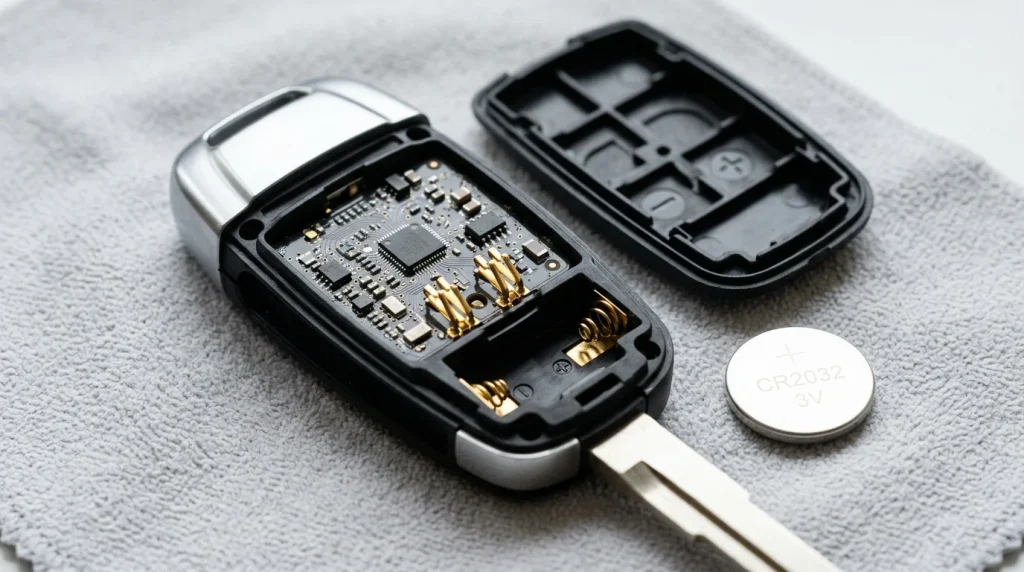
A weak CR2032 battery is the culprit in the vast majority of cases. These batteries typically last two to three years depending on how frequently the keyless entry system is used. Proactive replacement prevents getting locked out of your vehicle.
Choosing the Right CR2032 Battery
Do not purchase cheap unbranded batteries. Luxury vehicles like Audi require consistent current. Choose high-quality lithium CR2032 coin cells from reputable brands like Panasonic, Energizer, or Duracell. Ensure the battery packaging indicates a fresh expiration date. Using a battery that has sat on a shelf for years will result in immediate low-voltage issues.
Opening the Audi Key Fob Housing
The process to open the key fob varies slightly depending on whether you have a newer smart key or an older switchblade key:
- For modern smart keys, locate the release button on the back of the fob.
- Press the release button and slide the mechanical metal key blade out of the housing.
- Look inside the slot where the metal blade was housed. You will see a small plastic tab.
- Use the flat edge of the mechanical key blade or a small flathead screwdriver to gently press the tab and pull the battery tray out of the remote.
- On older switchblade keys, flip the key open, then insert a flathead screwdriver into the seam in the middle of the fob and pry the two halves apart.
Installing the Battery and Cleaning Contacts
Moisture can seep inside the key fob over time, causing thin layers of corrosion to form on the metal contacts. Before inserting the new battery, inspect the positive and negative terminals inside the housing:
- Remove the old CR2032 battery and dispose of it safely.
- Inspect the metal contact prongs for green or white corrosion buildup.
- Dip a cotton swab in isopropyl alcohol and gently clean the metal contacts.
- If the prongs are slightly bent, use a small tool to gently adjust them back into position to ensure a tight connection.
- Insert the new CR2032 battery with the positive side facing down in the battery tray (consult the markings on the plastic tray for exact polarity).
- Slide the battery tray back into the fob body until it clicks, then reinsert the metal key blade.
Step 2: How to Resynchronize the Audi Key Fob
If you replace the battery and the red light continues to blink but the car still does not open, the remote has lost its pairing. The vehicle’s security system uses a rolling code generator to prevent signal theft. When the key fob battery is removed or drops below a critical voltage threshold, the synchronization between the rolling codes in the key and the car’s computer can desynchronize.
The Driver Door Lock Method (Most Common)
This manual resync procedure works on nearly all Audi models from 2005 to 2018:
- Slide the mechanical metal key blade out of your key fob.
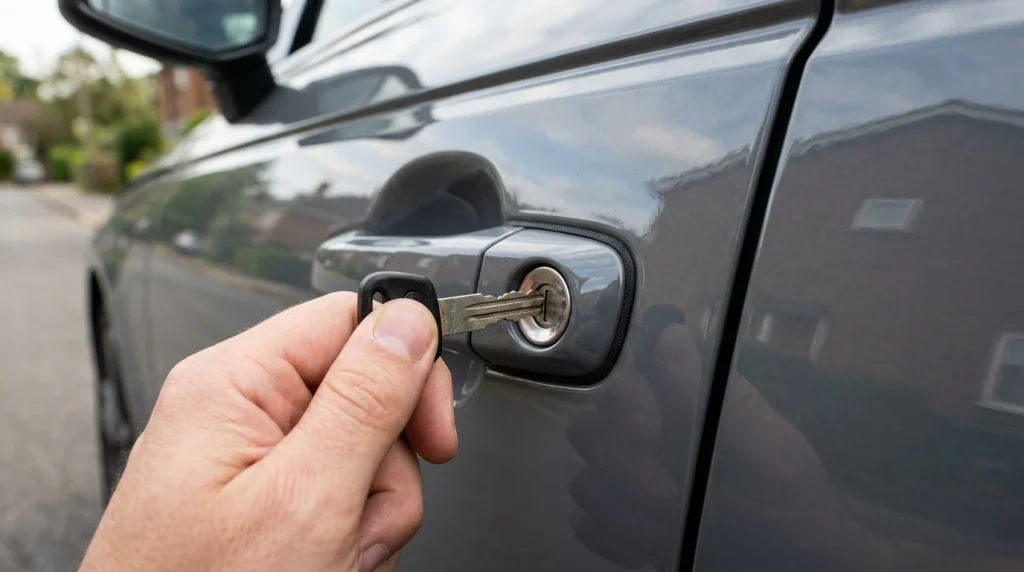
- Insert the mechanical metal key into the physical lock cylinder on the driver’s door handle.
- Turn the mechanical key to the unlock position (counterclockwise) and hold it there.
- While holding the physical key in the turned position, press and hold the unlock button on your key fob.
- Keep holding both the turned key and the button for exactly ten seconds.
- Release the unlock button, then turn the mechanical key back to the vertical position and remove it.
- Test the key fob buttons to see if the locks cycle automatically.
The Ignition Resync Method (Older Models 2005-2015)
If the door lock method does not work, try the internal ignition procedure:
- Sit inside the vehicle with all doors closed.
- Insert the key fob into the ignition switch slot.
- Turn the ignition to the accessory position (lights on, engine off).
- Press and hold the unlock button on the key fob for ten seconds.
- While continuing to hold the unlock button, turn the ignition key back to the off position.
- Remove the key from the ignition slot, then release the unlock button.
- Open and close the driver’s door, then step outside the vehicle to test the remote buttons.
MMI and Steering Column Method (Modern Push-Start Audis)
For modern Audis built after 2019 that feature keyless push-start ignitions:
- Enter the vehicle manually using the physical key blade.
- Locate the key symbol printed on the steering column (usually on the right side).
- Hold the back of your key fob directly against this key symbol.
- Press the Start-Stop engine button while holding the brake pedal down to start the vehicle.
- The car will automatically read the transponder chip and resynchronize the rolling codes.
- Allow the engine to run for at least two minutes, then turn the engine off and exit the vehicle to test key fob functionality.
The transponder chip inside the key fob does not require battery power to start the vehicle. It is powered inductively by the vehicle’s steering column antenna when held close.
Additional Factors Affecting Key Fob Range and Signal
If you have replaced the battery and attempted the resync procedures without success, the issue may lie outside of the key fob transmitter itself.
Weak 12V Car Battery Voltage
Your Audi remote keyless entry system relies on a wireless receiver module located inside the vehicle, which is powered by the car’s main 12V battery. If the vehicle has been parked for an extended period, or if the alternator is not charging the battery properly, the voltage may drop. When the car battery voltage falls below 12.4V, the vehicle’s power management system will automatically shut down parasitic draws, including the keyless entry receiver, to preserve starting power.
Symptoms of a weak car battery include slow engine cranking, dim interior lights, and multiple warning codes on the dashboard. Test your car battery with a digital multimeter. A fully charged battery should register 12.6V or higher. If it reads 12.2V or lower, charge the battery or jump-start the vehicle. Once the car battery is fully charged, the receiver module will restart and detect your key fob.
Radio Frequency (RF) Signal Interference
Radio signals can be blocked or scrambled by external electromagnetic interference. Common sources of signal interference include:
- High-voltage power lines and cell phone towers.
- Heavy metal structures in multi-level parking garages.
- Aftermarket phone chargers plugged into the vehicle’s 12V accessory socket.
- Other electronic devices, such as smart keys from different car brands, kept in the same pocket.
To determine if signal interference is the cause, try holding the key fob directly against the driver’s door glass or glass near the rear windshield, where the vehicle’s antenna is located. If the remote works when held close to the car but fails from a distance, environmental interference is likely blocking the signal.
Corroded Internal Contacts or Water Damage
If your key fob has been dropped in water or ran through a laundry cycle, the internal circuitry may be damaged. For detailed steps on recovering a wet key, refer to the guide on what happens when an Audi car key is washed in laundry. Moisture causes short circuits that drain the battery instantly and prevent the transmitter from functioning, even if the red LED light still flashes when buttons are pressed.
When Does Your Audi Fob Require Professional Programming?
There are times when manual at-home fixes are not sufficient, requiring specialized diagnostic equipment:
- Both Key Fobs Fail Simultaneously: If both your primary and spare key fobs stop working at the same time, the issue is likely a blown fuse in the vehicle’s central locking system, a failed antenna, or a faulty Comfort System Central Control Module (often referred to as the BCM or comfort module).
- Immobilizer Active Warning: If the key unlocks the doors but the dashboard displays an “Immobilizer Active” warning and the engine shuts off immediately after starting, the transponder chip pairing has failed.
- Severe Water Damage: If cleaning the internal circuit board with isopropyl alcohol does not restore function, the transmitter chip is fried.
Professional programming requires connecting to the vehicle’s OBD-II port using diagnostic software such as VCDS or OBDeleven. You can read more about automotive diagnostics in the news section to understand how central locking computers interface with the vehicle network.
Replacing and programming a new key fob through an authorized Audi dealership typically costs between $300 and $500 for the remote key transmitter itself, plus an additional $150 to $300 in labor fees to program the new key to the vehicle’s immobilizer. Independent automotive locksmiths equipped with Audi-compatible programming tools can often perform the same service for $200 to $400.
Frequently Asked Questions
Why does my Audi key fob light blink red but not unlock the car?
The red LED on your Audi key fob only indicates that the buttons are making electrical contact with the battery. It does not measure the strength of the radio signal being sent. When the battery is nearly dead, it can power the small LED bulb but lacks the voltage necessary to operate the wireless transmitter.
How do I resync my Audi key fob after a battery change?
Insert the mechanical metal key into the driver’s door lock cylinder. Turn the key to the unlock position and hold it there. While holding the key turned, press and hold the unlock button on the key fob for ten seconds. Release the button, turn the key back to the center, and test.
Can a dead car battery cause the remote key to stop working?
Yes. The car’s internal wireless receiver requires a stable 12V power supply. If the car battery drops below 12V, the vehicle entering sleep mode disables the receiver to protect the starting battery. In this state, the car will ignore all key fob signals.
How much does it cost to replace a lost Audi key fob?
A new replacement Audi key fob costs between $450 and $800 at an authorized dealership, which includes the physical remote and immobilizer programming. Qualified mobile automotive locksmiths can program keys for $200 to $400 depending on the model.

