

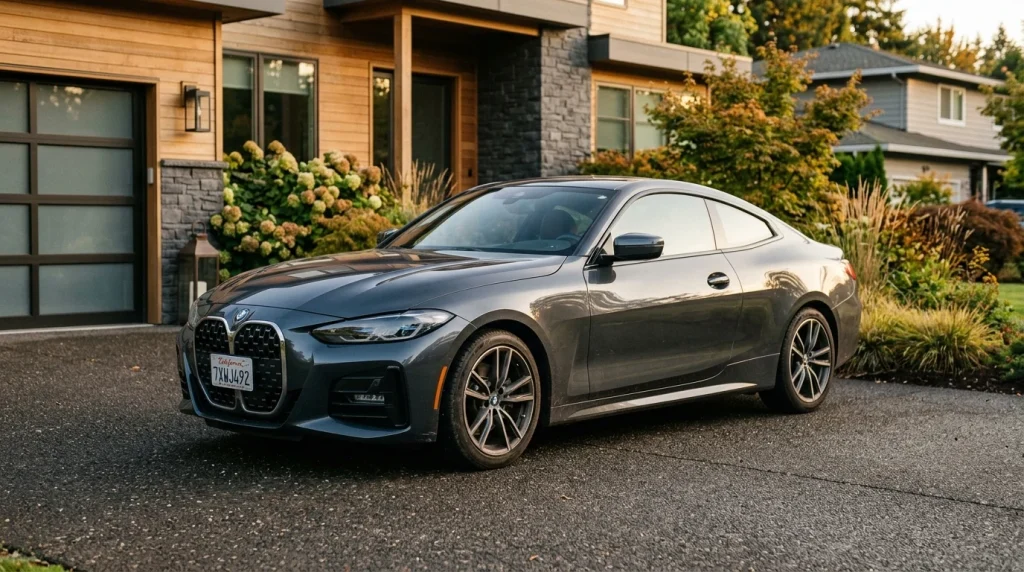
Quick answer: The used 2023 BMW 4 Series represents a highly compelling option in the luxury coupe market, with typical used prices ranging from $33,100 to $50,300 depending on body style and mileage. While it offers refined driving dynamics with its 255-horsepower B48 or 382-horsepower B58 engine, buyers must verify if critical safety updates have been performed, including the recent 2026 NHTSA starter-motor fire risk recall.
Key takeaways:
- Used market prices have depreciated 15% to 36% from the original MSRP, creating a sweet spot for luxury buyers.
- Engine reliability is highly robust thanks to the proven B48 4-cylinder and B58 inline-6 powertrains.
- Three active NHTSA recalls affect the 2023 model year, including door-locking software, TCU weld defects, and starter-motor overheating.
- Gran Coupe variants deliver the best balance of daily utility and fastback style compared to the Coupe or Convertible.
2023 BMW 4 Series Overview and Body Style Choices
The second-generation BMW 4 Series lineup stands out as one of the most distinctive design statements in the modern automotive landscape. Dominated by its bold, vertical kidney grille, this model line was engineered to distance the coupe and convertible offerings from their mechanically related sibling, the 3 Series sedan. For buyers shopping the used market, the 2023 model year represents the third production year of this generation. Choosing a used model from this specific vintage allows buyers to access mature electronics and mechanical platforms at a substantial discount compared to buying a brand new vehicle.
To cater to different driving styles and practical requirements, the used 2023 BMW 4 Series was offered in three distinct body styles, each carrying its own internal chassis code.
The classic Coupe (G22) remains the purist choice for driving enthusiasts. It features a two-door layout with a structure designed for maximum chassis rigidity. Compared to the 3 Series, the Coupe sits on a rear track that is 0.9 inches wider, and its center of gravity is roughly 1.0 inch lower. This translates directly into a more agile driving experience, with reduced body roll and a sharper turn-in during aggressive cornering. Standard features include 18-inch wheels, a sunroof, and power-adjustable front sport seats, though the rear passenger compartment is highly restricted.
The Convertible (G23) replaces the heavy, complex retractable metal hardtop of the previous generation with a multi-layer insulated fabric soft-top. This mechanical revision yields significant engineering benefits. The fabric roof assembly is approximately 120 pounds lighter than the old hardtop, which lowers the vehicle’s center of gravity and improves dynamic handling. Furthermore, the compact folding design of the soft-top increases trunk capacity by 1.2 cubic feet when the top is lowered. The multi-layer construction provides excellent acoustic insulation, matching the Coupe’s quietness at highway cruising speeds.
The Gran Coupe (G26) is the fastback four-door variant that successfully blends coupe-like styling with sedan utility. It features traditional rear doors for passenger access and a rear hatchback utility boot. The G26 is slightly wider and taller than the two-door model, which provides reasonable head and legroom for adult passengers in the rear. It serves as the ideal choice for families or daily commuters who want the low-slung aesthetic of the 4 Series but require a vehicle that can carry passengers and cargo with ease. If you are interested in other fastback designs within the brand, you can also explore the larger 2025 BMW 8 Series Gran Coupe or the entry-level 2025 BMW 2 Series Gran Coupe.
Engine Performance and Specifications: 430i vs M440i
Beneath the polarizing exterior bodywork, the 2023 BMW 4 Series relies on two of the most celebrated engines in modern automotive engineering, according to official specifications detailed by Car and Driver: the B48 4-cylinder and the B58 inline-6. Both engines feature twin-scroll turbochargers, high-precision direct fuel injection, and BMW Valvetronic variable valve lift. Power is directed to the wheels via the ZF 8HP 8-speed torque-converter automatic transmission, which is widely praised for its quick shifts and intuitive gear selection.
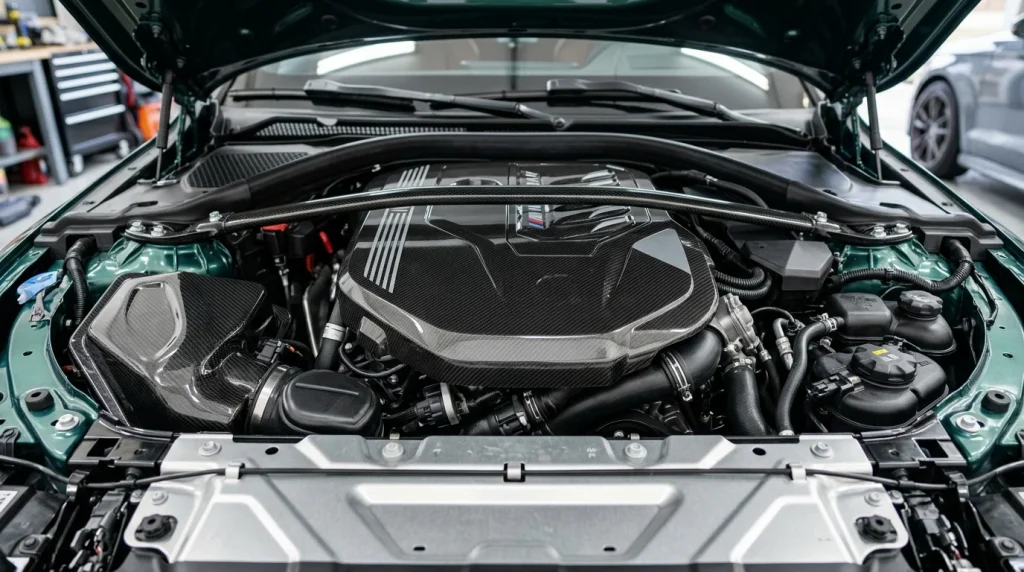
The table below outlines the core technical specifications and official performance metrics for the two primary model trims:
| Specification | BMW 430i (B48 Engine) | BMW M440i (B58 Engine) |
|---|---|---|
| Engine Type | 2.0L Turbocharged Inline-4 | 3.0L Turbocharged Inline-6 |
| Mild-Hybrid System | Not Available | 48-Volt Starter-Generator |
| Horsepower | 255 hp @ 5,000 – 6,500 rpm | 382 hp @ 5,800 – 6,500 rpm |
| Torque | 295 lb-ft @ 1,450 – 4,800 rpm | 369 lb-ft @ 1,800 – 5,000 rpm |
| Transmission | 8-Speed ZF Automatic | 8-Speed ZF Automatic |
| 0-60 mph (RWD) | 5.5 seconds | 4.6 seconds |
| 0-60 mph (xDrive) | 5.2 seconds | 4.4 seconds |
| EPA Fuel Economy (RWD) | 25 city / 34 hwy / 28 combined | 24 city / 32 hwy / 27 combined |
| EPA Fuel Economy (xDrive) | 23 city / 33 hwy / 27 combined | 22 city / 31 hwy / 25 combined |
The base 430i model utilizes the 2.0-liter B48 four-cylinder engine. Generating 255 horsepower and 295 pound-feet of torque, this engine delivers its peak pulling power at a low 1,450 rpm. This low-end torque availability ensures that the 430i feels responsive and quick during daily city driving. Sprinting from 0 to 60 mph takes just 5.5 seconds in the rear-wheel-drive configuration, and the all-wheel-drive xDrive system cuts that time to 5.2 seconds.
The high-performance M440i models are equipped with the 3.0-liter B58 inline-six engine. In this trim, the engine produces 382 horsepower and 369 pound-feet of torque. A key feature of this powertrain is the 48-volt mild-hybrid starter-generator system. The mild-hybrid setup is also integrated into the newer 2024 BMW 4 Series models to improve efficiency. It utilizes a starter-generator that harvests energy during deceleration, storing it in a compact 12-volt battery. This system provides a brief 11-horsepower boost to smooth out turbo lag at low engine speeds and makes the automatic stop-start process virtually imperceptible.
In real-world driving scenarios, both engines prove highly efficient. Operating the vehicle in Eco Pro mode allows the transmission to decouple from the engine during coasting, raising real-world highway fuel economy past 35 mpg on long road trips. However, both engines require premium fuel of 91 octane or higher. For buyers looking to compare model changes over years, the performance figures show how the chassis setup evolved into the 2025 BMW 4 Series options. Enthusiasts shopping for the latest updates can also check the tech changes introduced in the 2026 BMW 4 Series to decide if a used model is the right path.
Original MSRP vs Current Used Market Values
For used car buyers, the most appealing aspect of a used 2023 BMW 4 Series is the financial discount created by initial depreciation. Like most German luxury vehicles, the 4 Series experiences a steep depreciation curve during its first three years on the road, after which the rate of value loss begins to flatten out. By purchasing a 2023 model, buyers can avoid the heaviest hit of new-car depreciation while acquiring a vehicle that still has modern technology and safety features.
The table below displays the original base manufacturer suggested retail price (MSRP) compared to the typical Kelley Blue Book used market fair purchase range, based on vehicles in good condition with average mileage (25,000 to 45,000 miles):
| Model & Body Style | Original Base MSRP | Used Market Price | Average Depreciation |
|---|---|---|---|
| 430i Coupe RWD | $48,395 | $31,500 – $34,800 | 32% |
| 430i xDrive Coupe | $50,395 | $33,200 – $36,900 | 30% |
| 430i Gran Coupe RWD | $46,895 | $32,100 – $35,500 | 31% |
| 430i xDrive Gran Coupe | $48,895 | $32,900 – $36,200 | 33% |
| 430i Convertible RWD | $56,495 | $35,200 – $39,100 | 34% |
| 430i xDrive Convertible | $58,495 | $37,800 – $41,800 | 32% |
| M440i Coupe RWD | $59,245 | $42,100 – $46,200 | 26% |
| M440i xDrive Coupe | $61,245 | $41,900 – $45,800 | 28% |
| M440i Gran Coupe RWD | $58,445 | $39,200 – $43,400 | 29% |
| M440i xDrive Gran Coupe | $60,445 | $42,200 – $46,800 | 26% |
| M440i Convertible RWD | $67,245 | $43,100 – $47,500 | 33% |
| M440i xDrive Convertible | $69,245 | $47,800 – $52,800 | 27% |
The data reveals that the entry-level 430i trims have experienced the highest depreciation percentages. A rear-wheel-drive 430i Gran Coupe or Coupe can be acquired for close to $32,000, representing a savings of over $15,000 from the original sticker price. M440i performance trims have retained their value slightly better, reflecting strong enthusiast demand for the B58 inline-six engine and standard performance upgrades like the M Sport differential and brakes. If you want to see how these depreciation patterns compare to flagship models, check out the 2024 BMW 8 Series and compare details across the full BMW 8 Series lineup to make an informed choice.
When shopping, used buyers must choose between a private sale and a dealership Certified Pre-Owned (CPO) vehicle. To qualify for BMW’s CPO program, a vehicle must have less than 60,000 miles, pass a comprehensive dealer safety inspection, and be serviced with original parts. The CPO status adds a one-year, unlimited-mileage warranty extension that takes effect after the standard 4-year or 50,000-mile factory bumper-to-bumper warranty expires. While CPO vehicles typically cost $2,000 to $3,500 more than an equivalent private-party listing, the warranty extension provides valuable financial protection against potential electronic or mechanical repairs down the road.
Interior Design, Technology, and Cabin Comfort
The interior layout of the 2023 BMW 4 Series focuses heavily on the driver, featuring a center stack that is slightly angled toward the pilot’s seat. The cabin shares its core design language with the 3 Series, blending soft-touch materials, SensaTec synthetic leather upholstery, and aluminum trim pieces. The front seats are highly supportive, featuring deep side bolsters and manual thigh extensions that keep occupants secure during enthusiastic driving.
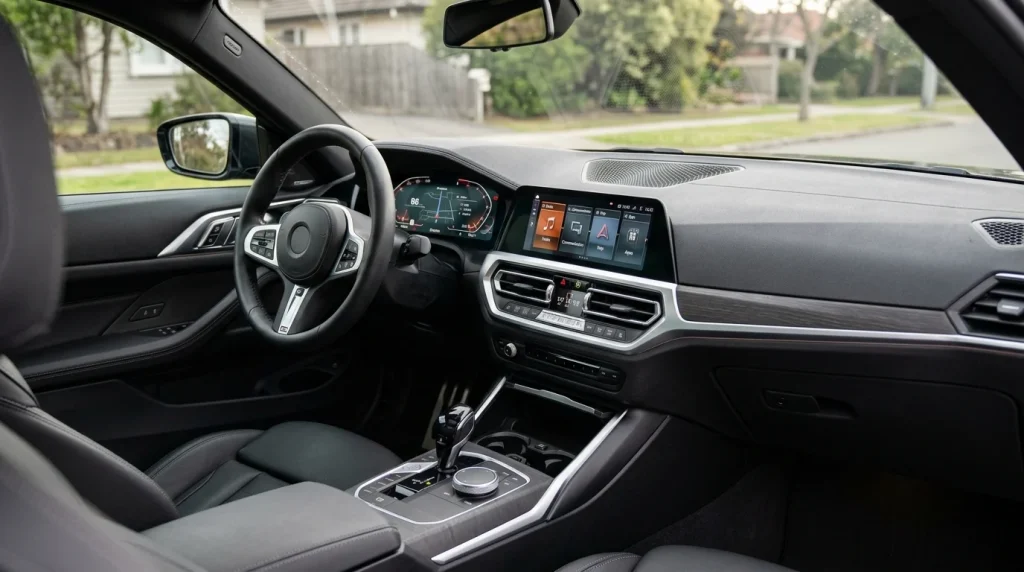
A notable technical detail of the 2023 model year is its infotainment setup. Unlike the 2024 and 2025 model updates, which transitioned to the single curved display running the iDrive 8 operating system, the 2023 model retains the older iDrive 7 system. This layout consists of a 12.3-inch digital instrument cluster behind the steering wheel and a separate 10.3-inch central touchscreen. Many drivers prefer the iDrive 7 interface because it preserves physical buttons for the dual-zone climate controls and a row of customizable radio presets. This makes adjustments simple while driving, without the need to navigate through nested touchscreen menus.
The iDrive 7 system supports multiple input methods, including direct touchscreen interaction, the physical rotary dial on the center console, steering wheel controls, and voice control. It includes wireless Apple CarPlay and Android Auto as standard. However, some owners report that the wireless connection can drop briefly when passing through areas with high electromagnetic interference, which can require a manual re-pairing of the phone.
Cabin space and daily utility are directly tied to the selected body style. In the two-door Coupe and Convertible, the rear seats are cramped, providing just 32.0 inches of legroom. Taller passengers will find headroom limited by the sloping roofline, and access requires folding the front seats forward. The Coupe offers a 12-cubic-foot trunk, while the Convertible’s cargo hold shrinks to 9 cubic feet with the soft-top stowed.
The four-door Gran Coupe represents the practical choice. It extends rear passenger legroom to 33.7 inches, and the rear doors make entry and exit straightforward. The rear hatchback design provides a wide loading aperture and a cargo capacity of 16.6 cubic feet behind the second row. Folding the 40/20/40 split-folding rear seats flat expands total cargo capacity to 45.6 cubic feet, allowing the Gran Coupe to easily transport bulky items like bicycles or large luggage sets.
Safety Ratings and Critical NHTSA Recalls
Safety is a primary consideration for second-hand luxury car buyers. The National Highway Traffic Safety Administration (NHTSA) awarded the 2023 model year a five-star overall safety rating. The Insurance Institute for Highway Safety (IIHS) named the model line a Top Safety Pick, earning Good scores in all crashworthiness assessments. Standard driving aids include forward collision warning, automated emergency braking, lane departure warning, and blind-spot monitoring.
Despite these safety achievements, the 2023 BMW 4 Series is subject to three safety recall campaigns overseen by the NHTSA:
Starter Motor Overheating and Fire Hazard: The most significant campaign is NHTSA Campaign 26V056, filed on January 30, 2026. This recall affects 87,394 vehicles in the U.S., including 4 Series models produced between 2021 and 2024. In affected vehicles, the engine starter motor can overheat due to electrical wear, posing a fire risk. Dealerships will replace the starter motor with an updated component free of charge. The starter motor fire risk also affected the subsequent 2024 BMW 4 Series models, making recall verification critical across both model years.
Transmission Control Unit Weld Defect: Issued on December 5, 2023, under NHTSA Campaign 23V821000, this recall affects a total of 552 vehicles across multiple BMW model lines. In affected cars, a manufacturing defect in the integrated transmission control unit cover’s weld seam can allow transmission oil to leak internally into the control unit. This can damage the mechatronics assembly, causing a sudden loss of drive power. Dealers must replace the mechatronics unit and transmission fluid free of charge.
ECU Software and Automatic Door Locking: Issued on February 22, 2023, under NHTSA Campaign 23V118000, this action affects a small batch of 120 cars in the U.S. Incorrect software loaded during a dealer service visit could disable the automatic door-locking function, allowing the doors to remain unlocked while the vehicle is in motion. Certified dealers must update the control software to resolve the issue.
Before purchasing a used 2023 model, buyers must use the NHTSA recall lookup tool with the vehicle’s 17-digit Vehicle Identification Number (VIN) to confirm that a certified dealer has performed all necessary recall repairs.
Used BMW 4 Series Ownership: Reliability and Maintenance Costs
Long-term operating and upkeep costs represent an important factor when purchasing a used German luxury car. While the engines and transmissions are mechanically durable, parts and labor rates at authorized dealerships are premium. According to data from Consumer Reports, the 2023 BMW 4 Series earns strong predicted reliability ratings, placing it near the top of its compact luxury class. Both the B48 4-cylinder and B58 inline-6 are modular engines that represent BMW’s best engineering in recent decades.
However, buyers should monitor several common wear points as these vehicles approach higher mileage:
Coolant Loss: The cooling systems on both the B48 and B58 engines operate under high thermal stress and pressure. Over time, the plastic coolant hose connectors, expansion tank, and the oil filter housing can become brittle and crack, leading to slow coolant leaks. Inspecting the engine bay for white residue is a key step during a pre-purchase inspection.
Valve Cover Gasket: The rubber valve cover gasket can dry out and develop leaks, allowing engine oil to weep onto the hot exhaust manifold. This typically occurs after 60,000 miles and is identified by a burning oil smell in the cabin.
PCV Valve Diaphragm: On B58 engines, the positive crankcase ventilation (PCV) valve diaphragm is integrated into the plastic valve cover. The rubber diaphragm can tear, causing increased oil consumption, rough idling, and a high-pitched whistling noise from the engine bay.
Annual maintenance costs for a used 2023 model typically average between $1,200 and $1,800. Standard oil and filter services cost $150 to $250 at independent specialist shops, while major interval services (including spark plug replacement, brake fluid flushes, and transmission fluid service) run between $600 and $1,200. Utilizing a qualified independent mechanic rather than a dealer service department can reduce overall ownership costs.
BMW 4 Series vs Audi A5 and Genesis G70
Used car buyers looking at the 2023 BMW 4 Series typically compare it to its two closest luxury rivals: the Audi A5 and the Genesis G70. Each model represents a different approach to styling, chassis tuning, and value.
The Audi A5 Coupe uses a 2.0-liter turbocharged four-cylinder engine generating 261 horsepower, paired with a 7-speed dual-clutch transmission and standard Quattro all-wheel drive. While the BMW 430i offers a more engaging rear-wheel-drive steering feel and sharper chassis response, the Audi A5 provides exceptional high-speed stability on the highway. Buyers considering smaller compact luxury options in the secondary market also evaluate the 2023 Audi A3 used review and pricing as an entry-level German alternative, though the 4 Series delivers greater grand touring capability and sharper driving dynamics. The Audi cabin layout is clean and minimalist, but the BMW iDrive 7 system features a more intuitive menu structure and faster processing speeds than the Audi system.
The Genesis G70 is a strong competitor, offering a 2.0T or a powerful 3.3-liter twin-turbo V6 engine. Used Genesis G70 models are priced $5,000 to $8,000 lower than comparable BMW 4 Series models, and they include a longer 10-year powertrain warranty for the original owner. While the Genesis interior features premium materials, the plastic switchgear on the console feels cheaper than BMW’s solid buttons. Additionally, the BMW 4 Series retains its resale value better over time, whereas the Genesis G70 suffers from steeper second-hand depreciation.
Original Analysis: Who Should Buy the 2023 BMW 4 Series?
Purchasing a used luxury vehicle requires a realistic look at long-term operating costs. While the M440i represents the performance pinnacle of the non-M lineup, its high purchase price and running costs make it a luxury purchase. In contrast, the 430i provides a highly compelling balance of style, prestige, and efficiency.
The table below outlines a projected three-year cost-of-ownership estimate (assuming 36,000 miles driven) for a used 430i RWD compared to an M440i xDrive Coupe:
| Cost Category | BMW 430i RWD | BMW M440i xDrive |
|---|---|---|
| Used Purchase Price | $34,000 | $44,000 |
| Projected Fuel Cost | $4,800 | $5,400 |
| Maintenance & Tires | $3,200 | $4,800 |
| Insurance Premiums | $5,400 | $6,600 |
| 3-Year Depreciation | $9,500 | $12,000 |
| Total Projected Cost | $56,900 | $72,800 |
The cost analysis shows that the M440i xDrive requires approximately $15,900 more to purchase, run, and maintain over a three-year ownership cycle. The B58 engine’s extra cylinders and the xDrive system increase tire wear and brake consumption, while the insurance premium is higher due to the performance classification.
Buyers should choose the 430i if they want the design, technology, and driving dynamics of a modern BMW coupe with reasonable fuel economy and operating costs. The 430i is the practical choice for daily commuters.
Buyers should choose the M440i only if they prioritize straight-line acceleration and the exhaust note of a six-cylinder engine, and are willing to pay the associated premium for fuel, insurance, and maintenance.
Pros and Cons: A 3-Year Used Ownership Summary
Pros:
- Sharp handling, precise steering, and excellent body control.
- B48 and B58 engines deliver strong performance and efficiency.
- iDrive 7 system preserves physical buttons for climate controls.
- Gran Coupe model offers practical hatchback cargo storage.
- High-quality cabin materials and quiet highway acoustics.
Cons:
- Polarizing vertical kidney grille design.
- Standard sport suspension feels firm on broken pavement.
- Restricted rear-seat legroom in Coupe and Convertible models.
- High parts and labor costs for out-of-warranty repairs.
- Active safety recalls require dealer service visits.
Frequently Asked Questions About the 2023 BMW 4 Series
What is the difference between the 2023 BMW 430i and M440i?
The 430i uses a 2.0-liter turbocharged four-cylinder engine making 255 horsepower and 295 lb-ft of torque. The M440i features a 3.0-liter turbocharged inline-six engine with a 48-volt mild-hybrid system, producing 382 horsepower and 369 lb-ft of torque. The M440i also includes standard sport suspension, upgraded brakes, and an M Sport rear differential.
How reliable is the 2023 BMW 4 Series?
The 2023 model year achieves strong predicted reliability scores, earning an 85 out of 100 quality and reliability rating from J.D. Power. Both the B48 and B58 engines are mechanically robust, though long-term maintenance costs are higher than mainstream passenger vehicles.
Should I buy a 2023 BMW 4 Series used or wait for newer models?
Buying a used 2023 model is the smart financial choice as it avoids new-car depreciation. Many drivers prefer the 2023 model because it uses the iDrive 7 system with physical climate buttons, which were replaced by touchscreens in the 2024 and 2025 model updates.
What are the biggest problems with the 2023 BMW 4 Series?
The most common problems include minor infotainment connection drops, plastic coolant line fatigue, and standard brake dust buildup. Used buyers should check that safety recalls for the starter motor, TCU mechatronics, and door-lock ECU software have been completed by a dealer.
How does the 2023 4 Series compare to the 3 Series sedan?
The 4 Series shares its engines and dashboard technology with the 3 Series, but features a lower center of gravity, wider rear track, and retuned suspension for sportier handling. The 3 Series sedan offers better rear-seat headroom and passenger accessibility.
Is the 2023 BMW 4 Series good for daily driving?
Yes, the 4 Series works well as a daily driver, providing supportive front sport seats, quiet highway cruising, and good fuel efficiency. The four-door Gran Coupe version is highly recommended for commuters who require rear-seat space and hatchback cargo utility.

