

Quick answer: The 2023 BMW i7 xDrive60 delivers 536 horsepower, 296-318 miles of EPA-estimated range, and 195 kW DC fast charging. Originally starting at $119,300, it has depreciated by 50% to 58% over three years, making the 2023 model year a compelling used purchase in 2026 with market prices ranging between $57,000 and $69,000. However, potential buyers should check for unresolved electrical issues and verify that all four NHTSA safety recalls have been completed.
Key takeaways:
- The original MSRP of $119,300 has depreciated to a used average of $57,000 to $69,000 in 2026.
- The single launch trim xDrive60 offers 536 hp and a tested 0-60 mph acceleration of 4.1 seconds.
- Maximum EPA range is 318 miles with 19-inch wheels, dropping to 296 miles on 21-inch wheels.
- The rear cabin features a luxury limousine experience with the optional 31.3-inch 8K theater screen.
- Key used inspection areas include electrical glitches, eSIM connectivity, and four official recalls.
Overview: what makes the 2023 BMW i7 special
The 2023 BMW i7 represents BMW’s boldest electrification move, establishing the brand’s electric flagship positioning that would later expand with additional trim levels in subsequent model years.
Launch year significance and evolution
BMW introduced the i7 in 2023 with several strategic considerations. The first-generation foundation established BMW’s electric flagship identity, utilizing the shared G70 platform with the gas-powered 7 Series. This allowed the vehicle to maintain familiar proportions. The single trim strategy (xDrive60 only) simplified the initial launch year. This served as a foundation for future lineup expansions, including the rear-wheel-drive eDrive50 and high-performance M70 variants. Software improvements have continued through over-the-air updates since launch.
Technical specifications at a glance
The following table outlines the key technical specifications for the inaugural model year:
| Specification | 2023 BMW i7 xDrive60 |
|---|---|
| Starting MSRP (New) | $119,300 (excl. $995 destination) |
| Used Pricing (2026) | $57,000 – $69,000 |
| Horsepower | 536 hp |
| Torque | 549 lb-ft |
| Drivetrain | Dual-motor AWD (xDrive) |
| EPA Range | 296 – 318 miles (wheel dependent) |
| 0-60 mph | 4.1 seconds (tested) |
| Top Speed | 150 mph (governed) |
| Battery Pack | 101.7 kWh usable |
Exterior design and styling
The 2023 BMW i7 showcases a bold exterior design that generated polarizing reactions among buyers and automotive journalists, departing significantly from the previous conservative elegance of the 7 Series.
Bold and polarizing design philosophy
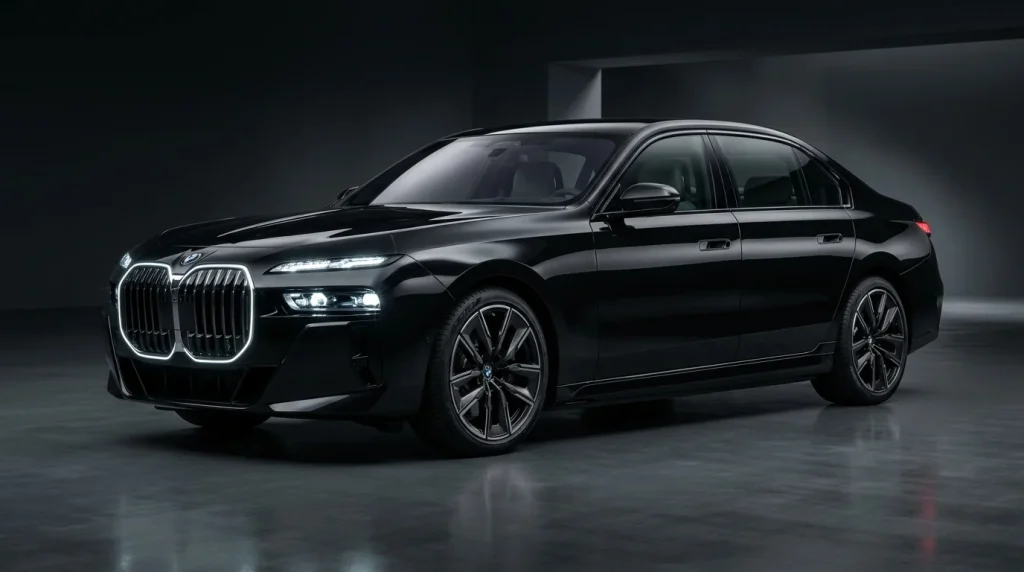
BMW designed the first i7 with distinctive exterior characteristics. The oversized illuminated kidney grille creates an unmistakable presence day and night. The split-element LED headlights offer a slender, modern design language. The vehicle measures 212.2 inches in length with a 126.6-inch wheelbase, offering traditional luxury sedan proportions. While it is more conservative than the jelly-bean-shaped Mercedes EQS, it remains bolder than previous 7 Series generations. The design reception has been highly polarizing, with some praising its boldness and others critiquing the front-end styling.
Distinctive lighting and premium elements
Premium lighting technology defines the vehicle’s exterior character. Available Swarovski crystal LED daytime running lights add jewelry-like detailing, while animated welcome and goodbye sequences create theatrical experiences. Flush, embedded door handles present automatically when approaching with the key. The full LED adaptive headlights adjust beam patterns for conditions, and chrome accents throughout the exterior create an upscale appearance appropriate for flagship positioning.
Wheel options and aerodynamic range impact
Official EPA testing provides these range estimates based on wheel size selection:
- 19-inch wheels: 318 miles (maximum efficiency configuration)
- 20-inch wheels: Approximately 305-310 miles (aesthetic/performance balance)
- 21-inch wheels: 296 miles (shortest range, sport appearance)
The 22-mile difference between wheel configurations represents approximately 7% of total range. This is a meaningful consideration for buyers prioritizing maximum efficiency, according to official EPA data.
Luxury interior and cabin experience
The cabin represents the pinnacle of BMW luxury craftsmanship, with exceptional attention to material quality rivaling or exceeding the Mercedes-Benz S-Class.

Front seat comfort and driver environment
Front passengers enjoy comprehensive luxury. Extended Merino leather upholstery is standard across the entire cabin, accompanying 18-way power-adjustable front seats with memory functions. The driving environment balances traditional driver focus with modern electric vehicle technology integration. Drivers benefit from 42.8 inches of front legroom and 41.2 inches of front headroom, accommodating taller occupants comfortably.
Rear-seat luxury and executive features
The rear cabin represents the vehicle’s true luxury showcase, offering 42.8 inches of legroom. Limousine-like amenities include power rear sunshades, side window sunshades, and quad-zone automatic climate control. Small touchscreens are integrated into the rear doors for convenient climate and seat control. The optional Rear Executive Lounge Seating Package ($7,250) adds power recline and a footrest, while the Luxury Rear Seating Package ($600) adds ventilated and massaging rear seats.
Panoramic Sky Lounge LED roof
The panoramic glass roof transforms the cabin atmosphere. It features LED-embedded light patterns that synchronize with the driving modes, creating a coordinated ambiance. The heat-reflecting laminated glass reduces solar heat gain, creating a sophisticated environment that enhances passenger comfort during nighttime transit.
Technology and infotainment systems
The vehicle showcases cutting-edge technology throughout, though the system’s complexity has generated mixed feedback regarding daily usability.
BMW Curved Display and iDrive 8 system
The driver-focused technology interface includes a 12.3-inch digital instrument cluster and a 14.9-inch central touchscreen. These are housed under a single floating glass panel running the iDrive 8 operating system. The dashboard features the BMW Interaction Bar, which integrates faceted glass with dynamic ambient lighting. The cloud-based navigation includes real-time traffic and charging station integration. Voice control is handled by the Intelligent Personal Assistant. However, owner reports indicate the iDrive 8 system has a steep learning curve, with some functions requiring too many menu steps to access.
31.3-inch rear theater screen
The optional rear-seat entertainment system delivers a cinema-quality experience. The 31.3-inch 8K display drops down from the headliner and folds away when not in use. It features Amazon Fire TV integration, 5G connectivity, and an HDMI port for connecting gaming consoles or laptops. Two pairs of wireless headphones are included. Note that deploying the screen blocks rear window visibility, though the vehicle’s camera systems compensate for this blind spot. Some owners have reported buffering issues despite the 5G connection.
Electric powertrain and performance
The electric powertrain, shared with the BMW iX SUV, delivers impressive performance wrapped in luxury sedan refinement.
Battery technology and charging specifications
BMW equipped the vehicle with a 101.7 kWh usable capacity (105.6 kWh total) lithium-ion battery pack. The floor-mounted battery pack contributes to a low center of gravity, enhancing handling dynamics despite the vehicle’s substantial 6,067-pound curb weight. Public DC fast charging up to 195 kW can replenish 10% to 80% battery capacity in approximately 34 minutes. Level 2 home charging via an 11 kW onboard charger takes approximately 10 hours for a full charge from empty.
Acceleration and real-world handling
The xDrive60 features a dual-motor configuration. The front motor produces 255 horsepower and 269 lb-ft of torque, while the rear motor produces 308 horsepower and 280 lb-ft of torque. The combined output reaches 536 horsepower and 549 lb-ft of torque. According to testing by Car and Driver, the sedan accelerates from 0-60 mph in 4.1 seconds and finishes the quarter-mile in 12.5 seconds at 114 mph. The standard adaptive air suspension with electronic damping adjusts in milliseconds to provide a composed, comfortable ride that glides over road imperfections. Standard rear-axle steering enhances maneuverability, reducing the turning circle by approximately 3 feet in tight urban spaces.
Range, charging, and real-world efficiency
Understanding charging capabilities and realistic range expectations helps set appropriate ownership expectations.
Real-world highway range test results
Independent testing by Car and Driver reveals that the vehicle achieves approximately 260 miles of range during sustained 75 mph highway driving. This represents about 82% of its maximum EPA estimate, which is typical for electric vehicles. In city or mixed driving conditions, conservative driving can yield 280 to 320 miles. However, cold weather temperatures below freezing can reduce the range by 20% to 30%.
Charging cost and fuel savings analysis
Electricity costs vary significantly by region. Home charging typically costs between $0.02 and $0.08 per mile (assuming residential electricity rates of $0.10 to $0.30 per kWh), resulting in $10 to $30 for a full charge. Public DC fast charging raises costs to an average of $0.15 to $0.35 per mile. Five-year fuel savings compared to a conventional gas-powered 7 Series are estimated at $10,000 to $15,000, assuming a gas price of $3.50 per gallon and 20 mpg.
Used pricing and steep depreciation in 2026
The used market presents a compelling opportunity for buyers due to the typical steep depreciation pattern of high-end luxury electric sedans.
Market valuation comparison
Appraisal data from Edmunds indicates that the retail value of a used 2023 model in good condition sits between $55,148 and $58,968. Trade-in values range from $52,199 to $64,454 depending on vehicle condition. On major listing sites like CarGurus, the average dealer listing index sits around $69,285. TrueCar listings average slightly lower at $57,950. Compared to the original base MSRP of $119,300, a used buyer in 2026 can acquire this flagship sedan at a 50% to 58% discount.
Depreciation trajectory and retail value
Luxury sedans historically lose value quickly, but electric variants experience even steeper declines. The 2023 model year has established a stable used floor between $57,000 and $69,000. Value retention is heavily influenced by optional packages, with the Rear Executive Lounge Seating and Driving Assistance Professional packages retaining the most value on the secondary market.
Common problems, recalls, and reliability
As a low-volume flagship vehicle, the reliability record of the 2023 model year should be evaluated carefully using official safety agency databases.
NHTSA complaints and common issues
The NHTSA has recorded 16 owner complaints for the 2023 model year. The most frequent issues are categorized as electrical system faults (9 complaints), followed by conventional brakes (7 complaints), and automatic emergency braking system malfunctions (7 complaints). Glitches in the eSIM connectivity, particularly for AT&T users, and automatic doors failing to latch properly are also common owner complaints.
Official safety recall campaigns
Used buyers must verify that the following four safety recalls have been resolved by an authorized dealer:
- Hands-On Detection System (NHTSA Recall 23V-748000): Affecting approximately 9,200 units of the 7 Series and i7. The driver-monitoring system may fail to detect if the driver’s hands are off the steering wheel, potentially failing to stop the vehicle in an emergency.
- Front Seat Welding Defect (NHTSA Recall 23V-424000): Affecting 29 units of the 2023 i7 xDrive60. Faulty welds in the front seat structure may fail during a crash, increasing injury risks.
- Interaction Bar Defect (NHTSA Recall 23V-510000): Affecting approximately 384 units of the 2023 model. A faulty microchip in the dashboard interaction bar can prevent the windshield defogger and hazard lights from functioning.
- High-Voltage Combined Charging Unit (NHTSA Recall 23V-456000): Affecting a single 2023 i7 xDrive60 unit. An improperly assembled charging unit could interrupt electrical power, causing the vehicle to stall while driving.
How the 2023 i7 compares to 2024 and 2025 model years
Buyers shopping the used market may wonder whether they should stretch their budget for a newer model year.
Model year changes and lineup expansion
The primary difference lies in model selection. The 2023 model year was offered exclusively as the dual-motor xDrive60. For the subsequent model year, BMW expanded the lineup by introducing the single-motor, rear-wheel-drive eDrive50 and the high-performance M70. The 2025 model year maintained these trims while upgrading the infotainment software. For a detailed breakdown of these newer models, check out our 2024 BMW i7 review or read our comprehensive 2025 BMW i7 review to evaluate the latest updates. You can also explore the broader lineup on our i7 category hub.
Value comparison: 2023 vs. 2024 vs. 2025
While newer model years offer more choice, they command higher prices. A used 2024 model averages $15,000 to $20,000 more than a comparable 2023 model. The 2023 xDrive60 remains the value sweet spot, offering identical performance and interior luxury to the newer xDrive60 versions at a significantly lower price point.
Verdict: is a used 2023 BMW i7 worth buying in 2026?
Yes. The 2023 BMW i7 xDrive60 is an exceptional used purchase in 2026 for buyers seeking executive-class electric luxury. The steep depreciation curve has made this $120,000 flagship accessible at a fraction of its original cost. It is best suited for buyers prioritizing rear-seat comfort, advanced cabin technology, and quiet highway cruising over maximum driving range. Prospective owners should verify that all recall work has been completed and seek vehicles with active factory warranties to mitigate potential out-of-pocket repair costs for complex electrical components.
FAQs about the 2023 BMW i7
What is the real-world range of the 2023 BMW i7?
The 2023 BMW i7 xDrive60 has an EPA-estimated range of 296 to 318 miles. Real-world highway driving at a sustained 75 mph yields around 260 miles. Cold winter temperatures can reduce this range by 20% to 30%, while city driving can occasionally exceed 300 miles.
Does the 2023 BMW i7 have a front trunk (frunk)?
No, the 2023 BMW i7 does not have a front trunk. The front compartment is occupied by electric drive components and the cooling system. The rear trunk offers 11.4 to 18 cubic feet of cargo space, which is smaller than some competitors.
Does the 2023 BMW i7 qualify for the federal EV tax credit?
When purchased new, the 2023 model did not qualify for the $7,500 federal EV tax credit due to its high MSRP exceeding the sedan price cap. Used buyers in 2026 do not qualify for the used EV tax credit either, as the used price exceeds the federal $25,000 price limit.
What are the main recalls affecting the 2023 BMW i7?
The 2023 model has been subject to four safety recalls: a hands-on steering wheel detection system defect, a front seat structure welding defect, a dashboard interaction bar microchip issue, and a high-voltage combined charging unit assembly error.
How long does it take to charge the 2023 BMW i7?
Public DC fast charging at 195 kW takes approximately 34 minutes to charge from 10% to 80%. Home Level 2 charging via a 240V outlet takes approximately 10 hours to complete a full charge from empty.
How much has the 2023 BMW i7 depreciated?
By 2026, the 2023 model has lost approximately 50% to 58% of its original value. A vehicle that cost $120,000 new now sells on the used market for $57,000 to $69,000 depending on mileage and condition.

