

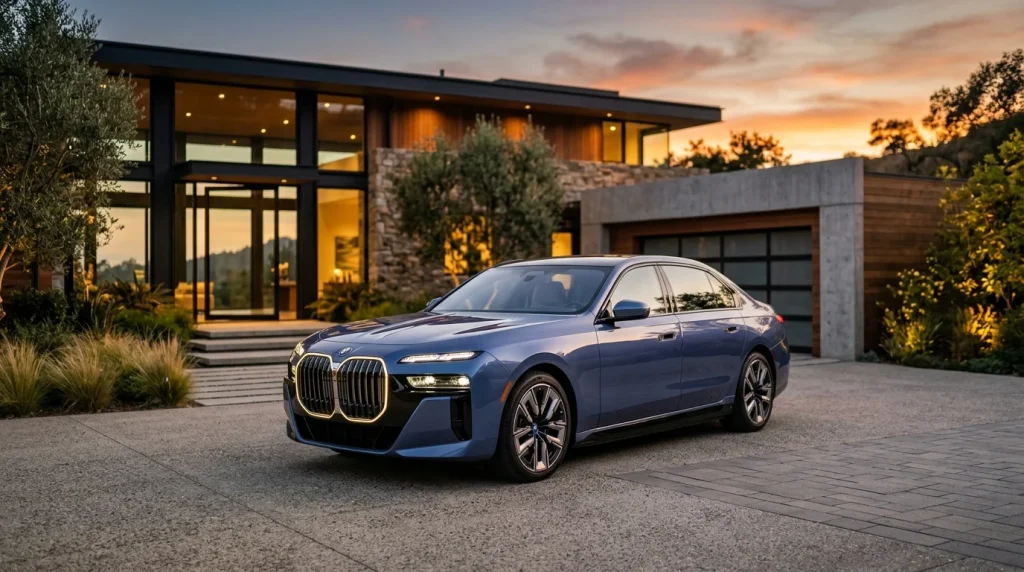
Quick answer: The 2024 BMW i7 is an electric flagship luxury sedan priced from $106,695 to $169,495, delivering an EPA-estimated range of 274 to 321 miles depending on the trim and wheel configuration. It features a usable battery capacity of 101.7 kWh and supports 195 kW DC fast charging to replenish 10 to 80 percent of battery life in approximately 34 minutes under ideal conditions.
Key takeaways:
- Lineup expands for 2024 with the new rear-wheel-drive eDrive50 and the high-performance M70 xDrive flagship.
- The eDrive50 with 19-inch wheels achieves the maximum estimated range of 321 miles per charge.
- Standard features include adaptive air suspension and four-wheel steering, while the 31.3-inch 8K theater screen remains a standout option.
- The vehicle does not qualify for the federal EV tax credit due to assembly location and price caps.
- Software recalls affect specific 2023-2024 units, including a 2025 recall for potential drive power loss.
The 2024 BMW i7 represents BMW’s most comprehensive attempt to define the ultra-luxury electric sedan segment. Built on the same architecture as the gas-powered 7 Series, this electric flagship combines traditional executive appointments with fifth-generation electric drivetrain technology. For the 2024 model year, the lineup expands from a single variant to three distinct trims, offering buyers a choice between maximum range, balanced all-wheel traction, or high-performance capability.
Pricing and Trim Levels Breakdown
BMW expanded the i7 family for 2024, introducing a new entry-level rear-wheel-drive trim and a performance-focused flagship. This bracketing strategy makes the vehicle competitive across a broader price spectrum. The lineup now starts at $106,695, representing a significant price drop for entry compared to the initial model year, which you can read about in our 2023 i7 review.
The three available configurations are detailed in the comparison table below:
| Trim Level | Drivetrain | Base MSRP (incl. destination) | Standard Wheels | Key Features |
|---|---|---|---|---|
| eDrive50 | RWD, Single Motor | $106,695 | 19-inch | Adaptive air suspension, rear-axle steering, soft-close doors |
| xDrive60 | AWD, Dual Motor | $125,195 | 20-inch | Standard all-wheel drive, Panoramic Sky Lounge LED roof |
| M70 xDrive | AWD, Dual Motor | $169,495 | 21-inch | Active roll stabilization, upgraded M brakes, unique trim |
While the base eDrive50 provides the most affordable entry point, buyers can customize their vehicles extensively. Selecting optional equipment like the Executive Lounge Seating, the rear theater screen, or the Bowers & Wilkins Diamond surround sound system can raise the final price of the flagship M70 to nearly $200,000.
For those looking ahead, you can check out how these pricing structures and options evolve in our comprehensive 2025 BMW i7 review. More information about the overall BMW i7 model line can also assist in deciding which year is right for you.
Battery, Range, and Real-World Charging Efficiency
All versions of the 2024 BMW i7 use a lithium-ion battery pack with a gross capacity of 105.7 kWh, of which 101.7 kWh is usable. Range and energy consumption vary based on the motor configuration and the size of the wheels selected.
EPA-Estimated Range vs Real-World Performance
Wheel choice plays a major role in aerodynamic efficiency and rolling resistance. In EPA testing, smaller wheels consistently deliver better range results:
- eDrive50: 321 miles on 19-inch wheels, 301 miles on 20-inch wheels, and 311 miles on 21-inch wheels.
- xDrive60: 317 miles on 19-inch wheels, 298 miles on 20-inch wheels, and 307 miles on 21-inch wheels.
- M70 xDrive: 274 miles on 20-inch wheels and 291 miles on 21-inch wheels.
According to retail data published by InsideEVs, the performance-oriented M70 sees a range reduction of up to 47 miles compared to the entry-level eDrive50. Real-world highway tests indicate that the i7 generally achieves 85 to 90 percent of its EPA rating under moderate weather conditions. However, driving at sustained speeds of 70 mph or driving in cold weather below freezing can reduce efficiency by 20 to 30 percent, dropping the practical highway range of the eDrive50 to approximately 240-260 miles.
DC Fast Charging and AC Home Charging
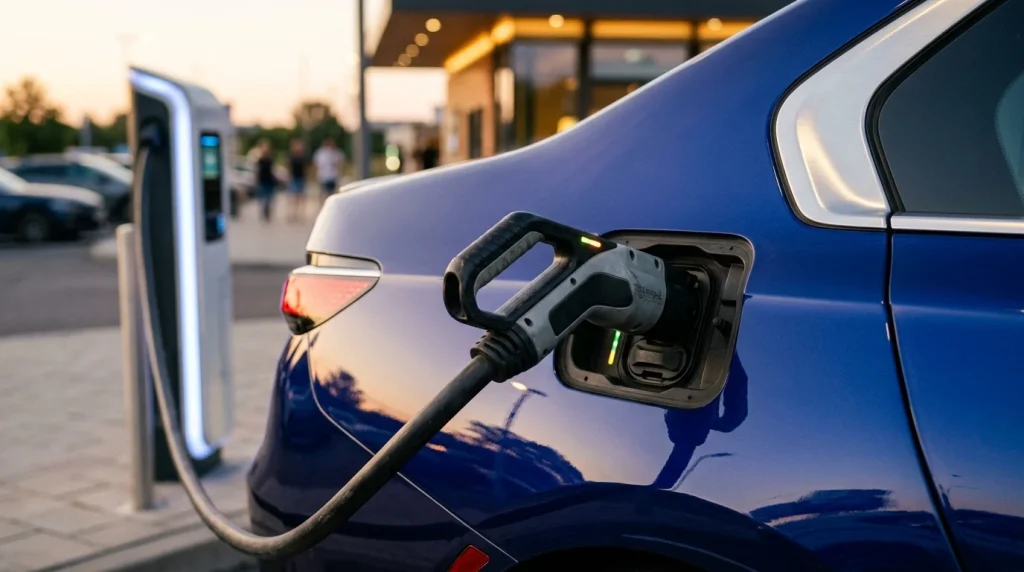
The i7 features a peak DC fast charging rate of 195 kW. When connected to a compatible high-speed charger, the battery can charge from 10 to 80 percent capacity in approximately 34 minutes. A 10-minute quick charge can add up to 80 miles of range under optimal temperature conditions.
For home charging, the i7 includes an 11 kW onboard AC charger. When connected to a 240V Level 2 home charger, a full charge from empty to 100 percent takes between 9 and 12 hours. BMW includes three years of complimentary 30-minute charging sessions on the Electrify America network for original buyers.
Electric Powertrain and Driving Dynamics
The electric motors in the i7 deliver immediate torque and near-silent operation, matching the refinement expected of a flagship luxury sedan.
Acceleration and Horsepower Output
Power outputs differ significantly depending on the trim level:
- eDrive50: The single rear-mounted motor produces 449 horsepower and 479 lb-ft of torque, enabling a 0-60 mph sprint in 5.3 seconds.
- xDrive60: Dual motors produce a combined 536 horsepower and 549 lb-ft of torque, lowering the 0-60 mph time to 4.5 seconds.
- M70 xDrive: The performance dual-motor system generates 650 horsepower and 749 lb-ft of torque, which increases to 811 lb-ft when using the M Sport Boost paddle or launch control. This variant accelerates from 0 to 60 mph in 3.5 seconds and has a top speed of 155 mph.
Despite a curb weight ranging from 5,917 pounds to 6,191 pounds, the instant electric torque provides quick passing power at highway speeds.
Handling, Suspension, and Ride Comfort
BMW uses chassis technology to manage the i7’s weight. Every model comes standard with a self-leveling two-axle air suspension system and electronically controlled dampers. The suspension lowers automatically at high speeds to improve aerodynamics.
Standard rear-axle steering rotates the rear wheels up to 3.5 degrees, reducing the turning circle by approximately 3 feet. This feature improves maneuverability in tight spaces and parking garages. The M70 trim adds active roll stabilization, which uses electric motors to counteract body roll during cornering, keeping the heavy cabin flat through turns.
Luxury Cabin Experience and Technology
The interior of the i7 uses premium materials like Merino leather, open-pore wood, and crystal glass accents for the seat adjusters and infotainment controller.
Executive Rear-Seat Seating Comfort
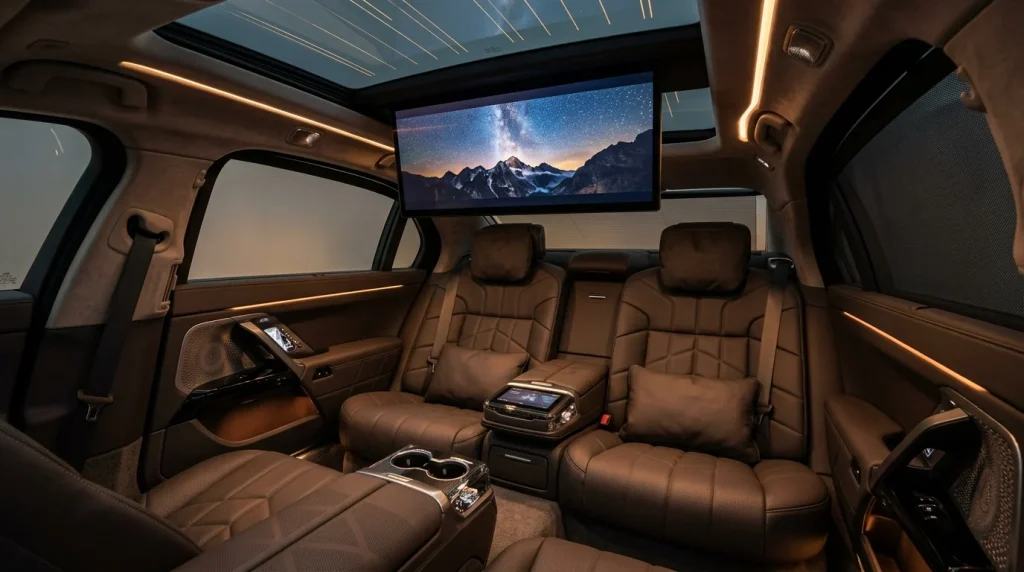
The i7 has a 122.6-inch wheelbase, creating 42.8 inches of rear legroom. The optional Executive Lounge Seating Package adds a power-reclining passenger-side rear seat with an integrated leg rest, heated door armrests, ventilating functions, and multiple massage programs. Rear passengers control these comfort settings through small 5.5-inch touchscreen panels integrated into the door trim.
Infotainment System and the 31.3-Inch Theater Screen
The front dashboard features the BMW Curved Display, which combines a 12.3-inch instrument cluster and a 14.9-inch center touchscreen under a single piece of glass. The system runs BMW Operating System 8.5, which introduces a QuickSelect feature to simplify menu navigation by placing common functions directly on the home screen.
Rear passengers can opt for the 31.3-inch Theater Screen. This display features 8K resolution, Amazon Fire TV integration, and 5G connectivity. It drops down from the ceiling at the touch of a button, automatically raising the rear side and back window sunshades to reduce glare. When deployed, the screen blocks the driver’s direct view through the rear window, requiring reliance on side mirrors and the backup camera.
Advanced Driver Assistance and Safety Systems
The 2024 BMW i7 includes standard active safety features like forward collision warning, automatic emergency braking, lane departure warning, and blind-spot detection.
Highway Assistant and Hands-Free Capability
The optional Driving Assistance Professional Package adds the Highway Assistant system. This system allows hands-free driving on designated highways at speeds up to 85 mph. The driver must remain attentive and look at the road, as monitored by an infrared camera in the instrument cluster. The system also includes an active lane change feature, which suggests lane changes to pass slower vehicles and executes them once the driver confirms by looking in the corresponding side mirror.
Safety Recalls and Known Issues
While generally reliable, the 2024 model year has been subject to several recalls listed by safety databases like Cars.com:
- Drive Power Loss: A software recall in early 2025 addressed an issue where a diagnostic error in the motor control unit could cause the high-voltage system to shut down, leading to a loss of propulsion. BMW resolved this through a software update.
- Steering Spindle Defect: A global recall in late 2024 affected a small number of units due to a double universal joint in the steering spindle that could loosen or break, potentially causing stiff steering.
- Hands-on Detection System: A recall in late 2023 addressed an improperly secured steering-wheel ground connection, which could fail to detect if a driver’s hands were on the wheel during assisted driving.
Original Analysis: Total Ownership Costs and Buying Verdict
Evaluating the i7 requires looking beyond the initial purchase price to consider its unique strengths and packaging limits.
Who Should Buy the 2024 BMW i7?
- Chauffeur-Driven Executives: The rear cabin comfort, noise isolation, and optional theater screen make it an excellent choice for passengers who spend their time in the back seat.
- Tech Enthusiasts: The combination of hands-free highway driving, curved displays, and door-mounted control screens appeals to early adopters.
- Traditional Luxury Buyers: The upright grille and conventional sedan profile appeal to buyers who find the aerodynamic styling of some competitors too unconventional.
Who Should Avoid the i7?
- Road Trippers Needing Maximum Range: While its range is respectable, the i7 lags behind class leaders. Buyers who frequently travel long distances may find competitors with larger batteries more convenient.
- Active Families: The rear trunk offers 17.7 cubic feet of space, and the rear seats do not fold down. Because there is no front trunk (frunk), cargo capacity is limited compared to electric SUVs or hatchbacks.
- Value-Focused Buyers: The 2024 i7 is fully imported and has an MSRP exceeding the federal limit, meaning individual buyers cannot claim the $7,500 U.S. federal EV tax credit.
Competitor Comparison: i7 vs EQS, Model S, and Lucid Air
The ultra-luxury electric sedan segment features distinct approaches to technology and design.
Mercedes-Benz EQS
The Mercedes EQS uses a dedicated cab-forward electric platform, giving it a lower drag coefficient and a larger trunk. The EQS 450+ starts at $104,400, matching the base i7 price closely while offering up to 350 miles of range. However, the EQS cabin uses more plastic trim, and its sloping roofline limits rear-seat headroom compared to the i7’s traditional sedan roofline.
Tesla Model S
The Tesla Model S starts significantly lower, between $74,990 and $89,990, and provides access to Tesla’s Supercharger network. The Model S Dual Motor offers 405 miles of range and faster acceleration than the eDrive50. However, the Model S cabin lacks the sound insulation, premium leather upholstery, and rear-seat amenities of the BMW.
Lucid Air
The Lucid Air focuses on engineering efficiency, offering up to 516 miles of range on the Grand Touring trim and a massive 41.7 cubic feet of total cargo space, including a large frunk. The base Lucid Air Pure starts at $69,900. While the Air delivers better driving dynamics, its newer dealer and service network is less established than BMW’s nationwide infrastructure.
Frequently Asked Questions about the 2024 BMW i7
What is the price range of the 2024 BMW i7?
The 2024 BMW i7 starts at $106,695 for the eDrive50 and $125,195 for the xDrive60. The high-performance M70 xDrive starts at $169,495. Optional packages can increase the final price of the vehicle by $20,000 to $30,000.
Does the 2024 BMW i7 have a front trunk (frunk)?
No, the 2024 BMW i7 does not have a front trunk. The front compartment is filled with electric motor components, climate control systems, and structural bracing, leaving only the 17.7 cubic foot rear trunk for cargo storage.
How long does it take to charge a 2024 BMW i7?
Using a DC fast charger at the peak rate of 195 kW, the i7 can charge from 10 to 80 percent in approximately 34 minutes. A standard 240V Level 2 home charger takes between 9 and 12 hours to charge the battery from empty to 100 percent.
Does the 2024 BMW i7 qualify for the federal EV tax credit?
No, the 2024 BMW i7 does not qualify for the federal EV tax credit for individual purchases. The vehicle is built in Germany and its retail price exceeds the federal $80,000 limit for electric sedans.
What are the main safety recalls for the 2024 BMW i7?
The 2024 model year has three notable recalls: a software error in the motor control unit that could cause a loss of drive power, a steering spindle assembly defect that could make steering stiff, and a loose steering-wheel ground wire that could disable the hands-on driver monitoring system.

