

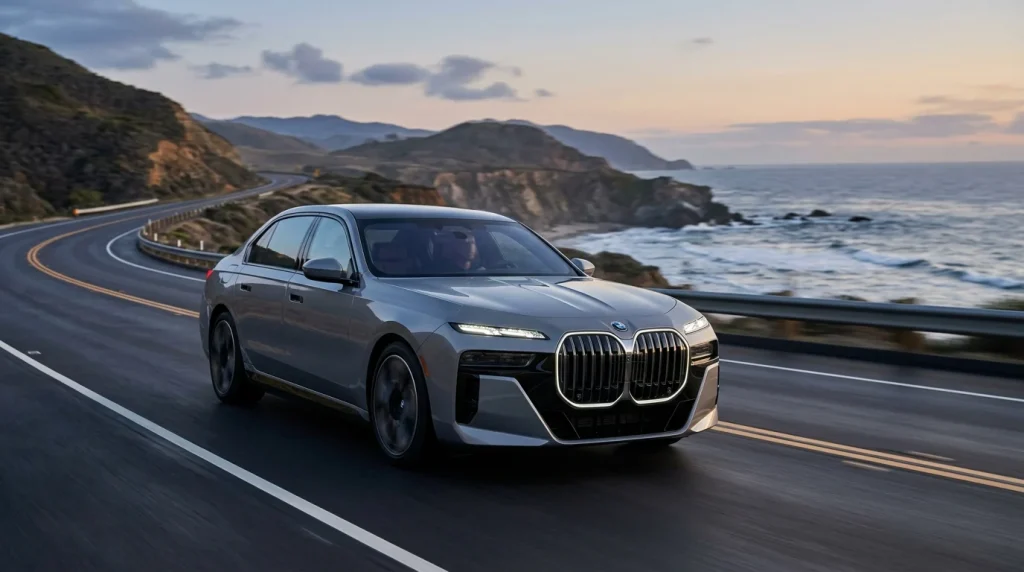
Quick answer: The 2025 BMW i7 starts at $105,700 for the base eDrive50, rising to $124,200 for the xDrive60 and $168,500 for the M70 xDrive flagship, excluding a $1,175 destination charge. Powered by a 105.7 kWh battery pack, this electric luxury sedan delivers a certified EPA range of 274 to 321 miles depending on its motor configuration and wheel size. Acceleration from 0 to 60 mph ranges from a respectable 5.3 seconds in the single-motor RWD model to a swift 3.5 seconds in the dual-motor AWD performance variant.
Key takeaways:
- Base vehicle MSRP starts at $105,700 for the eDrive50, with the xDrive60 priced at $124,200 and the M70 xDrive at $168,500.
- Certified EPA range spans from 274 miles to 321 miles, with 19-inch wheels yielding the best efficiency and 20-inch setups proving the least efficient.
- Standalone pricing for the signature 31.3-inch rear Theater Screen is $4,750, which is often combined with rear executive seat packages.
- Cargo capacity is a weak point, providing only 17.7 cubic feet of rear trunk space and entirely lacking a front trunk.
Overview: What Makes the 2025 BMW i7 Stand Out?
The 2025 BMW i7 is the all-electric sibling of the conventional BMW 7 Series, representing the absolute pinnacle of luxury and technology from the German automaker. Designed to compete directly with elite electric sedans such as the Mercedes-Benz EQS, the Lucid Air, and the Tesla Model S, the i7 focuses on providing an unmatched executive cabin experience. Rather than building a bespoke, futuristic capsule, BMW integrated its fifth-generation eDrive electric powertrain into the traditional, commanding body of its flagship sedan.
For the 2025 model year, BMW has introduced minor packaging updates. The Panoramic Sky Lounge LED roof, which was previously a premium add-on, is now standard equipment on the base eDrive50 trim. Additionally, dual-ventilation front and rear seats are standard on the mid-tier xDrive60. However, contrary to early automotive industry reports, massaging functionality for the seats remains an optional upgrade across the lower trims, requiring buyers to select specific luxury packages.
For prospective buyers comparing this model to older options, exploring a review of the 2023 BMW i7 reveals how values and features have shifted, particularly for pre-owned inventory in 2026.
2025 BMW i7 Trim Levels and MSRP Breakdown
The 2025 BMW i7 lineup is divided into three distinct trim levels that cater to range efficiency, all-weather traction, or high-performance acceleration. Each model carries a standard $1,175 destination and handling charge, which must be added to the base MSRP.
BMW i7 eDrive50
The eDrive50 serves as the entry point to the lineup. It features a single electric motor driving the rear wheels, making it the only rear-wheel-drive variant in the family. With a base MSRP of $105,700 ($106,875 including destination), this trim is optimized for maximum driving range. Standard equipment includes the Panoramic Sky Lounge LED roof, an 18-speaker Bowers and Wilkins Surround Sound system, adaptive air suspension, and the BMW Curved Display running Operating System 8.5.
BMW i7 xDrive60
The xDrive60 is the volume seller of the family. Starting at a base MSRP of $124,200 ($125,375 including destination), it adds a second electric motor to the front axle, providing standard all-wheel drive. The xDrive60 balances luxury and performance, coming standard with heated and ventilated seats for both front and rear passengers.
BMW i7 M70 xDrive
The M70 xDrive is the high-performance flagship of the range, tuned by BMW’s M division. Priced from $168,500 ($169,675 including destination), it features upgraded electric motors, M-specific adaptive air suspension, high-performance brakes, and standard 21-inch wheels. It sacrifices a small amount of driving range in exchange for explosive, supercar-like acceleration.
For a broader view of the flagship electric luxury ecosystem, visit the dedicated BMW i7 hub to compare reviews and local market pricing.
Electric Powertrain and Performance Specs
Every version of the 2025 BMW i7 utilizes the same underfloor lithium-ion battery pack, which features a total capacity of 105.7 kWh and a usable capacity of 101.7 kWh. Despite sharing the same battery, the trims deliver vastly different power outputs and acceleration figures.
| Specification | eDrive50 | xDrive60 | M70 xDrive |
|---|---|---|---|
| Drivetrain | RWD (Rear Motor) | AWD (Dual Motor) | AWD (M-Tuned Dual Motor) |
| Horsepower | 449 hp | 536 hp | 650 hp (660 hp in Boost Mode) |
| Torque | 479 lb-ft | 549 lb-ft | 749 lb-ft (811 lb-ft in Launch Control) |
| 0-60 mph Time | 5.3 seconds | 4.5 seconds | 3.5 seconds |
| Top Speed | 127 mph | 130 mph | 155 mph (unlocked) |
| Curb Weight | 5,917 lbs | 6,050 lbs | 6,191 lbs |
The i7 uses adaptive air suspension with electronic dampers on both axles as standard equipment. The system automatically adjusts the vehicle height depending on the selected drive mode and vehicle speed, lowering the body to reduce aerodynamic drag at high speeds. Rear-axle steering is also standard, pivoting the rear wheels up to 3.5 degrees. This feature reduces the turning circle of this 212.2-inch sedan to just 38.7 feet, making it surprisingly maneuverable in tight parking garages.
EPA-Estimated Range and Charging Efficiency
Range is a key metric for luxury electric vehicle buyers. The 2025 BMW i7 certified EPA range varies significantly depending on the trim and, crucially, the wheel size selected.
Official EPA Range by Wheel Size
The range ratings reveal a non-linear relationship with wheel sizes. For both the eDrive50 and xDrive60, the optional 21-inch wheel package actually yields a longer driving range than the 20-inch package. According to BMW, this is due to the lower rolling resistance of the specific tires fitted to the 21-inch wheels, whereas the 20-inch tires prioritize passenger comfort at the cost of rolling efficiency.
- eDrive50 EPA Range:
- 19-inch wheels: 321 miles (90 MPGe combined)
- 20-inch wheels: 301 miles (86 MPGe combined)
- 21-inch wheels: 311 miles (89 MPGe combined)
- xDrive60 EPA Range:
- 19-inch wheels: 317 miles (89 MPGe combined)
- 20-inch wheels: 298 miles (84 MPGe combined)
- 21-inch wheels: 307 miles (87 MPGe combined)
- M70 xDrive EPA Range:
- 20-inch wheels: 274 miles (77 MPGe combined)
- 21-inch wheels: 291 miles (81 MPGe combined)
Real-world highway tests conducted by automotive journalists indicate that at a sustained 70 mph, the eDrive50 delivers between 260 and 280 miles of actual range. The M70 xDrive typically yields between 240 and 260 miles on the highway in moderate weather conditions.
Charging Times and Infrastructure
The i7 features an onboard 11 kW AC charger that can replenish the battery from 0 to 100 percent in approximately 11 hours when connected to a standard Level 2 home charger.
For road trips, the sedan supports DC fast charging at rates of up to 195 kW. When connected to a compatible high-speed public charger, the battery can charge from 10 to 80 percent in 34 minutes. A brief 10-minute fast charge can add up to 89 miles of range under optimal conditions.
Analysis: While the DC fast-charging speed of 195 kW is highly respectable, it trails the 800-volt architecture of the Porsche Taycan and Audi e-tron GT, which can charge at rates up to 270 kW. However, BMW includes three years of complimentary 30-minute charging sessions on the Electrify America network with every new i7 purchase, offsetting public charging costs for early owners.
In the US market, the i7 currently utilizes the CCS connector. However, BMW has announced plans to adopt the Tesla-developed North American Charging Standard (NACS) for future model years, which will eventually grant owners native access to the Tesla Supercharger network via factory adapters.
Interior Luxury, Technology, and Seating Comfort
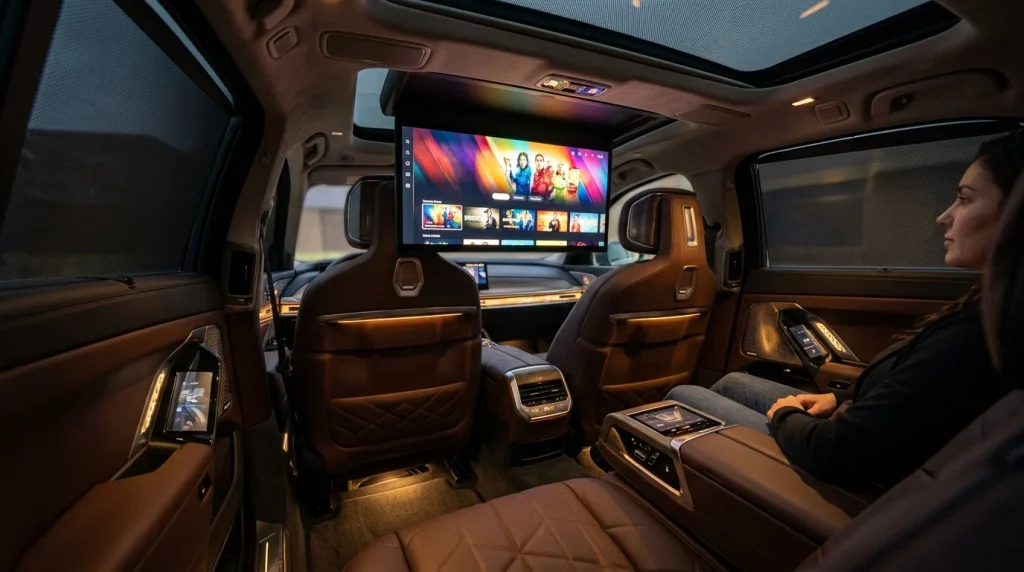
The cabin of the 2025 BMW i7 is designed to feel like a private lounge. Material quality is exceptional, featuring standard Merino leather upholstery, open-pore wood trim, and glass controls for the seat adjusters and the iDrive rotary dial. Buyers can also opt for a unique cashmere and wool blend upholstery on the xDrive60 and M70, offering a sustainable, highly tactile luxury alternative to traditional leather.
Seating Configuration and Massaging Seat Corrections
Seating comfort is a key highlight, though buyers must understand the packaging constraints:
- Front Seats: Heated, ventilated, and 18-way power-adjustable seats are standard across the range. Massaging front seats are optional on the eDrive50 and xDrive60, requiring a $1,000 standalone option or the selection of the Executive Package.
- Rear Seats: Heated rear seats are standard. Standard ventilated rear seats are included on the xDrive60 and M70. However, massaging rear seats are not standard on any trim. To get rear massaging functions, buyers must order the $1,500 Luxury Rear Seating Package.
- Executive Lounge Seating: For the ultimate limousine experience, the $7,250 Rear Executive Lounge Seating Package adds a passenger-side reclining lounge seat with an integrated footrest, a executive rear center console, and rear wireless charging.
The 31.3-inch BMW Theater Screen
The defining technology feature of the i7 is the optional BMW Theater Screen. Priced at a standalone option cost of $4,750, this massive 31.3-inch ultra-wide display folds down from the headliner at the touch of a button.
Featuring up to 8K resolution, built-in Amazon Fire TV, and native 5G connectivity, it allows rear passengers to stream movies, play games, and watch live television. When deployed, the screen automatically closes the rear window and side shades to minimize glare and create a theater-like environment. Audio is routed either through the Bowers and Wilkins system or to two pairs of included wireless headphones.
Bowers and Wilkins Audio Options
The i7 offers two levels of high-fidelity audio:
- Standard System: An 18-speaker Bowers and Wilkins Surround Sound system delivering 655 watts of clear, detailed audio.
- Upgraded Diamond System: A $4,400 option that upgrades the cabin to a 36-speaker Bowers and Wilkins Diamond Surround Sound system. This configuration delivers 1,965 watts of power and includes speakers integrated into the headrests and bass exciters in the seats, creating a physical 4D audio experience.
Driver Assistance and Safety Specifications
The 2025 BMW i7 is equipped with a comprehensive suite of active safety technologies. The standard Active Driving Assistant includes forward collision warning, automatic emergency braking, lane departure warning, active blind-spot detection, and rear cross-traffic alert.
For highway commuters, the optional $1,700 Driving Assistance Professional Package is highly recommended. It adds BMW’s Highway Assistant, which enables hands-free driving on designated access-controlled highways at speeds of up to 85 mph. The system utilizes interior cameras to monitor driver attentiveness, allowing the car to maintain its lane, adjust its speed, and perform automatic lane changes when the driver looks at the corresponding side mirror.
The standard Parking Assistant Professional package includes a Surround View camera with 3D views and a Back-up Assistant. The Back-up Assistant memorizes the steering inputs of the last 50 yards traveled forward, allowing the car to autonomously back out of tight, winding driveways or parking spaces.
Practicality and Cargo Space Limitations
While passenger comfort is class-leading, the i7 suffers from practical packaging limitations caused by its shared platform layout. Because the body is designed to accommodate gasoline, hybrid, and electric powertrains, the front compartment is occupied by electric drive components rather than a front trunk.
Consequently, the i7 has no frunk, which represents a notable disadvantage against the Lucid Air and the Tesla Model S. The rear trunk provides only 17.7 cubic feet of cargo space. While it includes a center pass-through for longer items like skis, the floor is relatively shallow. The cargo volume is significantly smaller than the Lucid Air’s 22.1 cubic feet rear trunk (plus 10 cubic feet frunk) and the Tesla Model S hatch layout.
For buyers who frequently take long road trips with extensive luggage, comparing the i7 to the 2024 BMW i7 specs reveals that cargo dimensions remain unchanged, meaning utility remains a known trade-off across recent model years.
Competitive Comparison: i7 vs. Key Rivals
Evaluating the 2025 BMW i7 against its primary luxury electric sedan competitors highlight its distinct positioning in the US market.
| Feature | 2025 BMW i7 eDrive50 | Mercedes-Benz EQS 450+ | Tesla Model S Long Range | Lucid Air Pure |
|---|---|---|---|---|
| Base MSRP | $105,700 | $104,400 | $74,990 | $69,900 |
| EPA Range | 301-321 miles | 350 miles | 405 miles | 419 miles |
| Horsepower | 449 hp | 329 hp | 670 hp | 430 hp |
| 0-60 mph | 5.3 seconds | 5.6 seconds | 3.1 seconds | 4.5 seconds |
| Trunk Space | 17.7 cu ft (No Frunk) | 22.0 cu ft (No Frunk) | 25.0 cu ft (+ 3.1 cu ft Frunk) | 22.1 cu ft (+ 10.0 cu ft Frunk) |
| Rear Entertainment | 31.3-inch 8K Screen | None | 8.0-inch Screen | None |
The comparison shows that while the Tesla Model S and Lucid Air deliver superior raw range, acceleration, and cargo capacity at lower price points, they do not match the material craftsmanship or rear-seat comfort of the i7. The Mercedes EQS is the most direct competitor, but its jellybean-like exterior styling and touch-heavy hyperscreen dashboard contrast with the i7’s imposing, traditional luxury sedan body and physical control buttons.
Total Cost of Ownership and Value Analysis
Evaluating the long-term cost of owning a 2025 BMW i7 reveals standard luxury car depreciation trends alongside electric vehicle savings.
5-Year Projected Ownership Costs
Like most flagship luxury vehicles, depreciation is the single largest cost of ownership. The i7 is projected to lose approximately 50 to 55 percent of its initial value over its first five years. However, this is offset by lower routine maintenance requirements compared to a conventional gasoline-powered 7 Series.
- Electricity vs. Fuel Savings: Assuming 15,000 miles driven annually, charging an eDrive50 at average US residential electricity rates ($0.16 per kWh) costs approximately $850 per year. In comparison, fueling a gasoline 740i averaging 25 mpg with premium fuel at $4.00 per gallon costs $2,400 annually, yielding estimated savings of $7,750 over five years.
- Maintenance Projections: With no engine oil, spark plugs, or transmission fluid to replace, estimated five-year maintenance and repair costs for the i7 are projected at roughly $4,200, primarily covering tire replacements, cabin air filters, and brake pad wear.
- Incentives: The 2025 BMW i7 does not qualify for the federal $7,500 EV tax credit for personal retail purchases because its MSRP exceeds the government’s $80,000 cap for electric sedans. However, the credit can be utilized to reduce monthly payments on business leases through commercial clean vehicle provisions.
Common Owner Problems and Reliability Outlook
As a highly complex flagship model, early owners of the i7 have reported several software and electrical issues. According to National Highway Traffic Safety Administration (NHTSA) complaints, the most common issues involve:
- eSIM Connectivity: Intermittent dropouts of the personal eSIM system, which cuts off internet connectivity for the Theater Screen and onboard Wi-Fi, particularly on major cellular networks.
- Infotainment Software Glitches: Periodic delays, system freezes, or black screens on the Curved Display, requiring a manual system reboot via the steering wheel controls.
- Automatic Doors: Malfunctions of the optional automatic opening doors, where the external ultrasonic sensors falsely detect obstacles and stop the doors from opening fully.
- Lack of Heat Pump: The i7 does not utilize a heat pump system. In cold climates below 32 degrees Fahrenheit, the resistance cabin heater draws power directly from the battery pack, resulting in a notable range reduction of 20 to 30 percent.
BMW addresses these software issues through regular over-the-air (OTA) updates. The powertrain and battery pack have proven highly reliable, backed by a comprehensive 4-year/50,000-mile new vehicle warranty and an 8-year/100,000-mile high-voltage battery warranty.
Frequently Asked Questions about the 2025 BMW i7
How long does it take to charge a BMW i7?
At home using a Level 2 charger, the i7 takes approximately 11 hours to charge from empty to 100 percent. At a public DC fast-charging station, the sedan can charge from 10 to 80 percent in 34 minutes at a peak rate of 195 kW.
What is the real-world range of the BMW i7?
The real-world range is between 260 and 280 miles during highway driving at 70 mph, and 300 to 320 miles in mixed city driving. In extreme cold weather, the range drops by 20 to 30 percent due to cabin heating demands.
Is the BMW i7 more expensive than the Mercedes EQS?
Yes, the base BMW i7 eDrive50 starts at $105,700, which is slightly more expensive than the base Mercedes-Benz EQS 450+ at $104,400. The performance-tuned i7 M70 starts at $168,500, which is significantly more expensive than the EQS 580.
Does the BMW i7 have a front trunk (frunk)?
No, the i7 does not have a front trunk. The front compartment is occupied by electric motors and high-voltage power electronics, leaving only the 17.7 cubic foot rear trunk for cargo storage.
Can the BMW i7 use Tesla Superchargers?
Currently, the US-market i7 cannot natively use Tesla Superchargers because it features a CCS connector. However, BMW has announced plans to adopt the Tesla NACS connector, which will grant owners access to the Supercharger network via official adapters in the near future.
How much does it cost to fully charge a BMW i7?
Based on average US household electricity rates, a full charge at home costs between $10 and $20. Charging at public DC fast chargers typically costs between $40 and $55, depending on local provider rates.
Is the BMW i7 worth the premium over a Tesla Model S?
The i7 justifies its premium price for buyers who prioritize traditional luxury materials, superior build quality, rear-seat lounge comfort, and advanced cinema technology. For buyers who prioritize acceleration, cargo utility, and maximum range, the Tesla Model S remains the more practical choice.
What is the warranty coverage on the BMW i7 battery?
BMW covers the high-voltage battery pack with an 8-year or 100,000-mile warranty against defects and capacity degradation. The rest of the vehicle is covered by a 4-year or 50,000-mile bumper-to-bumper warranty.
Does the BMW i7 qualify for the federal EV tax credit?
No, the i7 does not qualify for the federal EV tax credit for retail purchases because its MSRP exceeds the $80,000 limit for sedans. However, the credit can be passed through to reduce monthly lease payments on commercial or business leases.
How does the BMW i7 perform in cold weather?
In temperatures below freezing, the i7 experiences a 20 to 30 percent reduction in range. Preconditioning the battery while the car is still plugged in at home can help minimize these range losses.
What problems have BMW i7 owners reported?
Owners have reported eSIM network dropouts, temporary infotainment software lag, automatic door sensor malfunctions, and occasional streaming buffering on the rear Theater Screen.
Can I get the 31-inch theater screen on all i7 trims?
Yes, the 31.3-inch BMW Theater Screen is available as a standalone option for $4,750 on all three i7 trims, though it requires selecting supporting rear-seat comfort packages to function.

