

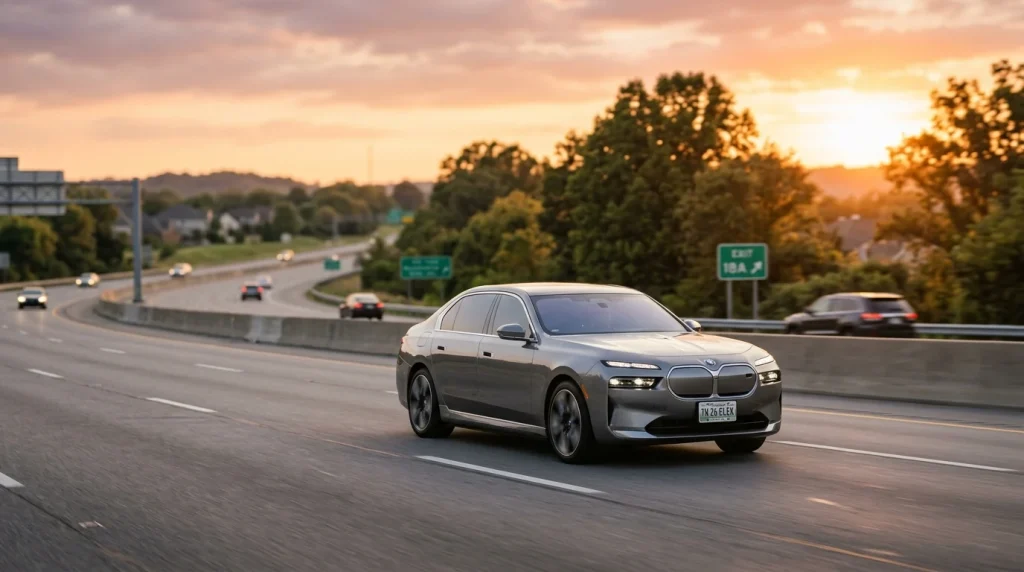
Quick answer: The official 2026 BMW i3 Neue Klasse electric sedan was unveiled on March 18, 2026, with full technical specifications released on June 18, 2026. Production is scheduled to begin in August 2026 at BMW’s Munich plant, with European deliveries starting in autumn 2026 and U.S. availability expected in early 2027. The launch-edition i3 50 xDrive features a 108.7 kWh battery, 463 hp, and up to 912 km (567 miles) of WLTP range.
Key takeaways:
- BMW officially revealed the production-ready i3 sedan on March 18, 2026, replacing the discontinued hatchback nameplate.
- The i3 50 xDrive variant features dual-motor AWD producing 345 kW (463 hp) and 645 Nm of torque.
- Built on an 800V Neue Klasse architecture, the i3 supports peak DC fast charging up to 400 kW.
- WLTP range reaches up to 912 km, while U.S. EPA range is estimated at approximately 440 miles.
- U.S. market launch is slated for early 2027, with native NACS charging integration.
Global Reveal and Launch Timeline
The design premiere of the 2026 BMW i3 occurred on March 18, 2026, following a series of technical disclosures in early March after winter testing in Arjeplog, Sweden. The German automaker finalized the car’s specifications on June 18, 2026, positioning the new model as the second vehicle in the Neue Klasse lineup.
This sedan represents a complete conceptual shift for the i3 nameplate. The original carbon-fiber hatchback ended its manufacturing run in July 2022. In contrast, the new i3 transitions into a mainstream, high-volume luxury sport sedan designed to challenge established executive EVs. This transition represents a key part of BMW’s corporate target to have fully electric models account for half of its global sales before 2030. The BMW i3 lineup has entered a new era of performance and design.
Production Schedule and Manufacturing Details
Series production of the Neue Klasse electric sedan starts in August 2026. The initial production phase is centered at BMW’s Munich plant in Germany, which has undergone a multi-billion-dollar retooling to accommodate the Neue Klasse assembly lines. Following the start of production, the initial European market launch is scheduled for autumn 2026, with the high-specification First Edition models serving as the introductory variants.
The North American rollout follows a slightly different timeline. U.S. market models are scheduled to start assembly support from BMW’s San Luis Potosi plant in Mexico later in 2026, which ensures eligibility for regional EV tax credits under updated U.S. manufacturing rules. American customers can expect the official dealership arrival and initial customer deliveries in early 2027.
| Market Region | Assembly Location | Pre-Order Launch | Expected Delivery | Initial Trim Available |
|---|---|---|---|---|
| Europe | Munich, Germany | Spring 2026 | Autumn 2026 | i3 50 xDrive First Edition |
| North America | San Luis Potosi, Mexico | Summer 2026 | Early 2027 | i3 50 xDrive |
| Asia-Pacific | Munich / Joint Venture | Late 2026 | Mid-2027 | i3 50 xDrive / Regional Trims |
This structured timeline allows BMW to optimize manufacturing efficiency before introducing lower-tier configurations. The staggered market entry ensures that the initial production run meets quality control standards for the new battery and platform technologies.
Technical Specifications and Powertrain Dynamics
The engineering details of the launch-edition model confirm that BMW intends to maintain its reputation for driver-focused performance. As detailed in the BMW Blog reveal report, the introductory variant is the BMW i3 50 xDrive, which utilizes a dual-motor all-wheel-drive layout. According to the BMW i3 NA0 Wikipedia database, the electric motor configuration consists of an AC induction motor at the front axle and an externally-excited synchronous motor at the rear.
- Combined Power Output: 345 kW / 463 horsepower (hp) / 469 PS
- Maximum System Torque: 645 Nm (476 lb-ft)
- Acceleration (0-100 km/h): 4.7 seconds (manufacturer rating)
- Top Speed: 200 km/h (124 mph, electronically limited)
- Vehicle Curb Weight: 2,205 kg (First Edition, without driver)
- Length / Width / Height: 4,760 mm / 1,865 mm / 1,480 mm
- Wheelbase: 2,897 mm
- Cargo Volume: 420 liters (rear trunk) + 31 liters (front trunk/frunk)
The mechanical layout prioritizes rear-wheel-drive bias under normal driving conditions to preserve the classic handling feel. When the onboard traction control sensors detect wheel slip or during aggressive cornering, the front motor engages instantly to distribute power across all four wheels. This electronic torque vectoring operates via a centralized computing unit that adjusts power delivery in milliseconds.
Sixth-Generation Battery Technology, Range, and Charging
The heart of the 2026 BMW i3 is the sixth-generation (Gen6) eDrive battery pack. BMW has transitioned from the previous prismatic battery cell design to new cylindrical cells. These cells offer a 20% increase in volumetric energy density, allowing more capacity to fit within the same structural footprint. The launch model features a net usable capacity of 108.7 kWh, which represents one of the largest battery packs in the compact luxury EV class.
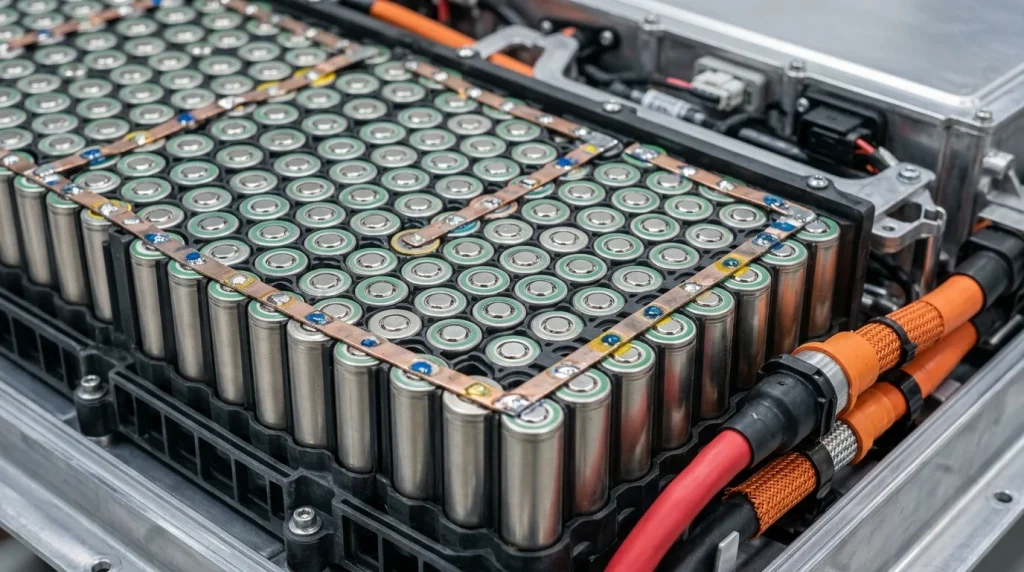
This energy density boost yields impressive range figures. The standard i3 50 xDrive achieves an official WLTP-certified range of up to 912 km (567 miles) under optimal testing conditions. For the First Edition model fitted with wider 19-inch performance wheels, the WLTP range is rated at up to 906 km. For the U.S. market, preliminary EPA range estimates point to approximately 440 miles on a single charge.
The 800V electrical architecture enables class-leading charging speeds. When connected to a compatible ultra-rapid DC fast charger, the i3 can accept a peak charging power of up to 400 kW.
- DC Fast Charging (10% to 80%): 21 minutes under optimal thermal conditions
- DC Fast Charging (10-minute session): Adds up to 423 km (263 miles) of WLTP range
- Standard AC Charging (Onboard): 11 kW three-phase standard (0-100% in approx. 10 hours)
- Optional AC Charging (Onboard): 22 kW three-phase upgrade (0-100% in approx. 5 hours)
- Bidirectional Power Support: Built-in hardware for Vehicle-to-Load (V2L), Vehicle-to-Home (V2H), and Vehicle-to-Grid (V2G) functions
For U.S. buyers, the vehicle ships with a native North American Charging Standard (NACS) port, allowing direct access to the Tesla Supercharger network without requiring adapters.
Interior Design, Panoramic Vision, and Technology
The interior of the 2026 BMW i3 introduces a major shift in cabin layout and driver interface. BMW has eliminated the traditional instrument cluster in favor of the new BMW Panoramic Vision display. This system projects key driving metrics, navigation prompts, and media data across the entire lower section of the windshield, creating a wide-angle head-up display that remains visible to both the driver and front passenger.
The infotainment is powered by BMW Operating System X, which uses a new central control unit called the Heart of Joy. This system integrates the vehicle dynamics, driving assistance, and cabin electronics into a single high-performance computer. Users interface with the system via a central 17.9-inch touchscreen, steering wheel controls, or advanced voice commands.
Standard driver assistance features are designed for Level 2 semi-autonomous driving, with the sensor hardware pre-configured to support Level 3 hands-free operation in markets where regulatory approval is granted. Over-the-air software updates are fully integrated, allowing BMW to deploy efficiency tweaks, maps, and safety patches automatically.
Architecture Comparison: Neue Klasse vs. CLAR Platform
Evaluating the engineering difference between a dedicated EV architecture and a shared platform shows the core value of the 2026 BMW i3. The legacy of the 2020 BMW i3 and the subsequent 2021 BMW i3 proved that lightweight carbon-fiber construction could offset battery mass. However, that approach was too expensive for mass production. With the Neue Klasse platform, BMW uses a dedicated steel-and-aluminum EV platform that integrates the battery pack directly into the floor structure (cell-to-pack design).
This dedicated architecture offers clear advantages over the current BMW i4, which is built on the CLAR platform shared with gas-powered cars. By eliminating transmission tunnels and engine bays, the i3 maximizes interior cabin space while lowering the center of gravity.
| Neue Klasse i3 (EV Only) | CLAR i4 (Gas / EV Shared) |
|---|---|
| Flat cabin floor (no tunnel) | Elevated center tunnel |
| Long wheelbase, short overhang | Long hood, cramped rear legroom |
| Integrated cell-to-pack floor | Battery modules fit in gas bay |
| Optimized weight distribution | Front-heavy weight bias |
Despite the dedicated platform, the massive 108.7 kWh battery pack contributes to a total curb weight of 2,205 kg. While this is heavier than the old i3 city hatchback, the structural integration creates a near-perfect 50:50 front-to-rear weight distribution. This setup delivers superior handling stability and flatter cornering compared to combustion-conversion models. The dedicated Neue Klasse platform gives the i3 a distinct dynamics advantage over the i4 by removing the structural compromises of gas-car architecture. However, the large 108.7 kWh pack keeps the total weight at 2,205 kg, which still requires sophisticated damper control.
Head-to-Head: BMW i3 vs. Tesla Model 3
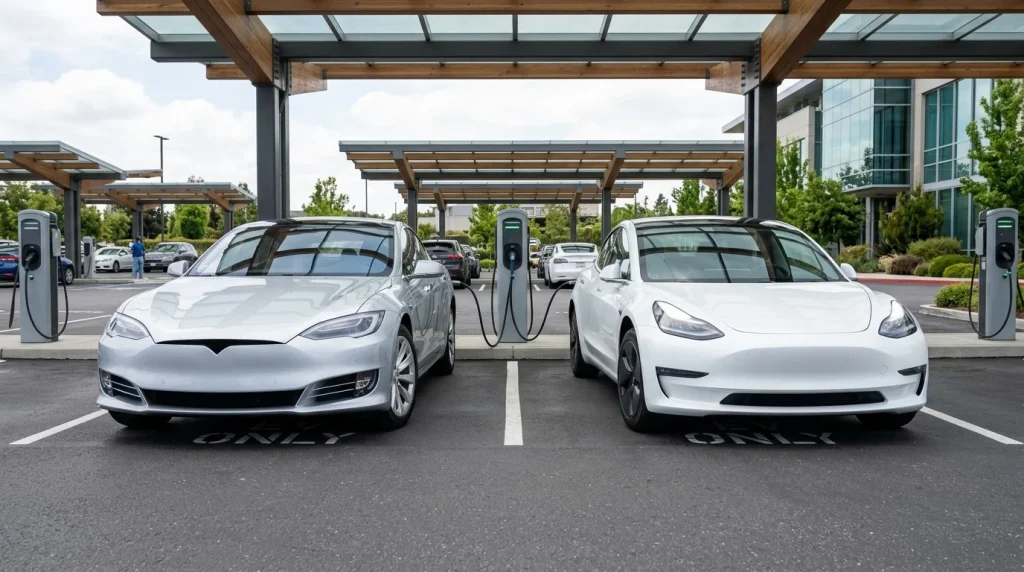
The 2026 BMW i3 enters a highly competitive market segment dominated by the Tesla Model 3. To succeed, the i3 must justify its premium positioning by delivering tangible performance and charging advantages.
| Specification | 2026 BMW i3 50 xDrive | Tesla Model 3 Long Range AWD |
|---|---|---|
| Platform Type | Dedicated Neue Klasse EV | Dedicated Custom EV |
| Battery Usable Capacity | 108.7 kWh | ~75.0 kWh |
| System Power Output | 345 kW / 463 hp / 469 PS | ~393 hp |
| Combined Torque | 645 Nm (476 lb-ft) | ~490 Nm |
| WLTP Range | Up to 912 km (567 miles) | Up to 629 km (391 miles) |
| Peak DC Charging Rate | 400 kW | 250 kW |
| 0-100 km/h Sprint | 4.7 seconds | 4.4 seconds |
| Top Speed | 200 km/h (124 mph) | 201 km/h (125 mph) |
While the Tesla Model 3 maintains a slight edge in raw 0-100 km/h acceleration, the BMW i3 holds a significant advantage in battery capacity and range. The i3’s 108.7 kWh pack is roughly 45% larger than the Model 3’s battery, which translates directly to longer highway range. Furthermore, the i3’s 400 kW peak fast-charging capability outperforms Tesla’s 250 kW limit, reducing highway charging stops.
Trim Levels, Standard Equipment, and Pricing
According to the Top Gear pricing report, the 2026 BMW i3 will launch initially in Europe and the UK with two primary pricing tiers for the dual-motor powertrain:
- i3 50 xDrive (Standard): Starting at £53,005 in the UK and €65,900 in Germany. Standard equipment includes the BMW Panoramic Vision display, a twin-spoke steering wheel, 18-inch aerodynamic alloy wheels, dual-zone automatic climate control, and Level 2 driving assistance.
- i3 50 xDrive (First Edition): Starting at £57,905 in the UK. This launch-limited package adds 19-inch performance wheels, electrically adjustable front seats, three-zone climate control, sun-protection glazing, and a heated steering wheel.
While BMW has not published official U.S. pricing, automotive analysts estimate a starting MSRP of approximately $55,000 for future entry-level, single-motor trims, with the high-performance i3 50 xDrive expected to start near $65,000.
Note: Official list prices for the North American market remain unannounced by the manufacturer. All pricing figures represent industry projections and will be updated upon final homologation closer to the late 2026 launch.
Frequently Asked Questions
Is there actually a 2026 BMW i3 available?
Yes, BMW officially revived the i3 nameplate as an all-new electric sedan built on the Neue Klasse platform, debuting the production model on March 18, 2026. It is completely different from the discontinued hatchback.
When is the release date of the new BMW i3?
Production starts in August 2026 at the Munich plant. The first customer deliveries will begin in Europe in autumn 2026, while U.S. availability is confirmed for early 2027.
What is the range of the 2026 BMW i3 Neue Klasse?
The i3 50 xDrive achieves a WLTP-certified range of up to 912 km (567 miles) for the standard configuration. The U.S. EPA range is expected to be approximately 440 miles.
How much will the new BMW i3 cost?
In the UK, the standard i3 50 xDrive starts at £53,005, while the First Edition starts at £57,905. In Germany, the starting price is €65,900. Official U.S. retail pricing remains unannounced, but estimates project a starting MSRP of around $55,000 for the future single-motor variant.

