

Quick answer: Yes, most lenders require you to carry full coverage insurance on a financed car until the auto loan is completely paid off. This mandate typically includes comprehensive and collision coverage in addition to state-required liability insurance. Since the vehicle serves as collateral for your loan, these coverages protect the lender’s financial interest if the car is damaged, stolen, or totaled.
Key takeaways:
- Lenders mandate collision and comprehensive coverage to protect their collateral.
- Deductibles are capped by lenders, commonly between 500 and 1,000 dollars.
- Letting coverage lapse triggers expensive, lender-placed insurance policies.
- Gap insurance is highly recommended if your loan balance exceeds the car’s cash value.
- You can legally drop full coverage once you receive the lien release document.
What Insurance Is Required on a Financed Car?
Lenders require comprehensive and collision coverage on a financed car, which combined with state-mandated liability insurance forms a full coverage policy. You must maintain this specific combination of insurance protections for the entire duration of your auto loan agreement.
As noted by Allstate, full coverage is a common term rather than a single policy. It represents a combination of essential protections designed to cover both third-party damage and your own vehicle. A standard financed car insurance package consists of:
- Liability Insurance: This is legally required by almost every state. It pays for bodily injury and property damage you cause to other people in an accident. However, it does not pay for any damage to your own car.
- Collision Coverage: This pays to repair or replace your vehicle if it is damaged in an accident with another vehicle or an object, such as a tree or guardrail, regardless of who is at fault.
- Comprehensive Coverage: This protects your vehicle against damage caused by events outside of your control. This includes theft, vandalism, fire, hail, windstorms, and animal strikes.
While state laws only require you to carry minimum liability limits, your lender mandates that you purchase comprehensive and collision coverage. This ensure that the vehicle, which serves as security for the loan, remains fully protected.
Why Do Lenders Mandate Full Coverage Insurance?
Auto lenders require full coverage insurance because your vehicle serves as collateral for the auto loan until the balance is paid. By enforcing comprehensive and collision coverage, the lienholder protects its financial interest in case the car is destroyed.
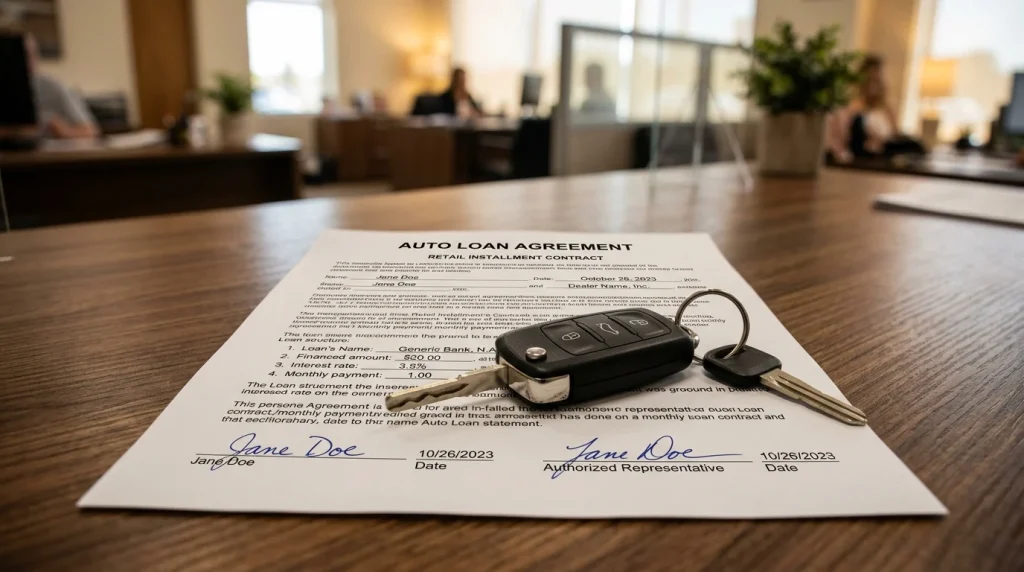
When you purchase a vehicle using an auto loan, the bank or credit union is the actual owner of the asset until you pay off the debt. They are listed as the primary lienholder on the car’s title. Planning your purchase timeline and knowing how long it takes to buy a car can help you secure insurance quotes before finalizing your loan.
According to GEICO, lenders enforce these coverage rules because the car serves as collateral. If a borrower carries only basic liability coverage and totals the car in a severe crash, the vehicle is rendered worthless. The borrower might stop making monthly payments, leaving the lender with no collateral to repossess and a significant financial loss. Enforcing comprehensive and collision policies ensures the insurance company will pay to repair or replace the car, protecting both the lender and the borrower from severe financial damage.
Specific Deductible Limits by Lender Type
Most lenders cap deductible limits to ensure borrowers can afford to pay their share of repairs. These maximum limits typically range from 500 to 2,500 dollars depending on the specific bank, credit union, or dealership agreement.

An insurance deductible is the out-of-pocket amount you must pay before your insurance policy covers a claim. Choosing a higher deductible lowers your monthly premium, but it increases your financial responsibility during an accident. To prevent borrowers from setting deductibles they cannot afford, lenders enforce caps.
| Lender Type | Typical Deductible Limit | Special Requirements |
|---|---|---|
| Commercial Banks | 1,000 to 2,500 dollars | Standard comprehensive and collision coverage |
| Credit Unions | 500 to 1,000 dollars | May require lower deductibles for high-risk borrowers |
| Dealership Financing | Varies by contract | Often requires gap insurance in the agreement |
| Lease Companies | 500 to 1,000 dollars | Requires higher liability limits (e.g., 100k/300k) |
For instance, Mountain America Credit Union requires collision and comprehensive deductibles not to exceed 2,500 dollars. Other institutions are much stricter. For example, Truliant Federal Credit Union enforces a maximum deductible limit of 500 dollars for both comprehensive and collision claims. Always verify these limits in your loan documents. Setting a deductible higher than the allowed cap violates your contract and can lead to immediate penalties.
Note: Deductible caps are set by lenders at the time of financing. Changing deductibles later without lender consent may trigger a lease or loan default.
What Happens If You Do Not Maintain Full Coverage?
Dropping full coverage on a financed car triggers lender-placed insurance, which is significantly more expensive and offers fewer protections. In severe cases, letting your policy lapse can result in loan default and vehicle repossession.
Insurance companies are legally required to notify the lienholder whenever a policy is modified, canceled, or lapses due to non-payment. If you drop comprehensive or collision coverage, your lender will receive an automated alert. Keeping the vehicle in clean, operational order is another contract standard; for instance, learning how to remove the smell of smoke in a car protects the lender’s asset value.
If the lender discovers you do not have the required coverage, they will purchase force-placed insurance on your behalf. The bank will add this cost to your monthly auto loan payment. Force-placed insurance commonly costs two to three times more than standard auto insurance. Furthermore, it only protects the lender’s interest, meaning it does not include liability coverage for you or medical coverage for passengers.
Continuous insurance violations put you in default of your loan agreement. This allows the lender to accelerate the loan, demanding the entire balance immediately, or repossess the vehicle to recover their investment.
Do You Need Gap Insurance in Addition to Full Coverage?
Gap insurance is not always required by lenders, but it is highly recommended if your loan balance exceeds your car’s actual cash value. This coverage pays the difference between the depreciated value of the car and your outstanding loan balance.
New vehicles depreciate rapidly, often losing 20 percent of their value within the first year of ownership. This creates a situation where you owe more on your auto loan than the car is actually worth, a state known as being underwater.
Suppose you owe 25,000 dollars on your car loan, and the vehicle is totaled in an accident. If the car’s actual cash value at the time of the crash is only 20,000 dollars, your standard collision insurance will only pay 20,000 dollars to the lender. You are still legally obligated to pay the remaining 5,000 dollars on the loan for a vehicle you can no longer drive.
Gap insurance covers this 5,000 dollar shortfall. It is highly recommended if you:
- Made a down payment of less than 20 percent.
- Signed a loan term of 60 months or longer.
- Are financing a luxury vehicle that depreciates rapidly.
- Rolled negative equity from a previous vehicle loan into the new loan.
How Much Does Financed Car Insurance Cost in 2026?
The average cost of full coverage car insurance in 2026 is 2,441 dollars annually, which is significantly higher than the average minimum liability cost of 733 dollars. Rates vary depending on your location, driving record, and vehicle type.
Financing a vehicle requires you to factor the cost of full coverage into your monthly budget. Because lenders require comprehensive and collision coverage, your premiums will be substantially higher than basic liability coverage.
| Coverage Option | Average Monthly Cost | Average Annual Cost |
|---|---|---|
| Minimum Liability Only | 61 dollars | 733 dollars |
| Full Coverage (1000 dollar Deductible) | 203 dollars | 2,441 dollars |
| Full Coverage (Low Deductible) | 240 dollars | 2,880 dollars |
These national averages serve as a helpful baseline. Your personal rates will depend on your driving history, age, geographic location, and vehicle model. For additional financing and vehicle tips, you can explore the Autvex news hub for updated automotive resources. Comparing quotes from multiple insurance providers is the most effective way to secure affordable rates while maintaining the required coverage limits.
Original Analysis: When to Adjust Coverage After Loan Payoff
Once your auto loan is paid off, you can drop comprehensive and collision coverage to save money, but you should base this decision on your car’s current resale value. If your annual premium exceeds 10 percent of the vehicle’s total value, dropping full coverage is often financially logical.

When you complete your final auto loan payment, the lender will send you a lien release document. At this point, you legally own the car and are no longer contractually required to carry full coverage. You can choose to drop down to state minimum liability-only insurance.
To determine if you should drop comprehensive and collision, utilize the 10 percent rule of thumb:
| Vehicle Value | Annual Premium Cost | Recommended Action |
|---|---|---|
| Under 4,000 dollars | Over 400 dollars | Consider dropping to liability only to maximize savings |
| 4,000 to 8,000 dollars | Under 600 dollars | Keep full coverage if you lack emergency savings to buy a new car |
| Over 8,000 dollars | Any rate | Keep full coverage to protect your significant financial asset |
If your car is worth 3,000 dollars and your comprehensive and collision coverages cost 400 dollars per year, you are paying over 13 percent of the car’s total value annually just to insure it. In this scenario, dropping to liability-only insurance makes financial sense, provided you save the difference to help purchase a replacement vehicle if an accident occurs.
Expert view: For vehicles valued under 5,000 dollars, shifting to liability-only coverage can free up significant monthly cash, provided you have sufficient savings to handle an unexpected replacement.
Frequently Asked Questions
What insurance coverage do I need for a financed car?
At minimum, you must carry comprehensive and collision coverages alongside your state’s required liability limits. Lenders also enforce deductible caps, usually under 1,000 dollars, to ensure you can afford repairs. Refer to your auto loan agreement for exact requirements.
Do you have to get full coverage on a used financed car?
Yes, lenders require full coverage regardless of whether the financed vehicle is new or used. The lender’s financial risk remains the same, so they enforce comprehensive and collision insurance to protect their collateral until you complete all payments.
What happens if I get liability insurance on a financed car?
Purchasing only liability insurance violates your loan contract. The lender will be notified of the coverage drop and will buy expensive force-placed insurance on your behalf, adding the premiums to your monthly loan payment.
Do I need full coverage on a financed car if I have gap insurance?
Yes, gap insurance does not replace full coverage. Gap coverage only pays the difference between the car’s depreciated cash value and your loan balance, but it only kicks in if you have collision and comprehensive coverage active to pay the primary claim.
Is it illegal to not have full coverage on a financed vehicle?
It is not illegal by state law, as states only mandate minimum liability insurance. However, it is a breach of your legally binding auto loan agreement, which allows the lender to repossess your car or purchase force-placed policies at your expense.

