

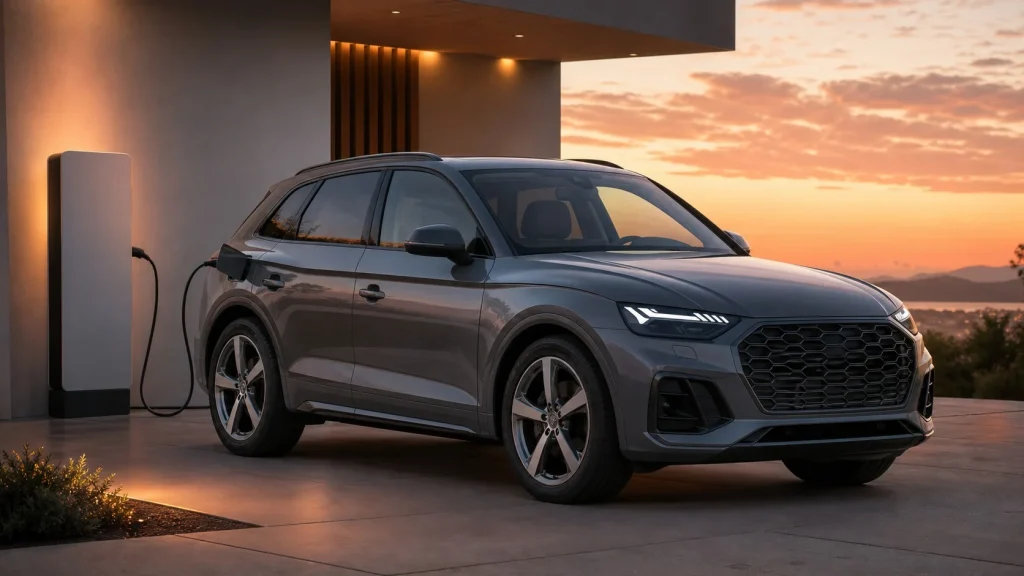
Yes, Audi produces hybrid vehicles, offering both mild-hybrid electric vehicles (MHEV) across most of its core lineup and plug-in hybrid electric vehicles (PHEV) under the “TFSI e” moniker. In the United States market, Audi equips standard sedans and SUVs with 12V or 48V mild-hybrid starter-generators, while the Audi Q5 55 TFSI e Quattro serves as the main plug-in hybrid option offering around 23 to 28 miles of all-electric driving range. Audi does not produce traditional self-charging full hybrids.
Key takeaways:
- Audi offers two electrified hybrid setups: Mild Hybrid (MHEV) for seamless stop-start efficiency and Plug-In Hybrid (PHEV) for short-distance all-electric commuting.
- The Audi Q5 55 TFSI e Quattro combines a 2.0L turbocharged engine with an electric motor to deliver 362 horsepower and plug-in charging capability.
- Core combustion models including the A3, A4, A6, A7, A8, Q3, and Q8 incorporate mild-hybrid starter-generator technology as standard equipment.
- Audi uses the designation “TFSI e” or “e-hybrid” for plug-in hybrids, distinguishing them from fully electric “e-tron” vehicles.
Does Audi make a hybrid car in 2026?
Yes, Audi manufactures hybrid cars, catering to drivers looking for reduced emissions and improved fuel economy without committing to full battery-electric vehicles. Audi’s hybrid strategy relies on two distinct electrification technologies: mild-hybrid systems (MHEV) integrated into standard gasoline models, and plug-in hybrid systems (PHEV) designated as TFSI e models.
When exploring the broader Audi vehicle lineup, buyers will find that electrification is standard across nearly every segment. Mild-hybrid setups use a belt-driven starter-generator and a compact lithium-ion battery to recover kinetic energy during braking, coasting with the engine turned off at highway speeds, and restarting the engine smoothly. For drivers seeking electric-only driving for daily commutes, Audi offers plug-in hybrid technology that pairs a traditional TFSI turbocharged gasoline engine with an electric motor and a larger high-voltage battery pack.
Audi is part of the Volkswagen Group, so shoppers researching who makes Audi cars often ask whether hybrid architecture is shared across sister brands. Audi develops its premium electrified powertrains centrally while sharing key modular platforms with Volkswagen and Porsche. According to a Marshall Audi hybrid guide, Audi does not build conventional self-charging hybrids (like a Toyota Prius). Instead, Audi bridges the gap between internal combustion and full electric vehicles through mild-hybrid enhancement and plug-in charging capability.
Does Audi have a plug-in hybrid (PHEV)?
Audi offers plug-in hybrid electric vehicles, marketed globally under the “TFSI e” or “e-hybrid” designation. A plug-in hybrid combines a turbocharged gasoline engine, an electric motor integrated into the transmission, and an external charging port connected to a high-voltage battery.
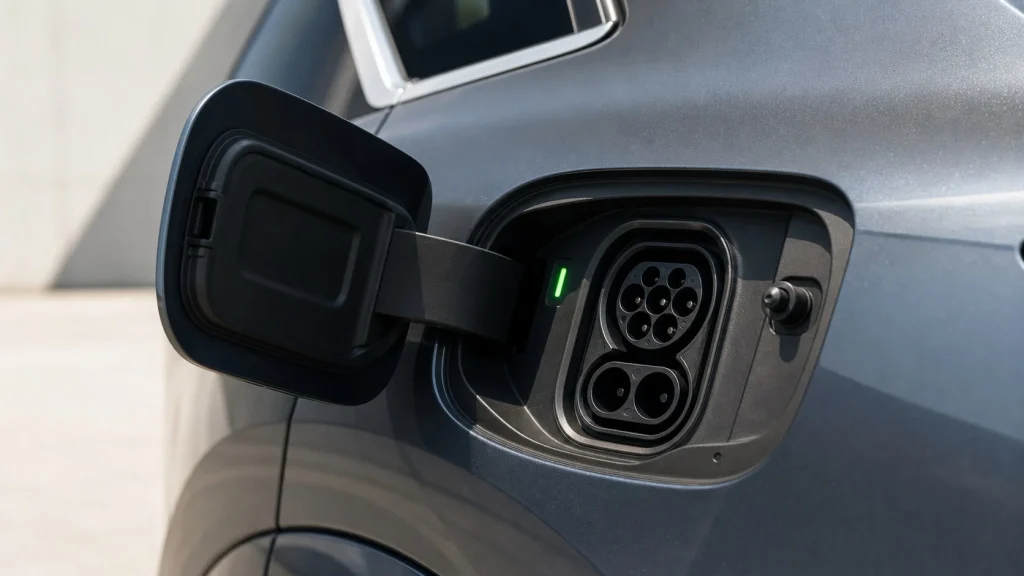
In North America, the premier plug-in hybrid offering is the Audi Q5 55 TFSI e Quattro. This model pairs a 2.0-liter turbocharged 4-cylinder engine with a 105 kW electric motor, producing a combined output of 362 horsepower and 369 lb-ft of torque. Power is delivered through a 7-speed S tronic dual-clutch transmission and Audi’s signature Quattro drive system, optimizing traction across all four wheels in all weather conditions.
According to official technical specifications from Audi’s plug-in hybrid technology overview, Audi PHEVs feature multiple drive modes, including EV mode (electric only), Hybrid mode (automatic optimization of engine and motor), and Battery Hold mode (preserving electrical energy for later use).
Here are key specifications for the Audi Q5 55 TFSI e plug-in hybrid:
- Powertrain: 2.0L Turbocharged 4-Cylinder + Electric Motor
- Combined Output: 362 hp / 369 lb-ft torque
- Battery Capacity: 17.9 kWh lithium-ion battery
- EPA Electric Range: Approximately 23 to 28 miles
- 0 to 60 mph Acceleration: 5.0 seconds
- Charging Time: Approximately 2.5 to 3 hours using a 240V Level 2 charger
Drivers comparing electrified utility vehicles can also examine the broader lineup of best Audi SUVs to evaluate total cargo volume and towing capacity alongside hybrid efficiency. Plug-in hybrids represent an ideal transition vehicle for drivers who want zero-emission electric commuting for short errands while retaining the long-distance refueling convenience of a gasoline engine for road trips.
Note: Real-world electric range for plug-in hybrids varies based on ambient temperature, driving aggressiveness, HVAC usage, and battery state of charge.
Which Audi hybrid cars are available now?
Audi integrates hybrid technology across its entire range of sedans, coupes, and crossovers. While plug-in hybrid availability varies by region, mild-hybrid technology comes standard on most current models.
The table below outlines current Audi models and their corresponding hybrid technology configurations:
| Audi Model | Hybrid Type | Powertrain Setup | Key Electrified Feature |
|---|---|---|---|
| Audi A3 | Mild Hybrid (MHEV) | 2.0L Turbo 4-Cylinder + 48V MHEV | Smooth engine coasting and stop-start recovery |
| Audi A4 | Mild Hybrid (MHEV) | 2.0L Turbo 4-Cylinder + 12V MHEV | Enhanced fuel efficiency during city driving |
| Audi A6 | Mild Hybrid (MHEV) | 2.0L / 3.0L Turbo + 48V MHEV | High-output energy regeneration and engine-off coasting |
| Audi A7 | Mild Hybrid (MHEV) | 3.0L V6 Turbo + 48V MHEV | Seamless torque assist and rapid restart |
| Audi A8 | Mild Hybrid (MHEV) | 3.0L V6 / 4.0L V8 + 48V MHEV | Executive luxury refinement with 48V electrical architecture |
| Audi Q3 | Mild Hybrid (MHEV) | 2.0L Turbo 4-Cylinder + 12V MHEV | Subcompact crossover efficiency enhancement |
| Audi Q5 55 TFSI e | Plug-In Hybrid (PHEV) | 2.0L Turbo 4-Cylinder + Electric Motor | 23-28 miles all-electric range with wall plug charging |
| Audi Q8 | Mild Hybrid (MHEV) | 3.0L V6 Turbo + 48V MHEV | Flagship SUV power with brake energy harvesting |
For buyers researching specific model years, entry-level premium buyers can review specs for the 2024 Audi A3 mild hybrid. Those seeking executive luxury can check the updated 2026 Audi A6 to see how 48V electrical systems support high-end infotainment and driver assistance features.
What’s the difference between Audi mild hybrid and plug-in hybrid?
Understanding the distinction between mild-hybrid (MHEV) and plug-in hybrid (PHEV) systems helps shoppers choose the right vehicle for their driving habits.
Mild Hybrid Electric Vehicles (MHEV)
Mild-hybrid systems enhance internal combustion engines but cannot drive the car solely on electric power. Audi utilizes two MHEV architectures:
- 12-Volt MHEV: Used primarily on 4-cylinder engines. It features a belt alternator starter (BAS) connected to the crankshaft and a compact 12V lithium-ion battery.
- 48-Volt MHEV: Standard on V6 and V8 engines. The 48V system recovers up to 12 kW of power during deceleration, allows coasting with the combustion engine deactivated at speeds between 34 and 99 mph for up to 40 seconds, and enables start-stop operation from 13 mph.
MHEV vehicles do not have a plug socket. Drivers fuel them at standard gas stations without changing their daily routine.
Plug-In Hybrid Electric Vehicles (PHEV)
Plug-in hybrids feature a significantly larger high-voltage battery (typically 14.1 kWh to 17.9 kWh in Audi models) and a more powerful electric motor integrated directly into the transmission.
- Charging: Requires plugging into an electrical outlet or wall charger (Level 1 120V or Level 2 240V).
- Electric-Only Driving: Can drive at highway speeds (up to 84 mph in EV mode) purely on electricity without burning gasoline.
- Hybrid Operation: Automatically switches to hybrid mode once the battery depletes, operating much like an efficient mild hybrid.
Shoppers comparing overall model quality across luxury brands often evaluate these powertrains when choosing among the best Audi cars for long-term reliability and fuel savings. Buyers interested in smaller crossovers can also check specifications for the 2025 Audi Q3 to see how mild-hybrid assistance operates in city conditions. A mild hybrid requires zero operational changes from traditional gas cars while delivering subtle fuel savings. A plug-in hybrid requires dedicated charging habits to maximize electric miles but unlocks daily gas-free driving.
Has Audi made hybrids before?
Audi was an early pioneer in hybrid technology, debuting concept vehicles and production hybrids long before electric vehicles became mainstream automotive products.
Audi’s hybrid timeline highlights several key milestones:
- 1989 (Audi Duo Concept): Audi introduced the Duo concept based on the Audi 100 Avant quattro. It combined a 134-hp 5-cylinder gasoline engine driving the front axle with a 12-hp electric motor driving the rear axle.
- 1997 (Audi Duo III): Audi became the first European automaker to put a hybrid car into series production with the Duo III, based on the A4 Avant. It utilized a 1.9L TDI diesel engine paired with an electric motor.
- 2011-2012 (First Modern Production Hybrids): Audi introduced full hybrid variants of the Q5, A6, and A8. These models used a 2.0L TFSI engine paired with a 40 kW electric motor and a 1.3 kWh lithium-ion battery.
Flagship luxury sedans like the 2026 Audi A8 carry forward this engineering legacy with modern 48V hybrid infrastructure. Enthusiasts interested in global assembly roots can also learn where Audi cars are made to see how facilities adapt to producing both traditional and hybrid powertrains.
These early production models laid the engineering foundation for today’s advanced TFSI e plug-in hybrid system and 48V mild-hybrid networks.
Frequently Asked Questions
Does Audi have a full self-charging hybrid?
No, Audi does not manufacture traditional self-charging full hybrids (HEVs) that lack plug-in ports while driving on high-power electric battery assist. Audi focuses exclusively on mild-hybrid (MHEV) technology for fuel efficiency and plug-in hybrid (PHEV) technology for true electric capability.
Is Audi replacing hybrids with electric e-tron vehicles?
Audi is expanding its fully electric e-tron portfolio (such as the Q4 e-tron, Q8 e-tron, and e-tron GT) alongside its hybrid offerings. Audi views plug-in hybrids as an essential bridge technology while public charging infrastructure continues to expand globally.
How far can an Audi plug-in hybrid drive on electric power alone?
Current Audi plug-in hybrid models such as the Q5 55 TFSI e deliver an EPA-estimated all-electric driving range of approximately 23 to 28 miles on a single charge. In European WLTP testing cycles, newer e-hybrid battery packs achieve up to 40 to 60 miles of electric range.

