

Quick answer: BMW requires specific nitrate-free and phosphate-free coolants to protect its aluminum components. Vehicles built in 2018 and earlier use G48 (blue-green) coolant under the BMW GS 94000 standard. Newer models from 2019 onward require HT-12 (green) coolant matching the BMW LC-18 specification. Valvoline HT-12 green coolant offers an extended service life of up to 5 years or 250,000 km.
Key takeaways:
- BMW uses specific hybrid technology (HOAT) and forbids phosphates, nitrites, and amines.
- G48 is blue-green and used in pre-2018 models; HT-12 is green and used in 2019-present models.
- Green HT-12 is backward compatible with G48, but blue G48 cannot be added to HT-12 systems.
- OEM concentrates must be diluted 50/50 with distilled water; tap water minerals damage the system.
BMW Coolant Types: G48 vs HT-12
BMW utilizes two main coolant specifications depending on the vehicle’s production date. Pre-2018 BMWs require blue G48 (LC-87 HOAT) coolant, while 2019 and newer BMWs require green HT-12 (LC-18 Si-OAT) coolant.
To help you keep track of the latest automotive repair and servicing updates, we regularly post detailed maintenance guidelines in our news category.
For decades, the standard coolant for BMW engines was the G48 specification. This formula is a Hybrid Organic Acid Technology (HOAT) fluid that relies on a combination of organic acids and silicates to form a protective layer on engine internals. In 2018, BMW began transitioning to a newer technology known as HT-12. This specification is a Silicated Organic Acid Technology (Si-OAT) formula designed to withstand the higher operating temperatures of modern turbocharged engines.
The table below breaks down the key technical differences between these two factory fluids:
| Specification | Primary Color | Chemistry Type | BMW Approval Code | Target Model Years | Standard Service Life |
|---|---|---|---|---|---|
| G48 (LC-87) | Blue-Green | HOAT (Silicated) | BMW GS 94000 | 2018 and earlier | 4 years / 50,000 miles |
| HT-12 (LC-18) | Green | Si-OAT (Extended) | BMW LC-18 | 2019 to present | 5 years / 150,000 miles |
Both coolant types are supplied as concentrates. To achieve maximum freeze and corrosion protection, they must be mixed at a 50/50 ratio with distilled water. This standard mix provides freeze protection down to -37 degrees Celsius (-34 degrees Fahrenheit) for G48 and -34 degrees Celsius (-29 degrees Fahrenheit) for HT-12.
Can You Mix BMW Blue and Green Coolant?
Green HT-12 coolant is backward compatible and can top off or replace G48 blue coolant. However, blue G48 coolant cannot be added to systems designed for HT-12.
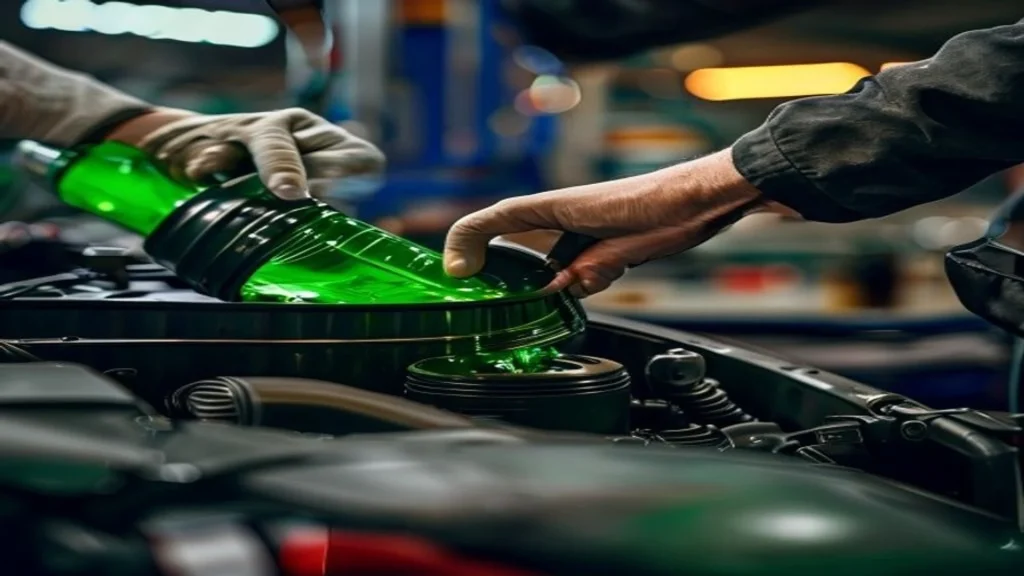
If you own an older BMW that originally came with blue G48, you can safely top off the expansion tank using the newer green HT-12. The additive package in HT-12 is designed to blend smoothly with G48 without causing chemical breakdown or dropouts. However, the reverse is strictly prohibited. You must never add G48 to a newer system that came from the factory with HT-12. The older blue coolant lacks the advanced thermal inhibitors required by newer engines, and mixing it can reduce the overall boiling point and protection levels.
In the event of an accidental mixing where blue coolant is added to an HT-12 system, the cooling system will not fail immediately. However, you should plan a complete cooling system flush and refill within the next few weeks. Over time, the mixed inhibitors can deplete faster than intended, leaving the radiator and cylinder head vulnerable to localized hot spots.
Why BMW Engines Require Specific Coolant Chemistry
BMW engines utilize magnesium-aluminum alloy engine blocks and aluminum radiators that are highly sensitive to corrosion. Standard coolants contain phosphates, nitrites, or amines that react aggressively with these metals, leading to deposit build-up or structural degradation.
The cooling system passages in BMW engines are narrow, designed to minimize weight and optimize heat transfer. Standard aftermarket coolants typically contain phosphates to protect iron engine blocks. However, when phosphates mix with the minerals in hard water, they precipitate out of the solution, creating solid calcium-phosphate scale. This scale adheres to the hot metal surfaces inside the radiator and heater core, forming an insulating barrier that reduces heat transfer and eventually clogs the system.
To prevent this, BMW requires a formula that is completely free of phosphates, nitrites, amines, and imidazoles. Instead, BMW-approved coolants use a combination of organic acid inhibitors and a precise amount of silicates. The silicates form a micro-thin, self-healing protective layer on the aluminum and magnesium surfaces, protecting the cooling system metals from cavitation and galvanic corrosion.
Expert view: Mixing standard phosphate-rich coolant in a BMW engine creates a chemical reaction that precipitates solid calcium-phosphate deposits. This blocks the micro-channels in the radiator and heater core, eventually leading to catastrophic engine overheating.
Approved Aftermarket BMW Coolant Alternatives
Several aftermarket coolants are officially approved to meet BMW G48 and HT-12 standards, offering reliable alternatives to expensive dealer-branded fluids.
You do not have to buy coolant directly from a dealership parts counter. As long as the product bottle explicitly states the correct manufacturer specification, it is safe to use. For older models, Glysantin G48 concentrate by BASF is the exact OEM fluid sold in aftermarket packaging. Other highly rated alternatives for the blue-green specification include Zerex G-48 by Valvoline and Pentosin NF Antifreeze, both of which are widely available at local auto parts retailers.
For newer vehicles requiring the LC-18 specification, Valvoline HT-12 Green Coolant is the officially approved aftermarket option. Because the HT-12 standard is relatively new, generic aftermarket brands have not yet formulated compatible alternatives. We highly recommend sticking to the Valvoline HT-12 product or buying the genuine BMW green coolant concentrate from an authorized distributor. Avoid generic “European Formula” coolants that claim universal compatibility, as many still contain trace phosphates.
BMW Coolant Specifications by Model Year
The correct coolant for a BMW is determined by its model year, with 2018 acting as the transition year between the G48 and HT-12 standards.
The transition from blue G48 to green HT-12 occurred gradually between 2018 and 2019. Because the transition was phased across different factory assembly lines, some late-2018 models shipped with green HT-12, while others maintained the blue G48. The most reliable way to identify your factory fill is to inspect the fluid inside the expansion tank or check the sticker on the expansion tank cap.
Refer to the table below to find the correct specification based on model years:
| Vehicle Type and Model Years | Required Specification | Coolant Color | Backward Compatible Notes |
|---|---|---|---|
| BMW Models (2018 and older) | G48 / GS 94000 | Blue-Green | Can be topped off or upgraded to HT-12 |
| BMW Models (2019 to present) | HT-12 / LC-18 | Green | Must not be filled or topped off with G48 |
| Electric Models (i3, i4, iX) | Check Owner’s Manual | Varies by year | Often requires specialized dielectric fluids |
Older classic BMWs, such as the E30, E36, and E46 generations, must stick to the G48 specification. Their older radiator solder materials and water pump seals are optimized for the G48 additive package. Upgrading to HT-12 is possible, but it requires a complete system flush with distilled water first to remove all traces of the old fluid.
Original Chemical Analysis: G48 vs HT-12 Total Cost of Ownership
While green HT-12 coolant has a higher initial purchase price than G48, its extended 5-year service life matches or exceeds G48’s 4-year cycle, resulting in comparable long-term maintenance costs.
When evaluating the cost of maintaining a BMW, coolant is a minor but regular expense. A single gallon of genuine BMW G48 blue concentrate typically retails for $25 to $35, while a gallon of genuine BMW HT-12 green concentrate ranges from $35 to $45. Valvoline HT-12 green aftermarket fluid carries a similar premium.
However, because Valvoline HT-12 green is formulated using advanced Si-OAT technology, it offers an extended service life of 5 years or 150,000 miles. By contrast, G48 is rated for 4 years or 50,000 miles. Over a ten-year ownership period, a G48 vehicle will require at least two complete flushes, whereas an HT-12 vehicle will only require one. This longer interval completely offsets the higher initial cost of the green coolant concentrate.
Cost of BMW Coolant Flush: DIY vs Professional
A professional BMW coolant flush typically costs between $292 and $372 in the US, whereas a DIY flush using approved aftermarket concentrates costs between $50 and $100.
Having a dealer or independent specialist perform a coolant flush ensures the old fluid is captured and disposed of safely. The professional service fee includes pressure-testing the system for leaks and vacuum-filling the lines to prevent air pockets. Understanding these service costs is a key part of managing your overall BMW maintenance costs.
The table below compares estimated costs for different service approaches:
| Service Option | US Estimated Cost | UK Estimated Cost | What is Included |
|---|---|---|---|
| DIY Flush (Concentrate + Water) | $50 – $100 | GBP 40 – GBP 80 | Coolant concentrate, distilled water, and waste container |
| Independent Repair Shop | $180 – $250 | GBP 120 – GBP 180 | Labor, fluid replacement, basic system pressure test |
| BMW Dealership Service | $292 – $372 | GBP 220 – GBP 300 | OEM fluid, vacuum-fill procedure, full system check |
If you choose the DIY route, you will save on labor but must budget for a scan tool or learn the manual bleeding procedure. Just like replacing the BMW microfilter regularly, performing a cooling system flush is vital to protect your engine’s longevity.
Note: The effective rates for coolant flushes are highly dependent on the engine configuration. Multi-turbo V8 models require more fluid and complex bleeding procedures, which can increase dealer labor fees.
How to Check and Top Off BMW Coolant Level
Checking and topping off BMW coolant must only be performed when the engine is completely cold to prevent pressurized hot steam from escaping.
Never attempt to open the expansion tank cap immediately after driving. The cooling system operates under high pressure, and opening the cap on a hot engine can cause boiling coolant to spray out, resulting in severe burns. Always wait at least 30 minutes after parking for the engine to cool down.
Follow these steps to check and top off the fluid safely:
- Park the vehicle on level ground and allow the engine to cool completely.
- Locate the coolant expansion tank, which is typically a black or translucent plastic tank situated near the passenger-side firewall.
- Slowly unscrew the cap counter-clockwise. If you hear a hissing sound, stop and wait for the remaining pressure to vent before removing the cap.
- Look inside the filler neck. Modern BMWs use a yellow floating indicator rod or internal plastic markers to show the fluid level. The top of the floating rod should be level with the top edge of the filler neck when the system is full.
- If the level is low, mix your G48 or HT-12 concentrate with distilled water at a 50/50 ratio. Pour the mixture into the tank in small increments until the indicator rod reaches the maximum fill mark.
- Reinstall the expansion tank cap and turn it clockwise until it clicks or locks firmly into place.
Once the system is closed, you must run the automatic bleeding procedure. BMW vehicles equipped with electric water pumps require this process to purge trapped air from the heater core and cylinder head. To start the automatic bleed, turn the ignition on without starting the engine, set the heater to the maximum temperature on the lowest fan speed, and press the accelerator pedal to the floor for 10 seconds. The electric pump will run automatically for approximately 12 minutes to bleed the system.
Frequently Asked Questions
Can I use Prestone in my BMW?
Only use Prestone European Formula that explicitly meets BMW G48 or HT-12 specifications. Standard universal Prestone contains silicates and phosphates that are not approved and will void the BMW cooling system warranty. Always verify the bottle label shows compliance with BMW GS 94000 or LC-18.
How often should BMW coolant be changed?
Blue G48 coolant must be replaced every 4 years or 50,000 miles. Green HT-12 coolant has an extended service life and must be replaced every 5 years or 150,000 miles, as specified by Valvoline. Keeping to these intervals prevents corrosion and helps avoid expensive cooling system failures.
Why is my BMW coolant green instead of blue?
A green color indicates your vehicle is a 2019 or newer model using the modern HT-12 specification, or an older model that was upgraded to the backward-compatible HT-12 standard. If your pre-2018 model has green fluid, verify that the shop used approved HT-12 and not generic green coolant.
Is BMW coolant the same as Mercedes coolant?
No, BMW and Mercedes-Benz use separate formulations. BMW requires specific HOAT or Si-OAT specifications (G48 or HT-12), which differ from Mercedes-Benz 325.0 and 325.6 standards. Using Mercedes coolant in a BMW engine can result in chemical incompatibility and reduced water pump life.
Can I use water temporarily if I run out of coolant?
In emergencies, you may top off with distilled water. However, this dilutes the system, reducing freeze and corrosion protection. You must flush and refill the cooling system with a proper 50/50 mixture of approved concentrate and distilled water as soon as possible.

