

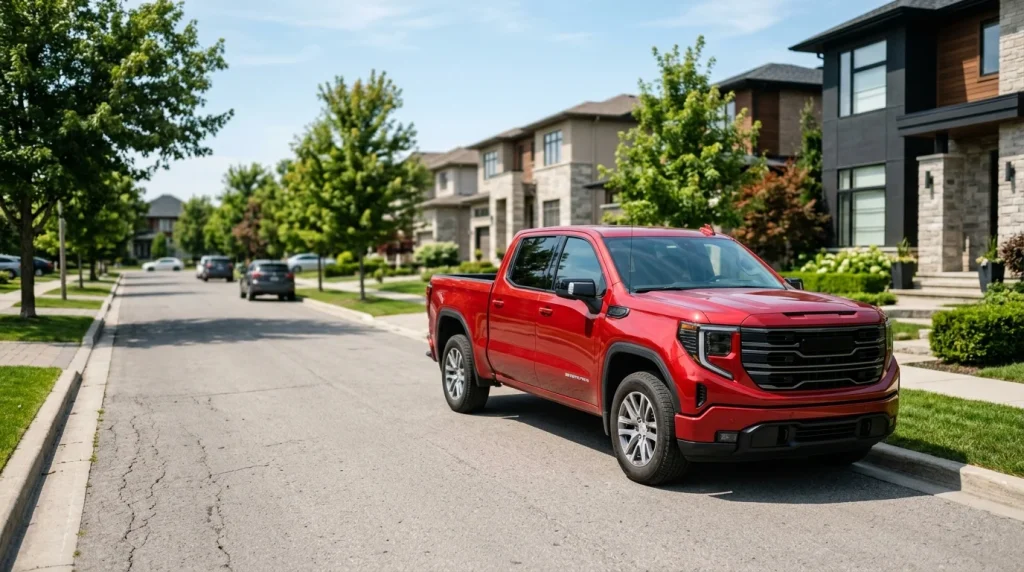
Quick answer: GMC originally stood for General Motors Truck Company when it was established in 1911 under GM founder William C. Durant. Today, the acronym represents General Motors Company’s dedicated premium division that exclusively manufactures trucks, SUVs, and commercial vehicles, positioning itself as a professional-grade alternative to Chevrolet.
Key takeaways:
- GMC stands for General Motors Truck Company, established in 1911 through a truck manufacturer merger.
- GMC manufactures only trucks, SUVs, and commercial vehicles, leaving passenger cars to Chevrolet.
- GMC shares platforms and engines with Chevrolet but commands a premium for upscale styling and Denali trims.
- The 2026 lineup ranges from the $30,200 Terrain SUV to the $110,000+ Hummer EV Pickup producing 1,160 horsepower.
The Meaning Behind the GMC Name and Acronym
If you look at the front grille of a modern pickup truck or SUV and ask yourself what does gmc car stand for, the direct answer goes back to the company’s industrial roots. The acronym GMC stands for General Motors Truck Company. In this three-letter abbreviation, the G represents General, the M represents Motors, and the C represents Company, which was derived directly from the brand’s original name as a truck-focused subsidiary.
It is a common point of confusion among U.S. buyers to assume the C stands for Corporation, leading to the belief that the brand represents General Motors Corporation. However, GMC has always been a distinct, specialized division within the larger General Motors Company. The C specifically points to the truck company itself. Understanding this naming scheme helps explain why the brand focuses entirely on utility vehicles, rather than traditional passenger sedans or coupes. Just like understanding what iS stands for in BMW models, decoding the GMC acronym requires looking back at the brand’s history.
The Historical Timeline: From Grabowsky to Professional Grade
The history of GMC is deeply rooted in the earliest days of American truck manufacturing. The brand’s origin began in 1900 when brothers Max and Morris Grabowsky founded the Grabowsky Motor Company in Detroit, Michigan. The company built some of the earliest commercial trucks in the world. Reorganizing the business in 1902, the brothers renamed it the Rapid Motor Vehicle Company and relocated operations to Pontiac, Michigan, where they opened the first factory dedicated exclusively to commercial truck production.
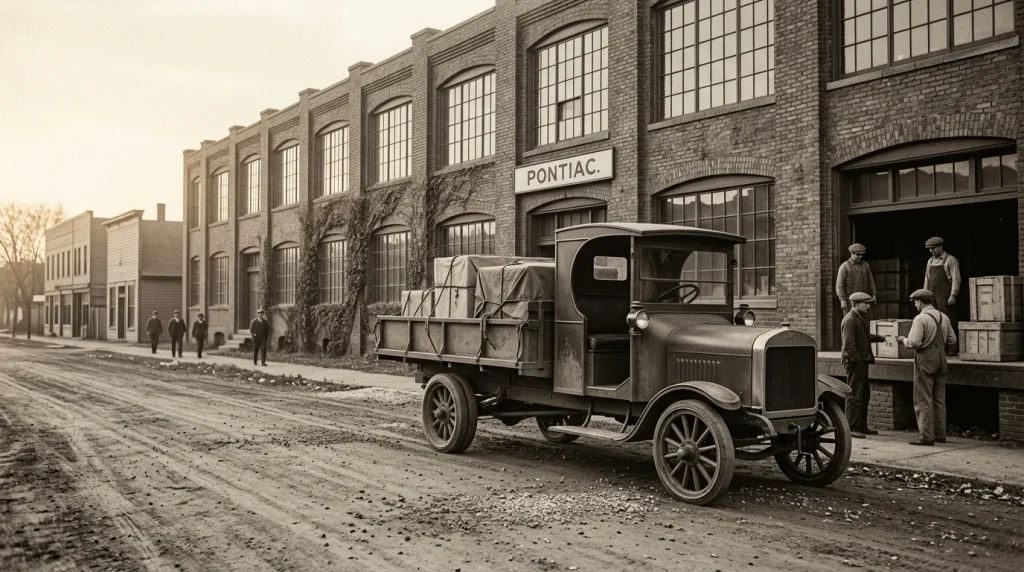
In 1909, General Motors founder William C. Durant recognized the growing potential of commercial transport and acquired a majority stake in Rapid Motor Vehicle Company. That same year, GM also purchased the Reliance Motor Truck Company, another early pioneer in heavy-duty vehicles. Durant merged these two acquisitions in 1911 to officially form the General Motors Truck Company.
The GMC logo was first shown to the public in 1912 at the New York International Auto Show, and the trademark was registered later that year. The company’s name evolved through several changes over the decades, as shown in the table below:
| Era | Official Corporate Division Name |
|---|---|
| 1911 – 1943 | General Motors Truck Company |
| 1943 – 1998 | GMC Truck and Coach Division |
| 1998 – Present | GMC |
According to official records on Wikipedia, the brand played a significant role in both World Wars. During World War I, GMC provided over 8,500 trucks to the U.S. military, primarily for use as battlefield ambulances and cargo transports. In 1943, GM acquired the Yellow Truck and Coach Manufacturing Company and reorganized the division as the GMC Truck and Coach Division, which was famous for producing transit buses and heavy commercial vehicles. In 1998, the division was simplified to GMC, focusing entirely on premium consumer trucks and SUVs sold today.
GMC vs Chevrolet: Platform Sharing and Key Differences
GMC and Chevrolet operate under the same parent company, General Motors. Because of this corporate relationship, the two brands share identical vehicle platforms, suspension setups, transmissions, and engines. For example, the GMC Sierra 1500 and the Chevrolet Silverado 1500 are built on the same General Motors T1 platform and roll off the same assembly lines in Fort Wayne, Indiana. They offer the exact same engine options, including a 2.7L TurboMax inline-4, a 5.3L EcoTec3 V8, a 6.2L EcoTec3 V8, and a 3.0L Duramax Turbo-Diesel.
However, General Motors uses a distinct marketing and design strategy to separate the two brands in the market:
| Feature | Chevrolet | GMC |
|---|---|---|
| Target Market | Mainstream, value-conscious families | Premium, professional-grade buyers |
| Vehicle Lineup | Full range (cars, SUVs, trucks, EVs) | Utility vehicles only (trucks, SUVs, vans) |
| Starting MSRP | Lower base entry price | Higher premium starting price |
| Signature Trim | High Country (Luxury) | Denali & Denali Ultimate (High Luxury) |
| Design Style | Traditional, athletic | Bold, chrome-accented, industrial |
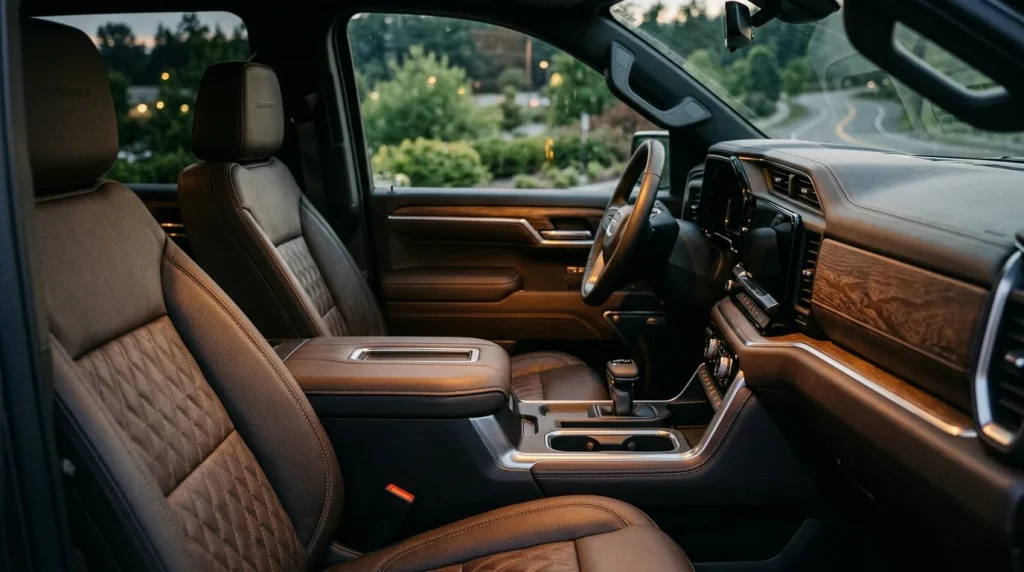
This brand division means that GMC vehicles carry a pricing premium. A base-model Chevrolet Silverado Work Truck starts at approximately $37,000, while the base GMC Sierra 1500 Pro starts at $38,300. At the luxury end, the difference is wider. A top-trim Chevrolet Silverado High Country is priced around $70,000, whereas the GMC Sierra Denali Ultimate starts at over $84,200. The GMC premium covers higher-quality interior materials, thicker soundproofing glass, real wood accents, and exclusive tech features like GM’s Super Cruise hands-free driving assistant with trailering capability.
Expert view: While the underlying frames and powertrains are identical, GMC serves as a stepping stone between mainstream Chevrolet utility and high-end Cadillac luxury. If you only need mechanical capability, Chevrolet offers the exact same power for less money.
The 2026 GMC Vehicle Lineup: Prices and Specs
For the 2026 model year, GMC continues its exclusive focus on trucks and SUVs. The entry point of the brand starts at $30,200 for the small Terrain SUV, while the top of the lineup is occupied by the all-electric Hummer EV supertruck.
2026 GMC Truck Models, MSRP, and Towing Capacities
GMC offers a range of midsize, light-duty, heavy-duty, and electric pickup trucks designed for work and luxury:
- Canyon: Starting at $38,900 MSRP. The midsize Canyon features a standard 2.7L TurboMax engine producing 310 horsepower and 430 lb-ft of torque. It offers a maximum towing capacity of 7,700 pounds on standard trims, which drops to 6,000 pounds on the off-road AT4X configuration due to specialized long-travel suspension.
- Sierra 1500: Starting at $37,650 MSRP. The light-duty Sierra is the brand’s bestseller, offering multiple engine options and a maximum towing capacity of up to 13,200 pounds when properly equipped.
- Sierra 2500 HD: Starting at $47,000 MSRP. The heavy-duty 2500 features a standard 6.6L V8 gas engine or an optional 6.6L Duramax Turbo-Diesel V8. It has a maximum towing capacity of up to 22,500 pounds.
- Sierra 3500 HD: Starting at $47,900 MSRP. Built for extreme hauling, the 3500 HD offers a dual-rear-wheel configuration that enables a maximum towing capacity of up to 36,000 pounds when paired with the Duramax diesel engine.
- Hummer EV Pickup: Starting at approximately $98,845 for the 2X trim, with the high-performance 3X starting around $110,000. According to official performance figures from GM, the 2026 Hummer EV Pickup 3X utilizes a tri-motor setup producing up to 1,160 horsepower and 13,000 lb-ft of torque, enabling a 0-60 mph sprint in 3 seconds. It features a GM-estimated electric range of up to 316 miles.
2026 GMC SUV Models, Seating, and Towing Capacities
The SUV lineup ranges from compact crossovers to massive, truck-based family haulers:
- Terrain: Starting at $30,200 MSRP. Re-engineered with a bold design, this 5-passenger compact SUV features a 1.5L Turbo engine. It has a maximum towing capacity of 1,500 pounds in its all-wheel-drive configuration, which drops to 800 pounds for front-wheel-drive models.
- Acadia: Starting at $43,800 MSRP. A midsize 3-row SUV seating up to 7 passengers, the Acadia is equipped with a 2.5L Turbo engine producing 328 horsepower. It has a maximum towing capacity of 5,000 pounds.
- Yukon: Starting at $69,600 MSRP. A full-size body-on-frame SUV seating up to 8 passengers, the Yukon is available with V8 gas engines or a 3.0L Duramax diesel. It offers a maximum towing capacity of up to 8,400 pounds.
- Yukon XL: Starting at $72,600 MSRP. The long-wheelbase Yukon XL offers extra cargo space behind the third row, with a maximum towing capacity of up to 8,100 pounds.
- Hummer EV SUV: Starting at $97,200 MSRP. The SUV version of the electric supertruck seats 5, delivering up to 830 horsepower and an estimated range of up to 310 miles.
Note: The starting MSRP values listed above represent the base trims and do not include local dealer fees, taxes, or destination freight charges, which typically range from $1,395 to $1,995.
Original Analysis: Is a GMC Vehicle Worth the Premium?
When choosing between a GMC and a Chevrolet, buyers must analyze the real cost of ownership. According to vehicle valuation data, both the GMC Sierra 1500 and the Chevrolet Silverado 1500 experience similar depreciation rates, losing approximately 43% of their initial value over the first five years of ownership.
However, the financial value of the GMC premium depends entirely on which trim level you select:
- When it is NOT worth it: If you are buying a base GMC Sierra Pro or a Terrain Elevation, you are paying a $1,300 to $2,000 premium over a Chevrolet Silverado Work Truck or Equinox. For this extra cost, you receive almost identical interior plastics, the same infotainment software, and identical driving dynamics. In this case, the Chevy equivalent offers superior value.
- When it IS worth it: If you are shopping for luxury or off-road capability, GMC shines. The GMC Denali and AT4 trims offer advanced active noise cancellation, authentic open-pore wood trim, and adaptive suspension systems that are not available on Chevrolet models. These high-end GMC models also hold their resale value better than base models due to strong demand in the used premium truck market.
If you are purchasing a new vehicle, it helps to understand how long it takes to buy a car or truck at a modern dealership.
Who Owns GMC and Where Are They Manufactured?
GMC is owned by General Motors, which is headquartered in Detroit, Michigan. The manufacturing of GMC vehicles is centered in several major assembly plants across the United States and Canada:
- Fort Wayne Assembly (Indiana): Builds the GMC Sierra 1500 and Chevrolet Silverado 1500 light-duty trucks.
- Flint Assembly (Michigan): Assembles the heavy-duty GMC Sierra 2500 HD and 3500 HD models.
- Arlington Assembly (Texas): Manufactures GM’s full-size SUVs, including the GMC Yukon and Yukon XL.
- Lansing Delta Township Assembly (Michigan): Assembles the midsize GMC Acadia.
- CAMI Assembly (Ingersoll, Ontario, Canada): Handles production for commercial vans and future electric models.
- Factory ZERO (Detroit, Michigan): Dedicated to electric vehicles, including the Hummer EV Pickup and SUV.
For the latest automotive news and reviews, stay tuned to our buying guides.
Frequently Asked Questions
Does GMC stand for General Motors Corporation?
No, GMC does not stand for General Motors Corporation. While General Motors Corporation was the parent company’s legal name until 2009, GMC specifically stands for General Motors Truck Company, representing the truck-focused division of the automaker.
Why doesn’t GMC make cars?
GMC does not make passenger cars because its entire brand identity is focused on utility vehicles. GM maintains Chevrolet, Buick, and Cadillac to sell traditional sedans, hatchbacks, and coupes, preventing internal competition.
Is GMC better than Chevrolet?
GMC is not mechanically better than Chevrolet, as they share the same engines, platforms, and gearboxes. However, GMC offers a more premium driving experience with superior interior cabin materials and better sound insulation.
Is GMC an American company?
Yes, GMC is an American brand headquartered in Detroit, Michigan. It operates as an active division of General Motors, which is one of the largest automakers in the United States.
What was GMC originally called?
GMC traces its origins back to the Grabowsky Motor Company founded in 1900. It was renamed the Rapid Motor Vehicle Company in 1902, before being merged with Reliance Motor Truck Company in 1911 to create the General Motors Truck Company.

