

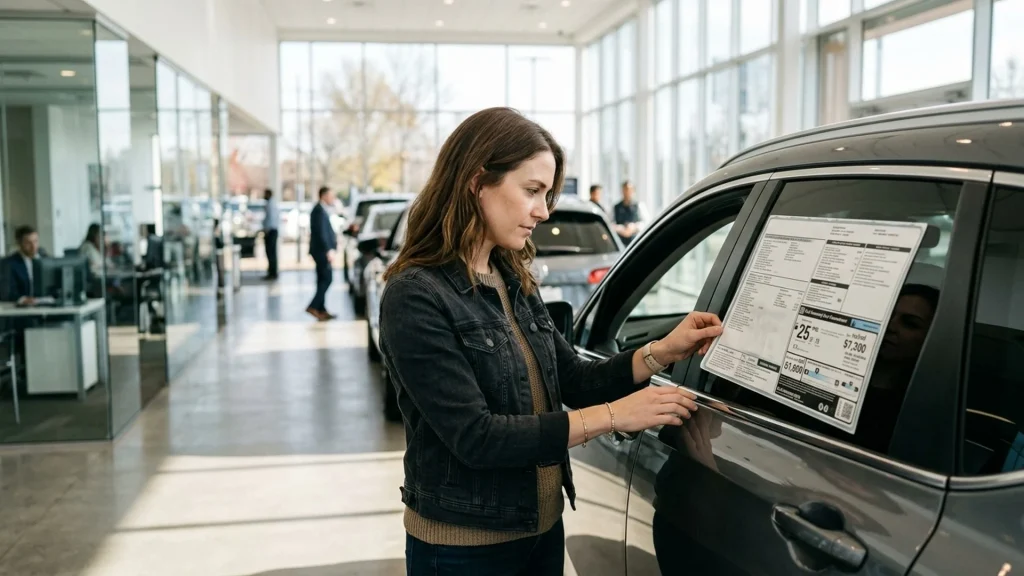
Quick answer: MSRP stands for Manufacturer’s Suggested Retail Price, which represents the price an automaker recommends dealerships charge for a new passenger vehicle. Established by federal law under the Automobile Information Disclosure Act of 1958, the MSRP must be displayed on the vehicle’s window sticker. It is a benchmark rather than a fixed price, meaning buyers can regularly negotiate below it.
Key takeaways:
- MSRP is a recommended retail price set by the manufacturer, not a government-mandated selling price.
- The federal Monroney Act requires all new passenger cars to carry a window sticker detailing the MSRP.
- Sticker price includes the base MSRP plus destination charges, which average $1,592 in early 2026.
- Invoice price is the dealership’s purchasing cost, typically sitting 5% to 10% lower than the MSRP.
- Buyers in the 2026 vehicle market can negotiate discounts of 3% to 10% off MSRP on slow-selling inventory.
What Does MSRP Stand For?
MSRP stands for Manufacturer’s Suggested Retail Price, which is the baseline price that an automaker recommends dealerships charge for a new vehicle. According to official guidelines from Mazda USA, this figure includes the vehicle’s standard build and trim level before any optional accessories or dealer additions are added.
The key word in this acronym is “suggested.” Under United States retail regulations, franchised car dealerships are independent businesses. This means they are legally permitted to set their own final transaction prices. A dealership can choose to sell a vehicle for exactly the MSRP, discount it to attract buyers, or mark it up when inventory is scarce. MSRP acts as a pricing anchor, providing a standard reference point so that buyers can compare offers across different showrooms.
The Automobile Information Disclosure Act of 1958 (Monroney Act)
Federal law strictly regulates how new car prices are presented to consumers. The Automobile Information Disclosure Act of 1958, which is codified in the U.S. Code at 15 U.S.C. §§ 1231-1233, mandates that every new passenger vehicle must display a comprehensive pricing label on its side window. This label is widely known in the automotive industry as the Monroney sticker, named after Oklahoma Senator Almer Monroney, who sponsored the consumer protection legislation.
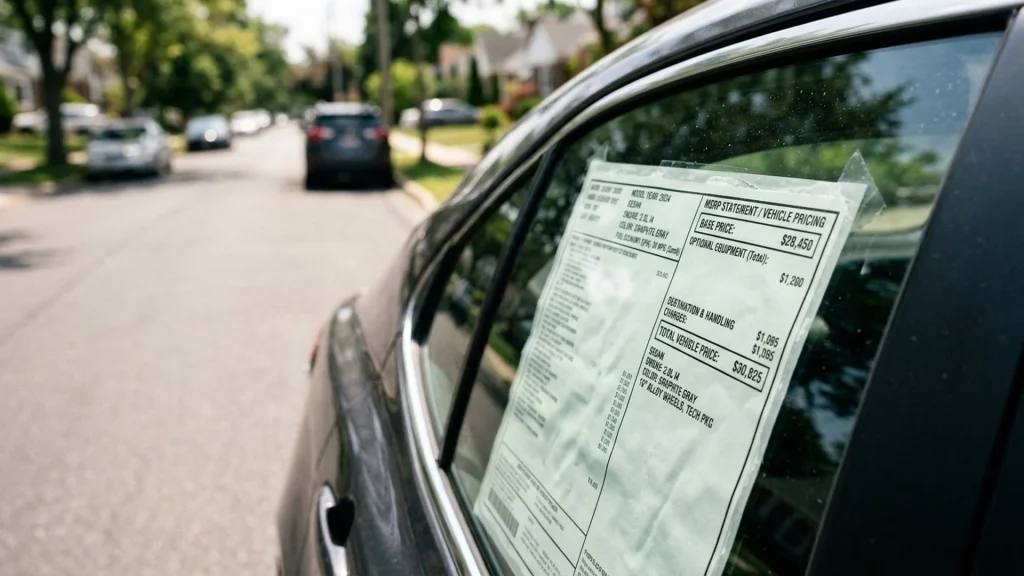
The law requires automakers to print specific details on the window sticker, ensuring dealerships cannot hide the recommended pricing. A valid Monroney sticker must display the following information:
- The manufacturer’s base retail price for that specific trim level.
- Itemized pricing for all factory-installed options and packages.
- The standard destination charge for transporting the vehicle to the dealership.
- EPA-estimated fuel economy ratings and greenhouse gas emissions data.
Altering, removing, or defacing a Monroney sticker before a vehicle is delivered to the final consumer is a federal offense, carrying substantial financial penalties for dealerships. This law ensures that buyers have immediate access to transparent pricing data when shopping on a dealership lot.
What MSRP Includes (and What It Excludes)
When you look at the MSRP of a new vehicle, you are looking at the factory-established price for the physical machine. It is important to know exactly what this figure covers, as additional fees will always be added to your final purchase contract.
What is Included in MSRP:
- The Base Price: The cost of the car in its entry-level configuration, which includes the engine, transmission, and standard features for that particular trim.
- Factory-Installed Options: Any upgrades added at the manufacturing plant, such as premium leather seats, advanced safety suites, or upgraded infotainment systems.
- Standard Warranty Packages: The basic manufacturer-backed bumper-to-bumper and powertrain warranties.
What is Excluded from MSRP:
- Destination Charges: The cost of shipping the vehicle from the assembly plant or shipping port to the dealership showroom. According to data tracked by Kelley Blue Book, the average destination charge in early 2026 has climbed to $1,592 due to rising logistics and transportation costs. Large SUVs and heavy electric vehicles can carry destination fees as high as $2,795.
- Sales Tax and Licensing Fees: State and municipal taxes, along with title, registration, and license plate fees charged by your local Department of Motor Vehicles (DMV).
- Dealer-Installed Accessories: Upgrades added at the dealership, such as window tint, all-weather floor mats, nitrogen-filled tires, or paint protection films.
- Documentation Fees: Administrative fees charged by the dealership to process the vehicle’s registration paperwork (often called “doc fees”).
The table below breaks down the components that make up the final cost of a vehicle:
| Pricing Component | Who Establishes It | Included in Base MSRP? | Negotiable? |
|---|---|---|---|
| Base Price | Manufacturer | Yes | Yes (indirectly through final sale price) |
| Factory Options | Manufacturer | Yes | Yes (indirectly) |
| Destination Fee | Manufacturer | No (added to sticker) | No (established by automaker) |
| Dealer Add-ons | Dealership | No | Yes (highly negotiable) |
| Documentation Fee | Dealership | No | Yes (subject to state legal caps) |
| Sales Tax & DMV Fees | State Government | No | No |
MSRP vs. Sticker Price vs. Invoice Price
Car buyers often confuse MSRP with sticker price and invoice price. Understanding the differences between these three terms is crucial for successful negotiation.
Invoice Price: The Dealer’s Wholesale Cost
The invoice price is the amount that the manufacturer bills the dealership for the vehicle. This is essentially the wholesale price. Dealerships prefer to keep this number hidden because it reveals their basic profit margin. The invoice price typically sits between 5% and 10% below the MSRP, depending on the brand and model.
However, the invoice price is not the absolute floor of the dealer’s cost. Manufacturers offer programs like “dealer holdbacks” (which usually equal 2% to 3% of the MSRP) and factory-to-dealer cash incentives. These programs are paid out to the dealer after the sale is completed. Consequently, a dealer can sell a car at invoice price and still make a profit.
Sticker Price: The Window Display Total
The sticker price, also known as the Monroney sticker price, is the total recommended retail price shown on the window. It is calculated by adding the base MSRP, factory-installed options, and the mandatory destination charge. If the dealership has added its own dealer-installed options or accessories, those are usually listed on a secondary addendum sticker affixed next to the Monroney label.
Out-the-Door (OTD) Price: The Final Cost
The out-the-door (OTD) price is the actual sum you write on the check to drive the car home. It represents the sticker price after negotiations, plus all taxes, vehicle registration, documentation fees, dealer accessories, and finance charges. This is the only number that truly matters when budgeting for a vehicle purchase.
Can Dealers Charge Above MSRP? (Dealer Markups)
Yes, dealerships are legally allowed to charge more than the MSRP. Because the MSRP is simply a recommendation, dealerships can adjust their prices based on supply and demand. When a dealer charges more than the MSRP, it is listed on the pricing addendum as a “market adjustment” or “additional dealer markup” (ADM).
Dealer markups are common under the following market conditions:
- High-Demand, Low-Supply Models: Limited-edition sports cars, newly released electric vehicles, or redesigned SUVs with long waitlists.
- Low Dealership Inventory: When automakers experience supply chain issues, dealers may add markups to make up for a lower volume of sales.
During the global supply chain challenges between 2021 and 2023, markups of $5,000 to $20,000 above MSRP were common. In the stabilized 2026 market, markups have largely returned to luxury or high-performance models.
Note:
If you encounter a dealership that refuses to remove a markup on a standard passenger vehicle, you should walk away. In the current market, most mainstream models have healthy inventory levels, and competing dealers will likely sell at or below MSRP.
How to Negotiate a Car Price Below MSRP in 2026
With inventory levels returning to normal in 2026, the new car market is generally a buyer’s market. Unless you are shopping for a rare specialty vehicle, you should expect to negotiate the selling price below the MSRP.
Step 1: Research the Fair Market Value
Before contacting a dealer, use online resources such as Kelley Blue Book to check what other buyers in your zip code are paying for the same vehicle. This is known as the fair market value. Your goal should be to negotiate a price at or below this average transaction price, rather than focusing purely on the MSRP.
Step 2: Request Out-the-Door Quotes via Email
Do not walk into a dealership showroom to start negotiations. Instead, search the inventories of multiple dealerships within a 50-mile radius. Contact their internet sales departments and request a detailed, itemized out-the-door quote for a specific vehicle by its Vehicle Identification Number (VIN). This forces the dealers to compete against each other.
Step 3: Secure Outside Pre-Approval
Always secure financing from a credit union or bank before negotiating with a dealer. Having a pre-approved loan rate removes the dealer’s ability to manipulate the deal by inflating the interest rate to hide the vehicle’s actual cost. If the dealer wants you to finance through them, they must beat your pre-approved rate.
Step 4: Time Your Purchase Strategically
Dealerships operate on monthly and quarterly sales quotas set by the manufacturers. Showroom managers are much more likely to accept a lower offer during the final two days of the month or quarter. At this time, hitting their volume targets to secure manufacturer bonuses is more important to them than maximizing the profit margin on a single sale.
Real Cost of Ownership vs. MSRP: Is MSRP a Good Deal?
Securing a discount below the MSRP on a new car feels like a victory, but it is only part of the financial equation. True vehicle affordability depends on the long-term cost of ownership, which includes depreciation, fuel costs, insurance, and routine maintenance.
Even if you negotiate a significant discount below the MSRP on a luxury vehicle, high repair bills can quickly erase those savings. For example, understanding average BMW maintenance costs will help you determine if the overall investment aligns with your long-term budget. German luxury vehicles often require specialized parts and labor, which can result in maintenance costs that are double those of mainstream passenger cars.
Furthermore, long-term brand reliability plays a massive role in whether a vehicle remains a good deal over time. For instance, analyzing brand reliability data, such as comparing whether BMW or Mercedes is more reliable, can save you thousands of dollars in post-warranty repair bills. Buying a highly reliable vehicle at MSRP is often a better financial decision than purchasing an unreliable competitor at a steep discount.
Expert view:
MSRP is a useful benchmark, but it should never be the sole factor in your buying decision. A vehicle with a low MSRP but high depreciation and maintenance costs will cost you more over five years than a slightly more expensive model with strong resale value and low repair costs.
Direct Sales: Do All Cars Have an MSRP?
Not all vehicle manufacturers use the traditional dealership-franchise model. Direct-sales automakers bypass independent dealerships entirely, selling their vehicles directly to consumers online or through corporate showrooms.
Examples of direct-to-consumer automotive brands include:
- Tesla: The pioneer of fixed direct pricing.
- Rivian: Selling electric trucks and SUVs directly online.
- Lucid: An electric vehicle manufacturer utilizing corporate studios.
Direct-sales brands do not have an MSRP in the traditional sense because there are no independent dealers to “suggest” a price to. The price advertised on the manufacturer’s website is the final transaction price. While this direct-sales model eliminates the stress of negotiation, it also removes the opportunity to secure discounts below the advertised price.
Frequently Asked Questions
Is MSRP the price you should pay for a car?
No, you should rarely pay exactly the MSRP for a standard passenger vehicle. In a balanced automotive market, the MSRP is a starting point for negotiations. Most mainstream vehicles can be purchased for 3% to 7% below the MSRP, while slow-selling models can see discounts of up to 15%. You should only pay MSRP for high-demand, low-supply models or at dealerships that operate on a strict, no-haggle pricing policy.
Why do dealers charge more than MSRP?
Dealers charge prices above the MSRP when consumer demand exceeds the available vehicle inventory. Because dealerships are independent businesses, they are legally permitted to add market adjustments to their vehicles. This practice is common on newly redesigned models, limited-production sports cars, and vehicles facing manufacturing shortages.
How much can you negotiate off MSRP?
On a standard new vehicle with healthy inventory levels, you can realistically target a discount of 3% to 8% off the MSRP. For slow-selling vehicles or previous model-year cars sitting on the lot for over 60 days, you can negotiate savings of 10% to 15% below MSRP. Conversely, popular models with high demand may offer very little room for negotiation.
Is destination fee included in MSRP?
No, the base MSRP advertised by automakers does not include the destination fee. The destination charge is a mandatory shipping fee that is added to the base MSRP on the vehicle’s Monroney sticker, forming the total sticker price. The average destination fee for passenger vehicles in early 2026 is $1,592, which must be paid by the consumer and is non-negotiable.
For more buying guides, industry analysis, and vehicle reviews, check our latest automotive news hub.

