

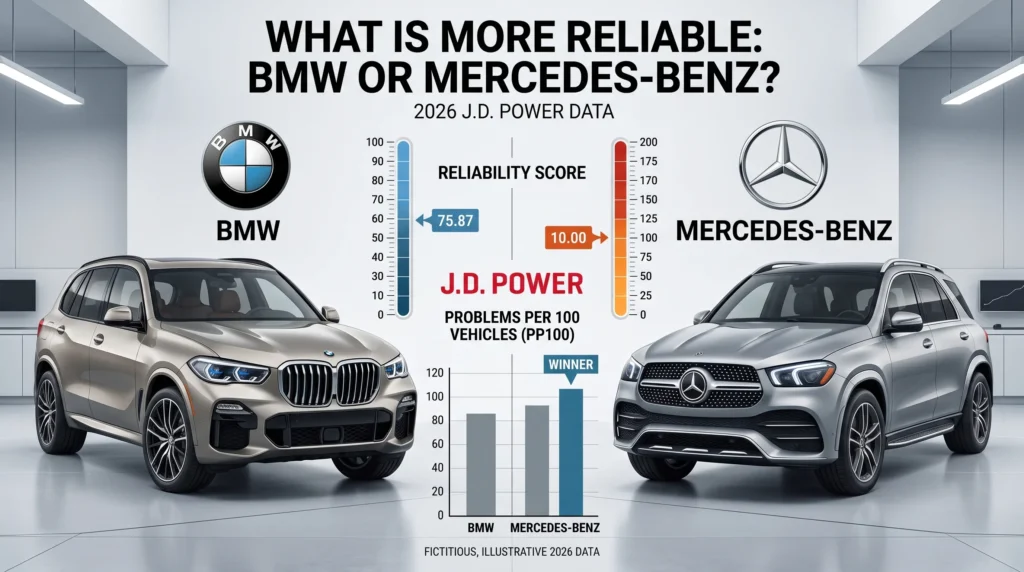
When evaluating what is more reliable BMW or Mercedes, BMW consistently holds the advantage based on aggregated multi-year data from major automotive research organizations. In recent Consumer Reports brand reliability rankings, BMW placed 5th overall with a predicted reliability score of 64 out of 100, while Mercedes-Benz ranked near the bottom at 29th out of 30 brands with a score of 24 out of 100. Similarly, J.D. Power dependability studies show BMW owners report fewer problems per 100 vehicles than Mercedes-Benz owners, largely due to BMW’s refined powertrains and more stable infotainment software. However, Mercedes-Benz holds a slight edge in average annual out-of-warranty repair expenses ($908 versus $968 for BMW).
Key takeaways:
- Major independent evaluations from Consumer Reports and J.D. Power rank BMW significantly higher in brand-level dependability than Mercedes-Benz.
- Mercedes-Benz reliability struggles stem primarily from complex in-car electronics, early 48V mild-hybrid integration, and infotainment glitches rather than core engine block failures.
- BMW has achieved notable mechanical consistency with its modular B48 and B58 turbocharged engine architectures paired with ZF 8-speed automatic transmissions.
- Average annual maintenance and repair costs remain comparable, with Mercedes-Benz averaging $908 per year and BMW averaging $968 per year.
Reliability definitions and metrics
Determining whether BMW or Mercedes-Benz is more reliable requires looking beyond casual driver impressions. In modern automotive engineering, vehicle reliability encompasses three distinct dimensions:
- Initial Quality: Defects, malfunctions, and design flaws experienced during the first 90 days of new vehicle ownership.
- Long-Term Dependability: Component failures, electrical glitches, and mechanical wear documented after three to five years of daily service.
- Total Cost of Ownership and Severity: The frequency of unscheduled garage visits and the financial impact of major component replacements over a vehicle’s operating lifecycle.
Independent testing organizations evaluate these dimensions through rigorous statistical surveys. J.D. Power measures problems per 100 vehicles (PP100), where a lower score reflects superior durability. Consumer Reports weights problem areas by financial severity, separating minor trim rattles from complete engine or transmission failures. Understanding these metrics helps buyers evaluate how purchase and ownership cost differences between BMW and Mercedes correspond to long-term workshop visits.
Long-term reliability: brand-level trends
Over the past decade, the reliability trajectories of BMW and Mercedes-Benz have diverged noticeably. Historically, both German automakers represented benchmark industrial assembly. However, contemporary vehicle complexity has shifted the balance in measurable ways.
According to official data from the Consumer Reports brand reliability rankings, BMW achieved 5th place among 30 ranked automotive brands. This placement makes BMW the highest-ranking European luxury automaker in the annual evaluation. Consumer Reports highlighted BMW’s steady mechanical refinement and dependable electronic controls across mainstream sedans and sports activity vehicles.
In contrast, Mercedes-Benz placed 29th out of 30 brands in the same Consumer Reports study. The primary factors dragging down the Mercedes-Benz score were frequent electronic accessory faults, touchscreen unresponsive episodes, and climate control sensor malfunctions in popular models like the C-Class, E-Class, and GLE. While Mercedes-Benz integrates complex digital cockpit hardware across upper trims, BMW standardizes popular comfort packages such as BMW Premium Package equipment options with more mature wiring architecture and stable interface modules.
| Organization / Study | BMW Rating / Metric | Mercedes-Benz Rating / Metric | Statistical Winner |
|---|---|---|---|
| Consumer Reports Brand Rank | 5th / 30 (Score: 64/100) | 29th / 30 (Score: 24/100) | BMW |
| J.D. Power U.S. Dependability (VDS) | 190 Problems Per 100 Vehicles | 218 Problems Per 100 Vehicles | BMW |
| RepairPal Reliability Rating | 2.5 / 5.0 (Rank 30th of 32) | 3.0 / 5.0 (Rank 27th of 32) | Mercedes-Benz |
| Average Annual Repair Cost | $968 / year | $908 / year | Mercedes-Benz |
| Severe Repair Probability | 15% of total repairs | 13% of total repairs | Mercedes-Benz |
The J.D. Power U.S. Vehicle Dependability Study reinforces these findings. Measuring original owners of three-year-old vehicles, BMW registered 190 PP100, outperforming the luxury segment average. Mercedes-Benz posted 218 PP100, reflecting higher user frustration with active safety sensors, infotainment connectivity, and auxiliary electrical hardware.
Common failure modes and maintenance costs
While BMW leads in broad reliability surveys, evaluating individual system failure modes reveals nuanced trade-offs for prospective owners.
Powertrain and mechanical durability
BMW has consolidated much of its modern vehicle lineup around modular engine architectures, notably the B48 2.0-liter turbocharged four-cylinder and the B58 3.0-liter turbocharged inline-six. Mechanics and automotive engineers widely praise the B58 for its closed-deck crankcase, sturdy timing chain arrangement, and durable forged internals. While older generation engines required preventative attention to BMW VANOS variable valve timing solenoids, modern B-series units feature redesigned cam phasers that rarely fail under normal service. When maintained with high-grade synthetic oil, these engines routinely surpass 150,000 miles without major internal overhauls.
Mercedes-Benz manufactures equally strong mechanical blocks, such as the M264 and M256 engine families. However, Mercedes-Benz incorporated 48-volt mild-hybrid systems (EQ Boost) across a broader portion of its standard lineup earlier than competitors. Early iterations experienced integrated starter-generator software communication faults and auxiliary battery discharge issues that left some drivers immobilized.
In-car electronics and software stability
Software and electronic interfaces represent the single largest category of consumer complaints across the luxury automotive sector. In fact, regulatory filings tracked by the National Highway Traffic Safety Administration reveal that software glitches and sensor recalibrations account for a growing share of modern technical service campaigns.
BMW’s iDrive interface has matured over multiple hardware generations, maintaining physical rotary controller inputs alongside touch displays in many models. Mercedes-Benz transitioned aggressively to capacitive steering wheel switches and massive pillar-to-pillar Hyperscreens, which generate higher rates of touch latency, Bluetooth pairing drops, and camera display freezes. When intermittent sensor communication errors occur in either brand, instrument clusters can trigger safe-mode warnings, such as a BMW drivetrain malfunction warning that requires an electronic scan tool to isolate the root cause. Software stability has become as influential as mechanical durability in determining modern vehicle reliability. When an infotainment screen fails or freezes the climate control interface, independent surveys categorize the incident with the same statistical weight as a mechanical fault because the driver loses vehicle functionality.
Annual maintenance and workshop repair expenses
According to comprehensive workshop records aggregated by RepairPal for BMW, BMW owners pay an average of $968 annually for scheduled maintenance and unscheduled repairs, with a 15% probability of a repair being severe. Conversely, RepairPal for Mercedes-Benz indicates an annual average of $908 and a 13% severity rate. While basic oil changes and brake services carry similar labor rates across both brands, Mercedes-Benz models benefit from slightly lower component pricing on routine wear items, keeping its baseline out-of-pocket maintenance figures marginally below BMW.
Reliability by model segment
Reliability varies substantially depending on vehicle class, driven by suspension complexity, all-wheel-drive hardware, and performance tuning.
Compact executive sedans and coupes
In the compact executive segment, the BMW 3 Series and 4 Series consistently achieve above-average reliability scores in Consumer Reports evaluations. Their conventional steel spring suspensions, proven ZF transmissions, and mature electronic harnesses minimize unexpected workshop visits. The Mercedes-Benz C-Class exhibits solid structural integrity but suffers from higher rates of digital gauge cluster resets and ambient lighting controller errors.
Luxury crossover SUVs
Luxury SUVs experience heavier wear on suspension bushings, active dampers, and transfer cases. Mainstream BMW X-series models like the X3 and X5 demonstrate solid mechanical dependability, benefiting from shared chassis platforms and proven transmission programming. Mercedes-Benz GLC and GLE models offer plush air suspensions and whisper-quiet cabins, but their complex multi-chamber air struts and electronic leveling sensors require more frequent maintenance as mileage accumulates.
High-performance divisions: BMW M vs Mercedes-AMG
Dedicated performance variants from BMW M and Mercedes-AMG demand specialized maintenance. High-output engines like the BMW M4 twin-turbo S58 engine operate under extreme cylinder pressures and elevated thermal loads. Evaluating top-tier acceleration across the fastest BMW M Series production models illustrates how reinforced cooling circuits and durable drivelines endure aggressive driving far better than standard commuter trims. Mercedes-AMG handcrafted engines deliver immense power, but their complex cooling systems, electronic locking differentials, and twin-scroll turbocharger plumbing necessitate strict preventative maintenance schedules to avoid costly workshop interventions.
Quick-reference comparison table
| Vehicle Segment | BMW Standout Attribute | Mercedes-Benz Standout Attribute | Relative Advantage |
|---|---|---|---|
| Compact Luxury Sedans (3 Series vs C-Class) | Powertrain stability, iDrive responsiveness | Interior cabin materials, ride insulation | BMW (fewer electronic defects) |
| Midsize Luxury SUVs (X5 vs GLE-Class) | Inline-six engine durability, agile chassis | Air suspension ride comfort, cargo room | BMW (powertrain & transmission) |
| Full-Size Flagships (7 Series vs S-Class) | Rear-seat entertainment integration | Active safety technology, chassis isolation | Neutral (both carry high electronic complexity) |
| Electric Vehicles (i4 / iX vs EQE / EQS) | Traditional vehicle platform familiarity | Aerodynamic efficiency, extended battery warranty | BMW (infotainment stability) |
Interpretation of data and caveats
Interpreting automotive reliability datasets requires understanding methodological differences between research bodies.
Consumer Reports bases its reliability findings on extensive annual questionnaires sent to hundreds of thousands of subscribed vehicle owners. This approach excels at capturing real-world ownership experiences across multiple vehicle age brackets, though it reflects a subscriber demographic that may prioritize functional simplicity over bleeding-edge gadgets.
J.D. Power surveys verified owners of three-year-old vehicles, providing a standardized statistical snapshot of original-owner dependability. However, its metric treats a confusing navigation menu with the same numerical weight as a failed water pump, which can distort perceptions of pure mechanical longevity.
Note: Vehicle reliability ratings reflect historical statistical probabilities across large vehicle fleets rather than guaranteed outcomes for individual cars. A neglected vehicle from a highly rated brand will suffer far more breakdowns than a meticulously serviced vehicle from a lower-ranked brand.
Expert view and engineering consensus
Industry analysts emphasize that modern German luxury cars require disciplined preventative care. Jake Fisher, Senior Director of Auto Testing at Consumer Reports, noted that BMW builds many high-performing and reliable models because the company focused on refining existing powertrains and controls rather than introducing unproven interfaces.
Frank Hanley, Senior Director of Auto Benchmarking at J.D. Power, observed that the rapid integration of complex automated features and multi-screen infotainment systems across the entire automotive sector has created new failure vectors that automakers must stabilize as vehicles age.
Regular preventative maintenance, including installing the latest BMW software updates to resolve electronic module communication bugs, plays an essential role in preserving long-term vehicle health. Tracking your scheduled BMW maintenance cost ensures routine fluid services and filter replacements are completed before minor electrical or mechanical issues escalate.
Practical guidance for buyers
For drivers deciding between BMW and Mercedes-Benz, aligning your ownership timeline with vehicle strengths provides the clearest path forward:
- Leasing Under Factory Warranty: If you plan to drive the vehicle strictly during the manufacturer warranty coverage period, brand reliability differences will have minimal impact on your direct repair costs. Base your decision on driving dynamics, seat comfort, exterior design, and lease terms.
- Purchasing Certified Pre-Owned (CPO): For recent post-lease or certified pre-owned vehicles, BMW models equipped with four-cylinder or six-cylinder B-series engines currently present lower statistical risk for major powertrain and electronic failures in long-term survey data. Adhering to manufacturer guidelines, such as using the correct BMW 328i engine oil type with Longlife-01 certification, safeguards precision turbocharger components against thermal breakdown.
- Extended High-Mileage Ownership: When keeping an out-of-warranty luxury vehicle for extended mileage, prioritize models with traditional steel suspensions rather than adaptive air suspensions, and verify complete dealer service records documenting regular transmission and differential fluid flushes. Understanding what mileage BMWs start to break down helps owners anticipate water pump, gasket, and bushing replacements before major mechanical interruptions occur.
- Pre-Purchase Diagnostic Scans: Always commission an independent pre-purchase inspection that includes a full electronic module fault scan to detect stored communication codes before finalizing a used luxury vehicle transaction.
Frequently asked questions about BMW and Mercedes reliability
Is BMW really more reliable than Mercedes?
Yes. Modern brand reliability rankings from Consumer Reports and J.D. Power place BMW substantially ahead of Mercedes-Benz. BMW ranks 5th overall in Consumer Reports predicted reliability, while Mercedes-Benz ranks 29th out of 30 surveyed brands, primarily due to electrical and infotainment issues in Mercedes-Benz vehicles.
Why does Mercedes rank lower in recent reliability surveys?
Mercedes-Benz vehicles suffer from frequent electronic accessory glitches, climate control sensor faults, and touchscreen software freezes associated with its complex MBUX infotainment systems and early 48V mild-hybrid integration. The core mechanical engines remain dependable, but electronic defects negatively impact survey scores.
Which brand costs more to maintain annually?
According to RepairPal data, BMW costs slightly more to maintain and repair, averaging $968 annually compared to $908 for Mercedes-Benz. BMW also exhibits a slightly higher probability of severe repairs (15% versus 13% for Mercedes-Benz).
Are older BMW or Mercedes models more dependable?
Older Mercedes-Benz models built prior to the mid-2000s are legendary for mechanical endurance. For models built over the past decade, however, BMW vehicles powered by modular B48 and B58 engines generally offer superior long-term dependability and fewer electronic failures than comparable Mercedes-Benz models.

