

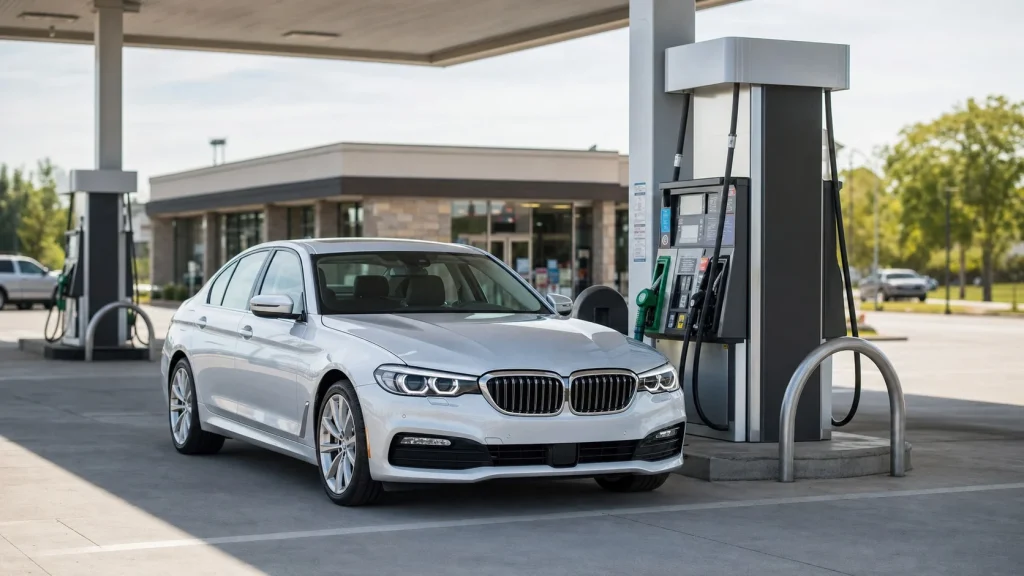
- faq.bmwusa.com -> https://faq.bmwusa.com/s/article/FAQ-BMW-Fuel-Recommendation-BMW-USA-JNDSF
- toptiergas.com -> https://www.toptiergas.com
- autvex.com -> https://autvex.com/news/
- autvex.com -> https://autvex.com/news/can-audi-run-on-regular-gas/
- autvex.com -> https://autvex.com/news/whats-the-maintenance-cost-for-bmw/
ARTICLE
What Type of Gas Do BMW Take? Octane and Fuel Guide (2026)
Quick answer: Modern BMW vehicles require premium unleaded gasoline with a recommended octane rating of 91 AKI (95 RON) or higher to protect their high-compression engines. While standard models can operate on a minimum of 89 AKI (or 87 AKI in extreme emergencies) by retarding ignition timing, doing so reduces performance and fuel efficiency.
Key takeaways:
- Premium fuel (91 AKI minimum) is the manufacturer recommendation for all standard BMW gasoline models.
- BMW M Performance and full M models require 91 AKI minimum and achieve peak power on 93 AKI (98 RON) fuel.
- Standard BMW engines are not designed for ethanol blends above E10; using E15 or E85 will void the warranty.
- BMW recommends TOP TIER detergent gasoline to prevent carbon deposit build-up on fuel injectors.
Why BMW Requires Premium Fuel: Engineering and Octane Ratings
BMW engines require premium fuel (91 AKI or higher) due to their high compression ratios and turbochargers, which generate extreme cylinder pressures. Low-octane gasoline can detonate prematurely under these conditions, causing destructive engine knocking.
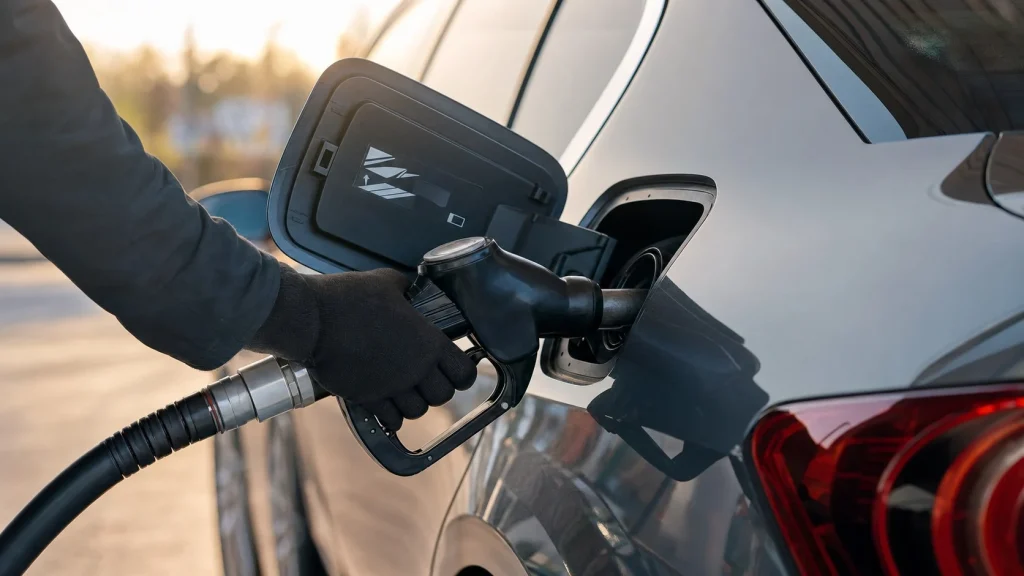
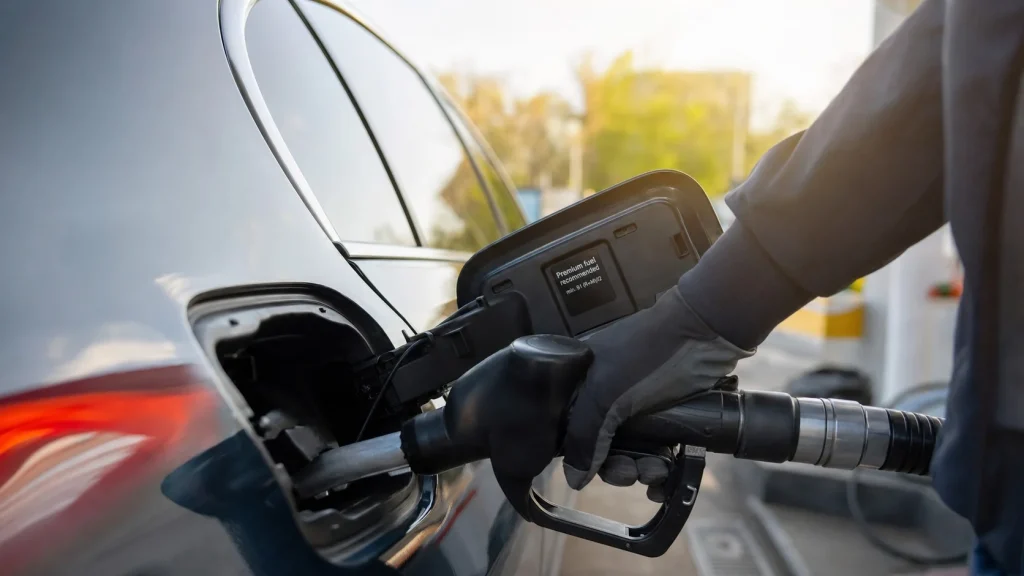
To understand why BMW engineers design their powertrains around premium fuel, it is essential to look at the combustion process. Modern BMW TwinPower Turbo engines operate with high static compression ratios. For instance, the widely used B48 turbocharged four-cylinder engine runs a 11.0:1 compression ratio (or 10.2:1 depending on the specific tuning), and the B58 turbocharged inline-six engine features a high 11.0:1 compression ratio. By compressing the air-fuel mixture to a smaller volume before ignition, these engines extract more energy from the combustion stroke, resulting in superior thermal efficiency and responsiveness.
However, high compression also increases cylinder temperatures. Under these extreme conditions, lower-octane gasoline can self-ignite due to heat and pressure before the spark plug fires. This premature ignition, known as pre-ignition or engine knocking, creates opposing shockwaves inside the combustion chamber. Over time, these uncontrolled explosions can chip pistons, bend connecting rods, and damage valves.
Octane rating measures a fuel’s resistance to this premature detonation. A higher octane rating means the fuel can withstand greater heat and pressure before igniting. In the United States and Canada, fuel quality is displayed as the Anti-Knock Index (AKI), which is the average of the Research Octane Number (RON) and the Motor Octane Number (MON). In Europe, Asia, and other regions, gas stations display the RON rating. Understanding this difference is critical for importing vehicles or reading international manuals.
| North American Rating (AKI) | European/Asian Rating (RON) | Fuel Grade Category | BMW Compatibility Status |
|---|---|---|---|
| 87 AKI | 91 RON | Regular Unleaded | Emergency Use Only (Significant power drop) |
| 89 AKI | 95 RON (Minimum) | Mid-Grade Unleaded | Permitted Minimum (Reduced efficiency) |
| 91 AKI | 95 RON (Optimal) | Premium Unleaded | Recommended Baseline for Standard Models |
| 93 AKI | 98 RON | Super Premium | Recommended for Peak M Model Performance |
Fuel Requirements by BMW Model Series
Fuel needs differ slightly between BMW lineups, where standard models baseline at 91 AKI, high-performance M models optimize at 93 AKI, and electric vehicles require no fuel.
Standard Gasoline Models (3 Series, 5 Series, X1, X3, X5, X7)
For the vast majority of standard BMW gasoline models, the factory-recommended fuel grade is 91 AKI. This standard applies to the popular BMW 3 Series (including the 330i), the BMW 5 Series, and the entire Sports Activity Vehicle (SAV) lineup.
If you drive a standard sedan or crossover, using 91 AKI ensures that the engine performs exactly as advertised. For example, the BMW 330i gas type requires 91 AKI to deliver its full rated torque. Similarly, heavier utility vehicles such as the BMW X5 and BMW X7 require premium fuel to move their heavy weights efficiently, especially under demanding conditions like towing, carrying cargo, or climbing steep grades. When owners search for what type of gas does a BMW X3 take, what type of gas does a BMW X5 take, or what type of gas does a BMW X1 take, the answer remains 91 AKI for optimal operation. Even older models like the BMW 328i and BMW 228i need 91 AKI to keep their combustion chambers clean and prevent timing adjustments.
High-Performance M and M Performance Models
BMW M Performance models (such as the M340i or X3 M40i) and full M models (such as the M2, M3, M4, M5, X5 M, and X6 M) utilize highly tuned engines designed for maximum power output. The S58 inline-six engine found in the M3 and M4 runs high turbocharger boost pressures, making it extremely sensitive to fuel quality.
For these high-performance models, BMW recommends 93 AKI (98 RON) fuel. While they can run on 91 AKI without damaging the engine, using 93 AKI allows the engine management system to advance spark timing to its limit, unlocking peak torque and throttle response. Running these vehicles on lower octane grades will trigger the knock sensors immediately, causing the engine computer to retard timing and lower boost pressure, which significantly drops horsepower.
Hybrid and Electric Powertrains
BMW plug-in hybrid electric vehicles (PHEVs), such as the 330e or the X5 xDrive50e, also require premium fuel. Even though these vehicles utilize electric motors to assist the combustion engine, the gasoline engine is still a turbocharged, high-compression unit. For example, when the battery is depleted, the internal combustion engine must run under high loads to propel the vehicle and charge the system, necessitating the use of 91 AKI to prevent knock. Pure electric models in the BMW i lineup, such as the i4, i8 hybrid counterpart (which uses a high-boost 3-cylinder engine requiring premium fuel), and iX, do not use gasoline.
What Happens if You Accidentally Put Regular Gas in a BMW?
If you accidentally fill a BMW with 87-octane regular gas, the engine computer uses knock sensors to retard ignition timing, preventing immediate damage but causing a drop in horsepower and fuel economy.
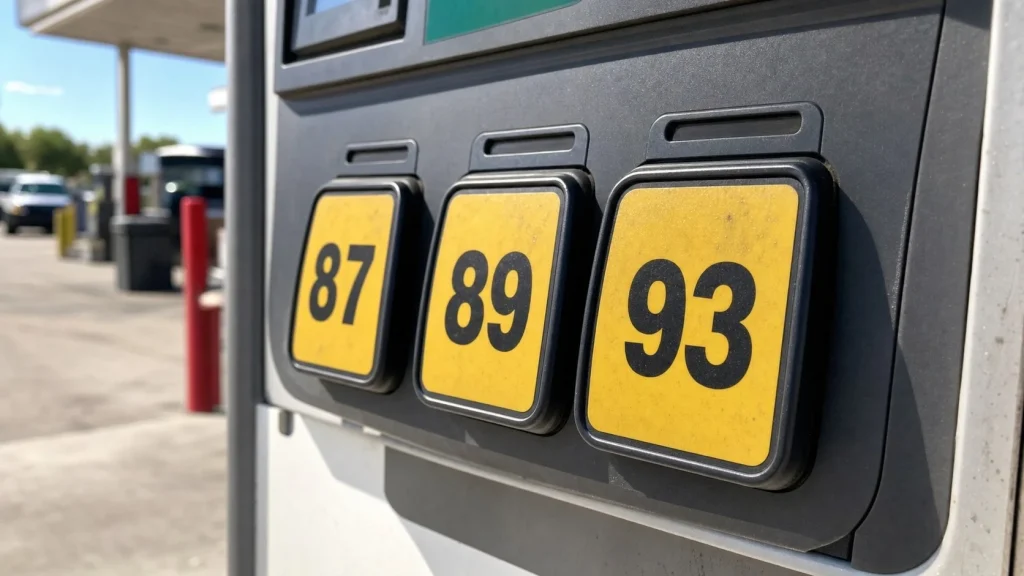
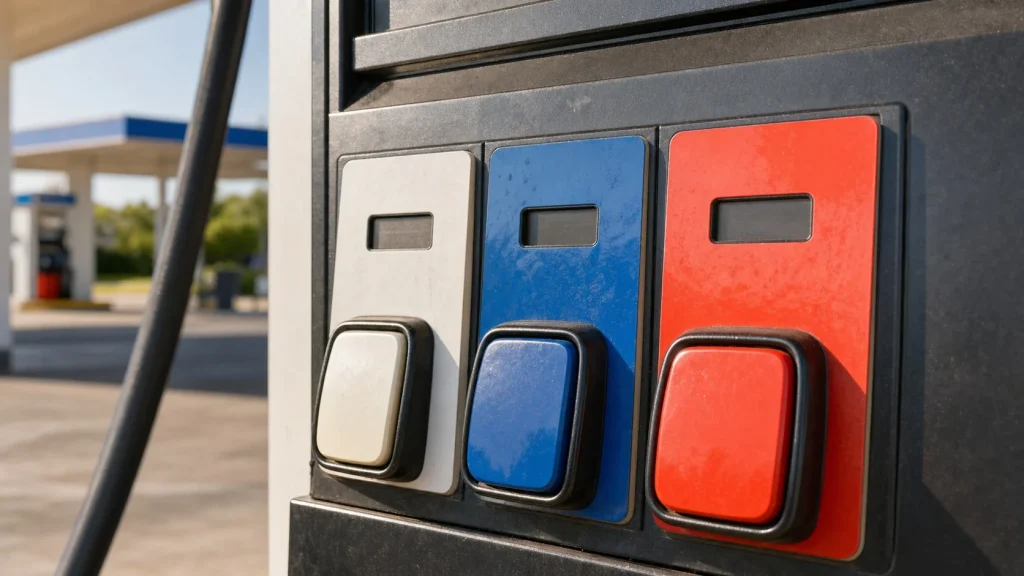
Modern BMW vehicles feature sophisticated engine management systems equipped with electronic knock sensors. These sensors act like microphones, listening for the specific high-frequency vibrations caused by engine knock. The moment they detect the onset of pre-ignition, the engine control unit (ECU) retards the ignition timing, delaying the spark plug firing. This reduces cylinder pressures and stops the knocking before it can damage the pistons.
Short-Term Effects: Performance and Economy
The immediate impact of running 87-octane regular gas is a noticeable drop in acceleration and engine responsiveness. Because the spark plug fires later in the compression stroke, the fuel burns less efficiently, producing less downward force on the piston. Additionally, fuel economy will suffer. The engine must consume more fuel to maintain the same vehicle speed, which often cancels out the temporary cost savings at the gas pump.
Long-Term Risks and Warranty Impact
While modern knock sensors prevent catastrophic engine failure from a single tank of bad gas, they are not designed to compensate for low-octane fuel indefinitely. Consistently running regular gas increases exhaust gas temperatures, puts extra stress on the catalytic converters, and leads to rapid carbon accumulation on the valves. Furthermore, if you experience engine failure and the dealer’s diagnostic scan reveals that the engine was run on substandard fuel, BMW can deny your warranty coverage for the repairs.
Can I Put 89 Gas in My BMW?
According to the official BMW USA Fuel Recommendation FAQ, the absolute minimum fuel grade permitted for standard gasoline models is 87 AKI, while some older manuals state 89 AKI. However, using 87 or 89 AKI is only intended for temporary emergency situations when premium gas is unavailable. If you must use mid-grade 89 gas, drive conservatively and avoid heavy throttle or towing until you can refill the tank with 91 AKI or higher. For comparison, owners can review the Audi regular gas compatibility guide to see how similar European direct-injection engines adapt to lower fuel grades.
Financial and Performance Analysis: The Real Cost of Running Regular Gas
Running regular 87-octane gasoline in a BMW to save money at the pump is a false economy, as the resulting 10% to 12% drop in fuel efficiency offsets the price difference while risking costly engine repairs.
Many drivers consider using regular gas because of the price gap between regular 87-octane and premium 91-octane fuel. To evaluate whether this saves money, we can calculate the real cost per mile.
Assume premium gasoline costs $4.20 per gallon and regular costs $3.80 per gallon, representing a 9.5% savings at the pump. In a BMW 330i that averages 30 MPG on premium fuel, the cost per mile is $0.14.
When running on regular 87-octane fuel, the engine computer retards spark timing, reducing combustion efficiency. Real-world testing shows this drops fuel economy by approximately 10% to 12%. At a 10% drop, the average fuel economy falls to 27 MPG. Dividing the $3.80 cost of regular gasoline by 27 MPG yields a cost per mile of $0.14.
In this scenario, the financial savings are zero. The driver pays the same cost per mile while experiencing slower throttle response, reduced torque, and higher long-term repair risks. Furthermore, if engine knocking causes damage to the pistons or fuel injectors, the cost of repairs will far exceed any theoretical savings.
BMW Recommended Fuel Brands: The TOP TIER Standard
BMW officially recommends using TOP TIER detergent gasoline to prevent carbon deposits on direct fuel injectors, maintaining optimal fuel spray patterns and combustion efficiency.
Octane rating is not the only measure of gasoline quality. The types and concentrations of detergents blended into the fuel are equally important. As gasoline burns, it naturally leaves behind carbon residue. In modern BMW engines, which inject fuel directly into the combustion chamber at pressures up to 350 bar (35 MPa), keeping fuel injectors clean is critical. The tiny spray holes on direct injectors can easily clog with carbon deposits, distorting the fuel spray pattern, causing rough idling, and reducing efficiency.
To solve this issue, major automotive manufacturers, including BMW, Toyota, Honda, General Motors, Ford, and Stellantis, established the TOP TIER Detergent Gasoline standard. TOP TIER gasoline is blended with higher concentrations of detergent additives than the minimum standards set by the Environmental Protection Agency (EPA). It contains no metallic additives, which can harm catalytic converters.
Expert view: TOP TIER gasoline is more critical than brand names. The TOP TIER certification guarantees that the fuel contains sufficient detergent additives to keep direct injection ports clean, regardless of which oil company refined it.
To ensure your engine remains clean, look for the TOP TIER logo on gas station pumps. Certified retailers in North America include Shell, Chevron, Exxon, Mobil, Costco, Sunoco, Texaco, and Valero. Consistent use of these approved brands keeps intake valves and fuel injectors free of carbon deposits, preserving original performance and gas mileage.
E85 Ethanol and Flex Fuel: Stock BMW Limits
Stock BMW gasoline engines cannot use E15 or E85 fuel because ethanol concentrations above 10% (E10) corrode stock fuel lines, seals, and high-pressure fuel pumps.
Ethanol is a renewable alcohol fuel made from corn and other plant materials. Most standard gasoline sold in North America is an E10 blend, which contains up to 10% ethanol. Modern BMW vehicles are designed to run on E10 fuel without issue.
However, many retail stations now sell E15 (15% ethanol) or E85 (up to 85% ethanol, also known as Flex Fuel). Stock BMW vehicles are not flex-fuel compatible. Ethanol is highly hygroscopic, meaning it absorbs water from the air. In concentrations above 10%, ethanol can corrode aluminum fuel components, dry out rubber fuel seals, and damage high-pressure fuel pumps. Additionally, ethanol contains roughly one-third less energy than gasoline, so running high ethanol blends without proper tuning causes the engine to run lean, triggering check engine lights and potential misfires.
For automotive enthusiasts, aftermarket flex-fuel kits are popular modifications. These kits add an ethanol content sensor to the fuel line and require custom ECU tuning (often on the B58 engine platform) to adjust fuel volume dynamically. Since ethanol has an equivalent octane rating of over 100, it allows tuners to run higher boost pressures safely. However, on a stock vehicle, using any fuel with more than 10% ethanol will void your warranty and cause fuel system corrosion.
Practical Fuel and Engine Maintenance for BMW Owners
Protecting your BMW engine requires combining premium TOP TIER fuel with regular maintenance of spark plugs, air filters, and the VANOS variable valve timing system to ensure clean combustion.
Using high-quality premium fuel is the first step in maintaining engine health, but it must be paired with regular service. Spark plugs play a critical role in high-compression engines. Over time, spark plug electrodes wear down, widening the gap and causing weak sparks. This can lead to incomplete combustion, mimicking the effects of low-octane fuel and reducing fuel economy. Spark plugs in turbocharged BMW engines should typically be replaced every 40,000 to 60,000 miles.
Additionally, owners must maintain the air intake system. A clogged engine air filter restricts airflow, forcing the engine to adjust fuel delivery, which can increase fuel consumption. Replacing the air filter every 15,000 to 20,000 miles keeps the air-fuel ratio optimal.
Clean combustion is also vital for the longevity of the BMW VANOS variable valve timing system. The VANOS system uses oil pressure and electronic solenoids to adjust camshaft timing dynamically. If low-quality fuel creates excess carbon deposits, these deposits can contaminate the engine oil and clog the tiny ports in the VANOS solenoids, leading to rough idling, loss of power, and timing error codes.
Note: Regular fuel system cleaner additives are not necessary if you consistently use TOP TIER gasoline, but they can help restore injector efficiency if you have been forced to use lower-quality fuel.
To budget for these tune-ups and ensure your vehicle runs efficiently, owners can review the BMW maintenance costs guide to plan their service intervals. Drivers looking for additional automotive news and diagnostic tips can check the Autvex news hub for updated guides.
Frequently Asked Questions
What is the minimum octane rating for a BMW?
Standard BMW models require a minimum of 89 AKI (95 RON) for normal operation, though 91 AKI is highly recommended. High-performance BMW M models require a minimum of 91 AKI and achieve peak performance on 93 AKI. While the engine can adapt to 87 AKI in emergencies, it is not recommended for regular use.
What happens if you accidentally put regular gas in a BMW?
The knock sensors will detect early detonation and retard ignition timing. Your car will run without immediate damage, but you will experience lower horsepower and worse gas mileage until you refill with premium gas.
Does the BMW M4 require premium gas?
Yes, the BMW M4 requires premium gas of at least 91 AKI. Its high-performance S58 twin-turbocharged engine operates under high boost pressures, making premium fuel essential for engine safety and peak performance.
Is unleaded premium good for BMW?
Yes, premium unleaded gasoline (91 AKI or higher) is the recommended fuel type for all gasoline-powered BMW models. It ensures proper combustion efficiency, prevents engine knock, and maintains designed performance levels.

