

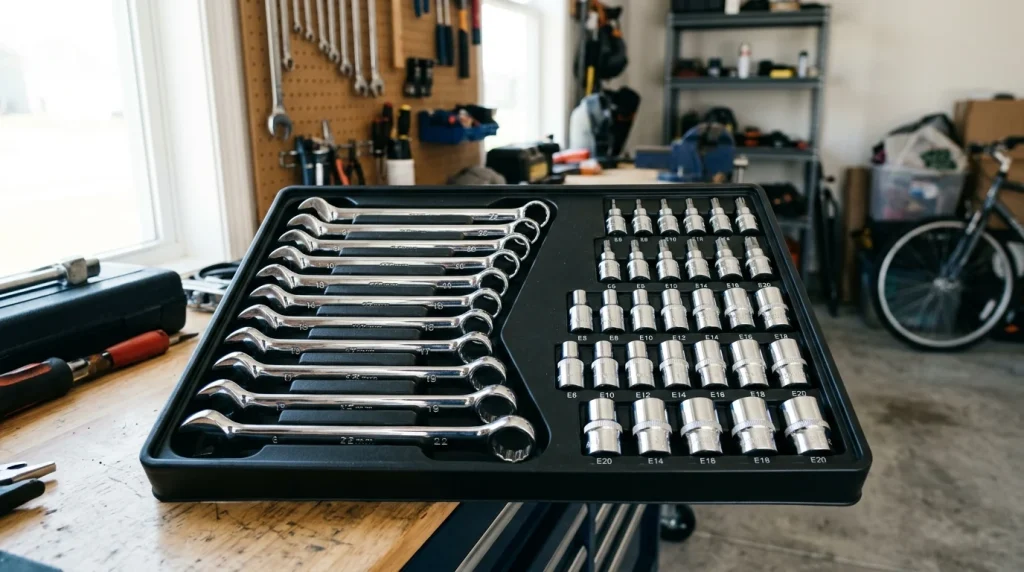
Quick answer: BMW engines exclusively use metric wrenches and sockets, typically ranging from 6mm to 24mm. Standard American SAE tools will not fit and will round off the bolt heads. In addition to standard metric tools, you will need a complete set of External Torx (E-Torx) sockets (E6 to E24), Internal Torx bits (T10 to T60), a thin-wall 14mm 12-point spark plug socket, and an 86mm 16-flute oil filter cap wrench.
Key takeaways:
- BMW engines strictly require metric sockets and wrenches; using standard SAE tools will strip fasteners.
- External Torx (E-Torx) and Internal Torx fasteners are standard across all modern BMW engine bays.
- Specialty tools like 14mm 12-point thin-wall spark plug sockets and 86mm 16-flute oil filter wrenches are mandatory.
- Calibrated torque wrenches must be used on aluminum components to prevent cracking block threads.
The Golden Rule: Metric Wrenches and Sockets Only
BMW engines are engineered and built in Germany, meaning every single fastener is measured using the metric system. If you are preparing to perform any work under the hood of a BMW, you must leave standard American SAE (Society of Automotive Engineers) tools in your drawer. Using a half-inch wrench on a 13mm bolt might feel like it fits, but under high torque, it will slip and round off the edges of the bolt head, leaving you with a stripped fastener.
A standard DIY toolkit for BMW engine maintenance should include metric wrenches and sockets ranging from 6mm to 24mm. The most common sizes you will encounter for general brackets, shields, and covers are 8mm, 10mm, 13mm, 15mm, and 16mm. For larger components or suspension-adjacent engine mounts, sizes like 17mm, 18mm, 19mm, 21mm, and 22mm are standard. We recommend purchasing 6-point sockets rather than 12-point sockets for hex heads to maximize grip and prevent rounding. You can explore more automotive DIY guides on our news hub to learn how to set up your garage.
Torx and E-Torx: The BMW Fastener Standard
If you only own standard hex sockets, you will not get far on a German car. BMW utilizes Torx (star-shaped) fasteners for almost every critical engine component. This design transfers rotational force much better than a traditional hex head, reducing the risk of stripping.
You will need two separate Torx sets:
- External Torx (E-Torx) Sockets: These are sockets that fit over star-shaped bolt heads. A complete set ranging from E6 to E24 is essential. You will encounter E6 and E8 bolts on small brackets, E10 and E12 bolts on valve covers and oil pans, and E14 to E20 bolts on transmission mounts and starter motors.
- Internal Torx (T-Type) Bits: These are bits that insert into star-shaped recesses. You will need sizes from T10 to T60. T20, T25, and T30 are common for plastic engine covers and intake ducts, while T50 and T60 are often found on the belt tensioners and oil drain plugs.
Gareth Foley, BMW Catalog Manager at FCP Euro, notes in his N51 and N52 engine maintenance guides that utilizing specialized Torx sockets, such as T30 and E-Torx sizes, is critical for tasks like valve cover gasket replacements to prevent rounding out fasteners.
Analysis: Utilizing standard hex sockets on E-Torx heads or Torx bits in Triple Square bolts is one of the most common mistakes made by beginner BMW DIYers, leading to stripped fasteners that require drilling or extraction kits to remove.
Specialty Sockets for BMW Engine Maintenance
Performing routine maintenance like oil changes or spark plug replacements on modern BMWs is impossible with standard tools. BMW engineers design these areas with tight clearances and unique shapes, necessitating dedicated specialty sockets.
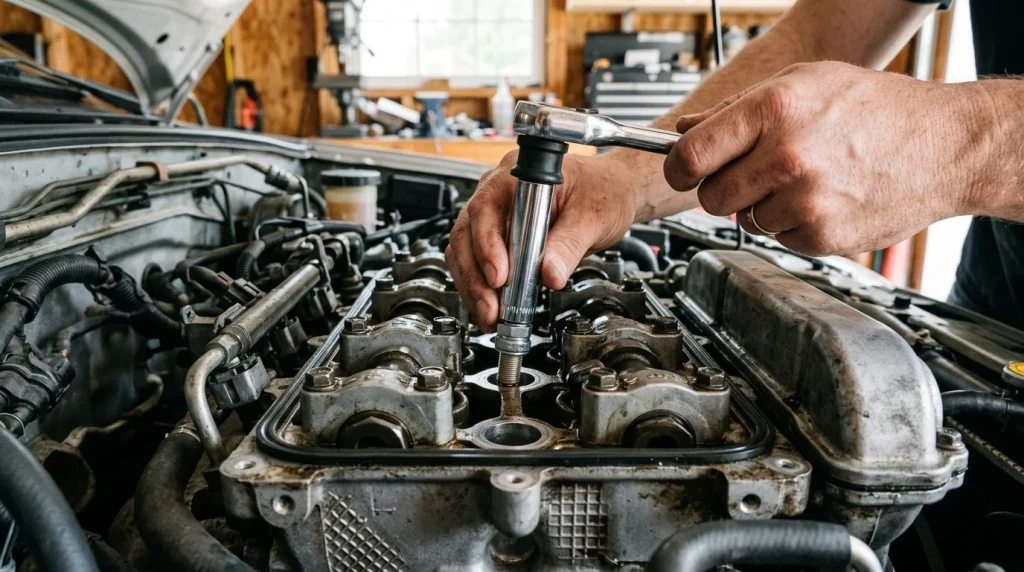
14mm 12-Point Thin-Wall Spark Plug Socket
Modern BMW turbocharged engines, such as the N20, N54, N55, B46, B48, and B58, use 12-point (bi-hex) spark plugs instead of the traditional 6-point plugs. Furthermore, the spark plug wells are extremely narrow. Standard spark plug sockets (like 5/8-inch or 13/16-inch) are too wide to fit down the tube. You must use a dedicated 14mm 12-point thin-wall spark plug socket with magnetic or rubber retention. Attempting to use a standard socket will get stuck in the cylinder head or fail to grip the plug.
86mm 16-Flute Oil Filter Cap Wrench
Almost all modern BMW engines use a cartridge-style oil filter housing with a plastic cap. This cap is easily cracked or rounded if you attempt to remove it with strap wrenches or channel locks. To remove and install the cap safely, you must use an 86mm (often specified as 86.6mm) 16-flute cup-style oil filter wrench. This tool fits perfectly over the ridges of the cap, allowing you to apply the correct torque without damaging the housing.
Triple Square (XZN) and Allen Bits for Internal Components
For high-stress applications deep inside the engine, such as cylinder head bolts, flywheels, and crankshaft pulleys, BMW moves beyond Torx and uses Triple Square (XZN) fasteners.
A Triple Square bit looks similar to a Torx bit, but it has 12 points with 90-degree angles, whereas a Torx bit has 6 points. Common Triple Square sizes include M6, M8, M10, and M12. You must never attempt to use a Torx bit in a Triple Square bolt or vice versa, as this will instantly destroy the fastener.
Additionally, you will need a set of metric Allen (hex) bits. A 17mm Allen socket is frequently required to remove manual transmission fill and drain plugs, while smaller sizes like 4mm, 5mm, and 6mm are common on internal engine brackets.
Why a Torque Wrench is Mandatory for BMW Aluminum Engines
You cannot tighten BMW engine fasteners by “feel.” Modern BMW engines utilize lightweight aluminum and magnesium alloys for the engine block and cylinder head. These soft metals are easily stripped or cracked if fasteners are over-tightened.
Furthermore, many critical assemblies on BMW engines use aluminum torque-to-yield (stretch) bolts. These bolts are designed to stretch permanently when tightened to their final spec and must be replaced after a single use. Examples include the water pump and thermostat mounting bolts on N52 engines.
To service these components, you need a high-quality 1/4-inch drive torque wrench (for low-torque fasteners under 25 Nm, like valve covers) and a 3/8-inch or 1/2-inch drive torque wrench (for higher torque specs). You can also apply these torque techniques to other areas of the vehicle, such as when you space a brake caliper bracket or perform wheel bearing replacements. Always check the official service manuals for the exact torque values and angle specifications. Before you attempt other electrical repairs or even jumpstart a car with a bad alternator, verify that you have disconnected the battery and secured the engine bay with the proper tools.
Note: Aluminum stretch bolts can be identified by their blue-painted heads or by verifying the official BMW service manual specifications, which always mandate single-use replacement.
FAQ: Common BMW Engine Wrench Questions
Does BMW use SAE or metric wrenches?
All BMW vehicles use strictly metric wrenches and sockets. There are no SAE standard fasteners used anywhere on a BMW engine, chassis, or body.
What size E-Torx sockets do I need for a BMW engine?
To service a BMW engine, you need an E-Torx socket set containing sizes E6, E8, E10, E12, E14, E16, E18, E20, and E24.
Can I use standard Torx bits instead of Triple Square (XZN)?
No. Standard Torx bits have 6 points, while Triple Square (XZN) bits have 12 points. Forcing a Torx bit into a Triple Square bolt will instantly strip the fastener head, requiring extraction.

