

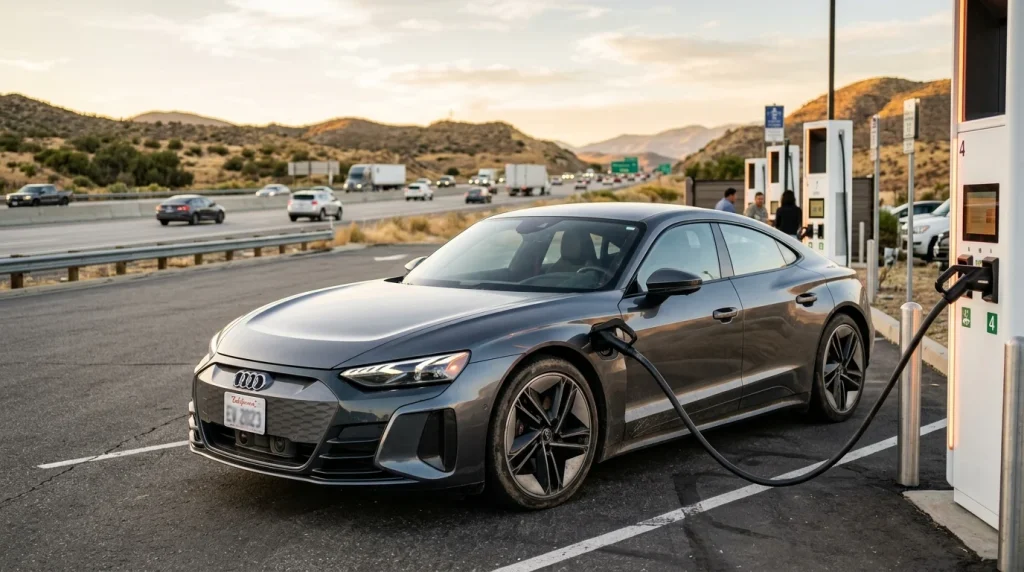
Quick answer: The 2023 Audi e-tron GT (often searched as the 2023 Audi e tron gt) has become an exceptional luxury electric vehicle bargain in 2026, with average used resale values plummeting to $35,800-$43,600. While this steep 66% depreciation from the original $104,900 MSRP makes it highly accessible, buyers must weigh its conservative 236-238 mile EPA range and battery recalls against the heavily upgraded 2025 model.
Key takeaways:
- Used market values for the base model have settled between $35,800 and $43,600, retaining only 34% of the original MSRP.
- Drivetrain performance remains outstanding with 522 horsepower on the base trim and 637 horsepower on the RS model.
- Real-world range typically spans 260-280 miles, exceeding the conservative EPA range rating of 236-238 miles.
- Critical battery recalls (NHTSA 24V-228) and sealant defects must be verified via VIN before purchase.
- The transferable 8-year or 100,000-mile warranty provides essential coverage for high-voltage battery components.
Used Market Value and Steep Depreciation of the 2023 e-tron GT
Used market values for the 2023 Audi e-tron GT have stabilized between $35,800 and $43,600 for standard models in good condition. According to Kelley Blue Book valuation data, the base trim now carries a representative resale value of approximately $35,800 and a trade-in value of $32,000. Edmunds appraisal data corroborates this pricing structure, placing clean, private-party examples in the $40,990 to $43,596 range. The high-performance RS e-tron GT variant commands a premium, with well-maintained used models ranging from $75,000 to $95,000 depending on mileage and option packages.
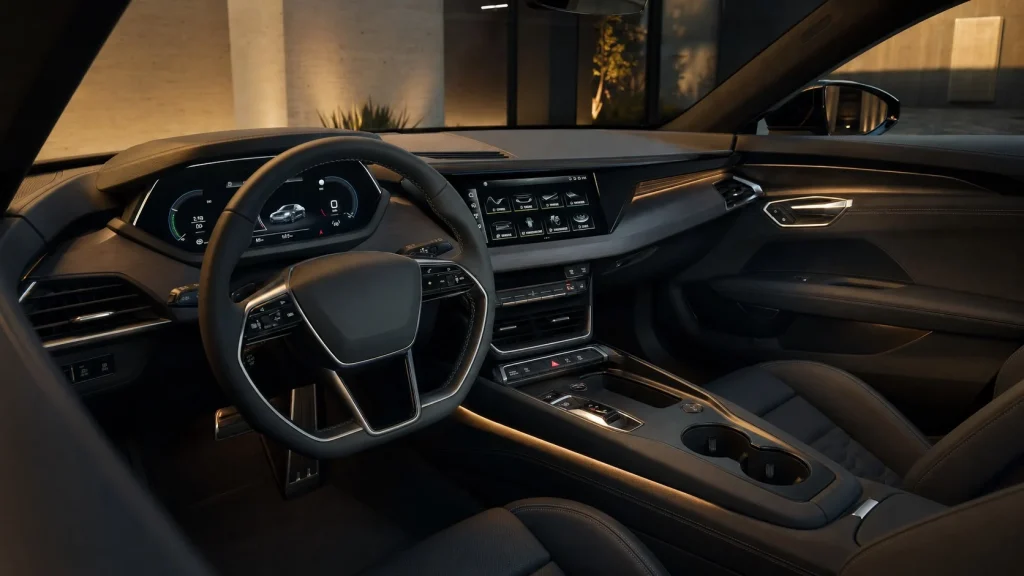
This pricing reflects a staggering 66% total depreciation over the first three years of ownership, resulting in a value loss of roughly $70,595 from the original starting MSRP. For buyers entering the used market, this front-loaded depreciation curve makes the vehicle an unprecedented luxury vehicle bargain. As a member of the broader Audi e-tron GT series, this model year allows second-hand buyers to bypass the steepest part of the depreciation curve. Compared to the 2022 Audi e-tron GT review baseline, the 2023 model benefits from slightly better packaging options but shares the same steep depreciation curve. The table below outlines the original MSRP across the lineup compared to representative used resale values.
| Trim Level | Original Starting MSRP | Used Resale Value (2026) | Retained Value Percentage |
|---|---|---|---|
| Premium Plus | $104,900 | $35,800 | 34.1% |
| Prestige | $111,300 | $41,200 | 37.0% |
| RS e-tron GT | $143,900 | $82,500 | 57.3% |
Several factors have driven these low residual values. Luxury electric vehicles typically face accelerated depreciation due to the rapid pace of battery technology improvements and the expiration of federal tax incentives for new purchases. Additionally, the release of the updated 2025 model year has increased pressure on older inventory, forcing dealers to lower prices on used models.
Performance Specifications and Real-World Range
The 2023 Audi e-tron GT performance specs remain highly competitive. The base powertrain utilizes dual permanent-magnet synchronous motors to produce a combined 469 horsepower under normal conditions and 522 horsepower during temporary launch control boost sessions. This setup delivers 464 pound-feet of torque to all four wheels through an electronic quattro all-wheel-drive system and a unique two-speed rear transmission. The performance-focused 2023 RS e-tron GT elevates output to 590 horsepower, boosting to 637 horsepower and 612 pound-feet of torque in launch mode.
Acceleration times are swift, with the base model achieving a 0-60 mph sprint in 3.9 seconds and the RS version completing it in 3.1 seconds. The vehicle draws power from a lithium-ion battery pack with a gross capacity of 93.4 kWh and a usable capacity of 85.0 kWh. This battery operates on an 800-volt electrical architecture, allowing a peak DC fast charging rate of 270 kW. When connected to a compatible high-speed charger, the battery can replenish from 5% to 80% capacity in approximately 22.5 minutes.
The official EPA range rating of 236 miles for the RS model and 238 miles for the base trim represents the vehicle’s primary drawback. However, independent real-world range tests demonstrate that these official estimates are highly conservative. In mixed highway and city driving, the vehicle consistently achieves between 260 and 280 miles on a full charge. Specialized range testing conducted by Bjørn Nyland recorded up to 305 miles under optimal weather conditions, showing the efficiency of the platform’s thermal management system. Conversely, highway driving in freezing temperatures can reduce range to approximately 200 miles.
Common Reliability Issues and Critical Recalls
A used 2023 Audi e-tron GT buyer must prioritize verifying the status of several critical recalls. The most significant recall campaign involves certain high-voltage battery modules supplied by LG Energy Solution. Registered under NHTSA campaign 24V-228 (manufacturer service codes 93VM and 93VN), some cell modules built before May 27, 2023, may experience internal short circuits. This defect can lead to thermal runaway and fire risk. The manufacturer’s remedy requires a dealer inspection to analyze battery module data and replace any compromised cells. Until this service is completed, owners are advised to limit their maximum charge level to 80% capacity to mitigate risks.
Water intrusion is another battery-related issue for this model year. A recall campaign covers 1,899 e-tron GT models built between September 2022 and mid-2023 due to insufficient sealant around the battery enclosure. Water ingress can cause electrical short circuits and vehicle shutdown. This issue is shared with 4,777 units of the Porsche Taycan manufactured during the same production window. In addition, Audi issued a recall (service codes 93U6 and 93U8) for the 220-volt to 240-volt home charging cables. The industrial plugs could overheat when charging at the full 100% load setting on standard outlets. The remedy is a replacement charging cable equipped with an integrated temperature sensor.
Note: Prospective buyers must obtain the specific vehicle identification number (VIN) and run it through the official NHTSA database. Confirm that all high-voltage battery diagnostics and physical recall remedies have been performed and documented by an authorized service center before completing a purchase.
General reliability beyond these recalls is average for the luxury EV class. Owners report occasional software anomalies within the MMI infotainment system, which are typically resolved with dealer-installed firmware updates. The high-voltage hardware, suspension air bladders, and electric motors have shown good durability, with minimal reports of mechanical failures.
Head-to-Head Comparison: 2023 e-tron GT vs 2025 e-tron GT
The 2025 model year introduced a major mid-cycle refresh that significantly altered the performance hierarchy. Audi restructured the lineup, replacing the base trim with the S e-tron GT and upgrading the flagship with the RS e-tron GT Performance. The 2025 models feature a larger battery pack with 105 kWh gross and 97 kWh usable capacity. Due to improved chemistry, this battery pack is 25 pounds lighter than the 93.4 kWh pack in the 2023 model.
Power outputs have increased dramatically. The 2025 S e-tron GT delivers 671 horsepower, which exceeds the output of the 2023 RS flagship by 34 horsepower. The new RS e-tron GT Performance produces 912 horsepower, making it the most powerful series-production road car Audi has ever built. Charging capabilities have also improved, with the peak DC rate rising from 270 kW to 320 kW. This reduces the 10-80% charge time to 18 minutes under optimal conditions. The table below provides a detailed comparison of key specifications between the model years.
| Specification | 2023 e-tron GT (Base) | 2025 S e-tron GT | 2025 RS e-tron GT Performance |
|---|---|---|---|
| Battery Capacity (Usable) | 85.0 kWh | 97.0 kWh | 97.0 kWh |
| Drivetrain Output | 522 hp | 671 hp | 912 hp |
| EPA Range | 238 miles | 300 miles | 275 miles |
| Peak Charging Rate | 270 kW | 320 kW | 320 kW |
| 0-60 mph Time | 3.9 seconds | 3.3 seconds | 2.4 seconds |
| Original Starting MSRP | $104,900 | $125,500 | $167,000 |
The 2025 Audi e-tron GT review notes that the refresh addresses the range and charging limitations of the older car. However, these improvements come with a significant price premium, as a new S model starts at $125,500 before options. For buyers seeking a used model, comparing these specs to the 2024 Audi e-tron GT review shows that the 2023 and 2024 models share the same J1 platform specs, making the heavily depreciated 2023 the optimal value selection.
Market Competitors: Porsche Taycan, Tesla Model S, and Mercedes-Benz EQE
The 2023 e-tron GT faces strong competition from other luxury electric sedans:
- Porsche Taycan (2023): Built on the shared J1 platform, the Taycan and e-tron GT share the same 800-volt architecture, dual motors, and 2-speed gearbox. However, the Porsche Taycan is tuned for a stiffer, track-focused driving experience, whereas the Audi is set up as a comfortable grand tourer. The base Taycan is rear-wheel drive and has only 402 horsepower, compared to the base e-tron GT’s standard all-wheel drive and 522 horsepower.
- Tesla Model S (2023): The Model S has a significant range advantage, with an EPA rating of 405 miles and access to the Tesla Supercharger network. It also offers more cargo space due to its rear liftgate. However, the Audi e-tron GT has superior interior build quality, better sound insulation, and a more traditional dashboard design with physical controls.
- Mercedes-Benz EQE Sedan (2023): The Mercedes-Benz EQE focuses on passenger space and cabin isolation, offering a larger rear seat and advanced tech features. However, its rounded exterior styling lacks the sporty proportions of the e-tron GT. The EQE also has less responsive driving dynamics.
Original Value Analysis: Who Should Buy the Used 2023 model?
For used luxury EV shoppers, the 2023 e-tron GT represents a compelling value proposition. Purchasing a well-maintained Premium Plus model for $38,000 instead of a new 2025 S e-tron GT for $125,500 saves more than $87,000 upfront. This savings easily covers the cost of out-of-warranty repairs or slightly higher insurance rates. For daily driving under 150 miles, the range differences between the model years are minor.
Furthermore, Audi’s high-voltage battery warranty covers the battery pack for 8 years or 100,000 miles, guaranteeing at least 70% capacity. This warranty transfers to second owners, providing protection until 2031 for a 2023 vehicle.
Choose the used 2023 model if you:
- Want luxury EV styling and performance under a $45,000 budget.
- Have a daily commute under 150 miles and can charge at home.
- Find a CPO vehicle with an extended factory warranty.
- Value traditional physical controls over large touchscreens.
Choose the 2025 model if you:
- Regularly drive more than 200 miles between charges.
- Require a 0-60 mph time under 3 seconds.
- Want the absolute latest software features and suspension tech.
- Have a budget that allows for a $125,500+ starting price.
FAQs about the 2023 Audi e-tron GT
Is the 2023 Audi e-tron GT worth buying in 2026?
Yes. The 2023 model is a strong used EV purchase because it has depreciated by 66%, dropping prices to the high-$30k range. It offers Porsche-engineered performance and high build quality at a fraction of its original price. Buyers must confirm that the battery module recalls have been completed before purchasing.
What is the real-world battery range of the 2023 e-tron GT?
Although it has a conservative EPA rating of 236-238 miles, the 2023 e-tron GT consistently achieves 260-280 miles in mixed real-world driving. Fast-highway driving in cold weather will reduce range to about 200 miles, while conservative driving in mild weather can yield up to 300 miles.
What are the common problems on a used 2023 Audi e-tron GT?
The most critical issues are battery-related recalls, including NHTSA campaign 24V-228 for cell short circuits and water ingress sealant issues. Other common problems include minor software glitches in the infotainment system and home charging cable overheating. These mechanical components are generally reliable.

