

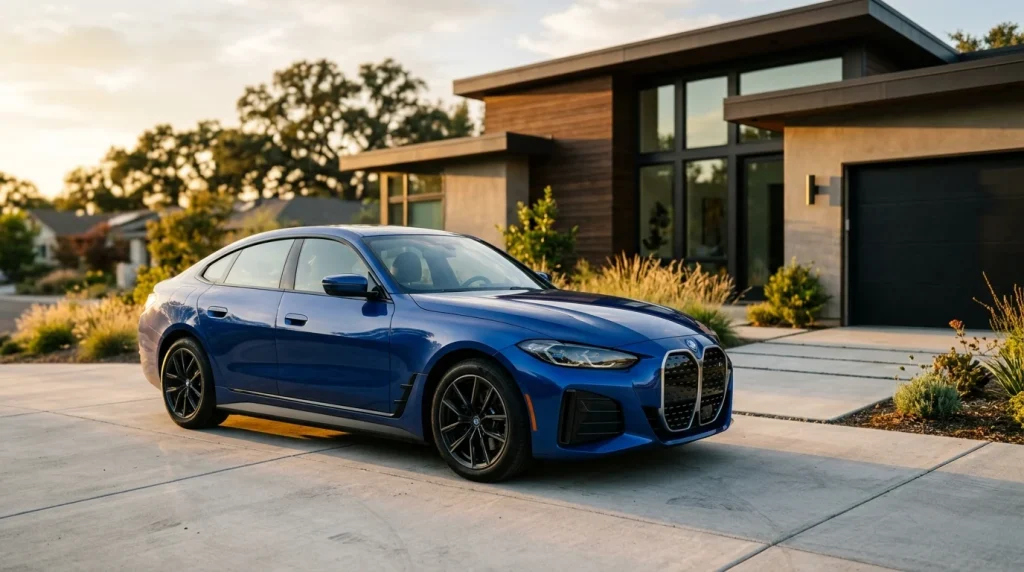
Quick answer: The 2023 BMW i4 starts at $52,395 for the entry-level eDrive35 trim, rising to $56,895 for the long-range eDrive40, and peaking at $68,295 for the high-performance M50. All MSRPs include the standard $995 destination charge. EPA-estimated range spans from 227 miles on the M50 with 20-inch wheels to 301 miles on the eDrive40 with 18-inch wheels. Built on a traditional luxury platform, this electric Gran Coupe delivers agile driving dynamics and premium build quality.
Key takeaways:
- Starting price is $52,395 for eDrive35, $56,895 for eDrive40, and $68,295 for the M50 variant.
- Maximum EPA range reaches 301 miles in the rear-wheel-drive eDrive40 on standard 18-inch wheels.
- Reliability is rated as about average by Consumer Reports, placing it in line with similar premium vehicles.
- The liftback hatchback tailgate offers 10.0 cubic feet of cargo space, expanding to 45.6 cubic feet with seats folded.
- No all-wheel-drive xDrive40 variant exists for the 2023 model year, as it debuted for the 2024 model year.
2023 BMW i4 Overview: Specs, Pricing, and Trims
The 2023 BMW i4 line expands for the U.S. market with the addition of the new entry-level eDrive35 trim. Positioned as a luxury electric four-door Gran Coupe, the i4 matches traditional BMW styling with refined electric drivetrains. The addition of the eDrive35 reduces the price of entry, helping BMW reach a broader segment of the electric vehicle market. U.S. buyers can view other model comparisons on our comprehensive BMW i4 hub to see how the lineup has grown.
Unlike dedicated electric vehicles built from the ground up, the i4 utilizes BMW’s flexible Cluster Architecture (CLAR). This shared platform supports both internal combustion engine models and battery-electric drivetrains. This choice ensures that the i4 retains the ride quality, handling characteristics, and styling of a conventional luxury sports sedan.
The starting prices for all three trims include a $995 destination and handling charge. The base eDrive35 features a single electric motor driving the rear wheels. The mid-tier eDrive40 also uses a rear-wheel-drive layout but features a larger battery and more horsepower. The dual-motor M50 variant sits at the top of the lineup, offering all-wheel-drive performance.
| Trim Level | Drivetrain | Usable Battery Capacity | Base MSRP | MSRP with Destination |
|---|---|---|---|---|
| i4 eDrive35 | Rear-Wheel Drive (Single Motor) | 66.0 kWh | $51,400 | $52,395 |
| i4 eDrive40 | Rear-Wheel Drive (Single Motor) | 80.7 kWh | $55,900 | $56,895 |
| i4 M50 | All-Wheel Drive (Dual Motor) | 80.7 kWh | $67,300 | $68,295 |
The eDrive35 features standard 18-inch aerodynamic wheels, synthetic leather upholstery, and the curved digital cockpit display. The eDrive40 provides a larger battery pack, increased power, and access to optional styling packages. The top-tier M50 adds a second electric motor for all-wheel drive, adaptive M suspension, variable sport steering, and upgraded M Sport brakes.
Performance Analysis: Powertrain and Driving Dynamics
The 2023 BMW i4 offers strong performance across all models, ranging from 281 horsepower in the base eDrive35 to 536 horsepower in the M50 during temporary power boost. According to Car and Driver’s review, the i4 balances responsive sports sedan handling with impressive daily comfort, making it feel remarkably agile despite the weight of its floor-mounted battery pack.
In the single-motor trims, power delivery is smooth and linear. The eDrive35 generates 281 horsepower and 295 pound-feet of torque, completing the 0-to-60 mph sprint in 5.8 seconds. The eDrive40 increases output to 335 horsepower and 317 pound-feet of torque, which drops the 0-to-60 mph acceleration time to 5.5 seconds. Both single-motor variants are electronically limited to a top speed of 118 mph.
The performance-oriented M50 features dual electric motors providing all-wheel drive. Under standard driving conditions, the M50 produces 469 horsepower and 538 pound-feet of torque. When the driver engages Sport Mode and depresses the accelerator fully, a “Sport Boost” function increases output to 536 horsepower and 586 pound-feet of torque for up to 10 seconds. This temporary boost propels the M50 from 0 to 60 mph in 3.7 seconds, with acceleration continuing up to an electronically limited top speed of 130 mph.
Handling is managed through model-specific suspension setups. The eDrive35 and eDrive40 models feature standard rear air suspension with automatic self-leveling to maintain a consistent ride height when loaded. The M50 upgrades to an Adaptive M Suspension with electronically controlled dampers that adjust in real time to road conditions. Braking is handled through an integrated system with adjustable energy regeneration. Drivers can choose Low, Medium, or High regeneration, or use the Adaptive mode, which automatically alters braking force based on traffic data.
Range, Charging, and Real-World Usability
The 2023 BMW i4 achieves its maximum EPA-estimated range of 301 miles in the eDrive40 trim equipped with standard 18-inch wheels. In comparison, the dual-motor M50 offers a maximum range of 271 miles on 19-inch wheels. Wheel size choice plays a major role in efficiency, with larger wheel options increasing rolling resistance and aerodynamic drag, which lowers overall range.
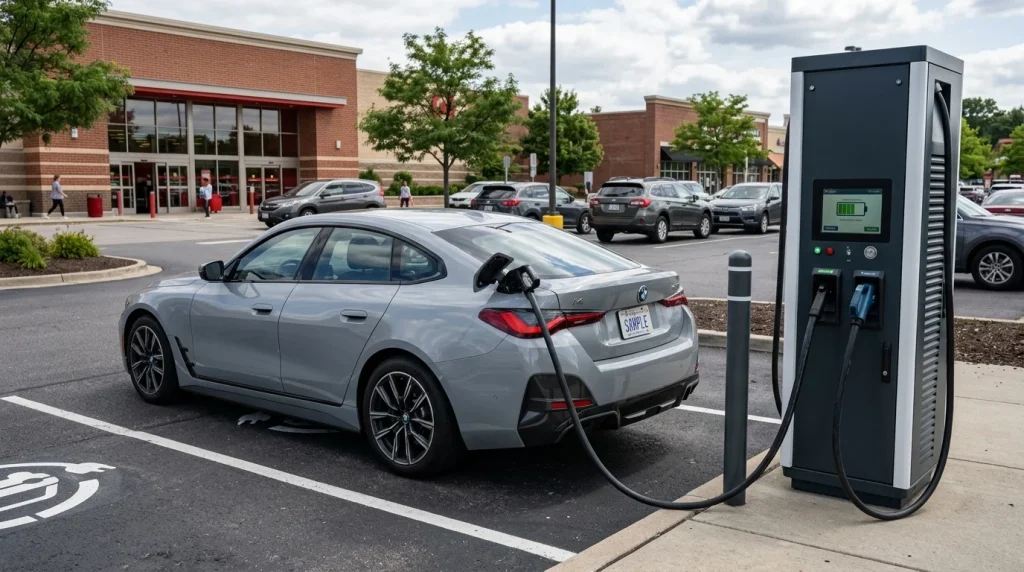
The battery packs differ by trim level. The eDrive35 uses a battery pack with 70.2 kWh total capacity (66.0 kWh usable). The eDrive40 and M50 utilize a larger battery pack with 83.9 kWh total capacity (80.7 kWh usable). Under standard EPA testing, the range estimates vary significantly based on configuration:
- eDrive35 (18-inch wheels): 256 miles of EPA-estimated range
- eDrive40 (18-inch wheels): 301 miles of EPA-estimated range
- eDrive40 (19-inch wheels): 282 miles of EPA-estimated range
- M50 (19-inch wheels): 271 miles of EPA-estimated range
- M50 (20-inch wheels): 227 miles of EPA-estimated range
Charging speeds are competitive with other premium electric vehicles. The eDrive35 supports DC fast charging at rates up to 180 kW, recharging the battery from 10% to 80% in approximately 32 minutes. The larger battery in the eDrive40 and M50 supports peak DC charging rates up to 205 kW, completing the 10% to 80% charge in about 31 minutes under optimal thermal conditions. For Level 2 home charging, the onboard charger accepts up to 11 kW, which fully replenishes the larger battery in 8.25 hours and the smaller pack in under 7 hours.
AC charging has encountered minor software issues. Some owners reported Level 2 home charging interruptions where charging paused overnight and failed to resume. These handshake errors were linked to vehicle firmware update 07/2023.53, which caused communication errors with smart home chargers. BMW has since addressed these communication issues with subsequent over-the-air software updates, but owners experiencing persistent charging faults should verify that their vehicle is running the latest system firmware.
Interior Comfort, Cargo Space, and Curved Display Tech
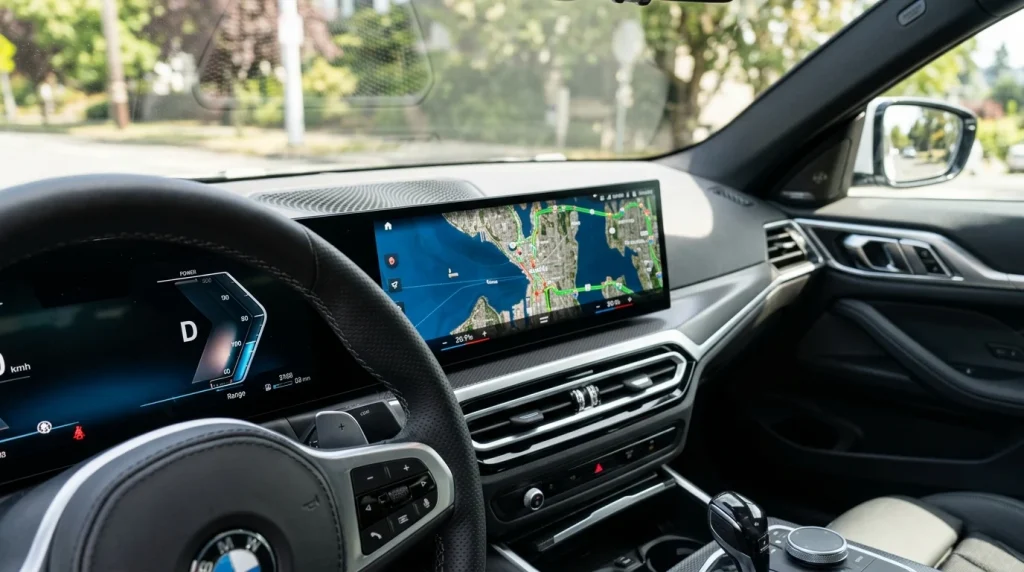
The cabin of the 2023 BMW i4 features high-end assembly and materials, centered around a standard curved glass assembly. This display integrates a 12.3-inch instrument cluster and a 14.9-inch touchscreen running the iDrive 8 operating system. The liftback hatchback design provides 10.0 cubic feet of cargo space behind the rear seats, expanding to 45.6 cubic feet when the rear seats are folded flat.
Analysis: The U.S. EPA cargo specification of 10.0 cubic feet reflects usable space beneath the cargo cover. European VDA measurements quote 470 liters, which converts to roughly 16.6 cubic feet. This discrepancy is due to differing testing standards rather than physical changes to the cargo area. The liftback tailgate makes loading large boxes much easier than in a traditional sedan trunk.
Sensatec synthetic leather is standard, while genuine Vernasca leather is available as an option in multiple colors. The front sports seats offer adjustable side bolsters for excellent support. Front cabin occupants enjoy ample room, but rear seat headroom is limited by the sloping fastback roofline. Additionally, the cabin floor is raised slightly to accommodate the underfloor battery pack, forcing taller rear passengers to sit with their knees bent higher than in a traditional combustion engine car. The i4 also lacks a front trunk (frunk), as the area under the hood is filled with electric drive components and cooling systems.
The curved touchscreen running iDrive 8 offers sharp graphics and quick responses. Wireless Apple CarPlay and Android Auto are standard. However, the lack of physical buttons for the climate control system presents a learning curve. Basic tasks like adjusting fan speed or temperature require using the touchscreen menus or voice commands, which can be distracting while driving.
Reliability Ratings and Common Owner Issues
The 2023 BMW i4 achieves about average reliability according to Consumer Reports owner survey data. While early owner feedback has been generally positive, multiple safety recalls have been issued by the National Highway Traffic Safety Administration (NHTSA) to address potential defects.
One major safety recall was issued under NHTSA campaign 23V-449 to address the Combined Charging Unit (CCU). Traced to a Panasonic supplier defect, the CCU in certain 2022 and 2023 models could experience internal electrical faults. A failing CCU can cause a sudden loss of drive power or interrupt charging, which increases safety risks. Dealers replace the affected CCU hardware free of charge.
A separate campaign, NHTSA recall 23V-295, covers a potential defect in the high-voltage battery cell monitoring circuit. In affected vehicles, an improper circuit connection could cause a sudden loss of power while driving. Authorized dealers inspect and replace the monitoring circuit at no cost. Additionally, NHTSA campaign 23V-026 addresses a software defect where the external pedestrian warning sound generator may fail to activate at startup. Owners can verify their vehicle’s status on the NHTSA database using their Vehicle Identification Number (VIN).
Total Cost of Ownership and Value Verdict
A 5-year total cost of ownership analysis reveals that the single-motor eDrive40 provides the best balance of range, performance, and long-term operating costs. While electric cars eliminate oil changes and exhaust emissions, they are subject to segment-typical depreciation and accelerated tire wear.
Depreciation represents the largest single expense for luxury electric vehicles. The i4 segment experiences an average 5-year depreciation rate of 48%. The entry-level eDrive35 loses the least cash value due to its lower initial purchase price. The high-performance M50 loses value most rapidly because expensive optional features and high-performance trims depreciate faster on the secondary market.
Tire replacement is another notable cost. The high torque and heavy weight of electric vehicles accelerate tire wear. The rear-wheel-drive trims on 18-inch wheels typically require new tires every 30,000 miles. The dual-motor M50, especially when fitted with 20-inch wheels and summer tires, can exhaust its rear tread in 15,000 to 20,000 miles, with a replacement set costing roughly $1,400.
U.S. home charging costs remain low. Based on an average U.S. residential electricity rate of $0.16 per kWh, the eDrive40 costs approximately $0.05 per mile to run, compared to $0.07 per mile for the less efficient M50.
| Expense Category (5-Year Estimate) | eDrive35 | eDrive40 | M50 |
|---|---|---|---|
| Depreciation (48% average) | $25,150 | $27,300 | $32,780 |
| Electricity (15,000 miles/year) | $3,500 | $3,990 | $4,980 |
| Maintenance & Tires | $2,200 | $2,500 | $4,800 |
| Insurance | $9,500 | $10,200 | $12,900 |
| Total 5-Year Ownership Cost | $40,350 | $43,990 | $55,460 |
The eDrive40 represents the ideal choice for daily commuters who want maximum range and moderate operating costs. The eDrive35 serves as a great budget option for drivers who prioritize starting price over maximum range. The M50 is recommended only for enthusiasts who are willing to accept faster tire wear, higher insurance premiums, and reduced range in exchange for sport-car-like acceleration.
BMW i4 vs. Tesla Model 3 Head-to-Head Comparison
The 2023 BMW i4 and the 2023 Tesla Model 3 Long Range take very different approaches to premium electric motoring. While BMW focuses on traditional assembly, cabin quietness, and conventional luxury styling, Tesla leads in pricing, native charging infrastructure, and rear seat room.
The starting price and tax incentives favored Tesla in 2023. The 2023 Tesla Model 3 Long Range started at $47,240 and qualified for the full $7,500 federal tax credit for purchases made from June through December 2023. The Munich-built i4 was ineligible for the federal tax credit on direct purchases, though lease deals could bypass this restriction through commercial loopholes.
Charging infrastructure is another key difference. The Model 3 utilizes Tesla’s native Supercharger network, which offers simple plug-and-play charging. The 2023 i4 relies on public CCS1 networks, such as Electrify America and EVgo, which can suffer from broken screens, slow charging speeds, and communication errors. While BMW committed to adopting the North American Charging Standard (NACS) for future models, 2023 models require an adapter to use compatible Tesla Supercharger stations.
| Feature Comparison | BMW i4 eDrive40 | Tesla Model 3 Long Range (AWD) |
|---|---|---|
| Starting MSRP (2023) | $56,895 | $47,240 |
| EPA-Estimated Range | 301 miles | 358 miles |
| Peak DC Charging Speed | 205 kW | 250 kW |
| Highway Cabin Noise (70 mph) | 65 dB (Very Quiet) | 69 dB (Moderate) |
| Cargo Configuration | Liftback Hatchback | Standard Sedan Trunk |
Interior build quality is where the BMW i4 shines. The cabin is constructed with high-end soft-touch plastics, premium switchgear, and tight panel gaps. Highway noise in the i4 measures a quiet 65 dB at 70 mph, compared to 69 dB in the Tesla Model 3, which suffers from less sound insulation and more wind noise. The i4’s traditional dashboard layout feels familiar to conventional car buyers, whereas Tesla’s minimalist cabin requires managing almost all vehicle functions through a single center screen. Buyers interested in subsequent model changes can read our 2024 BMW i4 review, 2025 BMW i4 review, or 2026 BMW i4 review for details on later technology and styling updates.
Frequently Asked Questions
Is the 2023 BMW i4 reliable compared to other EVs?
The 2023 BMW i4 achieves about average reliability ratings according to owner survey data compiled by Consumer Reports. This places it on par with other premium electric sedans, though it avoids the severe battery and software bugs that have plagued some newer electric vehicles in this segment.
What are the most common problems with the 2023 BMW i4?
The most common issues reported by owners include Level 2 home charging interruptions, occasional software bugs affecting Apple CarPlay or Android Auto connection, and a sticking charging port flap. Serious safety concerns, such as Combined Charging Unit faults and battery monitoring connection issues, are covered under NHTSA safety recalls.
How does the 2023 i4 real-world range compare to EPA estimates?
In real-world highway driving at a steady 70 mph, the BMW i4 typically delivers 85% to 90% of its official EPA range under moderate weather conditions. For example, the eDrive40 on 18-inch wheels (rated at 301 miles) achieves roughly 270 miles of range, which drops further in cold winter temperatures.
Should I buy the eDrive35, eDrive40, or M50 trim?
For most buyers, the eDrive40 represents the best overall balance of price, range, and performance. The eDrive35 is best for budget-oriented buyers who only need a daily commuter, while the M50 is tailored for performance enthusiasts willing to accept shorter range and higher operating costs.
Is the BMW i4 worth more money than a Tesla Model 3?
The price premium for the BMW i4 is justified for buyers who prioritize traditional luxury assembly, low highway noise levels, traditional instrument controls, and the cargo versatility of a hatchback. However, buyers seeking the lowest price per mile of range and a seamless charging experience will find the Tesla Model 3 to be a better financial value.
Does the 2023 i4 have enough rear-seat space?
The rear seat of the 2023 BMW i4 is comfortable for children and average-sized adults, but headroom is tight for passengers over six feet tall due to the sloping Gran Coupe roofline. The rear legroom measures 34.2 inches, which is tighter than the 35.2 inches offered in the Tesla Model 3.
What charging problems do BMW i4 owners face?
Owners have reported AC home charging failures where Level 2 charging stops overnight. This was linked to handshake errors introduced by the 07/2023.53 system update. Additionally, vehicles affected by the CCU safety recall (NHTSA campaign 23V-449) may experience charging interruptions and complete charging system failures.
How steep is the learning curve for the i4’s technology?
The technology learning curve is moderate. The iDrive 8 operating system features a complex menu structure with numerous app icons, and the removal of physical climate control buttons requires using the curved touchscreen or voice commands to adjust standard cabin settings.

