

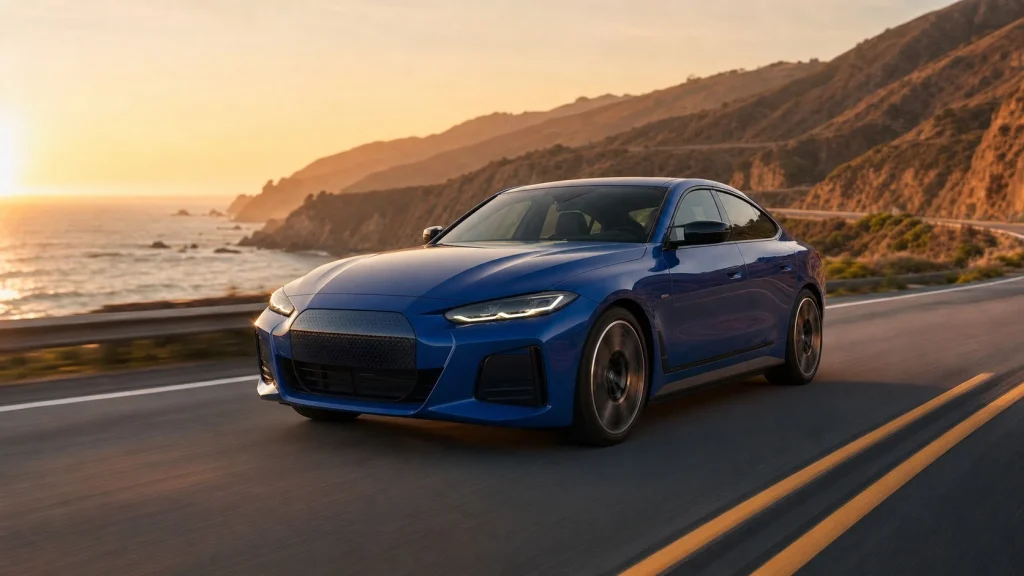
Quick answer: The 2026 BMW i4 introduces a technical mid-cycle update featuring advanced silicon-carbide inverters for a 5% efficiency improvement, increasing the estimated range of the eDrive40 to 333 miles. The lineup simplifies by discontinuing the eDrive35 in the U.S. and replacing the M50 with a more powerful 593-horsepower M60 flagship, while U.S. pricing remains unchanged starting at $57,900.
Key takeaways:
- Silicon-carbide inverters improve overall powertrain efficiency, adding up to 15 miles of range depending on configuration.
- The dual-motor M60 flagship succeeds the M50, pushing output to 593 horsepower and slicing 0-60 mph acceleration to 3.6 seconds.
- Base eDrive40 starts at $57,900 and maintains range above 300 miles even with upgraded 19-inch aerodynamic wheels.
- Charging capabilities support up to 205 kW DC fast charging, replenishing 10% to 80% battery capacity in approximately 31 minutes.
Key Technical and Styling Updates for the 2026 BMW i4
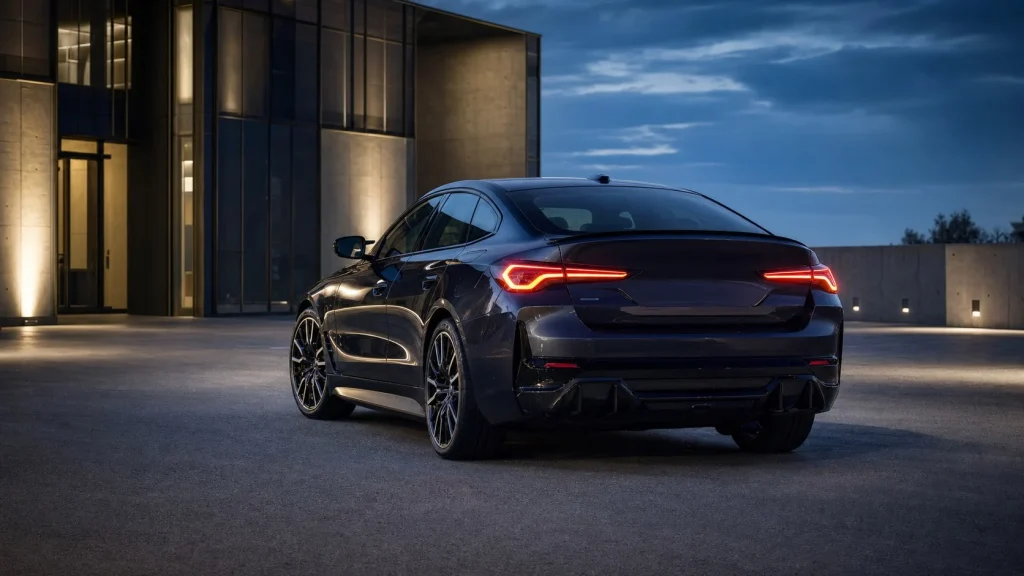
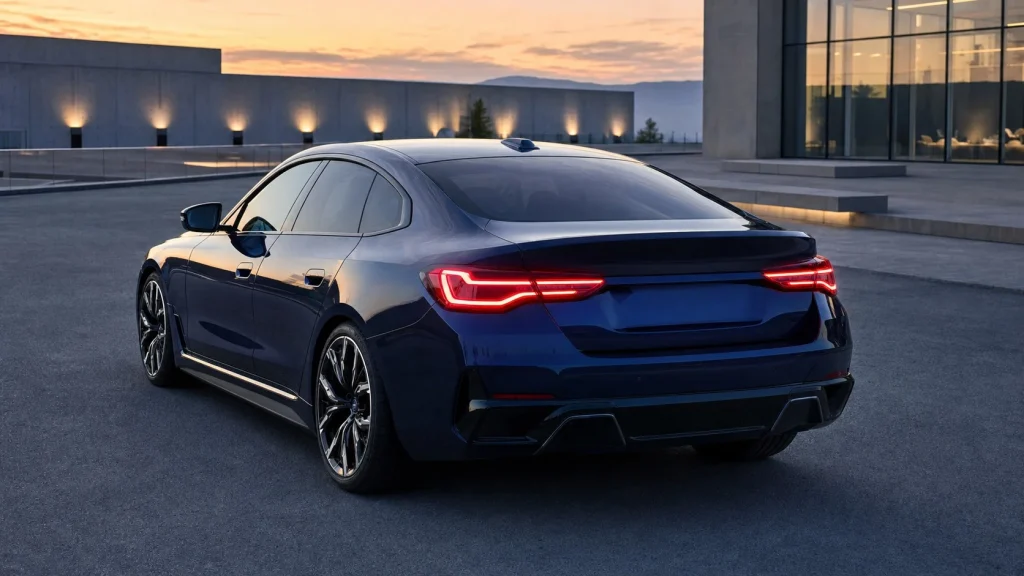
The 2026 BMW i4 LCI (Life Cycle Impulse) update focuses on mechanical refinement and subtle styling revisions, keeping the chassis rooted on the CLAR platform. According to the official BMW USA Press Release, the vehicle continues assembly at BMW’s Munich plant in Germany. The front fascia features a subtly revised kidney grille with horizontal slats on standard models and a sporty honeycomb pattern on M Sport packages. The LED headlights receive updated internal daytime running light signatures, moving to a modern vertical arrow design. At the rear, the high-end M60 and M Sport models can be optioned with the intricate Laserlight taillights first seen on the exclusive M4 CSL, creating a distinctive three-dimensional light pattern at night. These aesthetic touch-ups maintain the classic four-door Gran Coupe silhouette that distinguishes the i4 from modern, slab-sided electric vehicle designs.
Efficiency Breakthrough: New Silicon-Carbide Inverters
Integration of silicon-carbide semiconductor technology in the power electronics optimizes energy flow from the battery pack to the motors, lowering heat loss by 5% and boosting range. The vehicle continues to utilize the lithium-ion battery pack with an 81.1 kWh usable capacity. However, the efficiency optimization translates directly into increased range for drivers without requiring a larger, heavier battery pack. Drivers can compare these updates with the previous 2025 BMW i4 model year configurations to understand the progression of real-world efficiency gains. Crucially, the efficiency gains resolve a long-standing complaint among EV buyers regarding wheel selection penalties. Previously, choosing larger 19-inch aerodynamic wheels on the eDrive40 significantly reduced the EPA-estimated range. For the 2026 model year, BMW states that the eDrive40 will exceed 300 miles of EPA range regardless of whether 18-inch or 19-inch wheel packages are fitted. Specifically, the base RWD eDrive40 achieves up to 333 miles of range on standard 18-inch wheels, and stays at 307 miles on 19-inch wheels, representing a 15-mile consolidated gain.
Performance Leap: i4 M60 Replaces the Outgoing M50
For performance enthusiasts, the biggest news of the 2026 refresh is the retirement of the popular i4 M50 trim. In its place, BMW introduces the new i4 M60 flagship, drawing technology from the larger iX M60 and i7 M60 premium models. This dual-motor all-wheel-drive configuration pairs the existing motor hardware with recalibrated software and the upgraded silicon-carbide power electronics. According to testing data published by Car and Driver, the M60 completes the 0-60 mph sprint in 3.6 seconds, shaving a tenth of a second off the M50’s official manufacturer estimate.
While the standard power output remains at a substantial 510 horsepower during everyday driving, activating Sport or Sport Boost mode unlocks the vehicle’s full potential. In this high-performance configuration, the system delivers 593 horsepower. Interestingly, peak torque remains unchanged at 586 lb-ft. This technical choice suggests that BMW engineers focused on sustaining power delivery at higher motor RPMs rather than increasing low-end wheel spin. The steering remains precise and well-weighted, providing a stronger connection to the road compared to the synthetic steering feel found in many modern electric competitors. The acoustic driving experience is enriched by the customizable Hans Zimmer soundtracks, which adjust their tone and volume based on speed and drive modes.
- Maximum Power: 593 hp (Sport Mode) / 510 hp (Normal)
- Peak Torque: 586 lb-ft (constant across drive modes)
- Acceleration (0-60 mph): 3.6 seconds
- Top Speed: 140 mph (electronically limited)
- Chassis Tuning: M-specific adaptive dampers with rear air suspension
Expert view: The transition from M50 to M60 highlights BMW’s focus on software calibration and power electronics efficiency rather than mechanical modifications. While torque remains identical, the power delivery at higher speeds is noticeably improved, making high-speed passes more effortless.
Charging and Battery Management
The 2026 BMW i4 utilizes an 800V-compatible charging logic that allows it to accept up to 205 kW DC fast charging, adding up to 100 miles of range in 10 minutes under optimal conditions. The standard onboard charger supports 11 kW AC charging, which is perfect for overnight charging at home, requiring approximately 8.25 hours to replenish a depleted battery. When connected to a public DC fast charging station, the i4’s charging capability allows it to go from 10% to 80% battery capacity in approximately 31 minutes. While this is slightly slower than some newer 800-volt dedicated EV architectures, the thermal management system ensures repeatable charging speeds without overheating the battery pack.
2026 BMW i4 Pricing and Trim Structure
According to official product details, BMW has maintained pricing parity for the 2026 model year, absorbing the cost of the silicon-carbide inverter upgrades to keep the BMW i4 line-up competitive. Shoppers looking for older model year pricing trends can check out our evaluations of the 2024 BMW i4 and 2023 BMW i4 reviews. The entry-point RWD models remain highly accessible, while the top-tier performance model carries a premium price point reflecting its dual-motor capabilities and M-specific hardware. Notably, the base eDrive35 trim has been discontinued for the U.S. market, making the eDrive40 the new entry point.
| 2026 BMW i4 Trim Level | Drivetrain Configuration | U.S. MSRP (Starting) | Key Included Features |
|---|---|---|---|
| eDrive40 | Rear-Wheel Drive (RWD) | $57,900 | 81.1 kWh battery pack, 333-mile range, power front seats |
| xDrive40 | All-Wheel Drive (AWD) | $62,300 | Dual motor, all-weather traction, 396 hp, 287-mile range |
| M60 | All-Wheel Drive (AWD) | $70,700 | 593 hp Sport Boost, adaptive M suspension, M brakes |
When evaluating the lineup, the mid-tier xDrive40 emerges as the best value proposition for the majority of luxury EV shoppers. While the eDrive40 is the range leader, the xDrive40 adds dual-motor all-wheel drive, providing confidence in wet or snowy climates. Additionally, it boosts horsepower from 335 to 396 and torque to 443 lb-ft, reducing the 0-60 mph sprint to 4.9 seconds. The range penalty for this performance is a minor 46 miles compared to the RWD model, which is easily offset by the safety and acceleration benefits of the AWD system. For buyers living in warmer regions who prioritize daily commuting efficiency, the rear-wheel-drive eDrive40 remains the logical selection due to its lower starting price and superior range.
Note: All prices exclude the mandatory $1,175 destination charge. Federal EV tax credits and regional incentives may vary depending on assembly location and buyer eligibility. BMW frequently offsets these changes with promotional lease offers that pass the $7,500 incentive directly to the lessee.
Interior Modernization: Cockpit Upgrades and iDrive 8.5
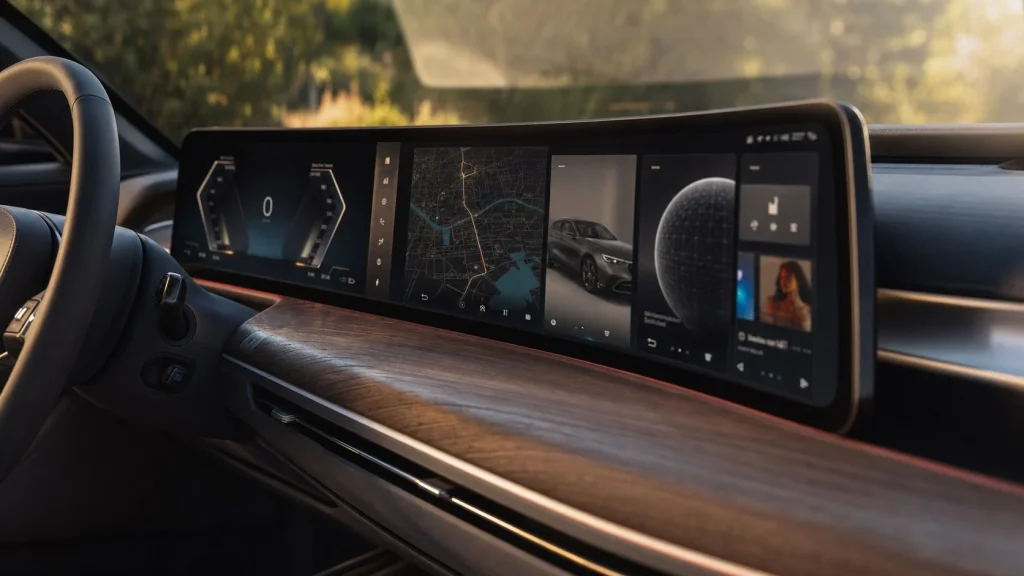
Inside the cabin, the changes focus on digital modernization and ergonomic simplification. BMW has updated the curved display panel, which seamlessly integrates a 12.3-inch digital instrument cluster and a 14.9-inch infotainment touchscreen. The system runs on the latest BMW Operating System 8.5, introducing the QuickSelect user interface. This layout places frequently used functions directly on the home screen as customizable widgets, reducing the need to dig through nested submenus to adjust climate controls or driver assists.
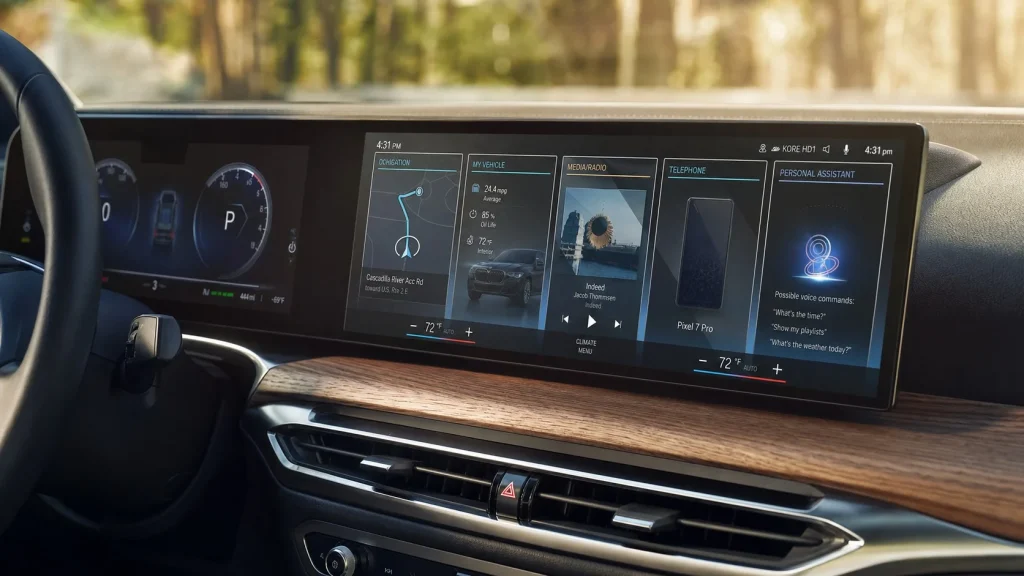
Passenger accommodation remains comfortable in the front, with highly supportive seats featuring multiple power adjustments. Rear passenger headroom is somewhat constrained by the sloping Gran Coupe roofline, offering 37.4 inches of vertical clearance. Rear legroom is adequate at 35.7 inches, though taller adults may find it snug on long journeys. The rear liftgate design continues to be a major practical advantage, opening wide to reveal 16.6 cubic feet of cargo space behind the rear seats, which expands significantly when the 40/20/40 split-folding seats are stowed.
- Operating System: BMW iDrive OS 8.5 with QuickSelect widget support
- Climate Controls: Digital integration on the lower display edge
- Cabin Materials: Standard SensaTec synthetic leather, optional Vernasca leather, open-pore wood, or carbon fiber trim
- Steering Wheel: New flat-bottom M leather steering wheel with red center marker on performance models
- Controls: Optional CraftedClarity glass controls for the gear selector and iDrive controller dial
Original Analysis: Platform Trade-offs and Value Verdict
The 2026 BMW i4 represents a highly practical technical evolution rather than a visual revolution. The core structural architecture remains the Cluster Architecture (CLAR) platform, which is shared with gasoline-powered BMW 4-Series models. This platform choice presents a clear set of trade-offs. On one hand, the shared platform gives the i4 a solid, familiar build quality and traditional premium cabin proportions. Unlike bespoke electric vehicles that often feature stark, ultra-minimalist cabins, the i4 feels like a traditional luxury car first and an electric vehicle second. On the other hand, because the platform must accommodate transmission tunnels and conventional engine bays, the cabin packaging is less efficient than dedicated EV architectures. The presence of a center tunnel in the rear footwell restricts center passenger comfort, and the overall interior volume is slightly less than what is found in competitors built on dedicated EV platforms.
-
Who Should Buy:
- Drivers transitioning from gasoline luxury sport sedans who demand traditional ride compliance, steering feedback, and premium interior switchgear.
- Commuters in colder climates who require all-wheel-drive security and want a highly efficient vehicle that minimizes winter range penalties via silicon-carbide efficiency.
- Performance buyers seeking an electric M-Performance experience that delivers reliable, repeatable acceleration times without thermal degradation.
-
Who Should Skip:
- Rear-seat passengers who require expansive legroom or headroom; those buyers should look toward larger luxury EV options like the BMW i5.
- Buyers seeking the absolute fastest charging speeds; the i4’s charging capability is limited to a maximum rate of 205 kW, which is slower than some newer 800-volt EV architectures.
- Budget-first EV shoppers who prioritize raw range-per-dollar value over premium material choices and European driving dynamics.
Head-to-Head: 2026 BMW i4 M60 vs. Tesla Model 3 Performance
The primary rival for the i4 M60 remains the updated Tesla Model 3 Performance. While both vehicles occupy the high-performance compact electric sedan space, they target fundamentally different driving philosophies. The Model 3 is built around a software-first approach, prioritizing digital simplicity and weight reduction, while the i4 M60 approaches the segment from a traditional chassis engineering perspective.
| Feature or Metric | 2026 BMW i4 M60 | 2026 Tesla Model 3 Performance | Comparison Winner |
|---|---|---|---|
| Starting MSRP | $70,700 | $54,990 | Tesla (by $15,710) |
| Peak Power Output | 593 horsepower | 510 horsepower | BMW (+83 hp) |
| Peak Torque | 586 lb-ft | 547 lb-ft | BMW (+39 lb-ft) |
| 0-60 mph Acceleration | 3.6 seconds | 2.9 seconds | Tesla (by 0.7s) |
| Top Speed | 140 mph | 163 mph | Tesla (by 23 mph) |
| EPA-Estimated Range | 278 miles | 303 miles | Tesla (+25 miles) |
| Max Charging Rate | 205 kW | 250 kW | Tesla (+45 kW) |
| Suspension Type | Adaptive M Dampers / Rear Air | Adaptive Dampers (Steel Springs) | BMW (Refinement) |
The comparison reveals a classic performance trade-off. The BMW i4 M60 boasts a clear advantage in peak horsepower and torque, delivering up to 593 horsepower in Sport Boost mode compared to the Tesla’s 510 horsepower. However, because the Tesla Model 3 Performance is built on a dedicated EV platform and weighs roughly 700 pounds less than the i4 M60, it utilizes its power more effectively from a standstill. The Tesla achieves a blistering 2.9-second 0-60 mph time, whereas the heavier BMW i4 M60 requires 3.6 seconds.
In terms of daily livability, the Tesla has a slight range advantage at 303 miles and benefits from direct integration with the Supercharger network, though BMW models are increasingly gaining access to Supercharger locations. Inside, the differences are stark. The Tesla Model 3 features an ultra-minimalist cabin where almost all functions are controlled via a single central display screen. In contrast, the BMW i4 M60 retains traditional physical switches for critical driving modes, high-end materials like leather and wood, and an instrument cluster directly in the driver’s line of sight.
Suspension refinement is another area where BMW justifies its premium pricing. The M60’s standard adaptive dampers and rear air suspension system provide a superior balance between track-day stiffness and highway cruising comfort. The Tesla Model 3 Performance, while improved with its new adaptive suspension, maintains a firmer, busier ride quality over rough pavement.
Frequently Asked Questions
What is new in the 2026 BMW i4 compared to the 2025 model?
The 2026 BMW i4 introduces silicon-carbide inverters that increase efficiency by 5%, adding roughly 15 miles of range. In addition, the range-topping M50 variant is replaced by the more powerful M60 flagship, which produces up to 593 horsepower.
How much power does the 2026 BMW i4 M60 produce?
The 2026 BMW i4 M60 produces up to 593 horsepower in Sport/Sport Boost mode and 510 horsepower during normal operation, delivering a 57-horsepower increase over the previous i4 M50 model.
What is the starting price of the 2026 BMW i4 eDrive40?
The starting price of the 2026 BMW i4 eDrive40 remains unchanged from the previous model year, beginning at $57,900 for the base rear-wheel-drive trim in the U.S. market.
Does the 2026 BMW i4 support over-the-air updates?
Yes, the 2026 BMW i4 supports over-the-air software updates through the BMW iDrive Operating System 8.5, enabling remote features, map updates, and performance optimizations.

