

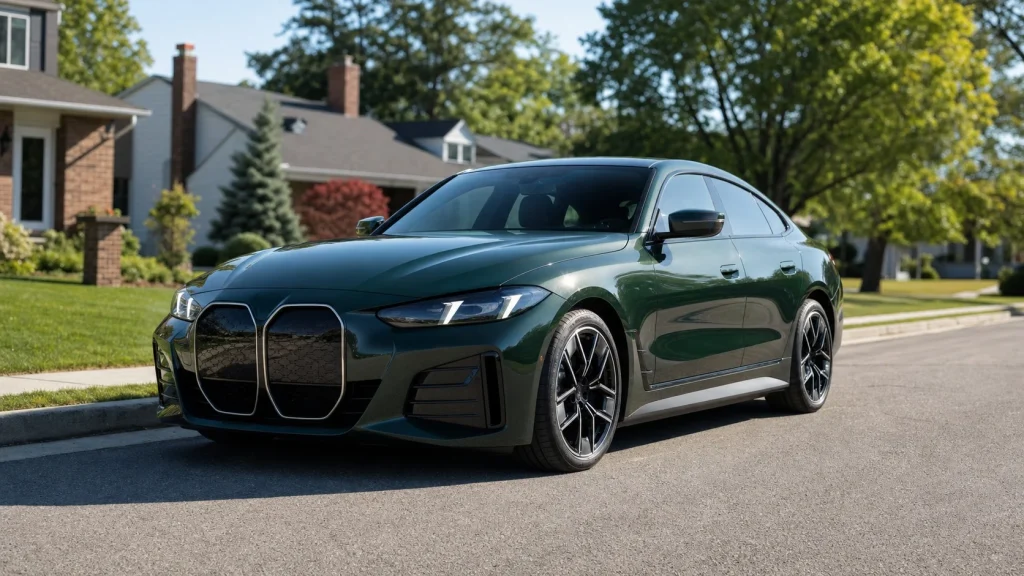
Quick answer: The 2025 BMW i4 is a premium electric Gran Coupe starting at $57,900 for the rear-wheel-drive eDrive40. Offering up to 318 miles of EPA-estimated range and peak DC fast charging of 205 kW, it balances traditional luxury driving dynamics with zero-emission technology. Although built in Germany and ineligible for federal purchasing tax credits, shoppers can secure a $7,500 rebate via promotional lease programs.
Key takeaways:
- Streamlined trim levels for the U.S. market include eDrive40, xDrive40, and the high-performance M50.
- High-speed DC fast charging replenishes the battery from 10% to 80% in approximately 28 minutes.
- Updated standard technology includes BMW’s curved display running the refreshed iDrive 8.5 operating system.
- Liftback utility provides a generous 16.6 cubic feet of trunk space, far exceeding traditional EV sedan competitors.
2025 BMW i4 Overview and Key Enhancements
The 2025 BMW i4 arrives as a key component of BMW’s electrification strategy, delivering mid-cycle enhancements to compete in the highly contested premium midsize EV segment. Unlike dedicated electric vehicles built on bespoke skateboard architectures, the i4 utilizes an adapted version of BMW’s Cluster Architecture (CLAR), shared with the internal combustion engine 4 Series Gran Coupe. This platform selection allows the i4 to retain the traditional proportions, seating position, and handling dynamics long associated with the Munich brand.
For the 2025 model year, BMW has introduced targeted updates to keep the vehicle visually and technologically fresh. Exterior styling changes include a redesigned active kidney grille surround featuring a sleek matte chrome finish, while the headlights receive revised internal vertical LED lighting patterns. The rear features updated laser-light fiber optics in the taillights, bringing visual elements previously reserved for the high-end M4 CSL. Inside the cabin, the layout has been cleaned of physical buttons, migrating climate functions directly into the curved glass touchscreen.
| Trim Attribute | 2024 BMW i4 | 2025 BMW i4 |
|---|---|---|
| Base Configuration | eDrive35 (RWD, 281 hp) | eDrive40 (RWD, 335 hp) |
| Infotainment Software | iDrive 8.0 | iDrive 8.5 with QuickSelect |
| U.S. Trim Selection | eDrive35, eDrive40, xDrive40, M50 | eDrive40, xDrive40, M50 |
| Standard Headlights | Standard LED graphics | Adaptive LED with laser-light accents |
| Infotainment Screens | 12.3-inch + 14.9-inch curved glass | 12.3-inch + 14.9-inch curved glass |
The most significant lineup adjustment for U.S. buyers is the consolidation of trim options. BMW has discontinued the entry-level eDrive35 variant, which carried a smaller battery pack and a lower power output. This shift leaves the eDrive40 as the entry point for U.S. buyers, providing a more robust standard feature list that now includes previously optional packages like a heated steering wheel, heated front seats, and a wireless phone charging pad. The software system is also upgraded to the iDrive 8.5 system, introducing a more responsive layout and a flatter menu hierarchy to improve ease of use on the go.
Comparison: 2025 BMW i4 vs 2024 BMW i4
When comparing the current model against the older 2024 BMW i4 and 2023 BMW i4 models, the 2025 version presents a more competitive tech suite and standard equipment level. While the previous years featured the eDrive35 as the lowest price point, the deletion of that trim raises the entry price but guarantees a minimum of 335 horsepower and a much larger battery. The standard active headlights and updated interior details represent a tangible step forward in material quality.
Look Ahead: 2025 BMW i4 vs 2026 BMW i4
For buyers considering the timing of their purchase, monitoring the upcoming 2026 BMW i4 is highly recommended. The 2026 model year is expected to transition some configurations to newer electric motor layouts and introduce NACS charging port integration natively, which could make the older CCS1-equipped 2025 models subject to heavier depreciation.
Performance, Powertrain, and Real-World Range
The 2025 BMW i4 powertrain configurations cater to varying priorities, separating the line into RWD efficiency, balanced AWD traction, and track-oriented dual-motor performance. The base single-motor configuration, the eDrive40, sends all its power to the rear wheels, producing 335 horsepower and 317 lb-ft of torque. According to performance evaluations by Car and Driver, the eDrive40 accelerates from 0 to 60 mph in a quiet 5.5 seconds, providing linear power delivery typical of modern electric motor designs.
For drivers needing enhanced traction in adverse weather, the xDrive40 integrates an additional electric motor onto the front axle. This dual-motor layout creates an intelligent all-wheel-drive system that actively varies torque between the front and rear axles. System output rises to 396 horsepower and 443 lb-ft of torque, dropping the 0 to 60 mph sprint time to 4.9 seconds. Under normal cruising conditions, the front motor decoupling system runs the vehicle in rear-wheel-drive mode to maximize efficiency, engaging the front axle only when wheel slip is detected.
The performance flagship remains the M50, tuned by BMW’s high-performance M division. The dual-motor AWD setup in this model generates a combined 536 horsepower and 586 lb-ft of torque when Sport Boost mode is active. This configuration launches the Gran Coupe from 0 to 60 mph in 3.7 seconds. To support this power, the M50 comes standard with an adaptive M suspension featuring electronically controlled dampers, variable sport steering, and a performance brake package with larger steel rotors.
| Specification | i4 eDrive40 | i4 xDrive40 | i4 M50 |
|---|---|---|---|
| Drive Layout | Rear-Wheel Drive (RWD) | All-Wheel Drive (AWD) | All-Wheel Drive (AWD) |
| Total Horsepower | 335 hp | 396 hp | 536 hp |
| Total Torque | 317 lb-ft | 443 lb-ft | 586 lb-ft |
| 0-60 mph Time | 5.5 seconds | 4.9 seconds | 3.7 seconds |
| Usable Battery Capacity | 81.1 kWh | 81.1 kWh | 81.1 kWh |
| EPA Range (18-inch wheels) | 318 miles | 287 miles | N/A |
| EPA Range (19-inch wheels) | 295 miles | 268 miles | 267 miles |
| EPA Range (20-inch wheels) | N/A | N/A | 227 miles |
| Combined MPGe Rating | 113 MPGe | 101 MPGe | 94 MPGe |
Battery capacity is standardized across the U.S. lineup. All three configurations use a lithium-ion battery pack with a usable capacity of 81.1 kWh (83.9 kWh gross). This pack operates on a 400-volt electrical architecture.
EPA-estimated range varies significantly based on motor count and wheel size selection. The eDrive40 on standard 18-inch wheels achieves the highest range at 318 miles, which drops to 295 miles if upgraded to 19-inch wheels. The dual-motor xDrive40 is rated at 287 miles with 18-inch wheels and 268 miles with 19-inch wheels. The M50 delivers a maximum of 267 miles on 19-inch wheels, which drops to 227 miles when optioned with wider 20-inch wheels wrapped in sticky performance tires. Real-world highway range testing indicates that drivers should expect a 10% to 15% reduction in these estimates during sustained 75-mph cruising, with mixed driving range landing at 280 to 290 miles for the eDrive40.
The regenerative braking system offers a high degree of personalization. Drivers can choose from Low, Medium, and High regen levels, or select a dedicated B mode on the gear selector for one-pedal driving that can bring the vehicle to a complete stop without touching the brake pedal. Additionally, the default Adaptive mode uses the front radar and navigation data to adjust the regeneration rate automatically, increasing engine braking when catching up to traffic or approaching intersections, and allowing the car to coast freely on open highways.
BMW i4 eDrive40 and xDrive40 Specs
The eDrive40 and xDrive40 represent the mainstream daily-driver offerings in the lineup. The rear-wheel-drive eDrive40 provides the classic balanced handling characteristics BMW is famous for, carrying a lighter front axle that sharpens steering response. The xDrive40, while heavier by approximately 240 pounds, adds substantial wet-weather confidence and acceleration pull off the line, making it highly suitable for northern climates.
BMW i4 M50 Performance Flagship
Positioned at the peak of the range, the M50 employs dual electric motors calibrated to behave like a rear-biased sport sedan. Under hard acceleration, the rear motor receives the majority of power, though the front motor intervenes instantly to maintain traction. The standard adaptive M suspension adapts to changing road surfaces in milliseconds, offering a comfortable ride in Comfort mode and minimizing body roll in Sport mode.
Battery Capacity and Charging Speeds
With a usable battery capacity of 81.1 kWh, the i4 supports a maximum DC fast charging speed of 205 kW. When connected to a compatible high-speed public charger, the battery can replenish from 10% to 80% in 28 minutes under optimal temperature conditions. For home charging, the onboard charger is rated at 11 kW, allowing a full 0% to 100% charge to complete in just over 8 hours using a standard Level 2 wallbox.
Interior Design, Comfort, and Hatchback Utility
The interior of the 2025 BMW i4 is heavily influenced by modern digital integration, moving almost all climate and secondary functions into the screens. Standard equipment features perforated SensaTec synthetic leather, which covers sport seats with deep side bolsters. Buyers can upgrade to Vernasca leather, available in multiple shades with contrast stitching. Trim options include open-pore ash wood, aluminum mesh, and carbon fiber.
While the front seats offer excellent support and an accommodating driving position, the packaging of the CLAR platform creates compromises in the rear. Because the chassis is shared with gasoline models, the cabin floor contains a prominent transmission tunnel hump that limits foot room for a middle rear passenger. The sloping roofline also restricts rear headroom, making the space tight for passengers over six feet tall.
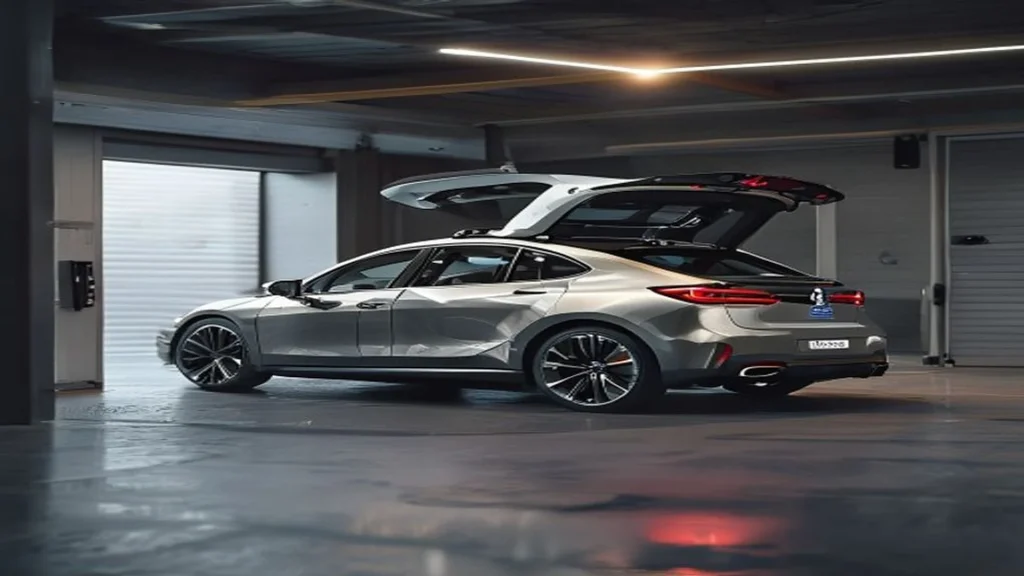
Unlike the Tesla Model 3, which uses a traditional sedan trunk lid, the i4 utilizes a liftback design. The entire rear glass lifts with the trunk lid, creating a large cargo opening that makes loading bulky items straightforward.
- Seats-Up Cargo Volume: The i4 provides 16.6 cubic feet of space behind the second row.
- Seats-Folded Cargo Volume: Folding the 40-20-40 split-fold rear seats flat expands the cargo volume to 45.6 cubic feet.
- Tesla Model 3 Comparison: The Model 3 offers 14.9 cubic feet of cargo space in a traditional trunk layout.
- Storage Compartments: Under the i4’s trunk floor, a small compartment houses the standard charging cord and tire repair kit.
- Under-Hood Storage: The i4 does not have a front trunk (frunk), as the space under the hood is filled with power electronics, steering gear, and cabin climate systems.
This packaging makes the i4 highly versatile for buyers needing to transport larger items like bicycles or bulk luggage, despite the narrow passenger space in the second row.
Curved Display Tech and Refreshed iDrive 8.5 Interface
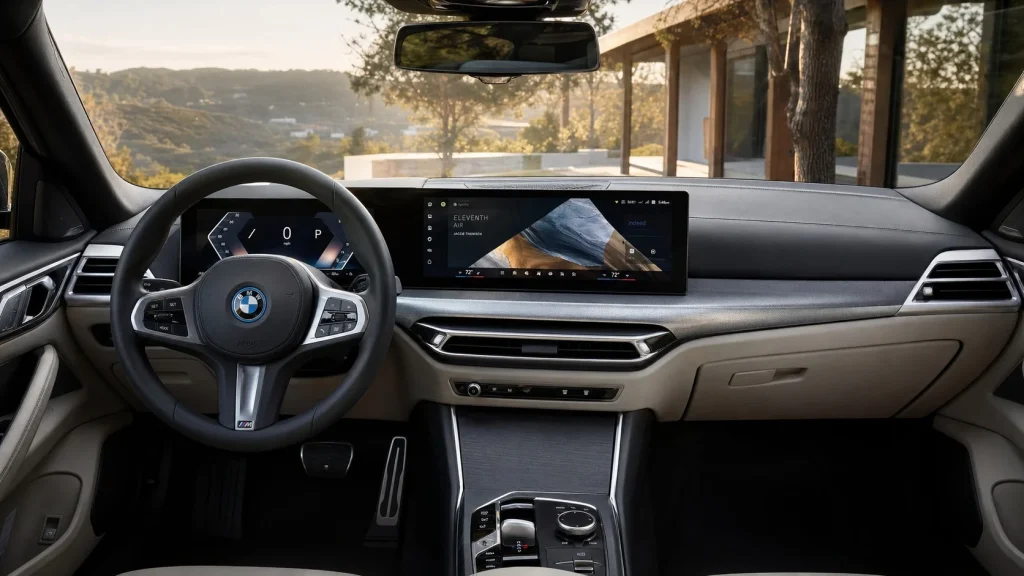
The dashboard is dominated by the BMW Curved Display, which places a 12.3-inch digital instrument cluster and a 14.9-inch infotainment screen under a single piece of anti-reflective glass. For 2025, the system runs the updated iDrive 8.5 software. This update introduces QuickSelect functionality, which uses widget tiles on the driver’s side of the screen to activate primary menus without drilling down into submenus.
Passenger Cabin Dimensions and CLAR Platform Compromises
The shared CLAR platform means the i4 inherits the proportions of a gas-powered car, including a long hood and a prominent transmission tunnel. This structure reduces the passenger cabin volume compared to dedicated EVs of similar exterior dimensions, making the rear seat feel narrow. Headroom is similarly limited by the fastback profile, which requires passengers to duck slightly during entry.
Hatchback Cargo Capacity vs Tesla Model 3 Trunk
While the Tesla Model 3 offers a slightly wider cabin, the i4’s hatchback utility represents a major advantage for utility. The wide hatch opening allows owners to load boxes and gear that would not fit through the Model 3’s trunk opening. When the rear seats are folded flat, the 45.6 cubic feet of total storage allows the i4 to function like a compact utility vehicle.
Safety Ratings and Driver Assistance Suites
The structural safety of the i4 is backed by crash test data from the Insurance Institute for Highway Safety (IIHS), which awards the sedan a top rating of Good in both small overlap front and side crash tests. The active safety suite is powered by camera and radar networks to prevent collisions.
Standard active safety features include:
- Frontal Collision Warning: Detects vehicles and pedestrians ahead, preparing the brakes for emergency stops.
- City Collision Mitigation: Automatically applies the brakes at low speeds to prevent rear-end collisions.
- Active Blind Spot Detection: Displays warning lights in the side mirrors and vibrates the steering wheel during lane changes.
- Lane Departure Warning: Uses steering wheel feedback and active steering corrections to keep the car centered.
Buyers can opt for the Driving Assistance Professional Package, which introduces semi-autonomous driving capabilities. This package features BMW’s Highway Assistant, which allows for hands-free driving on pre-mapped U.S. highways at speeds up to 85 mph. The package also includes a traffic jam assistant that handles stop-and-go driving, an active lane change system, and evasive steering aids.
Pricing, Trim Options, and the $7,500 Lease Loophole
The 2025 BMW i4 is priced to sit in the premium tier of the compact EV class. The entry-level eDrive40 carries a starting MSRP of $57,900, which rises to $62,300 for the all-wheel-drive xDrive40. The high-performance i4 M50 commands a starting price of $70,700. All U.S. configurations are subject to a mandatory $1,175 destination and delivery charge.
| Cost Component | i4 eDrive40 | i4 xDrive40 | i4 M50 |
|---|---|---|---|
| Base MSRP | $57,900 | $62,300 | $70,700 |
| Destination Charge | $1,175 | $1,175 | $1,175 |
| Starting MSRP (inc. dest) | $59,075 | $63,475 | $71,875 |
| Purchase EV Tax Credit | $0 | $0 | $0 |
| Lease Loophole Credit | $7,500 | $7,500 | $7,500 |
| Typical Option Package Cost | $3,500-8,000 | $3,500-8,000 | $5,000-12,000 |
Federal tax credit rules significantly alter the net cost of the i4. Because the vehicle is manufactured in Munich, Germany, it does not meet the North American assembly requirement under Section 30D of the Internal Revenue Code. As a result, purchasing a new 2025 BMW i4 yields a federal tax credit of $0.
However, the federal clean-vehicle rules contain a commercial clean-vehicle credit under Section 45W. This section exempts commercial leases from assembly location requirements. BMW Financial Services utilizes this provision by claiming a commercial tax credit and passing the savings directly to consumers as a $7,500 promotional lease credit (Lease Cash) at signing. For U.S. shoppers, leasing the i4 effectively reduces the price by $7,500, making leasing a more financially attractive path than buying.
IRS Clean Vehicle Credits: Section 30D vs Section 45W Commercial Lease Loophole
The clean vehicle tax credit structure represents a major factor in luxury EV shopping. While cash purchases or traditional loans receive no federal incentives, the commercial lease provisions in the IRS Section 45W allow foreign-made vehicles to qualify. BMW Financial Services applies this $7,500 credit directly to the lease capital cost reduction, lowering the monthly payments for the consumer.
Market inventory reports add a secondary advantage for buyers. According to dealer data published by iSeeCars, approximately 89.2% of 2025 BMW i4 inventory in the U.S. remained unsold at dealerships in late 2025, driven by slowing EV demand. This buildup of new car stock gives buyers strong leverage when negotiating transaction prices and interest rates at dealerships.
Note: These lease credits and promotional incentives require financing through BMW Financial Services and are subject to change. Always verify the current lease credit sheets with your dealer before signing.
Competitor Comparison: BMW i4 vs Tesla Model 3 and Audi e-tron GT
U.S. buyers shopping in the premium EV space typically cross-shop the i4 against the Tesla Model 3 and the Audi e-tron GT. These models offer distinct approaches to packaging, pricing, and cabin quality.
| Metric | BMW i4 eDrive40 | Tesla Model 3 Long Range | Audi e-tron GT |
|---|---|---|---|
| Base MSRP | $57,900 | $47,740 | $104,700 |
| Drivetrain Layout | Single Motor (RWD) | Dual Motor (AWD) | Dual Motor (AWD) |
| EPA Range | Up to 318 miles | 341 miles | 249 miles |
| 0-60 mph Acceleration | 5.5 seconds | 4.2 seconds | 3.9 seconds |
| Cargo Access | Hatchback (16.6 / 45.6 ft³) | Trunk (14.9 ft³) | Trunk (9.2 ft³) |
| Charging standard | CCS1 (NACS adapter) | NACS (Native) | CCS1 (NACS adapter) |
| Interior Quality | Premium luxury materials | Minimalist synthetic materials | Ultra-premium materials |
The Tesla Model 3 Long Range costs roughly $10,000 less, provides dual-motor AWD as standard, and delivers longer range estimates. However, the BMW i4 excels in cabin quietness and build quality. The interior of the i4 uses premium soundproofing materials that suppress road noise, and its assembly avoids the panel gap and rattle issues common in early Tesla production lines. The i4’s hatchback utility also provides a larger opening for carrying bulky cargo than the Model 3’s narrow trunk.
Against the Audi e-tron GT, the i4 represents a strong value proposition. The e-tron GT operates in a higher price tier, starting over $100,000. Despite its high price, the Audi e-tron GT delivers an EPA-estimated range of only 249 miles, which is lower than any version of the i4 eDrive40. The e-tron GT is rated at an inefficient 85 MPGe combined, whereas the i4 eDrive40 achieves 113 MPGe combined, making the BMW much cheaper to charge over time.
To explore other configurations in the brand’s electric portfolio, buyers can visit the main BMW i4 hub page.
Ownership Experience: Charging Infrastructure, Maintenance, and Depreciation
The daily ownership experience of the i4 centers around charging convenience. For home charging, U.S. owners typically install an 11-kW Level 2 wallbox running on a 240-volt circuit. This setup charges the i4 from 0% to 100% in approximately 8 to 8.25 hours, allowing owners to replenish the battery overnight.
For public charging, the i4 supports a peak DC fast charging rate of 205 kW. When connected to a high-power charger, the battery can charge from 10% to 80% in 28 minutes under normal temperatures.
Maintenance costs are lower than those of a gasoline 3 Series. Without an engine, the i4 requires no oil changes, spark plug replacements, or transmission fluid flushes. The standard service schedule consists of cabin air filter replacements every 12,000 miles, brake inspections, tire rotations, and battery coolant checks at 24,000-mile intervals. Brake wear is also reduced because the regenerative braking system handles most slowing duties.
Depreciation data shows the i4 holding its value better than larger luxury EVs. Five-year depreciation projections from iSeeCars indicate the i4 retains approximately 31.9% of its value over five years (a depreciation rate of 68.1%), which is better than the Audi e-tron GT’s 71.9% depreciation rate. This makes the i4 a safer luxury investment, especially when leasing cash is used to offset initial depreciation.
Home vs Public Charging Infrastructure
Level 2 home charging represents the most convenient and cost-effective method to power the i4, utilizing off-peak residential utility rates. However, for highway travel, owners rely on public DC fast chargers. Although the CCS1 charging port requires an adapter to access the Tesla Supercharger network, the 205 kW charging speed minimizes charging downtime.
Maintenance Requirements and Service Schedules
Without the complex mechanical components of an internal combustion engine, the i4 service requirements are minimal. Aside from regular cabin air filter swaps and tire rotations, key service visits are limited to checking the high-voltage battery coolant level. Brake pads and rotors routinely last past 70,000 miles due to the heavy reliance on regenerative motor braking.
Five-Year Depreciation Rates
While electric vehicles generally experience steeper depreciation curves than gasoline cars, the i4 outperforms the segment average. Retaining 31.9% of its original value after 5 years, it avoids the rapid loss of value that plagues larger, six-figure luxury EVs. This moderate rate of depreciation makes leasing a secure option to hedge against battery tech obsolescence.
Original Value Analysis: Is the 2025 BMW i4 Worth the Premium?
To evaluate the value of the 2025 BMW i4, it is helpful to look past marketing claims and run a swap test. If we swap the electric motor for a gasoline engine, the i4 drives and feels exactly like a traditional BMW 4 Series Gran Coupe. This is the i4’s greatest strength: it does not attempt to redefine the car interface. The seating position is low, the steering wheel is thick and heavy, and the vehicle handles with the rear-wheel-drive balance that BMW buyers expect.
However, this traditional design leads to compromises. The heavy steel chassis, adapted from gasoline models, weighs over 4,600 pounds. This weight can be felt when cornering hard on uneven pavement. The lack of a front trunk (frunk) and the cramped rear seats are also direct results of using a shared platform.
The i4 is worth the premium for buyers who want a premium, quiet electric vehicle that looks and drives like a real sport sedan. It is not recommended for buyers who prioritize maximum range per dollar, or families who need roomy rear seats and maximum cargo storage.
Platform Sharing Strengths and Compromises
Utilizing the CLAR platform allows BMW to build the i4 on the same assembly lines as its gasoline cars, keeping build quality high. However, this engineering compromise means the electric components are packaged into spaces originally designed for engines and exhaust pipes. The result is the omission of a front trunk (frunk) and a tight rear floor board.
buying vs Leasing Verdict
Given the lack of a purchase tax credit and the high supply of unsold vehicles, leasing is the recommended acquisition strategy for the 2025 model. The $7,500 lease rebate offsets the initial depreciation hit, while dealer inventories of nearly 90% unsold units in late 2025 provide significant leverage to negotiate lower monthly payments.
Expert view: For shoppers looking at the pre-owned market, older models offer excellent savings, while those looking to the future can monitor subsequent tech updates. To browse other configurations in the brand’s electric portfolio, visit the main hub page.
Frequently Asked Questions
How much does the 2025 BMW i4 cost?
The 2025 BMW i4 starts at $57,900 for the RWD eDrive40, $62,300 for the AWD xDrive40, and $70,700 for the performance-focused M50 model. These MSRP figures do not include the standard U.S. destination charge of $1,175.
What is the real-world range of the BMW i4?
While EPA estimates claim up to 318 miles, real-world highway testing shows the eDrive40 typically achieves 280 to 290 miles of range in mixed conditions. Cold winter weather below freezing can reduce this range by 15% to 20%.
How does the BMW i4 compare to Tesla Model 3?
The BMW i4 offers vastly superior cabin assembly, premium soft-touch materials, and better sound insulation than the Tesla Model 3. However, the Tesla Model 3 costs less, has longer EPA range estimates, and has native access to the Supercharger network.
Is the BMW i4 eligible for federal tax credits?
A purchased 2025 BMW i4 is not eligible for the federal EV tax credit because it is manufactured in Germany. However, if you lease the i4, BMW Financial Services passes down a $7,500 commercial clean vehicle lease credit directly to the customer.
What are the main problems with the BMW i4?
The primary issues are restricted rear-seat legroom and headroom due to the sloping roofline, the lack of a front trunk (frunk), and heavy curb weight compared to a gas-powered 3 Series.
How long does it take to charge a BMW i4?
On a public DC fast charger supporting 205 kW peak power, the i4 charges from 10% to 80% in approximately 28 minutes. Level 2 home charging with an 11 kW wallbox requires just over 8 hours for a 100% charge.
Is the BMW i4 rear seat spacious enough for adults?
The rear seats are cramped for adults over six feet tall due to the sloping Gran Coupe roofline. The rear door openings are also narrow, making entry and exit tighter than in a traditional 3 Series sedan.
What is new on the 2025 BMW i4 vs 2024 model?
Updates for 2025 include redesigned LED headlamp graphics, standard laser-effect rear taillights, Vegas Red and Cape York Green paint additions, and the upgraded iDrive 8.5 interface.

