

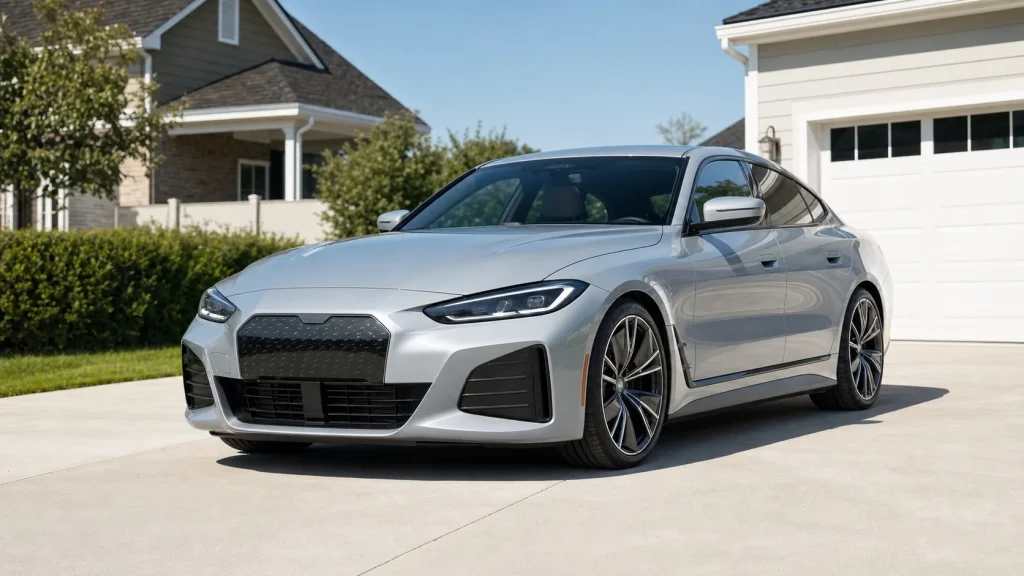
Quick answer: The 2024 BMW i4 is a premium electric sport sedan starting at $52,200 for the base eDrive35 trim, with the volume-leading eDrive40 offering up to 301 miles of EPA-estimated range. While delivering BMW’s signature driving dynamics, the 2024 model year is affected by key recalls, including a structural chassis beam defect and drive power software issues.
Key takeaways:
- The 2024 i4 lineup offers four distinct trims (eDrive35, eDrive40, xDrive40, M50) ranging from 282 to 536 horsepower.
- Base MSRPs range from $52,200 to $69,700, making the i4 significantly more expensive than the Tesla Model 3.
- Real-world highway range typically falls 10% to 15% below EPA estimates under steady 75-mph highway driving conditions.
- A structural recall (NHTSA 24V-611) affects approximately 1,150 units of the eDrive40, xDrive40, and M50 builds.
The 2024 BMW i4 represents a bridge between traditional automotive luxury and modern electrification. As a key entry in the broader BMW i4 model family, the vehicle is built on BMW’s modular CLAR platform, which also underpins the internal combustion 4 Series Gran Coupe. This design decision gives the i4 its classic, long-hood sports sedan proportions, but it also comes with minor interior compromises, such as a prominent transmission tunnel hump in the rear footwell.
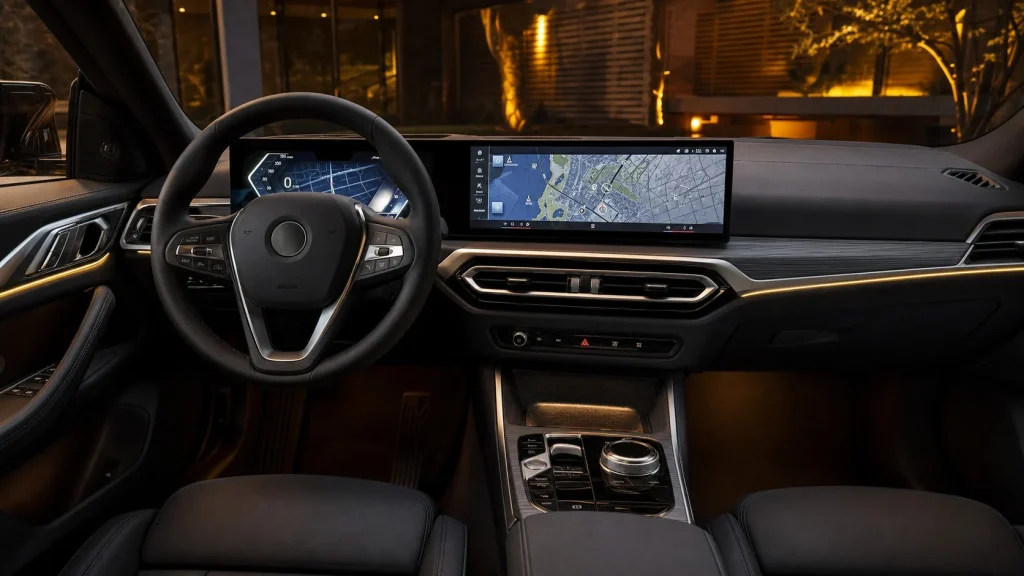
The primary target buyer for the BMW i4 is the luxury customer who wants to transition to an electric vehicle without abandoning traditional vehicle ergonomics, dashboard layouts, and build quality. BMW caters to this audience by offering a conventional cabin layout that features physical switchgear alongside digital displays. This approach contrasts sharply with the minimalist, screen-centric philosophy of the Tesla Model 3.
For the 2024 model year, the most significant change is the introduction of the dual-motor xDrive40 trim. While the model builds on the performance characteristics established by the 2023 BMW i4, this new variant fills a substantial price and performance gap between the rear-wheel-drive eDrive40 and the high-performance M50 flagship. Additionally, the 2024 models receive an updated infotainment system running iDrive 8.5, which refines menu navigation and quick-access climate controls.
| Vehicle Dimension | Spec Value | Cargo Configuration | Volume (Cubic Feet) |
|---|---|---|---|
| Wheelbase | 112.4 inches | Rear Seats Up | 17.0 cubic feet |
| Overall Length | 188.3 inches | Rear Seats Folded | 45.6 cubic feet |
| Overall Width | 72.8 inches | Front Trunk (Frunk) | None |
| Curb Weight | 4,553 to 5,078 lbs | Tailgate Style | Power Liftback |
According to official specifications from BMW USA, the i4’s hatchback design offers significantly more cargo loading flexibility than a traditional sedan trunk. However, the conversion from the CLAR gasoline platform means that there is no storage area under the hood. The space normally reserved for a front trunk is occupied by structural bracing, power electronics, and thermal management systems.
Trim Level Breakdown and MSRP Analysis
The starting price of the 2024 BMW i4 varies considerably across its four trim configurations. These base MSRP figures do not include the standard $995 destination charge, local sales taxes, registration fees, or dealer doc fees. Because the i4 is manufactured at BMW’s Munich plant in Germany, it does not qualify for the federal $7,500 EV tax credit at the time of purchase, though buyers can circumvent this restriction by choosing to lease the vehicle.
eDrive35 (Base Trim)
The entry-level eDrive35 starts at a base MSRP of $52,200. It utilizes a smaller 66.0 kWh usable battery pack and a single rear electric motor generating 282 horsepower. While it lacks the straight-line speed of the higher trims, its 276-mile EPA range is sufficient for daily suburban commuting. It is best suited for buyers who want the styling and cabin quality of the i4 but do not require maximum range or high-performance acceleration.
eDrive40 (The Volume Leader)
For most buyers, the eDrive40 represents the best overall balance of range, performance, and price. Starting at $57,300, upgrading to this trim brings the larger 81.5 kWh usable battery pack and a more powerful 335-horsepower rear motor. Crucially, it provides the maximum EPA range of 301 miles on 18-inch wheels, reducing range anxiety during longer road trips. The $5,100 price increase over the base model is justified by the larger battery and improved power.
xDrive40 (All-Weather AWD)
The xDrive40 is a new addition for the 2024 model year, introducing dual-motor all-wheel drive to the non-M lineup. With a starting MSRP of $61,600, it puts out 396 horsepower and 443 lb-ft of torque, reducing the 0-60 mph sprint time to 4.9 seconds. Despite the added front motor, it retains an impressive 307-mile EPA range when fitted with 18-inch wheels. This variant is highly recommended for buyers living in cold climates who require all-weather traction but want to maximize range.
M50 (Flagship Performance)
The M50 is the top-tier variant developed in collaboration with BMW’s M division, starting at $69,700. It features dual electric motors generating a combined 536 horsepower and 586 lb-ft of torque. It comes standard with the Adaptive M Suspension, upgraded M Sport brakes, and unique exterior aerodynamic styling. Performance is intense, matching the acceleration of high-end sports cars. However, the performance bias reduces range to 269 miles on 19-inch wheels, and selecting the optional 20-inch wheels drops the EPA estimate to 227 miles.
Powertrain, Horsepower, and Performance Specs
The driving experience of the 2024 BMW i4 is engineered to mimic the handling characteristics of the gas-powered 3 Series and 4 Series. By mounting the heavy lithium-ion battery packs flat under the floorboards, BMW achieved a very low center of gravity. This placement, combined with a near-equal front-to-rear weight distribution, minimizes body roll and allows the heavy electric sedan to feel agile during cornering.
The steering calibration is precise and weight increases naturally with speed, keeping the traditional road feel that BMW enthusiasts expect. Drivetrains vary from single-motor rear-wheel-drive configurations to dual-motor all-wheel-drive layouts. Every trim level utilizes current-generation electrically excited synchronous motors that avoid the use of rare-earth permanent magnets.
- eDrive35: 282 horsepower and 295 lb-ft of torque (single motor, RWD).
- eDrive40: 335 horsepower and 317 lb-ft of torque (single motor, RWD).
- xDrive40: 396 horsepower and 443 lb-ft of torque (dual motors, AWD).
- M50: 536 horsepower and 586 lb-ft of torque (dual motors, AWD, in Sport Boost).
Power delivery across all trims is linear, avoiding the sudden neck-snapping jolt common in some electric cars. Instead, BMW tuned the throttle response to build momentum rapidly but smoothly. The rear air suspension, which comes standard on all i4 models, self-levels to maintain chassis stability when carrying rear passengers or heavy cargo. An optional Adaptive M Suspension is available on the eDrive40 and xDrive40, and comes standard on the M50, allowing drivers to adjust damper stiffness between Comfort and Sport modes.
The i4 features a customizable regenerative braking system. In the standard driving mode (D), the vehicle utilizes adaptive regeneration, which uses radar sensors and navigation data to automatically adjust braking force based on surrounding traffic. For drivers who prefer one-pedal driving, sliding the gear selector into B-mode applies maximum regenerative force, allowing the car to come to a complete stop without the driver pressing the physical brake pedal.
Real-World Range and Battery Capacity
Range performance for the 2024 BMW i4 varies significantly based on motor configuration and wheel size selection. The single-motor eDrive40 equipped with standard 18-inch wheels achieves the longest range for RWD trims at an EPA-estimated 301 miles. The dual-motor xDrive40 is rated slightly higher at 307 miles due to different power management software, while the high-performance M50 model drops to 269 miles on 19-inch wheels.
Real-world range testing conducted by automotive outlets indicates that the i4 typically achieves between 85% and 90% of its official EPA range when driving at steady highway speeds of 75 mph. In cold winter climates, range degradation can increase to 15% to 20% due to the energy required to heat the battery pack and cabin, though standard heat pumps on 2024 models help mitigate this loss.
| Trim Level | Wheel Size | EPA Range | Real-World Highway Range | Battery Capacity (Usable) |
|---|---|---|---|---|
| eDrive35 | 18-inch | 276 miles | 240 miles | 66.0 kWh |
| eDrive35 | 19-inch | 252 miles | 220 miles | 66.0 kWh |
| eDrive40 | 18-inch | 301 miles | 270 miles | 81.5 kWh |
| eDrive40 | 19-inch | 283 miles | 250 miles | 81.5 kWh |
| xDrive40 | 18-inch | 307 miles | 275 miles | 80.7 kWh |
| xDrive40 | 19-inch | 279 miles | 245 miles | 80.7 kWh |
| M50 | 19-inch | 269 miles | 235 miles | 81.5 kWh |
| M50 | 20-inch | 227 miles | 195 miles | 81.5 kWh |
Selecting wheels also affects styling and range. The standard 18-inch aerodynamic wheels feature plastic inserts that smooth air turbulence around the wheel arches. Upgrading to the sportier 19-inch M double-spoke wheels improves visual appeal but increases rolling resistance, reducing the eDrive40’s range from 301 miles to 283 miles. Buyers should weigh this range reduction before choosing larger wheel options.
DC Fast Charging and Home Charging Times
Charging capability is robust, but the i4 does not feature the 800-volt architecture found in competitors like the Hyundai Ioniq 6 or Porsche Taycan. The eDrive40, xDrive40, and M50 models support DC fast charging. While the eDrive40 and M50 support rates up to 200 kW, the xDrive40 peaks at 205 kW. Under optimal temperature conditions, this charging speed adds approximately 90 to 108 miles of range in 10 minutes and charges the battery from 10% to 80% in 38 minutes.
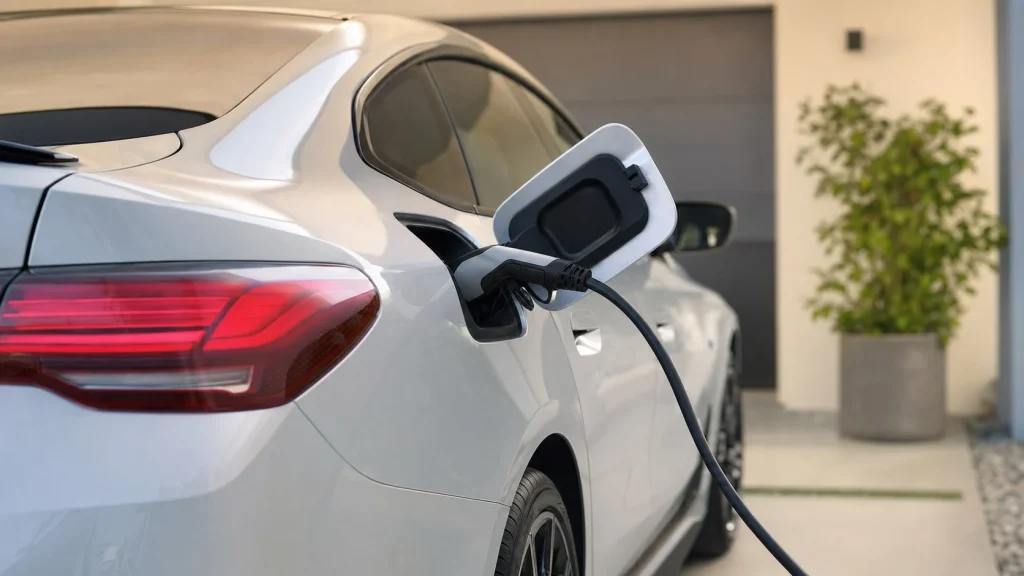
The entry-level eDrive35 peaks at a lower 180 kW charging rate. However, due to its smaller battery pack, it completes the 10% to 80% charge in a shorter time of approximately 32 minutes.
For home charging, the i4 has an 11 kW onboard charger. When connected to a 240-volt Level 2 charger pulling 48 amps, a full 0% to 100% charge takes roughly 8.25 hours for the larger battery pack. If using a standard 40-amp home outlet charger, charging times extend to approximately 10 hours.
Safety Recalls and Structural Integrity
Every 2024 BMW i4 is equipped with the Active Driving Assistant suite. This safety package includes forward-collision warning, pedestrian detection, automatic emergency braking, lane-departure warning, and active blind-spot detection. Buyers can opt for the Driving Assistant Professional package, which adds hands-free highway driving capability at speeds up to 37 mph, adaptive cruise control with stop-and-go functionality, and lane-keeping assist with side-collision avoidance.
Despite these safety features, the 2024 model year has been subject to critical recalls. According to safety reports filed with the NHTSA, under NHTSA recall campaign 24V-611, BMW recalled approximately 1,150 units of the 2024 i4 eDrive40, xDrive40, and M50 models built between March 7 and April 27, 2024. The recall report states that the rear left-side longitudinal chassis beam may not have been manufactured to supplier specifications and can develop cracks near a rivet flange. A cracked chassis beam can compromise the vehicle’s structural integrity, allowing excessive cabin deformation in a rear crash and potentially damaging the high-voltage battery, which increases injury and fire risks.
Note: Owners of 2024 BMW i4 models built in early 2024 should check their VIN on the NHTSA recall registry. BMW dealers inspect the chassis beam and, if cracks or defects are found, replace the affected structural parts free of charge.
Additionally, a broader software recall affects over 35,000 BMW electric vehicles, including i4 models from the 2022 to 2025 model years. The issue involves the electric drive motor control unit software, which can trigger an unexpected shutdown of the high-voltage system, causing a sudden loss of propulsion power while driving. BMW has resolved this issue via a free software patch that dealers apply in person or deploy through over-the-air updates.
Another battery-related recall affects a small number of early 2024 i4 xDrive40 and M50 models. The high-voltage battery modules may have been manufactured with insufficient weld seams, which can cause internal electrical resistance, leading to localized overheating and a potential fire. Dealers replace the entire affected battery module under warranty to correct this hazard.
Long-Term Value and Cost of Ownership
To understand the long-term value of the 2024 BMW i4, we must analyze the real-world operating costs. For an average American driver traveling 15,000 miles per year, charging a 2024 i4 eDrive40 at home using the national average electricity rate of $0.16 per kWh costs approximately $640 annually. In comparison, fueling a gas-powered BMW 440i Gran Coupe, which averages 25 mpg combined, with premium gasoline at $4.00 per gallon costs roughly $2,400 annually. This represents an annual fuel savings of $1,760.
Over a five-year ownership cycle, these savings accumulate to $8,800. Furthermore, because electric vehicles do not require engine oil changes, spark plug replacements, or complex transmission servicing, routine maintenance costs are lower. However, buyers must factor in tire wear. The heavy weight of the battery pack, resulting in a 4,680-pound curb weight for the eDrive40, and the instant torque of the electric motors cause tires to wear out 20% to 30% faster than on a comparable gasoline sports sedan. Buyers who are open to purchasing newer model years should also consider the mid-cycle updates introduced in the 2025 BMW i4 or explore the upcoming 2026 BMW i4 before making a final decision.
Head-to-Head Comparison: BMW i4 vs. Competitors
The primary competitor for the 2024 BMW i4 is the Tesla Model 3. While a comparable Tesla Model 3 Long Range AWD starts at $47,490, the i4 eDrive40 starts at $57,300, representing a premium of $9,810. The Tesla offers superior EPA range (341-346 miles) and native access to the Tesla Supercharger network, which remains the most reliable charging infrastructure in the United States. However, the BMW i4 offers vastly superior build quality, paint finishes, and interior sound isolation, with fewer squeaks and rattles over time.
Another key alternative is the Polestar 2. The Polestar 2 features a similar high-riding fastback shape with a practical rear liftback door. It starts at a lower price point and features a highly functional Google Android Automotive infotainment system. However, the Polestar 2 has a stiffer, less comfortable ride than the i4, and its rear seat legroom is even tighter.
| Feature | BMW i4 eDrive40 | Tesla Model 3 Long Range AWD | Polestar 2 Long Range Single Motor |
|---|---|---|---|
| Base Price (MSRP) | $57,300 | $47,490 | $51,300 |
| Horsepower | 335 hp | 425 hp | 299 hp |
| EPA Range | 301 miles | 341-346 miles | 320 miles |
| 0-60 mph Time | 5.4 seconds | 4.2 seconds | 5.9 seconds |
| Charging Network | CCS (NACS adapter ready) | Native NACS Supercharger | CCS (NACS adapter ready) |
| Hatchback Design | Yes | No (Traditional Trunk) | Yes |
For buyers seeking more luxury space, the Genesis Electrified G80 is an alternative. It provides superior rear-passenger accommodations and standard executive luxury features. However, the Genesis is significantly larger, heavier, and more expensive, starting at over $74,000, which positions it in a class above the compact i4.
Expert view: The 2024 BMW i4 is an excellent driver’s car, but it is not a dedicated EV design. If you regularly carry rear passengers or require maximum cargo versatility, a crossover EV like the BMW iX or a dedicated EV platform like the Hyundai Ioniq 5 will offer much better packaging and interior space.
Frequently Asked Questions
Is the 2024 BMW i4 reliable compared to Tesla Model 3?
The BMW i4 has moderate overall reliability, but it faces more frequent minor electrical and infotainment glitches than the Tesla Model 3. However, the mechanical build quality, paint durability, and cabin materials of the i4 are significantly better than the Tesla, which has a history of panel gaps and interior trim wear.
What are the most common problems with BMW i4 owners report?
The most frequent owner complaints center on software glitches. These include wireless Apple CarPlay dropping connections, GPS navigation drift, and Level 2 home charger handshake failures. Drivetrain components are mechanically reliable, but high-voltage software recalls have required dealer updates.
How does BMW i4 real-world range compare to EPA estimates?
In real-world highway testing at 75 mph, the i4 typically delivers 85% to 90% of its EPA-estimated range. In freezing temperatures, range can drop by 15% to 20% due to battery thermal management and cabin heating demands, despite the standard cabin heat pump.
Should I buy the eDrive40 or xDrive40 BMW i4?
The eDrive40 is recommended for buyers in warm climates who want to maximize range and value. The xDrive40 is the preferred choice for buyers in colder climates who require all-wheel-drive traction, offering 396 horsepower and a 307-mile range for a $4,300 price premium.
Is the BMW i4 worth more than a Tesla Model 3?
The premium price of the i4 is justified if you prioritize premium cabin materials, traditional dashboard controls, superior ride comfort, and quiet highway cruising. If you want the best range-per-dollar ratio and a superior fast-charging network, the Tesla Model 3 is the better value.
What BMW i4 recalls should I know about before buying?
The most critical recall is NHTSA campaign 24V-611, which affects approximately 1,150 units of the 2024 model year due to potential rear left longitudinal chassis beam cracks. Other recalls include electric drive software updates and high-voltage battery module weld defects.
Does the BMW i4 have enough rear seat space for adults?
Rear passenger space is tight. The i4 offers 34.2 inches of rear legroom, and the sloping roofline restricts headroom for adults over six feet tall. The rear middle seat is especially cramped due to the prominent floor hump inherited from the CLAR gasoline platform.
How long does BMW i4 charging take on road trips?
At a 250 kW DC fast charger, the i4 eDrive40 can recharge from 10% to 80% in approximately 38 minutes, peaking at a 205 kW charging rate. This adds about 90 to 108 miles of range every 10 minutes under optimal battery temperature conditions.
Disclaimer: Recalls and safety ratings may vary by vehicle identification number (VIN). Consult the NHTSA database or an authorized dealer for specific vehicle safety details.

