

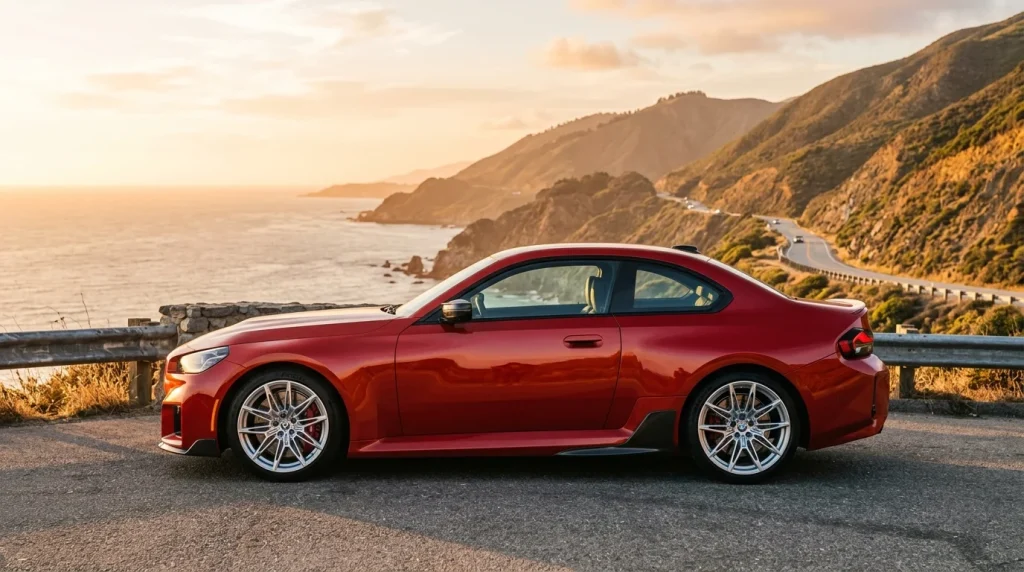
Quick answer: The 2025 BMW M2 is a rear-wheel-drive compact performance coupe starting at $66,075 including destination charge, powered by a 3.0-liter twin-turbocharged inline-six (S58) engine producing 473 horsepower. The latest model year introduces a 20-horsepower bump, updated iDrive 8.5 technology on a simplified curved screen layout, new paint options, and standalone carbon fiber bucket seat availability, representing the final manual transmission sports car in the BMW M lineup.
Key takeaways:
- Base starting MSRP is $66,075 including $1,175 destination charge, with no price penalty for selecting the 6-speed manual transmission.
- S58 engine output climbs by 20 horsepower to 473 hp, with automatic models receiving a torque bump to 443 lb-ft while manuals remain at 406 lb-ft.
- Tech updates feature BMW Operating System 8.5 on a curved dual-screen, moving climate buttons to screen-only and voice control.
2025 BMW M2 Performance, Engine, and S58 Upgrades
The S58 twin-turbocharged 3.0-liter inline-six engine in the 2025 BMW M2 receives a revised engine mapping that raises power output to 473 horsepower at 6,250 rpm. This is a 20-horsepower increase over the previous model year, aligning the compact coupe directly with the base outputs of its larger M3 and M4 siblings. Torque delivery varies depending on the chosen transmission, with the 8-speed automatic version climbing to 443 lb-ft of torque, while the 6-speed manual transmission remains limited to 406 lb-ft of torque.
The S58 powerplant features a closed-deck engine block design, which provides superior structural integrity compared to older open-deck engines like the N54 and N55. This architecture reinforces the cylinder walls to handle increased boost pressure, while forged internals and a 9.3:1 compression ratio support long-term durability under high thermal loads.
Under optimal driving conditions, acceleration performance is competitive with significantly more expensive sports cars. The 8-speed automatic M2 achieves a factory-estimated 0-60 mph time of 3.9 seconds, while the 6-speed manual model completes the sprint in 4.1 seconds. However, independent instrumented tests have recorded real-world 0-60 mph acceleration times as low as 3.6 seconds for the automatic and 3.8 seconds for the manual. Top speed is electronically capped at 155 mph, though purchasing the optional M Driver’s Package raises this limiter to 177 mph.
| Specification Metric | 6-Speed Manual Coupe | 8-Speed Automatic Coupe |
|---|---|---|
| S58 Engine Layout | 3.0L Twin-Turbo I6 | 3.0L Twin-Turbo I6 |
| Peak Power Output | 473 hp @ 6,250 rpm | 473 hp @ 6,250 rpm |
| Peak Torque Output | 406 lb-ft @ 2,650-6,130 rpm | 443 lb-ft @ 2,650-6,130 rpm |
| Factory 0-60 mph Claim | 4.1 seconds | 3.9 seconds |
| Independent 0-60 mph Test | 3.8 seconds | 3.6 seconds |
| Curb Weight | 3,814 lbs | 3,867 lbs |
| Wheel and Tire Setup | Staggered 19-inch front / 20-inch rear | Staggered 19-inch front / 20-inch rear |
| EPA Fuel Economy (City/Hwy) | 16 / 24 mpg | 16 / 23 mpg |
To handle this power, the M2 employs a staggered wheel diameter configuration. It rides on 19×9.5-inch front wheels wrapped in 275/35ZR19 tires, and larger 20×10.5-inch rear wheels with 285/30ZR20 tires. The standard tires are Michelin Pilot Sport 4S performance summer compounds, which require seasonal replacement in winter climates. Fuel economy is rated by the EPA at 16 mpg city and 24 mpg highway for manual models, and 16 mpg city and 23 mpg highway for automatic models, drawing fuel from a 13.7-gallon tank.
Manual vs. Automatic Transmission Choice
The transmission choice in the 2025 model year represents a philosophical decision for sports car buyers. The 6-speed manual option is a no-cost configuration that saves 54 lbs compared to the automatic, dropping the curb weight to 3,814 lbs. The manual features a switchable automatic rev-matching assistant, which helps match engine speed to wheel speed during downshifts. This gearbox provides authentic mechanical involvement and is highly favored by driving purists, particularly as manual gearboxes face permanent phase-out across the industry.
In contrast, the 8-speed M Steptronic automatic transmission maximizes acceleration. By handling 443 lb-ft of torque (an increase of 37 lb-ft over the manual), the automatic extracts maximum mid-range throttle response. It includes a launch control program that manages wheel slip at a standstill and integrates seamlessly with the optional radar-based adaptive cruise control system.
While manual gearboxes represent less than 10 percent of M2 sales globally, the United States market maintains a high manual adoption rate of roughly 30 to 45 percent, which makes the three-pedal configuration a key factor in future collector appeal.
Analysis: The automatic transmission provides superior track consistency and quicker acceleration times, but the manual transmission remains the recommended choice for long-term enthusiast ownership. Beyond the sensory engagement of shifting gears manually, three-pedal variants are projected to experience lower depreciation rates as the pool of manual performance cars shrinks.
Refined Cabin, Technology, and iDrive 8.5 Upgrades
The passenger cabin is updated with BMW Operating System 8.5, displayed across a single curved glass pane that houses a 12.3-inch driver instrument cluster and a 14.9-inch center touchscreen. This tech transition eliminates the physical HVAC control buttons from the lower dashboard, moving all fan speed, temperature, and heated seat adjustments into the digital screen menu or voice control system.
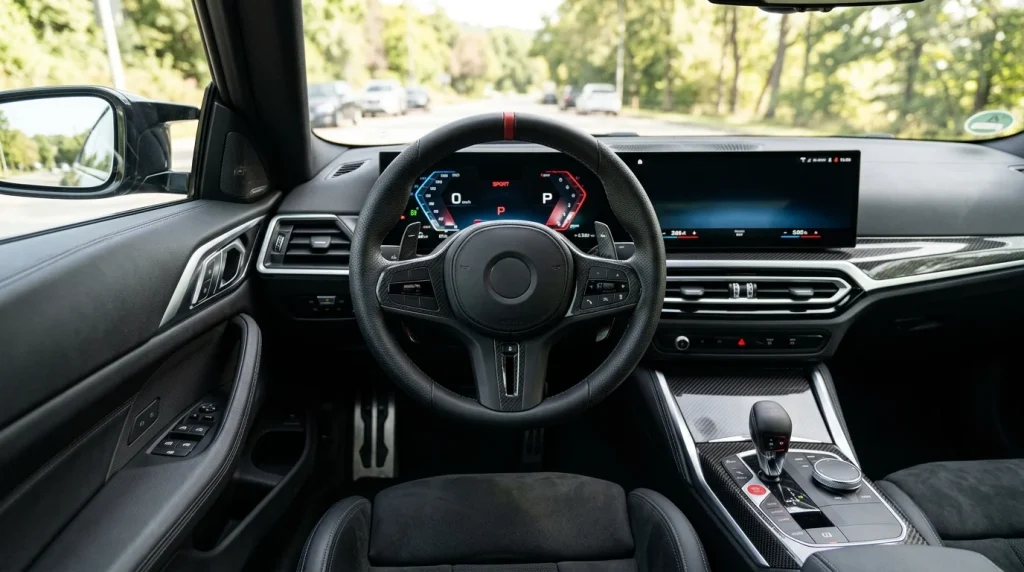
The driver interfaces with a redesigned flat-bottomed leather steering wheel featuring revised spokes, a red center marker at the 12 o’clock position, and dedicated red M1 and M2 buttons to recall pre-configured chassis and engine settings. Track-oriented M Carbon bucket seats are now available as a standalone option for $4,500, allowing buyers to select these lightweight, deeply bolstered seats without paying for the full Carbon Package.
Note: Consolidating the climate controls into the screen interface requires navigating multiple menu tabs for basic functions. Drivers can simplify adjustments by utilizing the voice activation button on the steering wheel.
Practicality remains reasonable for a compact sports coupe. The front cabin provides 42.2 inches of legroom, which easily accommodates drivers over six feet tall. The rear seats are very cramped, offering only 30.9 inches of legroom, which restricts rear transport to children or short trips. Trunk cargo capacity measures 13.8 cubic feet, which is larger than the trunk spaces of the Toyota Supra and Nissan Z, and the rear seats fold down in a 50/50 split to accommodate larger items.
Styling Updates and New Paint Colors
The exterior design maintains its muscular wide-body stance with prominent boxy fender flares that distinguish it from the standard 2 Series coupe. Unlike the larger M3 and M4 models, which feature polarizing vertical kidney grilles, the M2 employs horizontal kidney grilles that sit above three large rectangular lower air intakes.
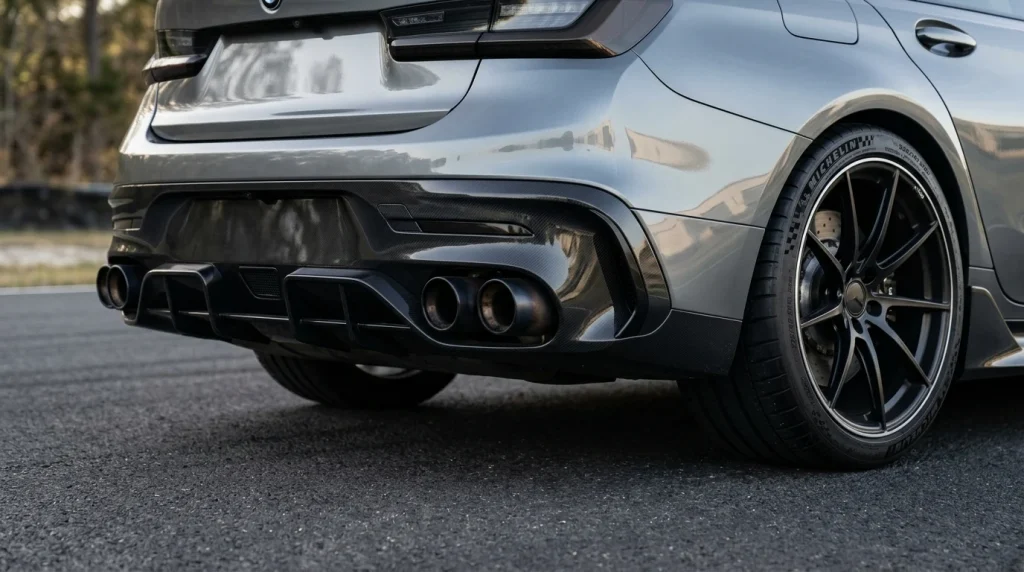
For the 2025 model year, BMW standardizes black quad tailpipes and introduces black badges with silver borders. The paint color palette is expanded to include Sao Paulo Yellow, Vegas Red Metallic, Portimao Blue Metallic, and Skyscraper Grey Metallic. Buyers can also order premium BMW Individual paint finishes, such as Voodoo Blue, Grigio Telesto, and Twilight Purple Pearl Effect, which range in price from $2,000 to $5,000.
Trim Levels, Option Packages, and Standalone Costs
The starting MSRP for the 2025 BMW M2 is $66,075, which includes the $1,175 destination charge. All models are assembled at BMW’s manufacturing facility in San Luis Potosí, Mexico, and come standard with an active M differential, adaptive M suspension, M compound brakes with blue calipers, and wireless smartphone integration.
Buyers can customize the vehicle using specialized option packages:
- Carbon Package ($9,900): Bundles a carbon fiber roof panel (which lowers the center of gravity), M Carbon bucket seats, carbon fiber interior trim, and the M Driver’s Package (unlocking the 177 mph top speed limit and a track training school voucher).
- M Carbon-Ceramic Brakes ($8,500): Provides fade-resistant stopping power for heavy track use and reduces unsprung weight, though replacement components are highly expensive.
- Lighting Package ($650): Adds adaptive full LED headlights with automatic high-beam matrix control.
- Executive Package: Incorporates a heated steering wheel, a wireless charging pad, a Head-Up Display, and Comfort Access keyless entry.
For a daily-driven configuration, a base coupe equipped with the standard Vernasca leather sport seats, the Lighting Package, and the Executive Package offers the best balance of comfort and performance. Track-focused buyers should prioritize the Carbon Package, as buying the lightweight seats and carbon roof separately costs significantly more.
2025 BMW M2 vs. Key Competitors
The M2 operates in a highly competitive performance segment, offering distinct layout and power advantages over its main rivals:
- BMW M4 Coupe: The M4 shares the S58 engine but produces 503 horsepower in its Competition guise. However, the M4 starts at over $79,000, and xDrive models exceed $87,000. The M2 offers a more compact 108.1-inch wheelbase, creating a more agile cornering character for over $20,000 less.
- Porsche 718 Cayman: The base Cayman starts higher at $72,800 but is powered by a 2.0-liter turbocharged four-cylinder engine making 300 horsepower. The Porsche offers a mid-engine layout and superior hydraulic-feeling steering feedback, but the M2 counters with an extra 173 horsepower and rear seats.
- Toyota GR Supra: The Supra is built on a shared BMW platform and utilizes the B58 engine to produce 382 horsepower. While the Supra is lighter and costs roughly $10,000 less, it lacks the raw power of the S58 engine and does not offer rear passenger seats.
Original Value Analysis: Who Should Buy the M2
The 2025 BMW M2 represents an exceptional performance-per-dollar value in the modern sports car market, but it is not a universal fit for every driver.
Who Should Buy the M2
- Manual Purists: Enthusiasts who want a modern high-performance sports car with a six-speed manual gearbox before they are phased out entirely.
- Track Day Drivers: Owners who need a factory-warrantied track weapon that can be driven to the circuit, run hard all day, and driven home comfortably.
- Value-Oriented Performance Buyers: Customers who want M4-level speed and chassis dynamics without paying the M4 price premium.
Who Should Avoid the M2
- Comfort-Focused Commuters: The ride is firm even in Comfort mode, and the wide tires generate noticeable road hum on concrete highways.
- Daily Family Drivers: The rear seats are very cramped, making child seat installation difficult and restricting passenger use to emergencies.
- All-Weather Drivers in Cold Climates: The standard summer performance tires do not provide traction in cold temperatures, requiring a separate set of winter wheels and tires.
Long-term ownership costs should be budgeted carefully. S58 engines are generally durable, but high-performance wear items like replacement Pilot Sport tires, brake rotors, and specialized oil services typically cost $1,500 to $2,500 annually. A known minor electrical defect is a taillight indicator malfunction, which BMW dealerships routinely replace under warranty.
FAQs about the 2025 BMW M2
Is the 2025 BMW M2 reliable?
The S58 engine is highly reliable with proper oil changes and maintenance, as its closed-deck block handles high power outputs easily. Common issues are minor, such as taillight assembly indicator faults and software glitches. Annual maintenance costs average $1,500 to $2,500.
What is the difference between the manual and automatic 2025 BMW M2?
The 6-speed manual M2 offers 406 lb-ft of torque, weighs 54 lbs less, and provides high driver engagement. The 8-speed automatic M2 offers 443 lb-ft of torque, accelerates to 60 mph 0.2 seconds faster (3.9s vs 4.1s), and is compatible with adaptive cruise control. Both options cost the same.
How much does the 2025 BMW M2 cost?
The starting MSRP is $66,075, which includes the $1,175 destination fee. Popular options like the Carbon Package ($9,900) or carbon-ceramic brakes ($8,500) can push the final retail price past $80,000.
Is the BMW M2 good for daily driving?
The M2 can daily drive comfortably on smooth roads, offering 13.8 cubic feet of trunk space and keyless entry. However, the suspension is stiff over potholes, the wide tires create road noise, and the rear seats are cramped for adult passengers.
What is the 0-60 time for the 2025 BMW M2?
BMW’s official 0-60 mph sprint times are 3.9 seconds for the automatic and 4.1 seconds for the manual. In independent instrumented tests, automatic models have achieved 0-60 mph times as quick as 3.6 seconds, with manual models hitting 3.8 seconds.
Does the 2025 BMW M2 have rear seats?
Yes, the M2 includes rear seats with 30.9 inches of legroom. The space is tight for adult passengers, making it a 2+2 layout best suited for children or cargo storage.
How does the M2 compare to the M4?
The M2 starts at $66,075 and shares the S58 engine producing 473 hp in a smaller, more agile footprint. The M4 starts at over $79,000 and offers up to 503 hp, more rear legroom, and optional all-wheel drive, but costs significantly more.
What are common problems with the BMW M2?
The most frequent issue reported is a rear taillight assembly fault that causes indicator warnings, which is replaced under warranty. The engine and mechanical components have shown excellent durability.
Is the BMW M2 worth buying over a Porsche Cayman?
The M2 costs $6,725 less than a base Cayman while providing 173 more horsepower and rear seats. The Porsche 718 Cayman offers superior mid-engine handling balance, lighter weight, and more communicative steering feel. Choose the M2 for horsepower value; choose the Cayman for handling purity.
Will the BMW M2 hold its value?
Yes, the G87 M2 is expected to maintain high residual value, particularly models equipped with the 6-speed manual transmission. As one of the final manual performance cars, manual variants are highly sought after in the used market and may command collector premiums in the future.

