

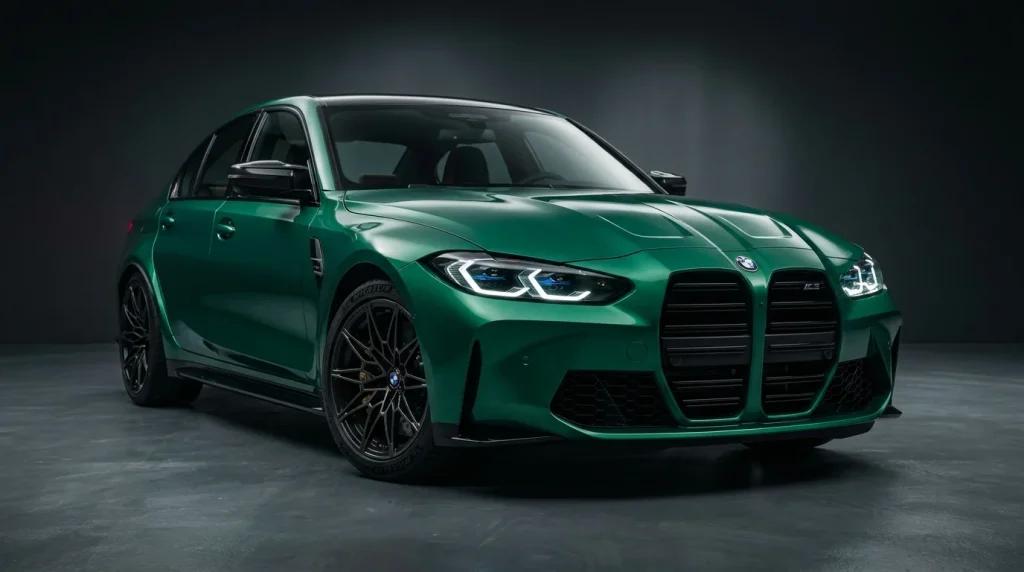
Quick answer: The 2025 BMW M3 represents a mid-cycle refresh (Life Cycle Impulse or LCI) for the G80 generation, highlighting a 20-horsepower increase for the top-tier Competition xDrive variant, which now produces 523 horsepower. Prices range from $77,175 for the base manual model to $86,475 for the all-wheel-drive Competition xDrive (both pricing figures include the mandatory $995 destination fee). With its twin-turbocharged inline-six engine and refined chassis, the M3 continues to serve as the high-performance benchmark for compact sport sedans.
Key takeaways:
- The 2025 BMW M3 Competition xDrive receives a power boost to 523 horsepower, while the base manual (473 hp) and Competition RWD (503 hp) remain unchanged.
- Technology updates include the implementation of BMW Operating System 8.5 with a updated climate control interface, reducing physical buttons on the center console.
- Aesthetic updates feature newly designed LED headlights with a distinctive arrow pattern and a flat-bottomed steering wheel design.
- The base model remains the sole variant offering a six-speed manual transmission, appealing directly to driving purists.
- Cargo capacity remains highly competitive with a 16.9 cubic feet trunk and 40/20/40 split-folding rear seats.
What is New for the 2025 BMW M3 LCI?
The 2025 model year brings the Life Cycle Impulse (LCI) refresh to the BMW M3 model lineup, introducing subtle styling and technology updates to keep the sports sedan modern. The most significant mechanical update is reserved for the range-topping Competition xDrive model. Through reconfigured engine management, BMW engineers extracted an additional 20 horsepower from the twin-turbocharged S58 engine, raising total output from 503 to 523 horsepower.
Beyond horsepower, the 2025 LCI introduces revised exterior lighting. The front fascia features new LED headlight units that consolidate the low and high beams into a single module. The daytime running lights (DRLs) now utilize an vertical arrow-shaped signature that also serves as the turn indicators.
Inside the cabin, the steering wheel features a new flat-bottomed rim, a red center-marker stripe at the 12 o’clock position, and updated spoke spokes. Drivers can select an optional Alcantara-wrapped version of this wheel. The infotainment screen runs on the updated Operating System 8.5, which brings refreshed graphics, a simplified home screen layout, and digital climate controls that replace the physical temperature buttons previously located on the dashboard.
2025 BMW M3 Powertrains and Performance
Every 2025 BMW M3 utilizes the S58 3.0-liter twin-turbocharged inline-six engine, a powerplant developed directly by the BMW M division. The engine features a forged crankshaft, wire-arc sprayed cylinder bores, and a 3D-printed cylinder head core, allowing it to withstand high track temperatures and lateral forces.
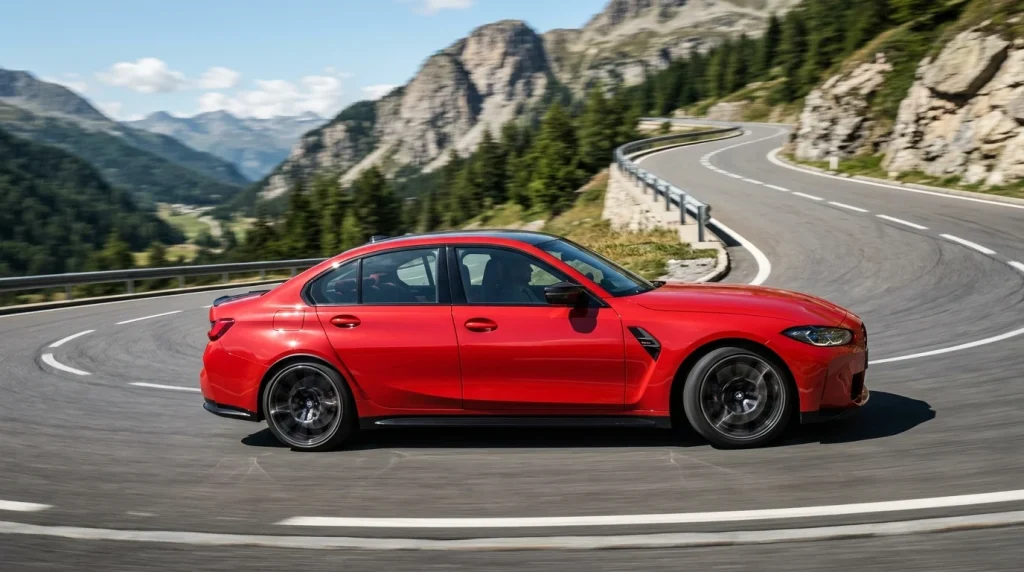
Performance Specifications by Variant
Depending on the chosen trim level, the S58 engine is tuned to three distinct output levels, paired with different transmissions and drivetrains:
| Variant | Horsepower | Torque | Transmission | Drivetrain | 0-60 mph (BMW Est.) |
|---|---|---|---|---|---|
| M3 Sedan (Base) | 473 hp @ 6,250 rpm | 406 lb-ft @ 2,650-6,130 rpm | 6-speed Manual | RWD | 4.1 seconds |
| M3 Competition | 503 hp @ 6,250 rpm | 479 lb-ft @ 2,750-5,500 rpm | 8-speed Automatic | RWD | 3.8 seconds |
| M3 Competition xDrive | 523 hp @ 6,250 rpm | 479 lb-ft @ 2,750-5,730 rpm | 8-speed Automatic | AWD | 3.4 seconds |
The base manual model serves as a direct link to the 2023 BMW M3 review and 2024 BMW M3 edition, preserving the manual gearbox that has defined the entry point of this generation. For the 523-horsepower Competition xDrive, the torque curve is broader than before, sustaining the peak 479 lb-ft of torque up to 5,730 rpm, providing relentless acceleration at high speeds.
Acceleration and Top Speed Capabilities
While BMW estimates a 3.4-second 0-60 mph time for the Competition xDrive, Car and Driver’s comprehensive testing has recorded the pre-LCI all-wheel-drive model hitting 60 mph in a blistering 2.8 seconds. The updated 523-hp engine continues this supercar-level performance. The base manual variant achieves a 3.9-second 0-60 mph sprint under independent testing, proving that even the entry-level model offers significant acceleration.
The top speed for all 2025 M3 models is electronically capped at 155 mph. However, buyers who opt for the M Driver’s Package ($2,500) receive an increase in the electronic limiter to 180 mph, along with a voucher for a professional driving school session at a BMW Performance Center.
RWD vs. xDrive All-Wheel Drive Dynamics
The choice of drivetrain dictates the handling character of the M3. The base and standard Competition models utilize rear-wheel drive, offering a traditional front-engine, rear-drive balance that rewards precise throttle inputs. An Active M Differential manages torque distribution between the rear wheels to maximize corner exit traction.
The xDrive system is an intelligent all-wheel-drive setup that is heavily rear-biased. Under normal driving conditions, the transfer case sends all torque to the rear wheels, only routing power to the front axle when slip is detected. For drivers seeking maximum customization, the xDrive transfer case features three selectable modes:
- 4WD: The default setting, providing maximum traction and neutral handling.
- 4WD Sport: Routes more torque to the rear axle, allowing for controlled drift angles while maintaining front-wheel intervention.
- 2WD: Requires the stability control (DSC) to be fully deactivated. This locks the transfer case into rear-drive mode, allowing the M3 to behave as a traditional RWD car.
Fuel Economy and Real-World Range
High-performance sports sedans are rarely fuel efficiency champions, but the 2025 BMW M3 delivers respectable numbers for its class. The EPA-estimated fuel economy ratings vary slightly based on the selected drivetrain:
- RWD Models (Base Manual & Competition RWD): 16 mpg city, 23 mpg highway, 18 mpg combined.
- AWD Model (Competition xDrive): 16 mpg city, 22 mpg highway, 18 mpg combined.
While the EPA highway rating sits at 22 to 23 mpg, real-world highway fuel economy can exceed those estimates. During steady-state highway cruising tests at 75 mph, automotive journalists have recorded fuel economy figures as high as 32 mpg, showing the efficiency of the twin-turbo inline-six when not under heavy boost.
With a fuel tank capacity of 15.6 gallons, the 2025 M3 has an estimated EPA combined range of approximately 280 miles. On long highway road trips, drivers can expect a driving range of 340 to 360 miles per tank. Premium unleaded fuel (91 octane minimum, 93 octane recommended) is required to prevent engine knock and maintain full power output.
Interior Layout, Seating, and Technology
The interior of the 2025 BMW M3 balances track-focused styling with premium daily-driver luxury, utilizing high-quality materials such as standard extended Merino leather, carbon fiber trim, and soft-touch plastics.
The BMW Curved Display and OS 8.5
The focal point of the dashboard is the BMW Curved Display, which houses a 12.3-inch digital instrument cluster and a 14.9-inch central touchscreen under a single piece of glass. For 2025, the system runs on Operating System 8.5. This updated software introduces a “QuickSelect” interface, placing frequently accessed menus, such as navigation and audio, on the left side of the screen as customizable widgets.
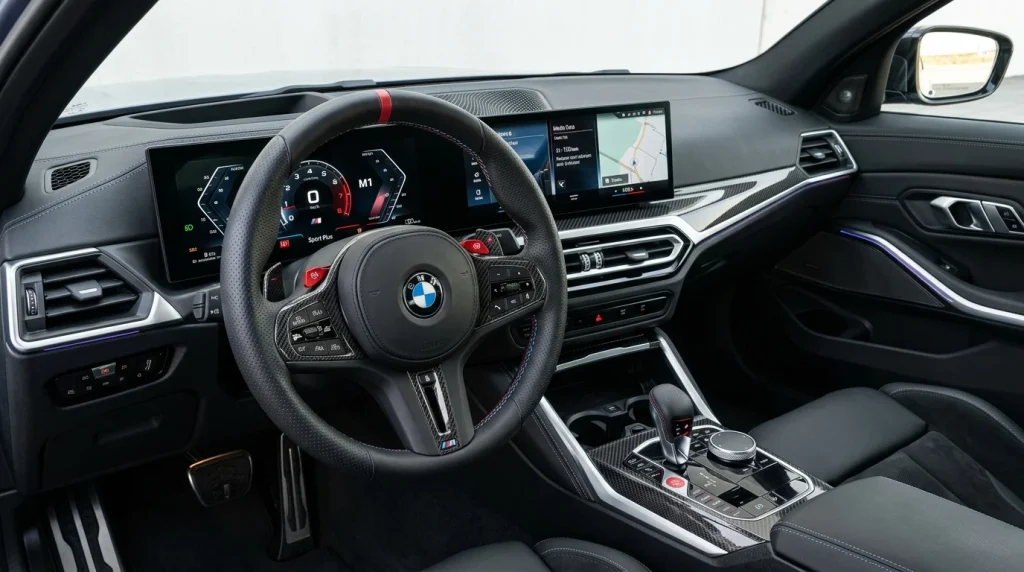
This update simplifies the control scheme, though the integration of the climate controls into the bottom of the touchscreen has drawn critique for requiring more driver attention than physical dials. Essential driving adjustments remain physical, with the red M1 and M2 buttons on the steering wheel allowing drivers to recall pre-configured engine, steering, suspension, and braking setups instantly.
Seating Configurations: M Sport vs. M Carbon Buckets
Buyers must choose between two distinct front seat designs:
- M Sport Seats (Standard): These seats offer excellent daily comfort, power adjustability, memory functions, and heating. The bolsters are supportive enough for spirited road driving without restricting movement.
- M Carbon Bucket Seats (Optional – $4,500): These track-focused seats feature structural carbon fiber shells and cutouts for multi-point harnesses. They save 21 pounds compared to the standard seats and offer extreme lateral support. However, they lack comfort for long-distance trips, and the high carbon-reinforced thigh bolsters make entering and exiting the vehicle difficult.
Daily Usability and Cargo Space
Unlike dedicated sports cars, the M3 functions well as a practical family sedan. The rear seats accommodate two adults comfortably, offering 35.6 inches of rear legroom. Child seats can be installed easily using the standard LATCH anchors.
The trunk provides 16.9 cubic feet of cargo volume, which is at the top of the compact luxury sedan segment. Standard 40/20/40 split-folding rear seats allow owners to carry longer items such as skis or golf clubs. Up front, door pockets, a center console bin, and dual cupholders provide sufficient small-item storage.
Pricing, Packages, and Customization
For the 2025 model year, base prices have risen slightly to accommodate the updated technology and headlights. Below is the pricing breakdown for the U.S. market:
| Trim Level | Base MSRP | Destination Fee | Effective Starting Price |
|---|---|---|---|
| M3 Sedan (Manual) | $76,000 | $995 | $77,175 |
| M3 Competition RWD | $80,400 | $995 | $81,395 |
| M3 Competition xDrive | $85,300 | $995 | $86,295 |
Note: Base MSRPs are verified with manufacturer pricing structures, and destination fees are mandatory for all U.S. deliveries.
Optional Packages and Standalone Upgrades
BMW offers several premium option packages that allow buyers to customize their M3:
- Executive Package ($3,000): Adds a Head-Up Display, a heated steering wheel, a power trunk lid, and ambient lighting updates.
- Parking Assistance Package ($800): Includes a 360-degree surround-view camera system and automated parking assists.
- M Carbon Exterior Package ($4,700): Replaces the standard plastic mirrors, front air intakes, rear diffuser, and trunk spoiler with carbon fiber components.
- M Carbon Ceramic Brakes ($8,500): Replaces the standard steel rotors with lightweight carbon-ceramic discs, reducing unsprung weight and eliminating brake fade under track conditions.
Safety Features and Driver Assistance Systems
The 2025 BMW M3 is built on the high-strength steel and aluminum structure of the standard 3 Series platform. While the low-volume M3 is not independently crash-tested by the IIHS or NHTSA, the standard 3 Series upon which it is based has received a 5-star overall safety rating from the NHTSA and Top Safety Pick honors from the IIHS.
Standard active safety features on every 2025 M3 include:
- Active Driving Assistant (Forward Collision Warning, Pedestrian Detection, and City Collision Mitigation).
- Lane Departure Warning.
- Blind Spot Detection.
- Rear Cross-Traffic Alert.
For automatic models (Competition and Competition xDrive), buyers can option the Driving Assistance Professional Package ($1,700). This package adds Adaptive Cruise Control with Stop & Go, Active Lane Keeping Assistant, Side Collision Avoidance, and Traffic Jam Assistant, allowing for hands-on, semi-autonomous highway driving at speeds up to 40 mph.
2025 BMW M3 vs. Key Competitors
The high-performance compact sedan segment features intense competition from both European and American manufacturers. Edmunds’ vehicle evaluations place the M3 at the top of this group, but each rival offers a distinct personality:
| Feature | 2025 BMW M3 Competition xDrive | Mercedes-AMG C63 S E Performance | Cadillac CT5-V Blackwing | Alfa Romeo Giulia Quadrifoglio |
|---|---|---|---|---|
| Engine Type | 3.0L Twin-Turbo I6 | 2.0L Turbo I4 Hybrid | 6.2L Supercharged V8 | 2.9L Twin-Turbo V6 |
| Horsepower | 523 hp | 671 hp | 668 hp | 505 hp |
| Torque | 479 lb-ft | 752 lb-ft | 659 lb-ft | 443 lb-ft |
| Drivetrain | AWD (with RWD mode) | AWD | RWD | RWD |
| Transmission | 8-speed Automatic | 9-speed Automatic | 6-speed Manual / 10-speed Auto | 8-speed Automatic |
| Curb Weight | 3,990 lbs | 4,650 lbs | 4,120 lbs | 3,820 lbs |
| 0-60 mph | 3.4 seconds (3.0s tested) | 3.3 seconds | 3.4 seconds | 3.8 seconds |
The Mercedes-AMG C63 has transitioned to a heavy four-cylinder hybrid setup, yielding high horsepower but carrying a substantial weight penalty that impacts handling agility. The Cadillac CT5-V Blackwing offers a larger supercharged V8 and standard manual gearbox, but lags behind the M3 in interior material quality and digital refinement. The Alfa Romeo Giulia Quadrifoglio offers sharp steering feedback but lacks the dealer network support and general reliability of the BMW.
Pros and Cons of the 2025 BMW M3
Pros
- Supercar Acceleration: The Competition xDrive achieves 0-60 mph times close to 3 seconds in real-world testing.
- Manual Gearbox Availability: The base model remains one of the few manual performance cars left on the market.
- Dual-Purpose Capability: Functions seamlessly as a comfortable daily commuter and a capable track car.
- Class-Leading Cargo Space: A 16.9 cubic feet trunk provides excellent utility.
- Refined Infotainment: OS 8.5 offers faster processing and a cleaner home screen layout.
Cons
- Polarizing Front Grille: The large kidney grille design remains a controversial aesthetic point.
- Stiff Ride Quality: Even in Comfort mode, the suspension is firm, transmitting sharp pavement cracks into the cabin.
- No Manual on High-Output Models: The manual transmission is limited to the base 473-hp engine.
- Touchscreen Climate Controls: Removing physical buttons for temperature adjustment increases driver distraction.
Verdict: Is the 2025 BMW M3 Worth the Price?
For buyers seeking a single vehicle that can handle a daily work commute, haul a family in safety, and deliver sports-car-beating track times, the 2025 BMW M3 is highly deserving of its benchmark status.
For the majority of buyers, the Competition xDrive is the recommended configuration. The $4,900 premium over the RWD Competition model is justified by the all-weather security of all-wheel drive, the full 523-horsepower engine output, and the ability to switch the drivetrain into a pure rear-wheel-drive drift machine when desired.
However, purists who value mechanical connection over outright acceleration should secure the base manual model before the manual transmission is retired. Those looking to buy may also want to evaluate the upcoming 2026 BMW M3 or look toward the anticipated 2027 BMW M3, though the 2025 LCI updates represent a highly polished state for the current G80 generation.
Frequently Asked Questions
Is the 2025 BMW M3 comfortable enough to daily drive?
Yes. When placed in Comfort mode, the adaptive dampers soften to absorb highway bumps, and the cabin insulation filters out most road noise. However, it remains a sports sedan; the ride is noticeably firmer than a standard 3 Series, especially if equipped with the optional 19-inch front and 20-inch rear wheel setup.
What are the main differences between the base M3 and the Competition?
The base M3 produces 473 horsepower and comes exclusively with a six-speed manual transmission and rear-wheel drive. The Competition model increases output to 503 horsepower (RWD) or 523 horsepower (xDrive AWD) and is only available with an eight-speed automatic transmission. The Competition variants also feature firmer suspension tuning and standard Active M Differentials.
How reliable is the G80 BMW M3 over long-term ownership?
The S58 engine and ZF-sourced eight-speed automatic transmission have proven highly robust under both street and track driving conditions. According to owner reports on enthusiast forums, major mechanical failures are rare before 50,000 miles if standard maintenance is performed. Regular oil changes every 7,500 miles (or 5,000 miles under severe track use) are critical. Annual maintenance costs average $1,500 to $2,500 at authorized service centers.
Does the 2025 BMW M3 have a carbon fiber roof?
Yes, a carbon-fiber-reinforced plastic (CFRP) roof is standard equipment on the 2025 M3. It lowers the vehicle’s center of gravity to improve handling. Buyers can opt for a steel roof with a power sunroof as a no-cost option, though this adds weight to the top of the vehicle.

