

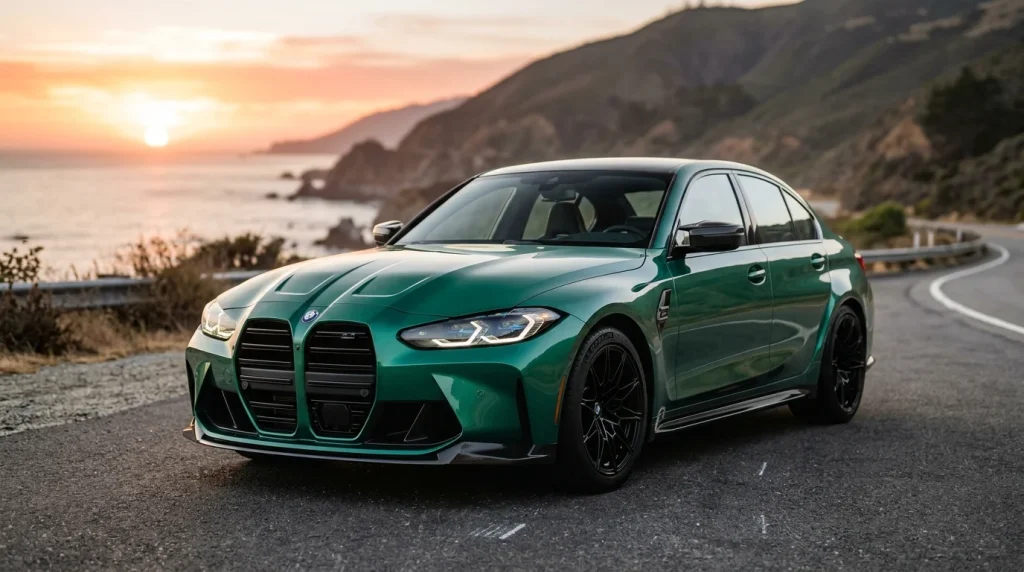
Quick answer: The 2026 BMW M3 is a high-performance luxury sports sedan starting at $80,475 for the standard manual variant, rising to $84,675 for the Competition, and topping out at $89,775 for the Competition xDrive model (prices include the $1,175 destination charge). Powered by a 3.0-liter twin-turbocharged inline-six engine (S58), it delivers between 473 and 523 horsepower. The Competition xDrive accelerates from 0 to 60 mph in a tested 2.8 seconds and offers an EPA-estimated highway fuel range of up to 354 miles.
Key takeaways:
- Post-January 2026 price increases raise the starting MSRP of all 2026 BMW M3 models by $900 over initial launch figures.
- The S58 twin-turbocharged inline-six engine delivers 473 horsepower in the base model, 503 in the Competition, and 523 in the Competition xDrive.
- The standard M3 remains the exclusive choice for driving purists who demand a six-speed manual transmission.
- Standard feature additions for 2026 include a heated steering wheel across all trims and remote engine start for Competition models.
- The Competition xDrive model achieves an EPA-rated 16 mpg city, 22 mpg highway, and 18 mpg combined.
What is New for the 2026 BMW M3?
The 2026 BMW M3 represents the final iteration of the purely combustion-powered G80 generation before BMW introduces its electrified Neue Klasse successor. While the mechanical layout remains identical to the heavily updated 2025 model year, BMW has introduced minor equipment upgrades and pricing adjustments.
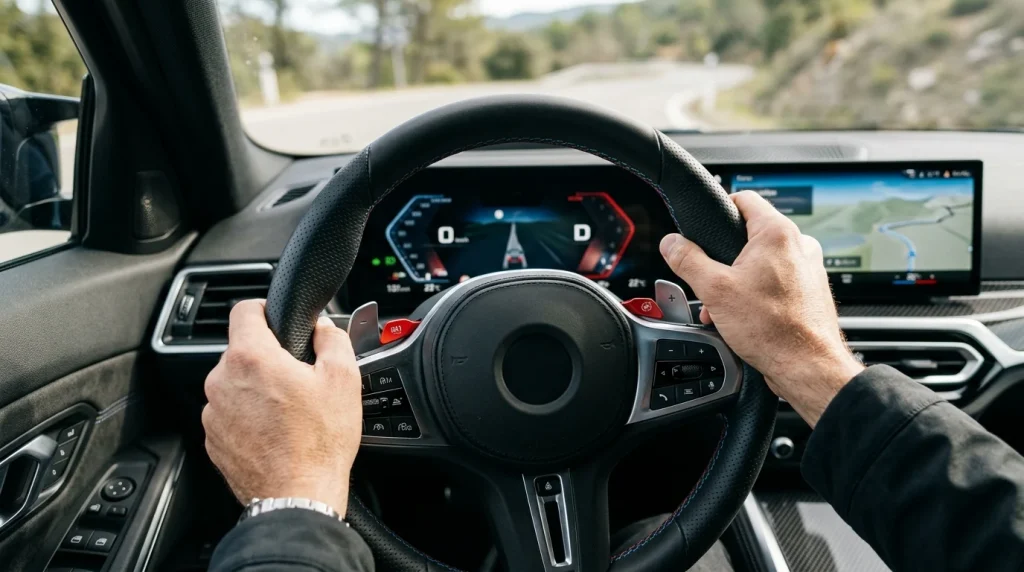
A heated steering wheel is now standard equipment across all trim levels. Additionally, remote engine start is now standard on the Competition and Competition xDrive models. The optional Executive Package has also been updated to include galvanic controls and a power tailgate, adding comfort and luxury to the daily driving experience.
BMW has also expanded the range of Individual paint finishes in the online configurator. Buyers can now select iconic heritage colors like Laguna Seca Blue, Dakar Yellow, and Techno Violet Metallic directly, without submitting a custom request. These paint options allow buyers to personalize their sports sedan to match historic M3 generations.
2026 BMW M3 Price and Trim Levels
BMW implemented two price hikes for the 2026 model year in the US market. The first occurred when the 2026 model year was announced, which added $1,700 to the MSRP. The second price adjustment went into effect on January 1, 2026, adding another $900 across the lineup.
The table below breaks down the updated manufacturer suggested retail price (MSRP) for the three available trim levels, including the $1,175 destination and handling charge.
| Trim Level | Drivetrain | Transmission | Horsepower | Torque | Base MSRP (incl. destination) |
|---|---|---|---|---|---|
| M3 Sedan (Base) | Rear-Wheel Drive (RWD) | 6-speed manual | 473 hp | 406 lb-ft | $80,475 |
| M3 Competition | Rear-Wheel Drive (RWD) | 8-speed automatic | 503 hp | 479 lb-ft | $84,675 |
| M3 Competition xDrive | All-Wheel Drive (AWD) | 8-speed automatic | 523 hp | 479 lb-ft | $89,775 |
For buyers looking to explore the broader history of the model, the G80 generation has seen gradual power increases. The all-wheel-drive Competition model received a 20-horsepower bump for the 2025 model year, which carries over to the 2026 car. Buyers seeking a balance of track capability and daily value can check the overview of the BMW M3 model family to compare older iterations, such as the 2023 BMW M3 or the track-oriented 2024 BMW M3.
Engine, Performance, and Acceleration Specs
The core of the 2026 BMW M3 is the S58 3.0-liter twin-turbocharged inline-six engine. This powerplant utilizes a forged crankshaft, 3D-printed cylinder head cores for optimized cooling, and a high-precision direct injection system operating at up to 5,076 psi. The engine features variable valve timing (Double-VANOS) and variable valve lift (Valvetronic) to deliver immediate power across the rev range.
The standard manual M3 produces 473 horsepower and 406 lb-ft of torque, accelerating from 0 to 60 mph in a manufacturer-claimed 4.1 seconds. Opting for the Competition RWD model increases output to 503 horsepower and 479 lb-ft of torque, lowering the 0 to 60 mph sprint to 3.8 seconds.
The range-topping Competition xDrive model benefits from the highest state of tune, outputting 523 horsepower and 479 lb-ft of torque. While the official 0 to 60 mph time for the xDrive model is 3.4 seconds, independent instrumented tests by Car and Driver achieved a blistering 2.8-second launch. This puts the Competition xDrive on par with dedicated six-figure supercars. The quarter-mile is completed in 11.0 seconds at 125 mph. All M3 variants are electronically limited to 155 mph, which can be raised to 180 mph with the optional $2,500 M Driver’s Package.
Handling, Suspension, and Braking Systems
The M3 utilizes an Adaptive M suspension system with electronically controlled dampers that adjust to road conditions in milliseconds. Drivers can select three distinct damping profiles:
- Comfort: Maximizes compliance for highway cruising and city driving, though the ride remains firm.
- Sport: Firms up the dampers to reduce body roll and sharpen steering response for dynamic backroad driving.
- Sport+: Delivers maximum stiffness designed specifically for flat track surfaces, translating minor road inputs directly to the cabin.
Handling precision is aided by the standard Active M Differential on the rear axle. This electronically controlled limited-slip differential varies the locking lockup from 0% to 100% to maximize power transfer out of tight corners. The xDrive all-wheel-drive system operates with a strong rear bias under normal conditions but can redirect torque to the front wheels when rear traction is compromised. Drivers can also select 2WD mode to lock the car into rear-wheel drive for traditional handling characteristics.
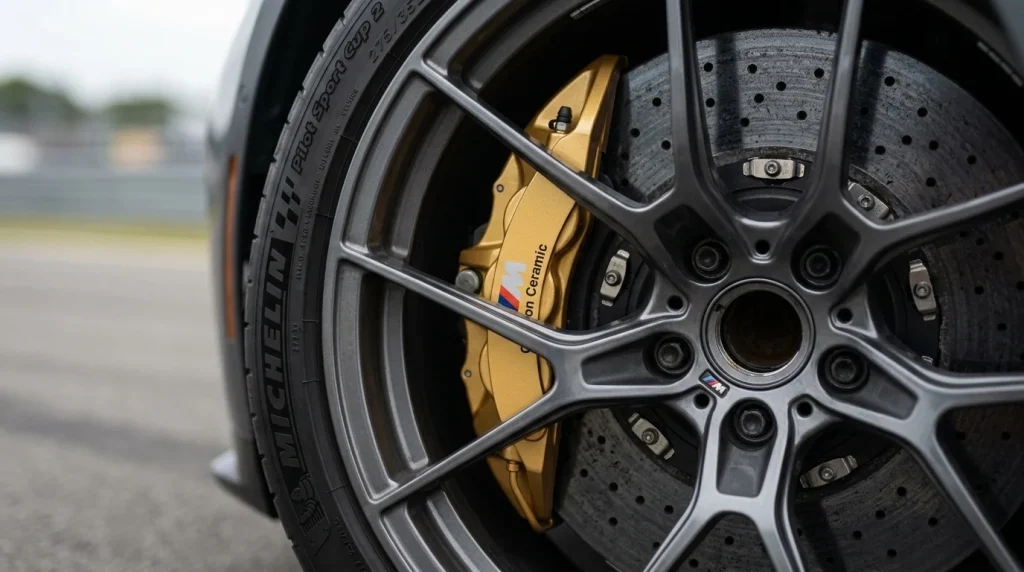
Braking duties are handled by standard blue-painted calipers clamping 15.0-inch front and 15.0-inch rear ventilated steel brake discs. Buyers planning frequent track days can upgrade to the $8,500 M Carbon-Ceramic brakes, which feature gold calipers and offer superior resistance to thermal fade. However, carbon-ceramic brakes require warm-up to achieve maximum bite and can display inconsistent pedal feel when cold or wet.
Fuel Economy, Range, and Real-World MPG
Despite its supercar-slaying performance, the M3 achieves reasonable fuel efficiency ratings. The EPA-estimated mileage ratings vary depending on the chosen drivetrain configuration:
- Base Manual and Competition RWD: 16 mpg city, 23 mpg highway, and 19 mpg combined.
- Competition xDrive AWD: 16 mpg city, 22 mpg highway, and 18 mpg combined.
In real-world highway testing conducted by independent automotive journalists, the G80 generation consistently outperforms these estimates. On a 75-mph highway test route, the automatic Competition model achieved 28 mpg, while the Competition xDrive model delivered 27 mpg. The six-speed manual base model returned 26 mpg.
With a standard fuel tank capacity of 16.1 gallons, the M3 Competition RWD model offers an estimated highway cruising range of approximately 370 miles, while the Competition xDrive delivers roughly 354 miles. This range makes it a viable road-trip companion compared to high-performance electrified concepts like the 2026 BMW i8 M or dedicated battery-electric sports sedans that require frequent charging stops.
Exterior Design and Customization Options
The exterior design of the G80 M3 remains dominated by its vertical, frameless kidney grille, a styling detail that continues to spark debate among automotive enthusiasts. While polarizing, the grille serves a vital engineering purpose by routing massive volumes of air to the engine radiators, engine oil cooler, and transmission fluid cooler.
The M3 features a carbon-fiber-reinforced plastic (CFRP) roof panel as standard equipment, which lowers the car’s center of gravity. Staggered wheel setups are standard across the lineup:
- Base Model: 18-inch front and 19-inch rear forged wheels.
- Competition models: 19-inch front and 20-inch rear forged wheels.
In addition to standard gloss colors like Alpine White, Black Sapphire Metallic, and Isle of Man Green, BMW offers premium Frozen matte finishes. For the 2026 model year, the manufacturer has made heritage paints available directly through the builder tool. This allows manual transmission buyers to choose classic colors like Laguna Seca Blue and Techno Violet Metallic to honor previous M3 generations, creating a unique collector appeal for the final year of the gas-powered platform.
Interior Comfort, Technology, and Cargo
The interior of the 2026 BMW M3 merges luxury-car refinement with race-car design. Premium Merino leather covers the seats, dashboard, and door cards. Carbon fiber trim accents the center console and steering wheel spokes.
Drivers are greeted by the BMW Curved Display, which houses a 12.3-inch digital instrument cluster and a 14.9-inch central touchscreen under a single glass surface. The system runs on iDrive 8.5, which includes wireless Apple CarPlay, wireless Android Auto, and cloud-based navigation.
M Sport seats are standard, offering heating, power adjustments, and side-bolster control. Buyers can opt for the $4,500 M Carbon Bucket seats, which shave 21 pounds off the car’s weight.
Analysis: While the M Carbon Bucket seats provide excellent lateral support during track driving, the aggressive thigh bolsters make getting in and out of the vehicle difficult. Daily commuters should test these seats before purchasing, as the standard M Sport seats offer a better balance of comfort and support.
Trunk capacity measures 16.9 cubic feet, which is larger than key competitors. The standard 40/20/40 split-folding rear seats allow owners to transport long cargo items, making the M3 a practical family vehicle.
Long-Term Maintenance and Reliability
The S58 engine has proven to be a robust and reliable powerplant. However, it demands strict adherence to maintenance intervals to ensure long-term durability.
- Break-in Service: Essential at 1,200 miles to flush out factory fluids from the engine and rear differential.
- Oil Changes: Recommended every 7,500 miles under normal driving, or 5,000 miles if driven aggressively on track.
- Spark Plugs: Require replacement every 30,000 miles due to high turbo boost pressures.
According to automotive data from CarEdge, the BMW M3 costs approximately $4,762 in maintenance and repair costs during its first five years of ownership. There is an estimated 42% probability of the vehicle requiring a major repair during this time frame, which is typical for high-performance German vehicles.
Competitive Comparison: M3 vs. Key Rivals
The luxury sports sedan segment remains highly competitive. The M3 faces strong competition from both domestic and European rivals.
- Mercedes-AMG C63 S E Performance: Mercedes made the choice to swap its V8 engine for a 2.0-liter turbocharged four-cylinder plug-in hybrid. While it produces 671 horsepower and 752 lb-ft of torque, it weighs a hefty 4,750 pounds. The M3 Competition xDrive, weighing in at roughly 3,970 pounds, feels more agile on winding roads and delivers superior track performance despite the power deficit.
- Cadillac CT5-V Blackwing: The Cadillac offers a supercharged 6.2-liter V8 outputting 668 horsepower and is available with a six-speed manual transmission. It delivers visceral engine notes and sharp handling but lacks the interior luxury, standard all-wheel-drive option, and advanced infotainment technology found in the M3.
- Audi RS5 Sportback: The Audi RS5 utilizes a twin-turbo 2.9-liter V6 producing 444 horsepower. It features Quattro all-wheel drive and offers a comfortable highway ride. However, it leans more toward grand touring comfort and lacks the track-day handling precision and acceleration limits of the M3.
Buyer’s Verdict: Buy the 2026 M3 or Wait for 2027?
Potential buyers face a choice between purchasing the 2026 model or waiting for the upcoming 2027 BMW M3, which will transition to an electrified Neue Klasse platform.
- Why you should buy the 2026 M3: The 2026 model represents the final year of the gas-powered, non-hybrid M3. Purists who want the physical connection of a manual transmission must buy the 2026 base model, as manual availability is highly unlikely to survive past this generation. The G80 platform is also a proven, reliable setup with resolved software and mechanical updates.
- Why you should wait for the 2027 M3: If you prioritize cutting-edge technology and maximum straight-line power, waiting for the 2027 redesign will grant you access to an advanced electric powertrain rumored to exceed 700 horsepower. However, you will lose the classic inline-six engine note and mechanical engagement.
For most buyers, the Competition xDrive model remains the best choice. It delivers supercar acceleration, daily drive capability, and all-weather traction. Pure driving enthusiasts should secure the standard manual model before the manual transmission is retired.
Frequently Asked Questions
Is the 2026 BMW M3 reliable?
Yes. The S58 inline-six engine and the ZF eight-speed automatic transmission are proven components with a strong track record of reliability. Proper maintenance, including the critical 1,200-mile break-in service and regular oil changes every 7,500 miles, is essential to ensure long-term durability.
Does the 2026 BMW M3 come with a manual transmission?
Yes, but only on the base model. The standard 473-horsepower M3 comes exclusively with a six-speed manual transmission and rear-wheel drive. The Competition and Competition xDrive models are offered only with the eight-speed automatic transmission.
What is the difference between the 2025 and 2026 BMW M3?
The mechanical specs remain unchanged, but the 2026 model adds standard features such as a heated steering wheel and remote engine start. Price increases have also raised the MSRP of all 2026 M3 trims by $2,600 over the equivalent 2025 BMW M3 models.
Is the M3 Competition xDrive worth the extra money?
Yes. The Competition xDrive costs $9,300 more than the manual base model and $5,100 more than the RWD Competition. For this premium, it adds all-wheel drive, a power output of 523 horsepower, and a tested 0 to 60 mph time of 2.8 seconds, making it the most capable daily driver in the lineup.

