

Quick answer: The next-generation 2027 BMW M3 introduces a revolutionary dual-powertrain strategy that coexists rather than replaces. The all-electric M3 (codename ZA0 or iM3) starts production in March 2027, featuring a quad-motor AWD setup producing 800-900 hp. The gas-powered M3 (codename G84) begins production in July 2028, carrying over the 3.0-liter twin-turbo S58 inline-six engine updated with a 48V mild-hybrid system producing 530-560 hp. Crucially, the G84 generation drops the manual transmission, making it automatic-only with standard M xDrive AWD. Starting prices are estimated at $80,000-$90,000 for gas variants and $95,000-$105,000 for the electric model.
Key takeaways:
- The next-generation M3 splits into two platforms: the electric Neue Klasse ZA0 (iM3) and the mild-hybrid gas-powered CLAR-evolved G84.
- Electric ZA0 production starts in March 2027 with deliveries in summer 2027, producing 800-900 hp and utilizing the Heart of Joy computer.
- Gas G84 production starts in July 2028, delivering 530-560 hp from a mild-hybrid S58 inline-six engine paired with an eight-speed automatic.
- Six-speed manual transmission is retired; the current G80 generation (ending late summer 2027) represents the final manual M3.
- US market faces an 18-month gap without a gas-powered M3 between G80 retirement and G84 launch in mid-2028.
- Cabin design adopts Neue Klasse styling with a minimalist digital cockpit, a 14.9-inch touchscreen, and Panoramic Vision windshield projection.
What’s New with the 2027 BMW M3
Parallel Dual-Powertrain Strategy (ZA0 vs. G84)
BMW is taking an unprecedented path for its signature sports sedan by developing two completely separate platforms to run in parallel. The all-electric model, codenamed ZA0 (and widely referred to as the iM3), represents the first battery-powered M3 in history. It rides on the purpose-built Neue Klasse architecture.
Coexisting alongside the EV is the G84 generation, which represents the next-generation combustion-powered M3. The G84 is built on an evolution of the existing CLAR platform. Rather than forcing a transition to all-electric power, BMW is choosing to serve both buyer types: tech-forward drivers wanting instant electric torque and traditional purists who value combustion engines.
Expected Production Timeline and US Market Availability
The rollout of these two high-performance machines is staggered, creating a complex timeline for buyers, particularly in the United States:
- Current G80 M3 Retirement: US production of the current-generation G80 M3 runs through late summer 2027 (specifically ending in August 2027). The final model year for the G80 is 2027.
- Electric M3 (ZA0) Production: Production begins in March 2027, with initial global deliveries expected in summer 2027.
- Gas M3 (G84) Production: Production is scheduled to begin in July 2028, arriving as a 2028 or 2029 model year vehicle.
For US buyers who prefer gasoline power, this staggered schedule creates a significant 18-month gap without a gas-powered M3. Between the end of the G80 production in late 2027 and the arrival of the G84 in late 2028, the electric ZA0 will be the only next-generation M3 variant actively rolling out. Early allocations for the electric ZA0 will be highly competitive, likely requiring pre-order deposits of $2,000 to $5,000 and waiting lists of 6 to 12 months.
Design Philosophy: Neue Klasse Aesthetics
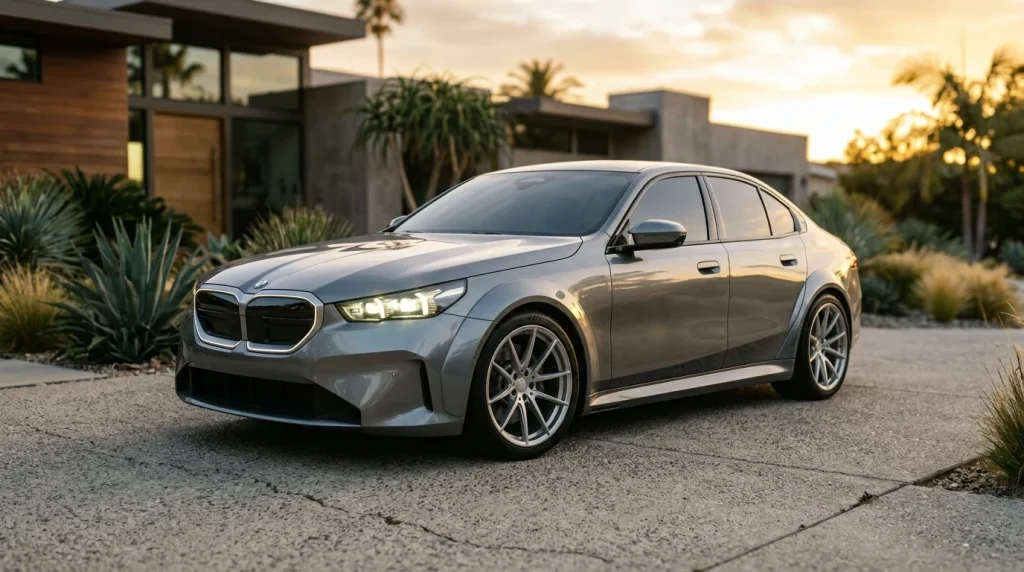
While built on different platforms, both the electric ZA0 and the gas G84 will share unified design genetics heavily influenced by the Neue Klasse sedan concepts. Spy photos show production-ready prototypes featuring twin slanted LED headlights, a wider stance, muscular fenders, and aggressively sculpted bumpers. Both models maintain cohesive proportions, though the electric variant features a slightly shorter front overhang due to the packaging advantages of its EV layout.
2027 BMW M3 Powertrain & Performance
Electric M3 (ZA0 / iM3) Specifications
The all-electric ZA0 M3 abandons mechanical differentials entirely. Instead, it utilizes a quad-motor all-wheel-drive setup, with one independent electric motor dedicated to each wheel. Power delivery is managed entirely through software torque vectoring, enabling millisecond-precision power distribution.
- Motors: Quad-motor configuration (two integrated drive units, one per axle).
- Horsepower: Industry reports target between 800 and 900 horsepower, a major step forward from the current generation.
- Weight: Expected to exceed 2,000 kg (approximately 4,400 lbs) due to the battery pack, representing a substantial weight penalty over combustion alternatives.
- Battery: Gen6 cylindrical cell battery pack exceeding 100 kWh capacity, utilizing an 800V fast-charging architecture.
The structural battery pack integrates directly into the Neue Klasse chassis, increasing torsional rigidity to sharpen suspension response. To offset the battery mass, BMW is introducing natural-fiber composite structural elements, reducing carbon emissions during manufacturing while maintaining high rigidity.
Gas-Powered M3 (G84) Engine Details
The G84 M3 updates the legendary 3.0-liter S58 twin-turbocharged inline-six engine to comply with stricter Euro 7 emissions standards. For the first time, the combustion M3 incorporates a 48V mild-hybrid system, integrating an electric motor directly into the transmission.
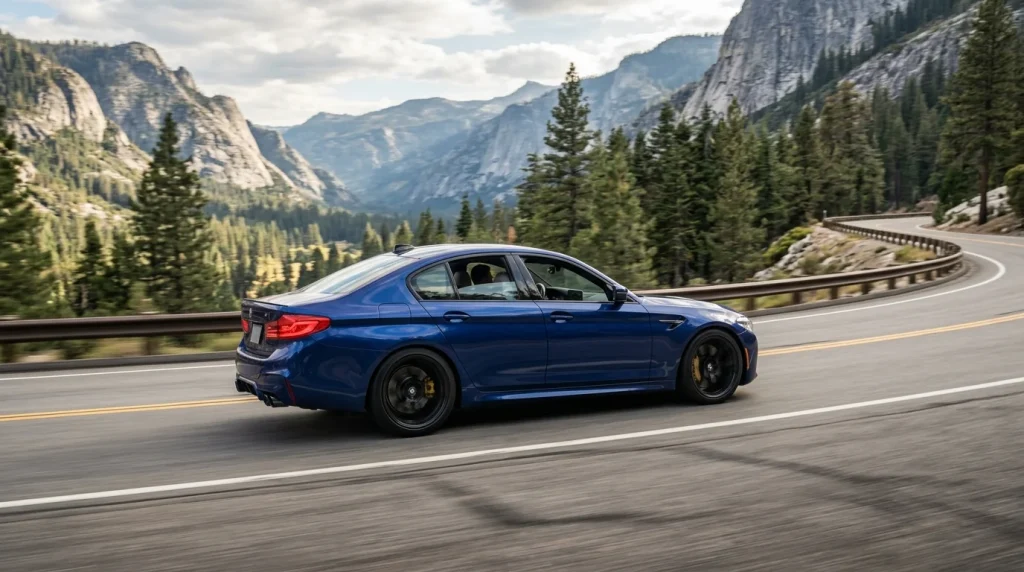
- Transmission: Eight-speed automatic transmission only. The six-speed manual gearbox will not return. The current G80 generation represents the final manual-transmission M3.
- Drivetrain: Standard M xDrive all-wheel drive. Rear-wheel-drive configurations are expected to be retired for the G84 generation.
- Horsepower: Starting at approximately 525 horsepower, with performance tunes ranging from 530 to 560 horsepower on Competition models.
By choosing a mild-hybrid setup instead of a heavy plug-in hybrid (PHEV) system like the G90 M5, BMW engineers aim to limit weight gain, preserving the nimble, lightweight handling that M3 owners expect.
Acceleration and Track Testing
Thanks to its quad-motor setup, the electric ZA0 is expected to launch from 0-60 mph in under 3.0 seconds, putting it in direct competition with elite electric hyper-sedans. The gas G84 Competition xDrive, despite its lower horsepower rating, will likely match the current model’s 3.3-second sprint, helped by the instant low-end assist of its 48V hybrid motor.
BMW M engineers have logged extensive track hours at the Nürburgring Nordschleife to tune both vehicles. Spy videos capture the electric ZA0 executing aggressive drift angles, demonstrating that the quad-motor software can mimic traditional rear-drive dynamics.
BMW’s “Heart of Joy” Central Supercomputer
The centerpiece of the electric M3 performance envelope is the “Heart of Joy” central control unit. This high-speed computer processes drivetrain, chassis, steering, braking, and energy recuperation systems in a single control loop. The Heart of Joy processes data 10 times faster than the individual control units found in current models, reducing input latency to under one millisecond.
This enables real-time torque vectoring that can instantly decouple the front axle to send 100 percent of the power to the rear wheels, enabling a dedicated drift mode or maximizing highway efficiency.
2027 BMW M3 Interior, Comfort, & Technology
Minimalist Cabin Design and Panoramic iDrive
The interior of the next-generation M3 follows a driver-centric, minimalist design language. Spy photos show body-hugging sport seats upholstered in carbon fiber shell backings and Alcantara suede, accented by M-colored stitching.
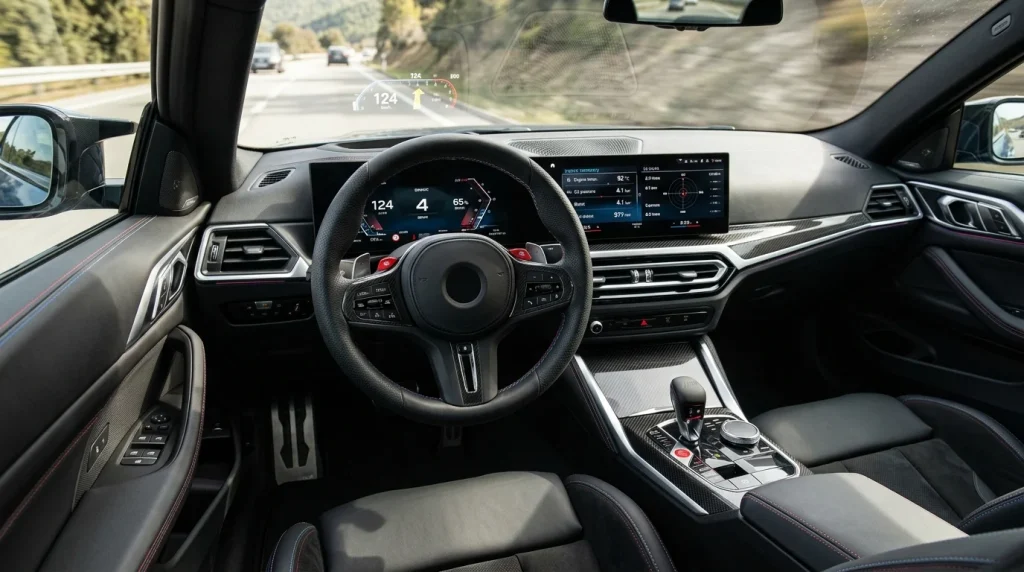
The dashboard eliminates most physical buttons in favor of BMW’s Panoramic iDrive system. This setup projects essential driving data across the lower edge of the windshield, acting as an interactive head-up display. A central 14.9-inch touchscreen controls media, navigation, and vehicle settings. Apple CarPlay and Android Auto are supported wirelessly.
M Drive Professional and Track Telemetry
Track-focused technology remains a priority. Both the gas and electric M3 feature M Drive Professional, which includes:
- Drift Analyzer: Evaluates and rates drift angle and duration.
- Lap Timer: Logs detailed lap telemetry and records split times.
- Data Logger: Records cornering forces, acceleration, and braking inputs.
For the electric ZA0, BMW is adding simulated gear shifts and synthetic soundscapes to provide acoustic feedback, keeping the mechanical connection alive for drivers.
Cargo Space and Touring Wagon Possibility
Trunk space will vary by model. The flat battery pack of the electric Neue Klasse platform offers efficient packaging, raising the likelihood of a practical electric iM3 Touring wagon variant. The gas G84 Touring wagon remains highly uncertain, particularly for the US market where performance wagon demand is small.
2027 BMW M3 Trim Levels & Pricing Estimates
Electric and Gas M3 Variants Breakdown
At launch, the lineup will feature distinct electric and gas-powered options:
| Powertrain | Engine / Motor | Horsepower | Transmission | Drivetrain |
|---|---|---|---|---|
| Gas M3 Base (G84) | 3.0L S58 Twin-Turbo I6 + 48V Hybrid | ~525 hp | 8-speed Automatic | M xDrive AWD |
| Gas M3 Competition (G84) | 3.0L S58 Twin-Turbo I6 + 48V Hybrid | 540-560 hp | 8-speed Automatic | M xDrive AWD |
| Electric M3 Base (ZA0) | Quad-motor Electric | 800-900 hp | Single-speed | Quad-motor AWD |
Estimated Starting Prices and Options
Official pricing has not been announced, but industry projections point to an upscale adjustment:
- Gas M3 Base (G84): Estimated starting at $80,000 to $90,000.
- Electric M3 (ZA0): Estimated starting at $95,000 to $105,000.
Individual customization packages will add to the price:
- M Carbon Package: Estimated at $8,000 to $12,000 (adds carbon fiber splitters, mirror caps, and interior trim).
- Carbon-Ceramic Brakes: Estimated at $8,500 to $10,000.
- BMW Individual Paint Colors: Commands a premium of $4,500 to $8,000.
Qualifying buyers of the electric M3 may benefit from federal tax credits up to $7,500, along with state-specific incentives depending on local regulations.
Long-Term Cost of Ownership
Operating costs represent a clear divide between the two powertrains. The electric M3 benefits from fewer moving parts, eliminating oil changes, spark plug replacements, and transmission fluid flushes. Annual routine maintenance for the ZA0 is estimated at $500 to $800, primarily covering tire rotations, brake fluid checks, and cabin filter replacements.
The G84 mild-hybrid demands traditional high-performance combustion maintenance. Annual servicing is estimated at $1,500 to $2,500, with major interval services reaching $3,000 to $5,000. Tire replacement intervals remain short for both models, with performance summer rubber lasting 15,000 to 20,000 miles.
2027 BMW M3 vs. Key Competitors
Mercedes-AMG C63 S E Performance
The primary German competitor to the M3 has taken a different approach to hybridization. The Mercedes-AMG C63 S E Performance replaced its V8 engine with a 2.0-liter turbocharged four-cylinder plug-in hybrid (PHEV) system producing 671 horsepower.
While the C63 offers more peak horsepower than the gas G84 M3, it suffers from a major weight penalty, tipping the scales at roughly 4,750 lbs. The gas G84 M3, by opting for a mild-hybrid setup, will be significantly lighter, offering sharper handling and throttle responses.
Tesla Model 3 Performance
For electric buyers, the Tesla Model 3 Performance is a strong alternative. It achieves 0-60 mph in 3.1 seconds and has direct access to the Tesla Supercharger network. However, the Model 3 lacks the track-oriented chassis setup, high-end interior options, and advanced torque vectoring of the quad-motor ZA0 M3.
Alfa Romeo Giulia Quadrifoglio
The current combustion-powered Giulia Quadrifoglio is highly praised for handling but suffers from poor reliability ratings. Furthermore, Alfa Romeo has announced that the next-generation Giulia (arriving around 2026 or 2027) will transition to an all-electric STLA Large platform. This leaves the gas-powered G84 M3 as one of the few remaining six-cylinder options in the premium sport sedan segment.
Electric vs. Gas: Which 2027 BMW M3 Should You Buy?
Electric iM3 Pros & Cons
- Pros: Instant torque, 800-900 horsepower, advanced torque vectoring, lower maintenance costs, and tech-forward cabin.
- Cons: Weight penalty (exceeding 4,400 lbs), charging dependencies, and potential track-use range drop.
Gas G84 Pros & Cons
- Pros: Traditional inline-six engine note, lighter curb weight, easy refueling, and proven track-day stamina.
- Cons: Manual transmission is retired, higher annual maintenance costs, and standard AWD reduces traditional tail-slide options.
Daily Usability and Road-Trip Practicality
For urban and daily commuting, the quiet operation and low running costs of the electric iM3 make it highly practical, provided you have home charging. However, for long-distance travel and track-day regulars, the refueling convenience and lighter chassis of the G84 gas M3 remain superior.
Historical Evolution of the BMW M3
To understand the significance of the 2027 and 2028 models, it helps to review the M3’s evolution. If you are comparing future options, read the 2026 BMW M3 Review to see how the final pure-ICE model year was configured. For older generations, the 2025 BMW M3 and 2024 BMW M3 showcase the development of the S58 engine’s output and the xDrive system, while the 2023 BMW M3 outlines the introduction of the modern curved screen display. These models can all be navigated on the main BMW M3 hub page.
Frequently Asked Questions About the 2027 BMW M3
When will the 2027 BMW M3 be released?
The electric M3 (ZA0) begins production in March 2027, with deliveries starting in summer 2027. The gas-powered M3 (G84) follows in July 2028.
How much will the 2027 BMW M3 cost?
Pricing is estimated to start around $80,000 to $90,000 for gas variants and $95,000 to $105,000 for the electric variant.
Will the 2027 BMW M3 have a manual transmission?
No, the next-generation gas M3 (G84) is expected to be eight-speed automatic only. The current G80 generation is the final manual M3.
What is the range of the electric BMW M3?
Official range is unconfirmed, but estimates suggest a target of over 300 miles on the EPA cycle. Real-world track range will be lower.
Is the electric M3 faster than the gas M3?
The electric ZA0 M3 is expected to have a quicker 0-60 mph sprint due to its 800-900 hp quad-motor output, likely dipping below 3.0 seconds, compared to the gas model’s 3.3 seconds.

