


Quick answer: A rotten egg smell from your car is hydrogen sulfide gas (H₂S). This odor is most commonly caused by a failing catalytic converter that can no longer convert toxic sulfur compounds into odorless sulfur dioxide. Other potential triggers include an overcharged lead-acid battery venting sulfuric acid, fuel system malfunctions creating a rich air-fuel mixture, degraded transmission fluid, or exhaust leaks. This smell indicates a mechanical issue that must be repaired immediately.
Key takeaways:
- The primary cause is a failing catalytic converter, which typically costs $1,000 to $4,000 to replace including parts and labor.
- Hydrogen sulfide is a highly toxic gas, and OSHA sets a strict workplace ceiling limit of 20 ppm to prevent health hazards.
- Always diagnose and fix the root engine problem before replacing a catalytic converter, or the new unit will quickly fail.
- An overcharged 12-volt battery can release sulfuric gas under the hood, which applies to both gasoline vehicles and electric cars.
What Causes the Rotten Egg Smell in a Car?
Gasoline contains trace amounts of sulfur compounds. During the combustion process, these compounds react to form hydrogen sulfide (H₂S), which is the chemical compound responsible for the distinctive rotten egg odor. Under normal operating conditions, your vehicle’s emissions control system processes this gas. The catalytic converter uses precious metals like platinum, palladium, and rhodium to oxidize hydrogen sulfide into odorless sulfur dioxide (SO₂) before it exits the tailpipe.
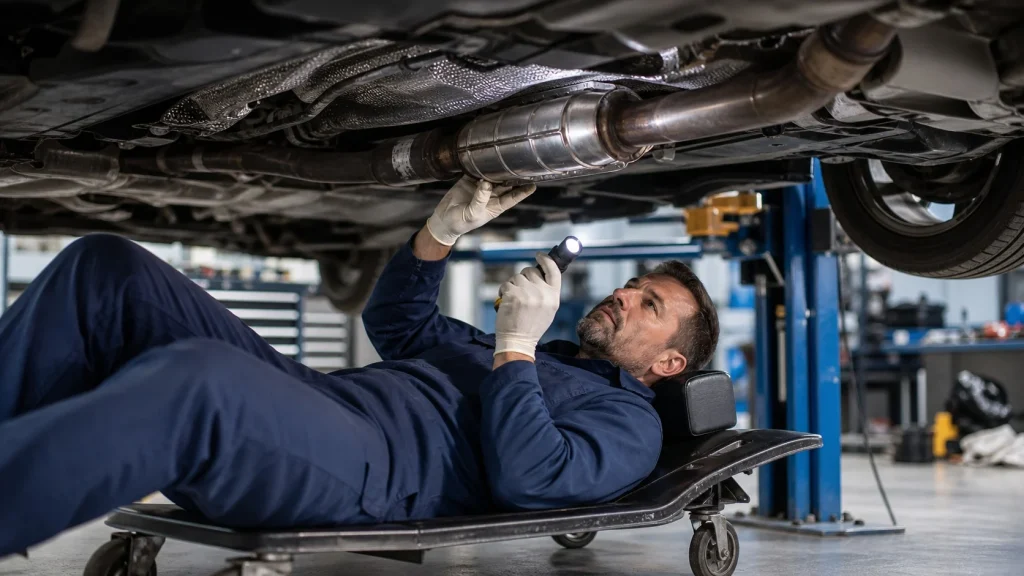
When a component fails, untreated hydrogen sulfide escapes. If your vehicle has an exhaust leak, the sulfur gas can infiltrate the cabin through floorboard gaps or the climate control intake. Smelling sulfur inside the cabin is a key indicator that the vehicle requires immediate mechanical inspection.
Failing Catalytic Converter (The Primary Culprit)
A failing catalytic converter is the most common reason for a persistent sulfur smell. When the precious metal catalysts inside the converter degrade, become clogged, or get coated with oil, they lose the ability to neutralize exhaust gases.
Several factors can lead to catalytic converter failure:
- A rich fuel mixture that dumps unburned gasoline into the exhaust, which overheats and melts the internal ceramic substrate.
- Engine misfires that send raw fuel pulses down the exhaust line.
- Internal engine leaks that allow engine oil or coolant to coat the catalyst.
- Physical road impacts that crack the delicate internal structure.
Companion symptoms of a bad catalytic converter include a glowing check engine light, sluggish engine performance, decreased fuel efficiency, and a metallic rattling noise from under the vehicle.
Overcharged or Swelling 12V Battery
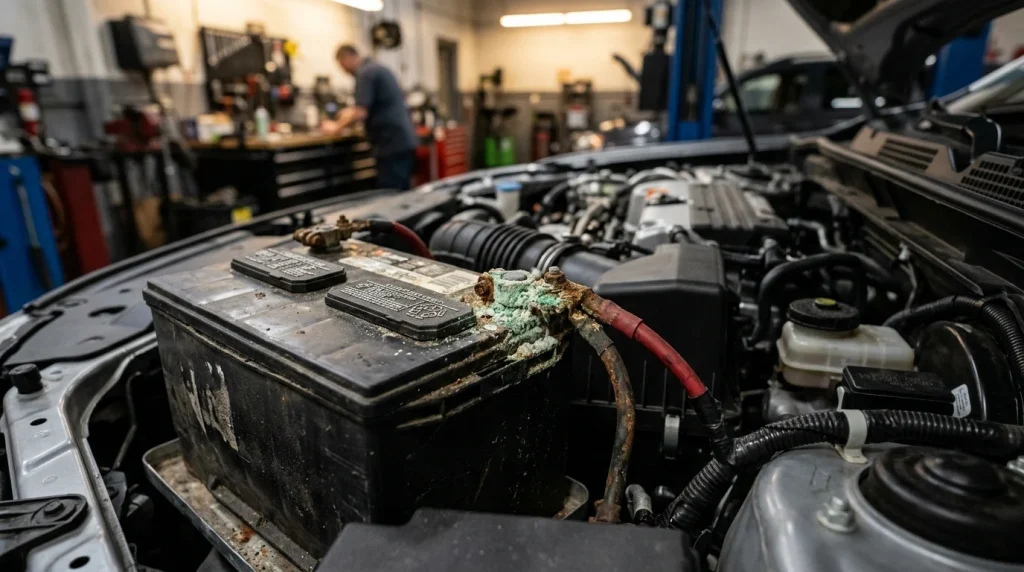
Traditional 12-volt lead-acid batteries contain sulfuric acid. If your vehicle’s alternator or voltage regulator malfunctions and overcharges the battery, the liquid electrolyte will overheat and boil. This process vents hydrogen sulfide gas directly under the hood.
This condition is dangerous. An overcharged battery can swell, leak highly corrosive acid, damage nearby wiring, or even explode under extreme pressure. If you detect the sulfur odor coming from under the hood rather than the tailpipe, inspect the battery for heat or swelling immediately. This issue also affects hybrid and electric vehicles (EVs). While the large lithium-ion traction battery does not produce a sulfur smell, EVs still utilize a standard 12-volt auxiliary lead-acid battery to power onboard electronics and safety systems. If this auxiliary battery is overcharged, it will release the same rotten egg smell.
Note: If you need to service your electrical system, check how long it takes to charge a car battery or learn how to jumpstart a car with a bad alternator to protect your charging system.
Faulty Fuel System and Rich Air-Fuel Mixture
When an engine runs rich, it burns too much fuel and too little air. This is often caused by leaking fuel injectors, a clogged fuel filter, a failing fuel pressure regulator, or bad oxygen sensors. The incomplete combustion of excess gasoline generates high concentrations of sulfur compounds, which quickly overwhelm the catalytic converter’s capacity.
This rich air-fuel mixture often causes the vehicle to smell strongly of sulfur when you accelerate. You may also notice black smoke exiting the tailpipe, poor gas mileage, and a rough idle.
Degraded or Overheated Transmission Fluid
Modern transmission fluid contains sulfur-based extreme-pressure additives. If your transmission fluid is old, severely degraded, or leaking onto hot engine parts, it can emit a strong sulfur smell that mimics rotten eggs.
To verify this, check the transmission dipstick. Fresh fluid is red or pink, while degraded fluid appears dark brown or black and smells burnt. Overheating transmission fluid requires prompt replacement to prevent costly internal gear damage.
Exhaust System Leaks Venting Gases Into the Cabin
Any crack, rust hole, or loose connection in the exhaust pipes before the catalytic converter allows raw, untreated exhaust gases to escape. Instead of exiting the tailpipe, these toxic fumes can rise directly into the cabin through the vehicle’s heating, ventilation, and air conditioning (HVAC) intake or body seals.
If you smell sulfur inside the vehicle while driving, roll down your windows immediately to introduce fresh air. This is a severe safety hazard that requires professional exhaust system repair. Drivers pulled over during safety checks for heavy exhaust smoke should also understand warrantless vehicle searches by police officers to know motorist rights during unexpected roadside stops. Ignoring cabin exhaust leaks exposes passengers to carbon monoxide and hydrogen sulfide. After repairing the mechanical leak, you may need to deep clean the interior to get other bad odors out of a car and refresh the cabin air.
High-Sulfur or Contaminated Fuel
Occasionally, the sulfur smell is not caused by a mechanical failure but by a bad batch of gasoline. Some low-quality fuel stations sell gas with elevated sulfur levels. This excess sulfur temporarily overloads a healthy catalytic converter, creating a temporary odor.
If the smell started immediately after refueling at a new station, drive the vehicle until the tank is empty, then refill at a reputable station. The smell should disappear within one or two fuel cycles.
Diagnostic Code Guide for Rotten Egg Odors
When a sulfur smell is accompanied by a check engine light, you can retrieve diagnostic trouble codes (DTCs) using an OBD-II scanner. The most common codes associated with this issue include:
- P0420 / P0430: Catalyst System Efficiency Below Threshold (Bank 1 or Bank 2). This indicates the catalytic converter is no longer cleaning the exhaust gases effectively.
- P0172 / P0175: System Too Rich. This confirms the engine is dumping too much fuel into the cylinders, which is overloading the catalytic converter with sulfur.
- P0300 – P0308: Engine Misfire Detected. Misfires allow unburned fuel to reach the catalytic converter, causing it to overheat and fail.
Expert Insights on Sulfur Smell Diagnosis
Professional technicians emphasize that replacing a smelly catalytic converter without finding the root cause is a costly mistake.
According to Duane Watson, a technical trainer at Bosch Mobility Aftermarket, a sulfur smell is usually a downstream symptom of a fuel system malfunction that forces the engine to run too rich. Watson warns that ignoring this issue reduces fuel economy and can lead to severe engine damage over time.
Chris Pyle, an ASE-certified master technician with JustAnswer, notes that smelling exhaust gases inside the cabin is a clear indicator of an exhaust leak. Pyle explains that exhaust odors should only be detectable at the tailpipe under normal operation, meaning cabin odors indicate a breach in the piping.
Repair Costs for Sulfur-Smell Issues
The cost to fix a rotten egg smell depends entirely on the failed component. Minor issues like a bad tank of gas cost nothing, while emissions repairs can be expensive.
According to data from the AAA, the typical catalytic converter replacement cost ranges from $1,000 to $4,000, including parts and labor. The high price is driven by the precious metals required to manufacture the part.
Below is a breakdown of estimated repair costs:
| Underlying Cause | Common Repair Solution | Estimated Cost Range |
|---|---|---|
| Contaminated Gas | Refuel with high-quality gasoline | $0 |
| Fuel Injector Clog | Professional fuel system cleaning | $50 – $150 |
| Exhaust Leak | Weld crack or replace pipe section | $100 – $500 |
| Bad 12V Battery | Replace battery and test charging system | $150 – $350 |
| Transmission Fluid | Drain, flush, and refill fluid | $150 – $300 |
| Catalytic Converter | Replace converter unit | $1,000 – $4,000 |
Consumer quotes compiled by ConsumerAffairs indicate that specialized vehicles, large SUVs, and hybrid models often fall at the higher end of the catalytic converter replacement spectrum, occasionally reaching up to $4,500.
When Is a Sulfur Smell Harmless?
There are a few temporary scenarios where a brief sulfur odor is normal and does not require repair:
- New Catalytic Converter: A newly installed catalytic converter will smell like sulfur for the first few days. This is caused by manufacturing coatings and adhesives curing on the hot metal.
- Cold Starts: When you start your car on a cold morning, the catalytic converter has not reached its optimal operating temperature of roughly 400 degrees Fahrenheit. Until it warms up, a brief puff of sulfur gas may exit the tailpipe.
- Temporary Bad Gas: A single tank of high-sulfur gasoline will cause a temporary smell that resolves after refilling with clean fuel.
How to Prevent Catalytic Converter and Battery Failures
Proper preventative maintenance is the best way to avoid emissions failures and battery issues:
- Maintain spark plugs and ignition coils: Preventing engine misfires protects the catalytic converter from raw fuel damage.
- Fix oil and coolant leaks promptly: Burning oil or coolant will coat the internal catalysts and clog the converter.
- Test your alternator and battery annually: Ensuring your voltage regulator works prevents overcharging and battery boiling.
- Take regular highway trips: The catalytic converter needs to heat up fully to burn off accumulated deposits. Frequent short city trips can accelerate clogging.
- Review regular maintenance guides: Read expert automotive news and maintenance guides to keep your vehicle’s engine running efficiently.
Frequently Asked Questions About Car Sulfur Smells
Is it safe to drive a car that smells like rotten eggs?
You should not drive a car with a strong sulfur smell for extended periods. Hydrogen sulfide is a toxic gas, and OSHA warning guidelines state that prolonged exposure can cause headaches, dizziness, and respiratory irritation. Additionally, a failing catalytic converter can overheat and become a fire hazard, especially if you park over dry leaves or grass.
Can a bad battery cause a rotten egg smell?
Yes, a failing or overcharged lead-acid battery can release hydrogen sulfide gas. This happens when the alternator overcharges the battery, causing the sulfuric acid inside to boil and vent through the battery casing.
Why does my car smell like sulfur when I accelerate?
Hard acceleration demands more fuel. If your fuel injectors are leaking or your catalytic converter is beginning to fail, the engine will run rich under load, producing excess sulfur gas that the converter cannot fully neutralize.
Can an electric car smell like rotten eggs?
Yes. Even though electric vehicles do not have an exhaust system or an internal combustion engine, they still use a 12-volt lead-acid auxiliary battery to power accessories. If this 12-volt battery is damaged or overcharged by the charging system, it will release the same sulfur odor.
[Verified data / Claim Ledger]:
| Claim ID | Exact claim in article | Source name | Exact URL | Supporting passage/location | Supported scope | Status |
|---|---|---|---|---|---|---|
| C1 | The typical catalytic converter replacement cost ranges from $1,000 to $4,000, including parts and labor. | AAA | https://www.aaa.com/autorepair/articles/how-much-does-a-catalytic-converter-cost | How much does a catalytic converter cost? Repair estimate breakdown for catalytic converter replacement parts and labor. | Catalytic converter replacement costs | VERIFIED |
| C2 | Specialized vehicles, large SUVs, and hybrid models often fall at the higher end of the catalytic converter replacement spectrum, occasionally reaching up to $4,500. | ConsumerAffairs | https://www.consumeraffairs.com/automotive/cost-to-replace-a-catalytic-converter.html | Cost to replace a catalytic converter guide with vehicle-specific ranges up to $4,500 for luxury and hybrid models. | High-end and hybrid catalytic converter replacement cost ranges | VERIFIED |
| C3 | Hydrogen sulfide is a toxic gas, and OSHA warning guidelines state that prolonged exposure can cause headaches, dizziness, and respiratory irritation. | OSHA | https://www.osha.gov/hydrogen-sulfide/hazards | Short-term symptoms table: 2-5 ppm prolonged exposure may cause nausea, tearing, headaches; 20 ppm causes fatigue, headache, dizziness; 50-100 ppm causes respiratory tract irritation. | Health hazards and symptoms of hydrogen sulfide exposure | VERIFIED |

